The Plan
The plan proposed by Baird Smith depended foremost on battering down the walls of Delhi to form a series of breaches t, through which the troops would then have access to the city through a frontal assault.
Without the breaches, however, any attack would have been fruitless and Baird Smith, along with his engineers, had started planning well before the final reinforcements arrived. All the deadly reconnoitring, the surveying and the picquet duties had all served one purpose – how best to beat down the formidable walls of Delhi.
There would be, in all, four Siege Batteries, each placed at different points as close to the walls of Delhi as possible. Constructing the batteries would have to be done at night under cover of darkness; under the same vein, the guns would need to be placed, the batteries stocked practically under the noses of 30’000 mutineers. It was an audacious plan – if it succeeded, Delhi would be taken swiftly – if it failed, the British would be destroyed.
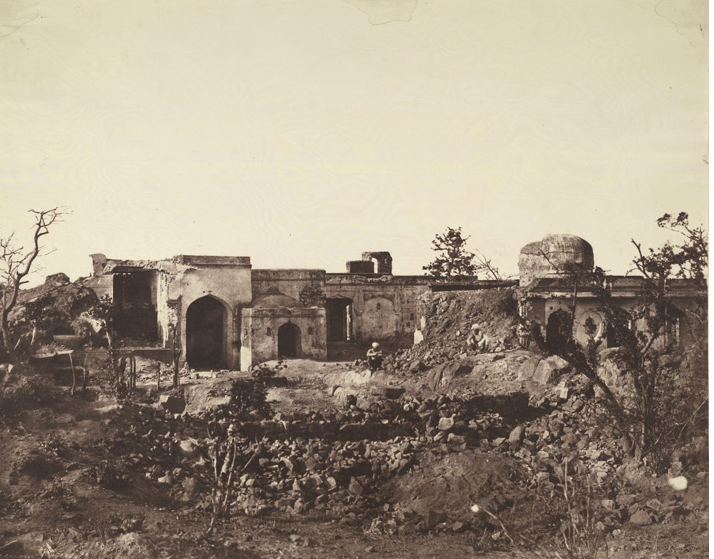
Before Nicholson and the final reinforcements arrived, the Engineers had been busy at work surveying the placement of the batteries; however, for the first to be built, they needed to construct one – called Reid’s Battery – with the sole purpose of providing covering fire during the construction of the 1st Siege Battery. Located slightly to the east of Sammy House, it housed four 9-pounder guns and two 24-pounders. As soon as the battery was completed, they were put into action against the formidable Mori Bastion – not to destroy the bastion but to silence the guns mounted on it once and for all. It was also tasked with destroying any sepoy sortie launched either from Lahore or Kabul Gate, thus providing covering fire while the other three breaching batteries were being built. Baird Smith also had another idea in this respect – as long as the mutineers were under the impression the British were planning a final assault from the right of the Ridge directly at Mori Bastion itself, they would be caught off guard when the rest of the plan was put into play.
The position of Reid’s Battery was surveyed during the first of Julius Medley’s reconnoitring expeditions in August; something which he remembered as exciting work:
“Captain T(Taylor) and myself started early in the morning with an escort of four Goorkhas, and getting into the long grass, we worked away in the proper direction I surveying, and T__ looking out for squalls.
The Goorkhas looked upon it as fine fun, and made capital videttes; at was we found ourselves on the road leading to the Lahore Gate, our old friend the Moree Bastion, with which we had so often exchanged civilities, looking us straight in the face. Several of the enemy’s Sepoys were coming jauntily down the road, when suddenly they saw us, not 200 yards off, and were brought up all standing with surprise. T___ then levelled his telescope at them, on which they took to their heels, and sang out to their friends in the Moree, and the next moment a bright flash and the whish-sh of a round shot over our heads warned us to beat a retreat, which we did very composedly.”
Situated on an isolated plateau barely 900 yards from the Mori Bastion and when completed, the six guns were moved into place. The flanks of the battery were connected to the rear to a ravine which not only protected the trench guards but allowed for the relatively safe movement of litters bearing the sick and wounded. By the 6th of September, Reid’s Battery was ready for operations, and under its covering fire, construction on Siege Battery No. 1 commenced.
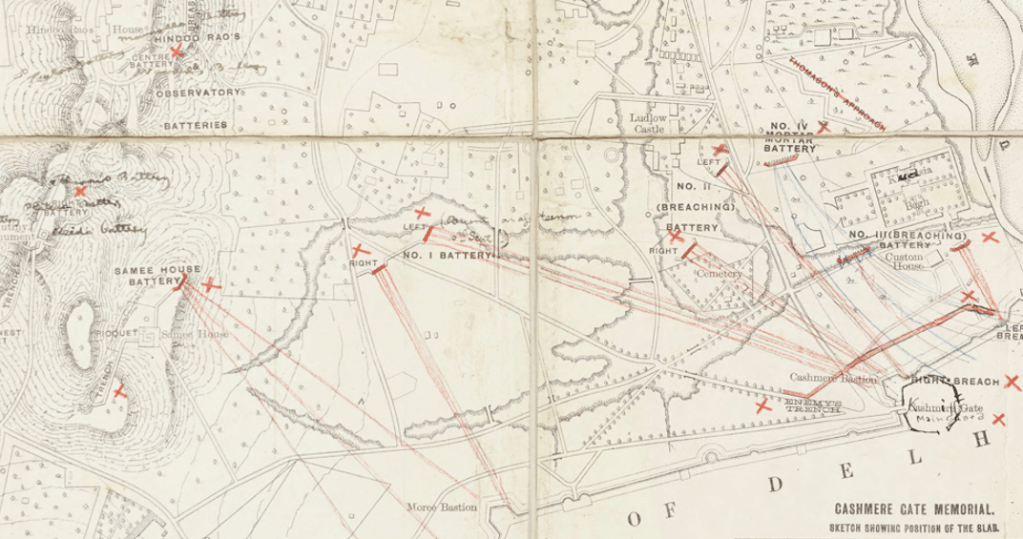
To gain an understanding of how close the guns were to the walls of Delhi, we can take a rough idea from the map above. No 1 Battery or Brind’s Battery directly to the front of the Ridge would consist of 10 heavy guns and mortars and was placed 700 yards from Mori Bastion. No. 2, to the left front close to Ludlow Castle, was only 600 yards from the walls and, when completed on the 10th of September, contained 19 artillery pieces. No. 4, placed close to No.2, was located at the Koodsia Bagh practically in front of the Kashmiri Bastion and finished on the same day, while No. 3 on the extreme left with its six guns was just 160 yards from the Water Bastion. Each battery served a distinct purpose:
No 1 – the right portion with 6 guns to smash the Mori Bastion, with the left, 200 yards distant with four guns to keep down the fire from Kashmir Bastion.
No 2 – The right half was constructed for seven heavy howitzers and two 18-pounders, and the left for eighteen guns. The 18 guns were to silence the fire from Kashmir Bastion and destroy the parapets while opening the main breach which would then be used to access the city. The Kashmiri Gate, however, would still need to be destroyed by gunpowder before the city could be stormed.
No. 3 and No. 4 to silence the guns of the Water Bastion and make a serviceable breach.
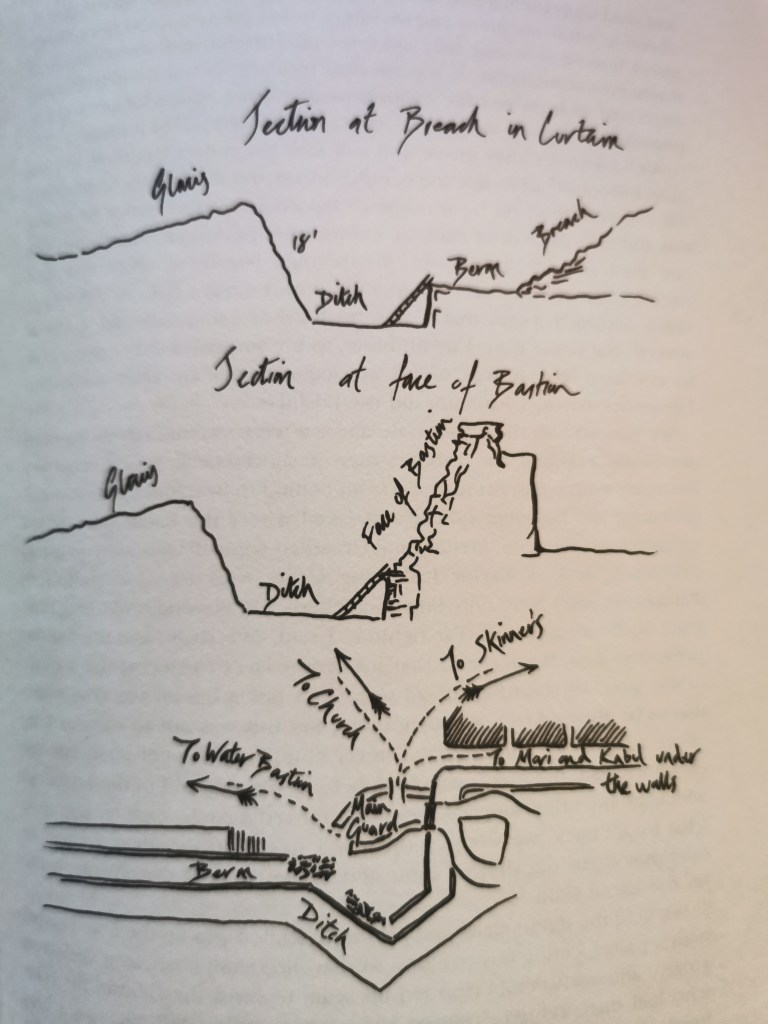
The walls which the batteries were to batter and breach consisted of a succession of bastioned fronts connected by long curtains, with the outworks consisting of one crown work at the Ajmer Gate and Martello Towers. The bastions themselves were small but were provided with masonry parapets some 12 feet thick and their relief some 16 feet above the plane of site. The curtains, too, were made of ramparts or masonry walls 16 feet thick but 11 feet thick at the top and 14 to 15 feet thick at the bottom. Baird Smith then described the rest as
“This main wall carries a parapet, loopholed for musketry, eight feet in height and three feet in thickness.
The whole of the land front is covered by a berm of variable width, ranging from sixteen to thirty feet. And having a scarp wall eight feet high in exterior to this a dry ditch of about twenty-five feet in width and from sixteen to twenty feet in depth. The counterscarp is simply an earthen slope, easy to descend. The glacis is a
very short one, extending only fifty or sixty yards from the counterscarp, using general terms. It covers from the besieger’s view from one-half to one-third of the height of the walls of the place.”
On the 27th of August in the Engineers Park other arrangements were underway – all along they had been experimenting with different ideas of how to build the batteries and so meticulous were their plans, they did not neglect to train the camels who would very soon be needed to carry the unwieldy fascines and gabions to the positions. By the 2nd of September, the engineers built an experimental battery at the rear of the Park from which they could ascertain the final design and by the 4th, troops were being given escalade practice in preparation for the final assault.
The Siege Batteries
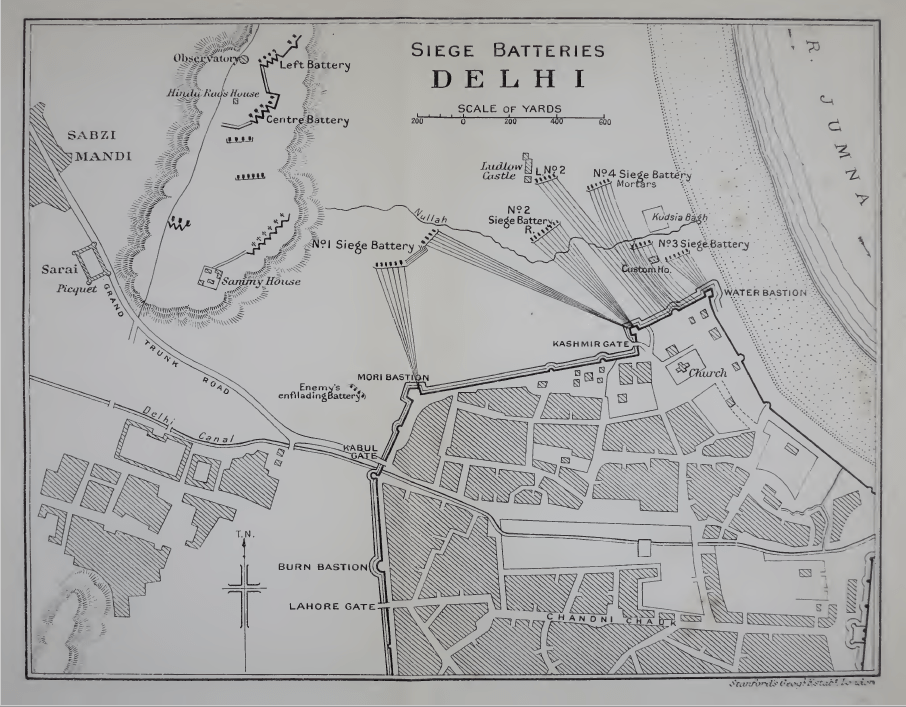
Surveying of all the positions had been completed in August, and the trench work had already begun – all that remained was to build the batteries. The plan was Baird Smiths, however, it was his second-in-command, Alexander Taylor, who not only prepared the batteries and fixed their sites, which he paced and measured himself; he had also designed their approaches with as much protection as possible, but had planned shelters for the off-duty gunners and covering parties. He then went about drawing sketch maps to be distributed to the troops to help them find their way around the unfamiliar ground in the dark. His maps left nothing to chance – all obstacles, be it buildings, walls, copses, underwood and ravines, were meticulously drawn in. It was, as engineer Frank Maunsell wrote,
“an operation unprecedented in the annals of warfare – a battlefield previously surveyed; the position of every gun, and of the attacking Force, and the way to every post distinctly marked on the ground which was under very eyes and fire of a watchful enemy and -finally- the operation carried out as pre-designed.“
However, due credit must still be given the Richard Baird Smith – laid up as he was with an injured ankle that had turned blue and black by degrees, allowing him little movement and causing him much pain, he still managed, mostly from the confines of his tent, to supervise the ongoing works. He was tireless in his efforts to ensure that when the attack finally came, nothing had been overlooked.
From the Field Force Order Book:
“Advancing party of the following strength to be provided at 7 P.M. with the proper complement of officers, commissioned and non-commissioned:
1st Brigade of Infantry to furnish 200 men; 2nd Brigade of Infantry to furnish 100 Rifles; 3rd Brigade of Infantry to furnish 100 Sikhs; 4th Brigade to furnish 150 N. I.; Belooch Battalion to furnish 100, making a total of 650. The party to the take one day’s provisions.
A working party composed as follows will parade in fatigue dress at 7 p.m. at the Engineer Park, where they will be provided with tools and conducted by an engineer officer to the proper place.
1st Brigade to furnish 160 Europeans ; 2nd Brigade to furnish 220 Europeans; 3rd Brigade to furnish 200 Europeans; 4th Brigade to furnish 100 Europeans; 1st Brigade to furnish 70 Natives; 3rd Brigade to furnish 100 Sikhs.
The 4th Infantry Brigade to furnish a working party of 200 men, paraded in fatigue dress at
Hindoo Rao’s house at 10 p.m. and to await the arrival of an engineer officer from No. 1 Battery
to conduct them to their work.
Working parties in fatigue dress from the following brigade to be sent to Sudder Bazaar on the Telegraph
Road. The above to assemble at half-past 1 A.M. -One party of 50 men and one officer from 4th Brigade; one party of 200 men and four officers from 4th Brigade; one party of 100 men and two officers from Belooch Battalion.”
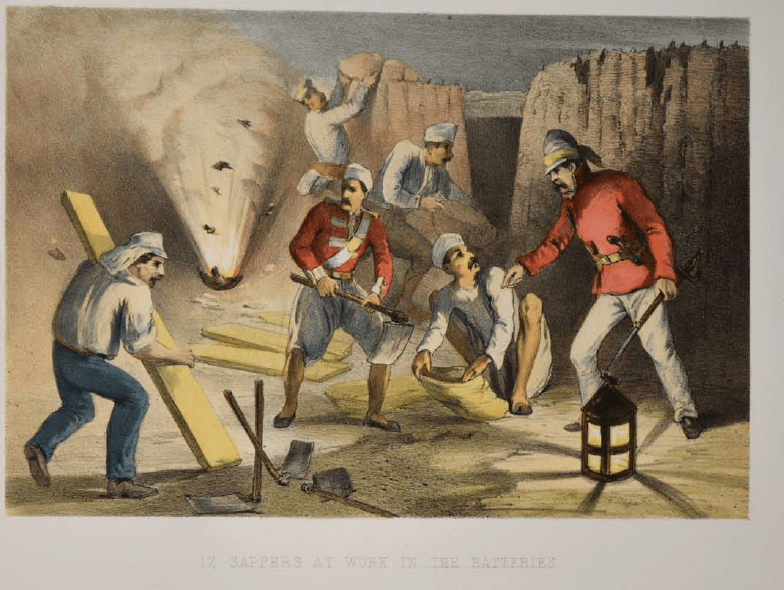
On the 7th of September, every available officer and soldier was told off to assist in the construction of the batteries, a task which would take four days and nights. As soon as the sappers and engineers had completed tracing the ground for the batteries, work commenced. It was not easy – the ground was rocky and had very little earth, and the engineers had to invent a new method of construction:
“The solid portion up to the level of the embrasures was constructed completely of fascines, the merlons above of sandbags previously filled; the embrasures and interior face of the merlons being reveted in the usual manner with gabions and fascines…”
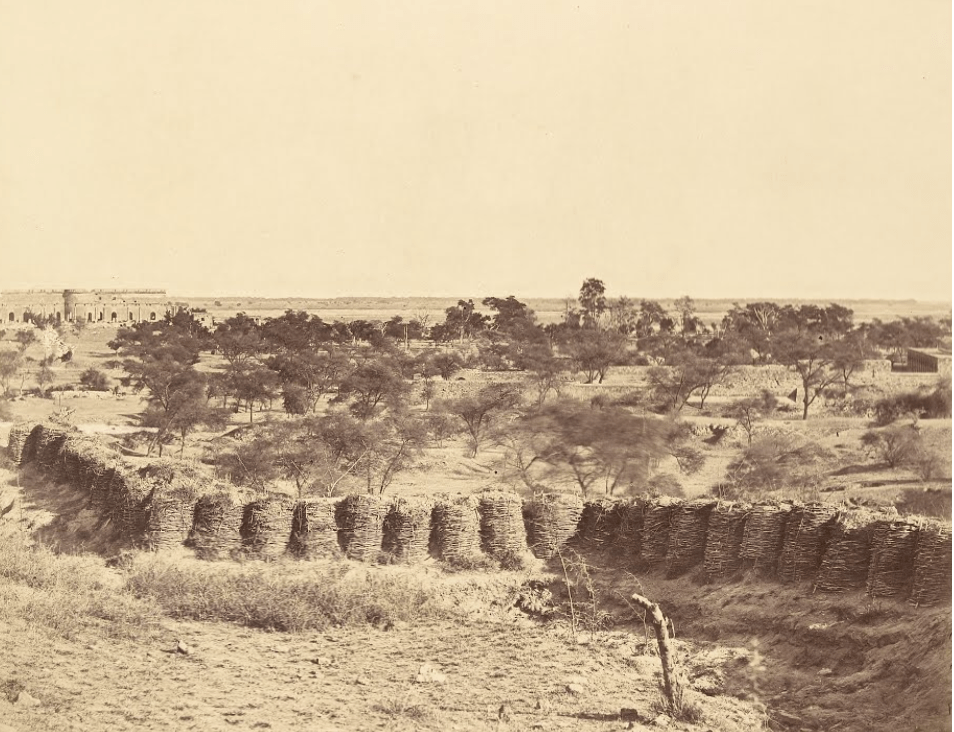
Impressively, Siege Battery No. 1 was completed shortly before daybreak on the 8th of September.
The Sappers Corps at Delhi were under the charge of Lieutenant Maunsell, and their work was carried out in somewhat abnormal circumstances. Many of the skilled Roorkee Sappers had mutinied, not by want but by circumstance in Meerut and their numbers at Delhi were thus reduced; they also lacked much of the equipment they would normally have had. It was the lack of trained sappers the camp missed most. They were supplemented by a sapper detachment that arrived with the moveable column, by eight hundred Mazabi Sikhs who had served on Taylor’s road project in the Punjab but they had been “sent in the rough” having only received marginally training in sapper’s work before being sent to Delhi, Henry Brownlow also provided six hundred Pioneers from Roorkee. For the heavy work however, the Engineers relied solely on the thousands of untrained road coolies assigned to digging trenches and chopping trees amongst other tasks, work which they were expected to do mostly under fire. It must be mentioned that these men were completely unused to warfare and were also unarmed. They relied on whatever protection the Ridge could give them.
“Throughout the occupation of the Ridge, trees had been cut down in large quantities for the making of fascines, and also in order to clear away the cover in the neighbourhood of “posts” and batteries. ” For about a fortnight prior to the commencement of the Siege- Batteries large working parties were sent out to cut down the trees and bushes near the sites proposed…the supervision of these parties was considered most arduous. The men were at work from dusk to dawn, groping and stumbling about in the long rank jungle, wet through with rain and dew, and frequently attacked by the enemy.”—(Thackeray)
The amount of material needed at Delhi was enormous – gabions needed to be made in the camp itself from the brushwood cut and collected day and night by bands of Pioneers sent out for this purpose. Then under the direction of a non-commissioned Sapper officer, the gabions were prepared into the necessary forms. The Ridge had thousands of these until August while a further ten thousand were stored in the Engineer Park for use for the construction of the batteries. Large areas of the camp had been given over to what looked like basket-making, a truly strange scene amid battle. The 1500 camels too were not without employ – they were out nightly collecting material needed for fascines. Of the 16000 sandbags required for the batteries, these were filled with dirt obtained from the surrounding areas of the Ridge with much of it taken from the gardens and open spaces between the Ridge and Delhi. On the night of the 7th, the covering parties under Colonel Greathed of the 8th Foot with his brother and Murray of the engineers advanced along the road to the Kashmiri Gate and “occupied a line from the Kudsia Bagh on the left to a point below the Ridge on the right, about 550 yards from the Mori Bastion; this line and all in rear occupied.” Behind them came the working parties – 3000 men both Europeans and Indians and under the supervision of twelve Engineering officers, with long lines of camels carrying empty sandbags. In the dark, it would have looked to the mutineers like two or three regiments on the march and thus they kept their peace. The sandbags were not only filled but sent off to their future position – Battery No. 2 situated at Ludlow Castle.
The work on the batteries was completed in much the same fashion for each one however, the most important, Siege Battery No. 1 deserves some detail.
 Mutiny Reflections
Fantastic, glued to it till last line.
thanks
LikeLike
Thank you so much! I am so glad you find it interesting!
LikeLike
Another fascinating and detailed read! Thank you for sharing your work with us! The last name on your list of officers caught my eye – is he perhaps related to the Younghusband who wrote several books about the Himalayas?
LikeLiked by 1 person