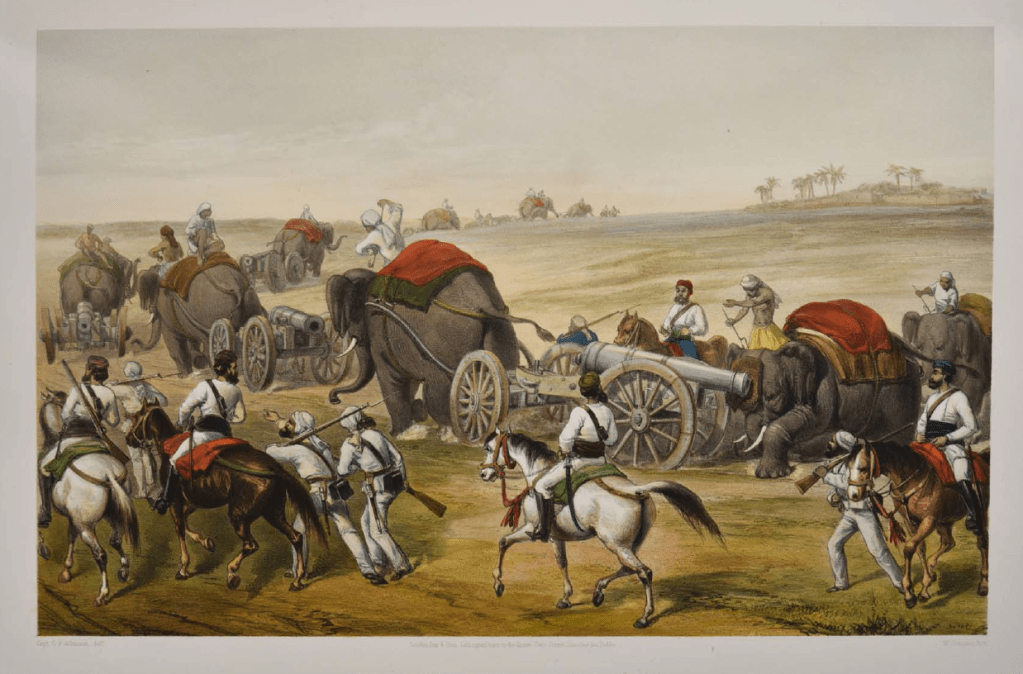
Following the arrival of Nicholson, voices clamoured loudly that the time to attack Delhi had finally arrived. General Wilson, however, was still dithering, using the same ploy of waiting for reinforcements – he felt the force was still lacking, although, by the 7th of September, he had at his disposal, after the arrival of the last reinforcements, an army of 9’998 men. To this could be added the Kashmir contingent of 2’200 men with four guns and the 400-strong cavalry of the Jind Raja. According to Hervey Greathed, Wilson also had enough shot and shell to “grind Delhi to powder.” Canning, from his lofty heights in Calcutta, was calling for an immediate attack on Delhi; Baird Smith had a plan, but Wilson had ” a dozen fears…” including the September sun, which, in the general’s estimation, was far too hot for a soldier to work under. Wilson wanted to propose waiting again for more reinforcements and possibly until the weather cooled down. For his part, Nicholson was ready to mutiny against Wilson, proposing the general should be replaced by someone who could lead. Tired of Baird Smith’s badgering, Nicholson’s glowering and Canning’s remonstrations, Wilson finally agreed to the attack on Delhi.
On the 7th of September, Wilson addressed the troops:
“ The force assembled before Delhi has had much hardship to undergo since its arrival in this camp, all of which has been most cheerfully borne by officers and men. The time is now drawing near when the Major-General commanding the force trusts that its labours will be over, and it will be rewarded by the capture of the city for all its past exertions, and for a cheerful endurance of still greater fatigue and exposure. The troops will be required to aid and assist the Engineers in the erection of the batteries and trenches, and in daily exposure to the sun, as covering parties.
“The artillery will have even harder work than they yet have had, and which they have so well and cheerfully performed hitherto: this, however, will be for a short period only, and when ordered to the assault, the Major-General feels assured British pluck and determination will carry everything before them, and that the bloodthirsty and murderous mutineers against whom they are fighting will be driven headlong out of their stronghold, or be exterminated. But to enable them to do this, he warns the troops of the absolute necessity of their keeping together, and not straggling from their columns. By this can success only be secured.
“Major-General Wilson need hardly remind the troops of the cruel murders committed on their officers and comrades, as well as their wives and children, to move them in the deadly struggle. No quarter should be given to the mutineers; at the same time, for the sake of humanity and the honour of the country they belong to, he calls upon them to spare all women and children that may come in their way.
“ It is so imperative, not only for their safety, but for the success of the assault, that men should not straggle from their column that the Major-General feels it his duty to direct all commanding officers to impress this strictly upon their men, and he is confident that after this warning the men’s good sense and discipline will induce them to obey their officers and keep steady to their duty. It is to be explained to every regiment that indiscrimi¬ nate plunder will not be allowed; that prize agents have been appointed, by whom all captured property will be collected and sold, to be divided, according to the rules and regulations on this head, fairly among all men engaged; and that any man found guilty of having concealed captured property will be made to restore it, and -will forfeit all claims to the general prize; he will also be likely to be made over to the Provost-Marshal to be summarily dealt with.
“The Major-General calls upon the officers of the force to lend their zealous and efficient co-operation in the erection of the works of the siege now about to be commenced. He looks especially to the regimental officers of all grades to impress upon their men that to work in the trenches during a siege is as necessary and honourable as to fight in the ranks during a battle.
“He will hold all officers responsible for their utmost being done to carry out the directions of the Engineers, and he confidently trusts that all will exhibit a healthy and hearty spirit of emulation and zeal, from which he has no doubt that the happiest results will follow in the brilliant termination of all their labours.”
The attack on Delhi now lay in the hands of the Engineers and that very afternoon, the siege works commenced.
 Mutiny Reflections
Fantastic, glued to it till last line.
thanks
LikeLike
Thank you so much! I am so glad you find it interesting!
LikeLike
Another fascinating and detailed read! Thank you for sharing your work with us! The last name on your list of officers caught my eye – is he perhaps related to the Younghusband who wrote several books about the Himalayas?
LikeLiked by 1 person