1st-13th September, before the Assault on Delhi
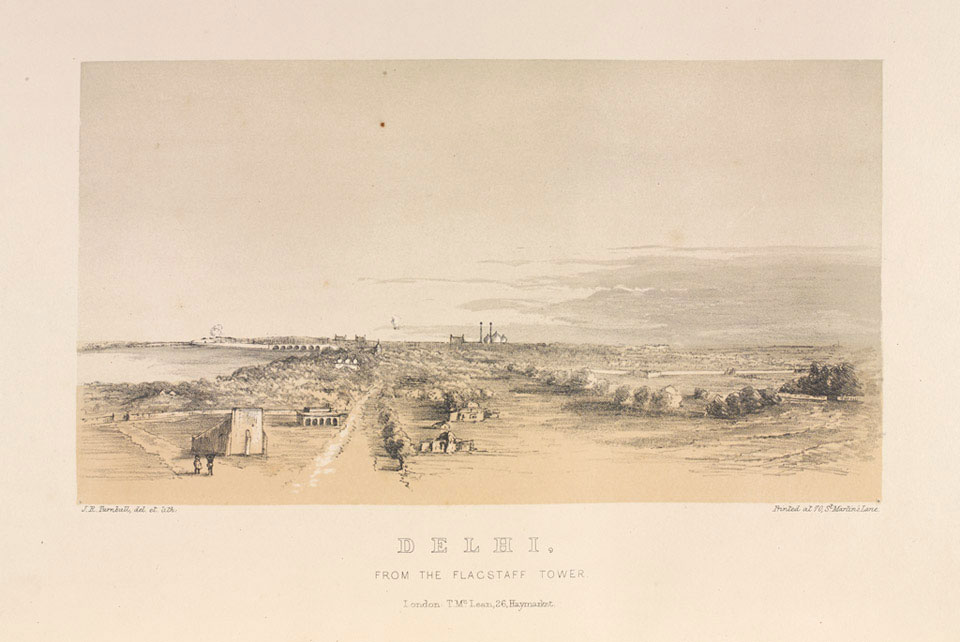
1st September
61st Foot
Privates
Baucan, Edward – killed in action
Brennan, Thomas – severely wounded in leg
Burke, Peter – severely wounded in shoulder
Fuller, Thomas – severely wounded in thigh
Lyons, Patrick – mortally wounded, died of wounds
Moore, John – severely wounded in arm
Bengal Horse Artillery
Sergeant Arthur Morgan – dangerously wounded, died of wounds
Gunner Michael Connor – dangerously wounded, died 7th of September
Bengal Field Artillery
Gunners
Daly, Charles – slightly contused
Stack, John – slightly injured by gun recoil
“September 1st.—A portion of my corps was on duty at the Metcalfe stable picket on September i, when a lamentable loss was experienced, unparalleled in the annals of the siege. The enemy’s battery across the river had never ceased shelling these pickets, though up to this day it had not caused much damage to the defenders.
Shortly after sunrise, the men were assembled outside, receiving their grog, which was served out to them every morning at an early hour. Some 100 men and officers, beside Sikhs and native attendants, were grouped around when a loud hissing sound was heard, and a shrapnel shell, fired from the enemy’s battery at the long range of 2,000 yards, exploded a few feet in front.
The bullets scattered around, and the scene which followed it is almost impossible for me to depict. Many threw themselves flat on the ground, falling one on top of the other, while groans and cries were heard. One soldier fell mortally wounded by my side, and on looking around to count up our losses, we found that two of my regiment had been killed outright, besides six others severely wounded. Two Sikhs and a bhisti, or water carrier, also met their death, and two doolie-bearers were wounded—thirteen men in all.
One very stout old officer was in the act of having his morning bath when the shell exploded, the bhisti standing at his side and pouring over him when squatted on a tent- mallet, his massuck of water. He rolled over and over on the ground, presenting such a ludicrous appearance in his wet, nude state, and covered with earth, that, notwithstanding the awful surroundings of the scene, I and others could not forbear laughing. The shot had been quite a chance one, but it proved how deadly was the effect of a shrapnel shell exploding, as this had done, only a few feet in front of a large body of men.” (A Narrative of the Siege of Delhi – Griffiths)
2nd September
52nd Foot
Private Charles Collyer – died of cholera
3rd September
52nd Foot
Privates
Clarke, Hugh – died of cholera
Cook, William – died of apoplexy
Smith, Henry – died of apoplexy
1/60th Foot
Colour Sergeant Stephen Garvin – slightly wounded
4th September
52nd Foot
Privates
Williams, George – died of cholera
Graham, James – died of cholera
2nd European Bengal Fusiliers
Private George George -died at Delhi
5th September
52nd Foot
Privates
Corporal Henry Dare – died of cholera
Private James McDermott – died of febris
6th September
52nd Foot
Privates
Barry, Richard – died of febris
Clarke, John – died of cholera
Shilcock, Henry – died of cholera
1/60th Foot
Private Francis McMullen – slightly wounded
75th Foot
Privat John Boyle- killed in action
2nd European Bengal Fusiliers
Private James Pyne – died of wounds
7th September
52nd Foot
Privates
Burcher, Henry – died of febris
Delaney, Michael – died of cholera
Holbrook, John – died of cholera
Howes, William – died of cholera
Keohan, Bernard – died of febris
2nd European Bengal Fusiliers
Private Thomas Dines – slightly wounded in leg on 19th June, severely wounded, 7th September
8th September
1st Bombay Native Infantry
Lieutenant Charles Bromhead Bannerman – killed in action, 8th September
Aged 22. Son of Patrick Wilson Bannerman of Aberdeen and Anna Maria née Johnston (daughter of Sir William Johnston of Caskieben, 7th Bt and Maria Bacon).
Lieutenant Charles Bannerman entered the Bombay Army in 1852 and arrived in India the same year. He was appointed for duty with the 3rd Bombay NI at Poona, where he served until November 1853, when he was ordered for duty with the 19th Bombay NI. He joined the corps at Baroda. He was still serving with the 19th when in February 1857, he was appointed acting adjutant of the 1st Beluch Battalion, whom he joined in Hyderabad (Sindh). The following June, he was appointed as the officiating Quarter Master of the same corps. With the mutiny in full force, Bannerman and the Beluch Battalion were moved up to the Punjab and eventually sent to Delhi to escort the siege train intended to blast the walls of Delhi. Four days later, after his arrival, Bannerman was dead.
He had been told off to relieve a company under Lieutenant Thomas Walker at the Kudisa Bagh who was doing duty as a covering party during the construction of the siege battery that night. Bannerman arrived with a company of the Beuch Regiment, and Walker quickly struck up an acquaintance with him – it was raining, and Bannerman shared his great coat with Walker. At daylight, they woke up and lit their pipes. Bannerman’s last hours were spent in the company of Walker, and they found a singular way to pass the time until the order was given to all the companies to fall in.
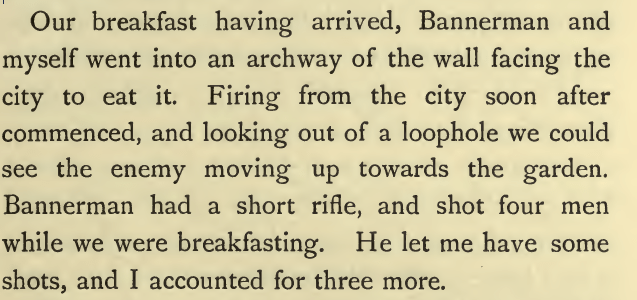
Bannerman and Walker left the archway together to join their men and, coming up to some tall wet grass which had not been beaten down save for a narrow path, Walker stopped and “invited Bannerman to go first along it but he caught hold of my arm and pushed me on ahead of him. I had not gone fifty yards when I heard him fall. On turning round to help him up, I found that he was shot dead through the head. He had a smile on his fair, handsome face.”
The shot had come from the top of a wall behind which the mutineers had managed to establish themselves, and they were firing down into the garden. Due to their position, no one from Walker’s party could see them well enough to get a shot. Bannerman was not the only one to die.
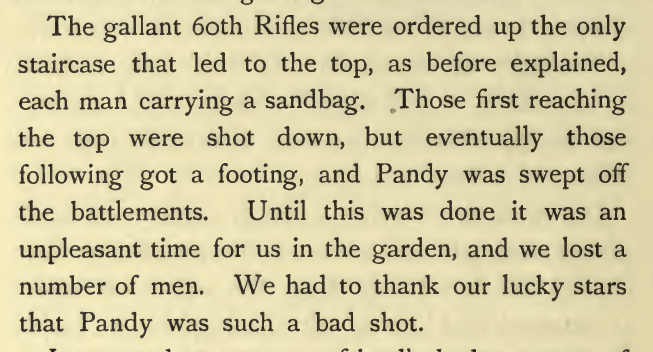
With the work done, Walker returned to Bannerman’s body. The fatal shot had left a part of Bannerman’s brain exposed and on the ground next to his head – a young corporal of his made a hole for it with his bayonet and buried Bannerman’s brain. Walker in the meantime took Bannerman’s ring off his finger and gave it to Major Brooke who was commanding the working and covering parties. He saw Bannerman’s sword placed in the dooly with his body but the sword never reached the hospital; someone it seems had more use for it than a dead man did.
There were, in all, three Bannerman brothers in India during the mutiny. Lieutenant Patrick Wilson (later Colonel Patrick Wilson Bannerman, Bombay Staff Corps) was serving with the 10th Bombay Native Infantry, Kotah Contingent – he spent much of 1857 trapped in Agra Fort, where he worked with the Militia Artillery. Another brother, William (later General William Bannerman), had fought in the Punjab Campaigns between 1848 and 1849. In 1857, he was part of the Persia Campaign – he fought in the mutiny until its end in 1859.
52nd Foot
Privates
Cain, John – died of apoplexy
Gander, John – died of cholera
Hunt, John – wounded
1/60th Foot
Privates
Brien, William – killed in action
Chlley, Lewis – severely wounded
Cribbins, Michael – slightly wounded
Ellingham, George – severely wounded
Hollis, John – slightly wounded
Nicholls, William – killed in action
Payne, George – severely wounded
Sherridan Martin – killed in action
Sherry, James -slightly wounded
Thorne, James – severely wounded
Wilkinson, George – severely wounded
61st Foot
Privates
Claire, Patrick – killed in action
Connolly, Patrick – killed in action
75th Foot
Private Samuel Harris – slightly wounded
Drummer Michael Quigley – slightly wounded
2nd European Bengal Fusiliers
Private Robert Hancock – killed in action
Bengal Horse Artillery
Lieutenant Edward Humfrey Hildebrand – killed in action at Delhi – on 8th September 1857
Born at Saxby, near Melton Mowbray, Co. Leicester on 6 January 1828, Hildebrand joined the Bengal Army in 1845 as an artillery cadet. He arrived in India in December of the same year and was appointed to do duty with the artillery at Dum Dum, outside Calcutta. In 1846, he was posted to the 1st Company, 3rd Battalion Foot Artillery at the same station and remained with them until the following year. He then transferred to the 3rd Company, 5th Battalion at Benares. In 1848, Hildebrand was appointed to officiate as Quarter Master for the 5th Battalion and of the Benares Division of Artillery, a post he retained for eight months. On receiving his promotion to First Lieutenant, he was re-posted to the 3rd. Co., 5th Battalion in March 1849. What followed was an avalanche of appointments.
In February and March 1850, he again officiated for some weeks as Adjutant and Quarter-Master of the 5th Battalion. The following October, he proceeded with the company to Dinapore, but less than five months later, he was removed to the 4th Co. 5th Batt., whom he joined in Cawnpore. At the end of the year, he marched with them to Ambala. In March 1852, Hildebrand was on the move again; this time, having been removed to the 1st Co., 5th Batt., he returned with it to Dum Dum in early 1853. Once again, he was removed to the 2nd Co., 3rd Batt., which saw him going back to Dinapore. It would appear by now he had seen much of NWP but nothing of the Punjab, so he was transferred to the 3rd Co., 4th Battalion, then at Peshawar. Unfortunately, his relief was late in coming, and Hildebrand would have to remain in Dinapore until the end of 1853, arriving in Mian Mir in January 1854. In Peshawar, he held temporary charge of the 2nd Co., 8th Batt., and No. 2 Light Field Battery for two months. However, Hidelbrand could at least settle for a moment in the Punjab, for in 1856, he was still there, officiating as Quarter Master of the 4th Battalion. Towards the end of June 1857, he was detached for duty in Delhi with the other companies of the 4th Battalion and arrived on the Ridge in early July.
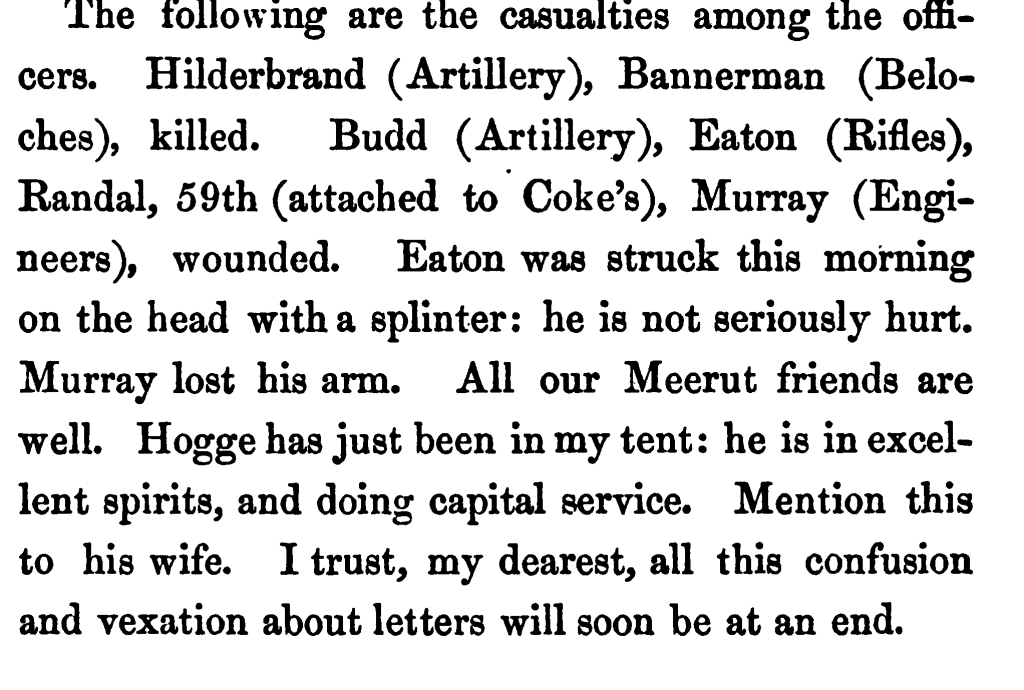
Griffiths, who witnessed Hildebrand’s death, states the officer’s head was taken completely off with the “mutilated trunk falling back amongst the men at the guns – a ghastly and terrible sight, which filled us who were present with horror.” Hildebrand had been hit by a three-pounder shot.
Staff Sergeant James Baxter, severely wounded in leg by a shell splinter
Gunners
Blake, William – killed in action
Boyle, William – severely wounded in abdomen
Cameron, Colin – wounded
Duffy, Patrick – killed in action
Dunne, James – dangerously wounded
Keys, Thomas – killed in action
Marshall, Campbell – wounded
Quinlan, James – slightly wounded on 19th June, severely wounded in abdomen by grapeshot, 8th September
9th September
52nd Foot
Privates
Leonard, Michael – died of apoplexy
Martin, Michael – died of cholera
Nolan, William – died of febris
1/60th Foot
Privates
Blakeman, Thomas – slightly wounded
Farthing, James – severely wounded
King, George – slightly wounded
Riordan, Daniel – wounded 15th June and again 9th September
Taff, John – slightly wounded
61st Foot
Sergeant Henry Walter – slightly wounded, musket ball to the head, recovered
Private Anthony Melia – slightly wounded in leg
75th Foot
Privates
Kelly, Michael – killed in action
Rudland, John – slightly wounded
Sirmoor Battalion
Quartermaster Sergeant James Lindon – killed in action
From Major Charles Reid’s Letters
September 9th – our two heavy batteries on the right, which are protected by my picquets, in full play. Moree replies. Two more batteries on the left will be completed tonight, one of 18 guns, the other of 6; the former 320 yards, the latter 160 yards. My quartermaster sergeant hit this morning and now dead…I had a very narrow escape…and so had General Nicholson, who was standing close to me at my look-out – a shrapnel shell burst right over our heads; three of the balls struck my telescope, which I had in my hand, but I was not touched. A Goorkah who was sitting below me lost his right eye and another was struck in the chest.“
Bengal Horse Artillery
Corporal Henry Burford – severely wounded
Bombardier John Callaghan – wounded
Gunners
Lineham, Charles – wounded 29th July, again 9th September
Thompson, James – severely wounded
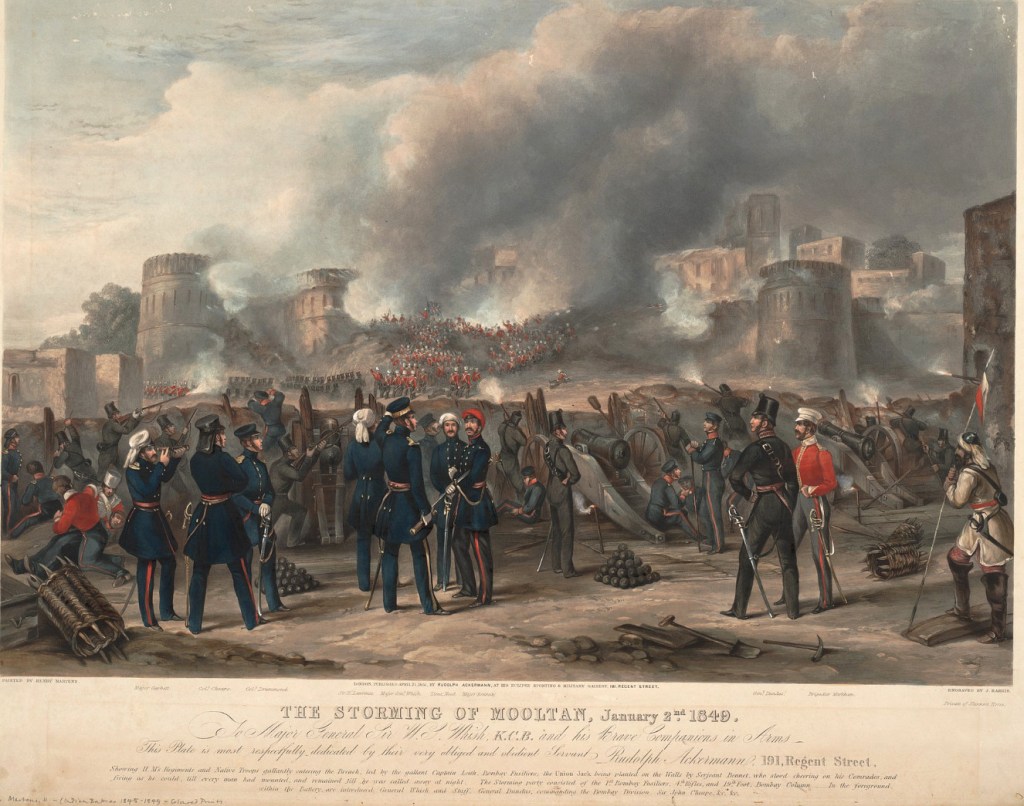
Lieutenant-Colonel Hubert Garbett – slightly wounded, died subsequently of infection at Simla in 1858. He is depicted in the painting above at the storming of Multan in 1849 on the left, holding a telescope up to his eye.
Born in 1804 in Hereford, Garbett joined the Bengal Army in 1819 as an artillery cadet and was posted on his arrival the same year to the 6th Company, 1st Battalion Foot Artillery, whom he joined in Dum Dum. Field service was not long in coming, and in 1821, the young Garbett was employed in operations against insurgents in Bundelkhand. He would subsequently see service at the siege and capture of Bharatpur, for which he received a medal and clasp.
After a few quiet years spent in Karnal, Nasirabad and Meerut with the artillery, with one furlough home and a longer spell in Simla on sick leave, he was back on active duty. Now commanding the 4th Company, 2nd Battalion, Garbett joined the Army of the Indus and went with it to Afghanistan. He served in the campaign of 1838-39 but having been left with his company at Kandahar when the army moved onward from there in June 1839, Garbett had no share in the events that followed. The same year, he transferred to the command of the 4th Troop, 3rd Brigade Horse Artillery, which also happened to be part of the Army of the Indus. He joined it at Bamian, 100 miles northwest of Kabul, in March 1840. As the senior officer at Bamian, he assumed command of the whole of the troops in the Bamian Valley and held it for the next half year. Barely a few days into his new command, Gabbert attacked and captured Fauladi Fort and, after the battle of Bamian, took up the pursuit of Dost Mohammed Khan over the Hindu Kush. Gabbert would be spared the toils and tribulations of his compatriots in Afghanistan – in October 1840, he returned with the troop to India, arriving in Ferozepore in February the following year. The troop was called down to Meerut, where they arrived a month later, then it was onwards to Ambala, and by March 1844, they were in Ludiana.
Following the reorganisation of the Artillery in 1848, Gabbert found himself reappointed to command the 4th Troop, 3rd Brigade, and on the outbreak of the First Sikh War, he took to the field with it as part of the Army of the Sutlej in December 1845. He commanded the troop at both the battles of Mudki and Ferozeshahr (medal and clasp) and was promoted to brevet Major. With the war over, Gabbert and his men returned to Meerut, arriving in April 1846. Attaining his regimental rank of Major, Gabbert vacated the command of the troop and was posted in October 1846 to the 3rd Brigade, then at Meerut. In the following year, Gabbert was back in Ludiana, this time transferred to the 1st Brigade, and here he remained until 1848 when he was appointed to command the Artillery at Lahore, which was proceeding to Multan. He then served through the Punjab Campaign of 1848-49, including the first, second and capture of Multan. At the Battle of Gujerat, Gabbert commanded the artillery attached to General Whish’s Division (medal and clasp) and would subsequently be promoted to Lietenant Colonel by brevet.
In 1851, now with the regimental rank of Lieutenant Colonel, Gabbert was posted to the 7th Battalion Foot Artillery, the command of which he assumed at Meerut; at the end of 1852, the head quarters of the battalion was sent to Sialkote, and for a short time, in 1855, Gabbert had command of the station. Since he had seen quite a lot of the Punjab, it was deemed prudent to transfer Gabbert now to the 6th Battalion, whose command he took over at Agra, and while serving there, in January 1856, he was given temporary command of the Agra and Muttra District. However, by the end of the year, the headquarters of the battalion was moved to Ferozepore, where Gabbert would find himself when the mutiny broke out in May 1857.
Towards the end of April, Gabbert was ordered to join the Delhi Field Force and arrived on the Ridge on 5 July, where, on the 17th of the same month, he was appointed Brigadier Commanding the Artillery. Less than a month later, on 8 August, Gabbert was wounded when passing from one battery to the other – the wound was hardly more than a graze, and Gabbert paid it no mind. Unfortunately, the wound refused to heal and turned into a “virulent sore,” so dreadful in condition, he was no longer fit for duty. On 30 September, he left Delhi on a six-month sick leave to Simla, but it was all a little too late for him. The effects of his wound and the supervening fever saw him to his grave on 14 January 1858. He lies buried in Simla.
His grandson, Sir Colin Campbell Garbett, would be a much-decorated officer (K.C.I.E., C.S.I., G.C.M.G) and twice mentioned in WWI for his services with the Mesopotamian Expeditionary Force, with which he attained the position of Chief Political Officer to the force in 1916.
Bugler Frederick Boardman – slightly wounded
10th September
1st Battallion 8th Foot
Private Richard Ranger – killed in action
52nd Foot
Privates
Ryan, Owen – died of cholera
Parson, John – dangerously wounded on 10th September, died of wounds on 20th September.
1/60th Foot
Lieutenant H.P. Eaton – dangerously wounded
“I regret to have to record the fact that Lieutenant Eaton, of H. M.’s 60th Royal Rifles, was wounded on
the 10th of September, and it was believed, mortally. Lieutenant Eaton was present at one of the advanced batteries; his tour of duty was over, as he had been relieved, but still, he would linger at the spot. The enemy were keeping up a heavy fire of artillery and musketry at the time, which they continued to do the whole of the day, and the results were somewhat disastrous to the covering and working parties, whose employments inevitably exposed them to its heat. We lost in killed and wounded, during the twenty-four hours, no less than fifty; and among the wounded was the gallant young Eaton, whose head was fractured, and the brain laid open. His recovery was a marvel of divine goodness and agreeably disappointed the expectations of his medical advisers.” (Chaplain’s Narrative of the Siege of Delhi – J.Rotton, p. 249-50)
Sergeants
Nesbitt, John – severely wounded
Wallace, John slightly wounded 1st of August, and again 10th September
Privates
Cowell, Stewart – slightly wounded
Divane, John – wounded
Dwane, John – severely wounded
Gibbs, James – killed in action
Gowan, Samuel- severely wounded
Henderson, William – killed in action
Keating, John – died of wounds
Knox, Patrick – slightly wounded
Little, Joseph – severly wounded
Richards, James- severely wounded 17th June and again 10th September
Wright, D.- slightly wounded
61st Foot
Privates
Cranny, Michael – killed in action
Walsh, David – killed in action
75th Foot
Privates
Rawlinson, George – slightly wounded
Tooney, Michael – shot in chest, died of wounds
1st European Bengal Fusiliers
Private Alexander Brown – killed in action
Privates
Burke, John – killed in action
Doyle, James – dangerously wounded. Died of wounds
Humphreys, Thomas – died at Delhi
McGregor, Duncan – killed in action
Ross, Thomas – killed in action
Swift, Richard – killed in action
Wilson, Andrew – wounded in right hand
Bengal Horse Artillery
Gunners
Anderson, William -severely wounded
Dempster, James – slightly burnt on hands and face
Seddon, George – killed in action
Donnell, Michael – wounded
Kelling, George – severely wounded
Travis, Thomas – slightly wounded
Bengal Engineers
Second Lieutenant P. Murray – slighly wounded
11th September
52nd Foot
Privates
Aldows, Robert – died of apoplexy
Bonnett, Joseph – died of cholera
Burgess, Henry -died of febris
1/60th Foot
Private Joseph Kewell – killed in action
61st Foot
Sergeant James Mateer – killed in action
75th Foot
Private John Keegan – severely wounded
Bengal Horse Artillery
Sergeants
Morgan, Arthur – dangerously wounded. Died of wounds
Stevens, James – killed in action
Corporal Henry Stevens – severely wounded in right arm
Bombardier Thomas Harley – killed in action
Gunners
Byrne, Andy – killed in action
McGee, Edward – severely wounded in left shoulder
Bengal Field Artillery
Major J.H. Campbell – severely wounded in the leg by grapeshot
1st Lieutenants
Gillespie, A. – wounded
Earle, E.L. – wounded
Unposted Recruit William Wiggins, slightly wounded in the thigh
Sirmoor Battalion
From Major Charles Reid
“Poor Lockhart, doing duty with my regiment, dangerously wounded yesterday. A great loss to me. He is a first-rate officer. Every officer in the regiment killed and wounded with the exception of Fisher and myself…”
This would be Lieutenant Lockhart, who Major Reid nominated for a VC when Kaye’s Battery (No.2 Siege Battery) caught fire. Lieutenant Lockhart, who was on duty with 2 companies of Gurkhas in the connecting trench between batteries 1 and 2, jumped up on the parapet with six or seven Gurkhas and tried to smother the fire with dirt from the sandbags. Two of the Gurkhas were shot dead and Lockhart was shot in the face – his jaw was smashed to pieces. According to Reid, Lockhart lay on the ground for a moment and then tried to get back on the parapet but “at length, fell from loss of blood and exhaustion.”
12th September
52nd Foot
Privates
Bottomley, George – severely wounded
Burchell, Thomas – died of cholera
Davis, David – died of cholera
Gilli, James – died of febris
Grady, Thomas – killed in action
Owens, Henry – died of cholera
Williams, John – died of febris
Winn, John – dangerously wounded, died of wounds 13th September
Worsfold, John – died of cholera
Yarby, John – died of diarrhoea
1/60th Foot
Bugler William Miller – severely wounded
Privates
Carrollean, Francis – severely wounded
Christopher, Thomas- slightly wounded
Moncur, Alexander – slightly wounded 23rd June, severely on 12th September
Shankland, Samuel – died of wounds
Turner, Henry – severely wounded
75th Foot
Private John Noon – severely wounded
1st European Bengal Fusiliers
Private James Wright – shot in head, died of wounds
2nd European Bengal Fusiliers
Drummer John Hanrahan – died of wounds
Privates
Kenny, John – died of wounds
Rowland, Charles- wounded in shoulder 12th June. Killed in action 12th September
Bengal Horse Artillery
Quarter Master Sergeant – Charles Neave (Staff/3) – killed in action
Staff Sergeant Amos Stratton (4/6) – slightly wounded in head
Corporals
Keeffe, Charles – severly wounded by musket ball
Noble, John – severely wounded in both shoulders by musket balls
Gunners
Clarke, Thomas – left arm fractured by cannon ball
Davidson, WIlliam – severely wounded in head by shell spinter
Gill, Thomas – severely wounded in both arms
Quigley, Bernard – slightly wounded in right hand
Bengal Field Artillery
Captain Robert Charles Henry Baines Fagan – killed in action at Delhi – 12th September 1857
Aged 34. Son of Major-General Christopher Fagan, CB.
He was born at Fatehgarh in 1823 and joined the Bengal Army in 1840 as an artillery cadet, arriving in India in January 1841, receiving his first posting to the 5th Company, 7th Battalion, Foot Artillery at Dum Dum. However, this was short-lived, and Fagan would soon find himself at Cawnpore with the 5th Co., 4th Batt., in June 1842. The following November, he was promoted to First-Lieutenant, and three months later, he was transferred to the 2nd Co., 7th Batt., at Almora, but a year later, he moved to the 4th Company of the same battalion and made his way to Bareilly. Several transfers and postings later, he would be in Lahore with the 1st Co., 5th Batt., and served as part of the garrison at Lahore during the Punjab Campaign of 1848-49 (medal and clasp).
By now, Fagan was a married man and a father. He married Sarah Humphrey Burt while stationed in Cawnpore in 1846 (the daughter of a doctor of a surgeon in the Bengal Army, Thomas William Burt). Over the next 10 years, they would have five children, one of whom, William Claude Horace, was born on 2 May 1857.
Perhaps his marriage or his fatherhood compelled Fagan, in 1852, to join the Department of Civil Engineering in the Punjab as superintendent of Civil Buildings in Lahore. Although he obtained his captaincy, he was transferred to the 1st Co., 4th Batt., but continued his work as a civil engineer until 1854. In that year, he moved to Dalhousie when he was appointed Officiating Executive Officer and was absorbed into the Department of Public Works in 1855. It was a short stint in the hills, for in 1856, Fagan was in Jalandhar, where he would remain as Executive Officer until the mutiny at Meerut and Delhi. In May 1857, shortly after the birth of his son, Fagan was directed, on the 19th, to proceed to Amabala, where he was to place himself under the orders of Major Laughton, and on the 23rd, he was appointed Assistant Field Engineer to the Delhi Field Force. During the advance to Delhi, on 6 June, he was placed at the disposal of Major Kaye for service with the siege-train and reverted to his correct position as an artillery officer. Fagan served at Badli-ki-Serai.
Throughout the Siege of Delhi, Fagan “repeatedly distinguised himself, especially in the repulse of the attack on the right rear on 9th July…he was marked by unceasing energy and conspicuous devotion to his profession,” and he, “gained for himself the respect of officers and men in every branch of the Force.” Captain Fagan was deemed a great loss to the Bengal Artillery – besides a capable officer, he was well-liked and known for his “pleasing manners, so affable was he, and so kind...No name in camp was ever connected more intimately and mote frequently with heroism and valour than that of Robert Charles Henry Baines Fagan, and no name was more worthy of the honour paid to it.” (Rotton, p.257-58) Like Lieutenant Hildebrand, Captain Fagan was shot in the head and died instantly.
“On the night of the 8th, a sortie -was made on No. 1 Battery; and although repulsed with slaughter to the enemy, yet it required constant showers of grape from Captain Remmington’s battery at the Sammy House, to clear the broken ground of skirmishers; while guns which had been brought out from the city into the suburbs, enfiladed our line of batteries and did much mischief.
Three guns with the same view were in battery on the opposite side of the Jumna and a continual fire was kept up from the Selimghur, a fort on the Jumna side of the city. On two occasions, sallies were made from the Cash-mere Gate before No. 2 Battery was in full play; and the heavy covering parties of infantry kept in the trenches were constantly at work keeping- down the musketry fire, which was opened from a trench running parallel to, and three hundred yards from, our left attack, and was kept up until the morning of the assault.
On No. 3 Battery, on the left, a tremendous fire of musketry was kept up from the city walls and the Water Bastion: the mantlets on the guns showed scarcely an inch without a dent. Captain Fagan, of the Artillery, whose gallantry and energy had won for him the admiration of every officer in the camp, was killed by a musket ball through the head while looking over his gun to see the effect of the fire. A kind friend and a gallant soldier, his loss was deeply felt by all who that evening followed him to the grave.” (Bourchier)
13th September
9th Lancers
Private George Dicker – slightly wounded
52nd Foot
Privates
Filer, John – died of cholera
Harrington, John – died of cholera
Redy, Michael – died of cholera
West, George – died of cholera
1/60th Foot
Sergeant Francis Kelly – dangerously wounded
Colour Sergeant William Hackett – died of wounds
Private William Dennis – died of wounds
75th Foot
Captain Alexander Chancellor – wounded Delhi, 13th September 1857. Died at Kasauli – 4th October 1857
The fourth son of Alexander Chancellor, Esq., of Shieldhill, Co., Lanark (sometimes captain of the 38th Foot, and an old Pennisular warrior who had been wounded at Talavera), he was born in 1827 and entered HM’s service on 20 October, 1846 as an ensign in the 27th Regiment of Foot. He joined the regiment the following year in South Africa and served with it on the Cape Colony frontiers until January 1848 and returned home with the regiment in 1848. He was promoted to lieutenant the same year. Over the next years, until 1852, he continued on with the 27th, serving in Scotland and Ireland; in 1852, now with the rank of Captain, Chancellor exchanged into the 10th Foot and proceeded to India, where he joined the regiment in Wazirabad during the summer of 1853. The following November, he exchanged into the 75th Regiment of and Foot, joining the regiment at Peshawar in January the next year. In October 1855, the 75th was sent to Rawlpindi and in the spring of 1857, they were stationed in Kasauli. They were called down to Ambala in May 1857 and subsequently accompanied the Delhi Field Force, fighting their way through Badli-ki-Serai.
Buried at No.4 Cemetery, Kasauli – “Sacred to the memory of Alexander Chancellor Esqr. late Captain in Her Majesty’s 75th Regiment, fourth son of the late Alexr. Chancellor Esqr. of Shieldhill Lanarkshire. Born 29th March 1827. This brave and devoted soldier departed this life at Kussowlee on the fourth day of October 1857. He died from wounds received in action before Delhi, against the Mutineers of India on the 13th Sept. 1857, the night previous to the successful assault by the victorious British Forces. His life was exposed to danger and hardship trial and privation cheerfully endured in a good cause from the 8th June 1857 when the memorable battle of Badli-ki-serai was fought and won to the day of his death.”
2nd European Bengal Fusiliers
Sergeant William Johnson – killed in action
Corporal William Doyle – died at Delhi
Privates
Brown, Alexander- died at Delhi
Callaghan, Patrick – died at Delhi
Victor Deblewell – wounded in hand
McGreggor, Duncan – killed in action
Bengal Horse Artillery
Corporal James McGann – slightly wounded in right ankle
Gunners
Beattie, James – severely wounded by a falling wall
Byrne, Walter – killed in action
Cocker, Frederick – severely wounded
Kelly, James – killed in action
Riley, John – severely wounded by a spent cannonball
Murray, Martin – killed in action
Sullivan, John – slightly wounded
Topham, Thomas – slightly wounded
Young, George – killed in action
14th September
52nd Foot
Privates
Birmingham, Charles – died of febris
Shallis, John – died of cholera
Walker, Henry – died of diarrhoea
Walters, Michael – died of cholera
“From the moment of opening the batteries until the morning of the assault, 327 officers and men were killed and wounded, exclusive, however, of a large number of workmen and non-combatants.’ (Letters of Wylie Norman, p 149)
Reports reached the Delhi Camp that some 1500 people, civilians and mutineers, had been killed in Delhi by the relentless cannonade. The residents around the various gates had fled as far as they could from the firing – the walled city would have been emptied to a man, but the guards refused to let anyone leave. Terrified they would be pressed into service should the British attack, the shopkeepers sent a petition to the King on the 12th of September for his protection. Many closed their shops and went into hiding to avoid policemen who had been dispatched for this very purpose. In a last-bid effort, Bahadur Shah agreed to personally lead an attack on the British on the 12th of September; although upwards of 10’000 people congregated near Kashmir Gate, they waited until midnight in vain. By the 13th of September, a rumour was running rife through the city that the British would attack the next day.
The Siege of Delhi was coming rapidly to a close but the butcher’s bill would have to be much higher before it was over.
Sources:
Barter, Richard. The Siege of Delhi: Mutiny Memories of an Old Officer. London: The Folio Society, 1984.
Behan, T. L., ed. Bulletins and Other State Intelligence for the Year 1858. Part 1. London: Harrison and Sons, 1860.
De Rhe-Philipe, George William, comp. Inscriptions on Christian Tombs or Monuments in the Punjab, the North-West Frontier Province, Kashmir and Afghanistan. Part II: Biographical Notices. Lahore: Government Press, 1912.
Griffiths, Charles John. A Narrative of the Siege of Delhi: With an Account of the Mutiny at Ferozepore in 1857. Edited by Henry John Yonge. London: John Murray, 1910.
Lee-Warner, Sir William. Memoirs of Field-Marshal Sir Henry Wylie Norman. London: Smith, Elder & Co., 1908.
Medley, Julius George. A Year’s Campaigning in India: From March, 1857, to March, 1858. London: W. Thacker and Co., 1858.
Norman, General Sir Henry Wylie, and Mrs. Keith Young, eds. Delhi-1857: The Siege, Assault, and Capture as Given in the Diary and Correspondence of the Late Colonel Keith Young. London: W. and R. Chambers, 1902.
Reid, Sir Charles. Extracts from Letters and Notes Written During the Siege of Delhi in 1857. London: Henry S. King & Co., 1858.
Roberts, Field Marshal Lord. Forty-One Years in India: From Subaltern to Commander-in-Chief. Vol. 1. London: Richard Bentley and Son, 1897.
Rotton, John Edward Wharton. The Chaplain’s Narrative of the Siege of Delhi: From the Outbreak at Meerut to the Capture of Delhi. London: Smith, Elder and Co., 1858.
Thackeray, Colonel E. T. Two Indian Campaigns: In 1857–58. Chatham: Royal Engineers Institute, 1896.
Walker, Colonel Thomas Nicholls. Through the Mutiny: Reminiscences of Thirty-One Years’ Service in India. London: Gibbings & Co., 1907.
Links:
https://www.britishempire.co.uk/forces/armyunits/indianinfantry/104thwellesleysstormingmultan.htm
 Mutiny Reflections
Very nice reflections on the Mutiny of 1857 .
LikeLiked by 1 person
Thank you! I enjoy your site very much!
LikeLike
Shortly I am going to shift to the history of other Asian civilization . Thanks .
LikeLiked by 1 person
Your writing is very detailed. Very informative and interesting!
LikeLike
Thanks !
LikeLiked by 1 person