The Battle That Should Not Have Been – Ruiya
Situated two miles from Madhoganj, fifty miles from Lucknow, (or more accurately, fifty-one
miles west by north from Lakhnao, and ten miles east of the Ganges– Malleson) stood the fort of Ruiya, the ancestral holding of a petty landowner, Nirpat Singh.
Singh was a rebel, “as long as rebellion seemed profitable,” but he had never taken an active stand against the British. Loot and plunder were more his style, and he took advantage of the surrounding chaos to start arguments with his neighbours. In April 1858, he was neither amassing an army nor actively picking a fight with the British. It would be Walpole, however, who would bring the contest to him.
The Council of War – of Sorts
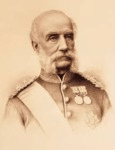
On 14 April, Walpole’s spies informed the general that Ruiya was not only occupied by rebels, but Nirpat Singh was planning to attack the column; they further exaggerated the numbers of his supposed force, driving it up from the actual 300 to the fantastical figure of 1500. No attempt was made to confirm that this was actually true, and being an officer with little Indian experience, Walpole did not feel inclined to question the veracity of the statement. Among his advisors, accompanying the force as civilian magistrate, was Captain Thurburn, a man of considerable experience (as we have already seen), who felt disinclined to accept such vague information; he further wanted Walpole to listen to what another informant had to say.
A trooper of Hodson’s Horse had, some weeks back, been captured by Nirpat Singh’s men and held in Ruiya Fort – the very morning Walpole arrived at Madhoganj, the trooper had managed his escape and had made his way straight to Walpole’s camp – it is unclear whether his escape was by design or by chance, but at any rate, his information was certainly worthy of mention. He informed Walpole, through Thurburn, that Nirpat Singh had no intention of fighting the British, yet he needed to save face in front of his people. He would oblige them by making a show of resistance, just sufficient to save his honour and then, when this was accomplished, he would evacuate Ruiya and leave the gate open for the British to walk in. Thurburn should have, at this point, insisted that Walpole listen to the trooper; he could have intervened and explained that this was not an unusual way of doing business in India; had he had any powers of persuasion, he might have prevented Walpole from attacking Ruiya at all. Instead, Walpole appears to have only half-listened to what Thurburn said. Information was abroad that Begum Hazrat Mahal had indeed been in touch with Nirpat Singh, and there was certainly a possibility he was hostile to the Government, but the statement of the trooper should have been given careful consideration. Besides this, after the Oudh Proclamation, Singh stood more to lose from an encounter with the British than Walpole stood to gain.
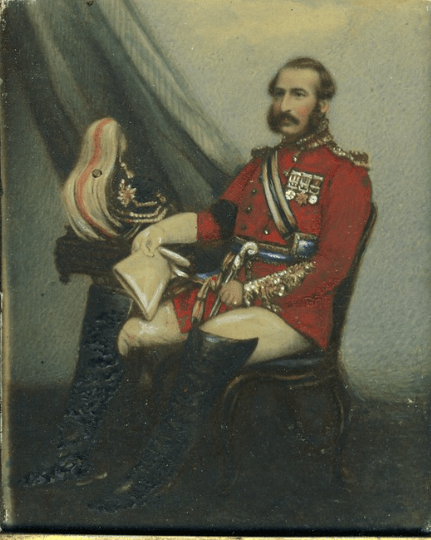
Walpole, however, refused give the trooper’s story any credit, nor did he bother to set up any communication with Nirpat Singh. In Walpole’s mind, the thought of winning his spurs against a fort of 1500 heavily armed rebels in a jungle fort was more appealing than using common sense. Then came the problem of sound military practices.
“The slightest examination would have shown him that whilst the northern and eastern faces were strong, covered by dense underwood and trees, the western and southern were weak and incapable of offering defence. These faces were approached by a large sheet of water, everywhere very shallow, and in many places dried into the ground, and the walls here were so low that an active man could jump over them…”
On the evening of the 14th, Walpole, after some persuasion by his DAAG Captain Carey, agreed to summon Brigadiers Hope and Haggart and Colonel Brind to his tent for something that could have been called a Council of War, had Walpole not already made up his mind. Without any ceremony, he informed them he intended to attack Ruiya Fort the next morning – the information he had received was sound regarding not only the fort but the road leading to it, as related by the native guides, whom he believed were honest and trustworthy. At daylight, the force would advance along a road leading to the left of Ruiya; this road split a couple of miles from the camp into two – one road then ran through supposed open country in the direction of the fort and the other to the village of Rowdamow. On reaching the junction in the road, Colonel James Brind was instructed to advance with the whole of the artillery and take up a position to fire at the fort, while the cavalry and infantry brigadiers were to follow and “act as circumstances might require.” Brind, a man of considerable experience and who had fought not just at Lucknow but through the Siege of Delhi, asked Walpole if his information was absolutely reliable and the country was indeed open as the guides intimated. Otherwise, he advised mounting a reconnaissance to the point where the road divided, before attempting to attack Ruiya. He further told Walpole that “under any circumstances his duty duty to his own Command, to the Force, to the General himself, to the Commander-in-Chief, and to the Government of India, made it imperative to a draw the General’s attention to the danger of advancing with the whole of the artillery without the support of the infantry, and without first reconnoitring the ground over which he was to move.”
Annoyed with Brind, Walpole turned on Haggart and Hope, asking if they held the same opinion – both men concurred. Seeing he had no choice, Walpole half-heartedly agreed that a reconnaissance would be carried out the following morning, by Captains Lennox and Maunsell of the Engineers.
The 15th of April
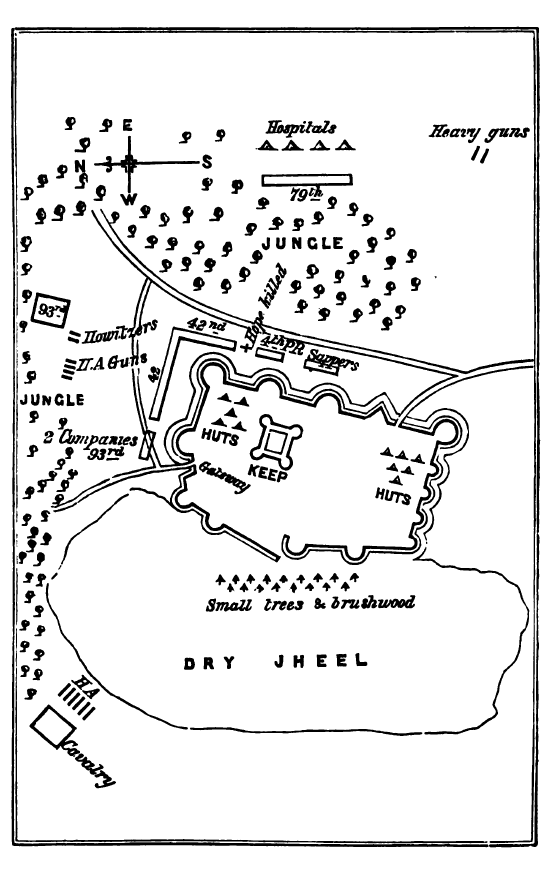
The next day, however, unprepared and completely convinced of his own self, Walpole ordered the men to march, under arms, toward Ruiya. The force began to move forward, and suddenly, contrary to Walpole’s belief of “open country,” they were faced with a wall of thick jungle. To the surprise of Brind, Hope and Haggart, Walpole determined to ignore any talk of reconnaissance at all, despite what had been agreed upon the night before, and ordered the whole of the artillery, with spare ammunition, to advance through the jungle towards the fort, the infantry following. The cavalry was to make a detour to the right and try to get around the rear of the fort – Brind immediately objected. He pointed out that the danger of taking the heavy guns and spare ammunition through an unknown jungle was not advisable and suggested instead to advance with the light guns instead, preceded and supported by the infantry; he also said the guides had already proved false and trusting them any further was folly. Brind suggested a method of ensuring the guides were not misled a second time – they should be, “induced to lead, with a bag of gold tied to their waists and a halter round their necks, and soldiers with loaded rifles on either side of them; explaining to them they should have the gold if faithful, be hanged if faithless and shot if they attempted to escape.”
For reasons known only to himself, Walpole refused to doubt the guides but “desired Colonel Brind to do what he pleased with his heavy guns, and to arrange with the Brigadier commanding the infantry for an escort to accompany his light guns through the jungle.” Accordingly, the heavy guns, baggage and spare ammunition were left parked in Madhoganj, as was Walpole’s fashion, on an open plain but at least under a guard of cavalry and infantry. Hope and Brind now proceeded with their arrangements.
Four Horse Artillery guns under Lieutenant-Colonel Harry Tombs would precede the skirmishers of the 42nd, to be followed by the main body of the regiment. Colonel Brind would lead, followed by a small detachment of breaching artillery, supported by the 93rd with the 79th and 4th Punjabis held in reserve. At the same time, the cavalry with one troop of Horse Artillery under Haggart would sweep around to the right to get as close to the fort as possible from the north-west.
After a considerable struggle to get through the jungle, the advance suddenly came to a halt, for quite unexpectedly, heavy firing opened from several small guns and matchlocks in the fort. If Walpole had listened to the trooper of Hodson’s Horse, he would have known this was Nirpat Singh making a show of things. It was still not too late to stop what would happen next, but as the artillery did not know Singh was making a sham attack and Walpole didn’t tell anyone, it looked like there would be a stiff fight ahead. He was also on the strongest side of the fort, and this would ultimately be his undoing. In his official report, Walpole states,
“The fort on the east and north side is almost surrounded with jungle, and at these two sides, the only two gates were stated to be, which information proved correct. It is a large oblong, with numerous circular bastions all round it, pierced for guns, and loopholed for musketry…” While he noted did cast a cursory glance at the west and south side, all he saw was “a piece of water, which was partially dried up.”
The southern wall, too, had a gate, scarcely defended, but this did not appear to shine in Walpole’s senses.
He continues, “A tolerable view of the fort having been obtained from the road which leads into it from the north, the heavy guns were brought up; the two 18-pounders were placed on it; the two 8-inch mortars behind a wood still further to the right.” He then ordered the infantry, in skirmishing order, to advance straight to the fort. The 42nd took up a position at the north-east angle of the fort on the slope of the glacis, not far from the ditch; two companies of the 93rd were sent to the right of the 42nd, and when the attack commenced, the 4th Punjabis to their left.
One can only imagine Nirpat Singh’s surprise when Walpole attacked him. He had intended to shoot off a few rounds and then, as promised, retreat, leaving Ruiya abandoned for Walpole’s taking. Instead, he saw the British general, who was obviously devoid of reason, sending his infantry in skirmishing order against the only defendable face of the fort. Nirpat Singh slammed the gates shut and was now determined to put up a fight, and the infantry would soon bear the brunt of Walpole’s folly.
Walpole sent two companies of the 42nd in skirmishing order, with no support, directly to the front. Nirpat Singh ordered his men to man the walls, and he further sent skirmishers to climb the numerous trees in the fort. Well hidden in their boughs, they were practically invisible to the advancing infantry and at considerable leisure to pick off their targets. When the infantry reached the fort they suddenly realised there was a ditch and they had no means of crossing it; meanwhile the fire from the loopholes increased in intensity –“The skirmishers still persevered, some of them even penetrated into the ditch; but their valour was useless, the enemy remained unseen, there was no breach, there were no ladders, and the hostile fire continued.” Captain Ross-Grove of the 42nd vainly called for scaling ladders; he received, instead, the 4th Punjabis. Captain Cafe quickly led his gallant regiment of five officers including the regimental surgeon and 105 men down through the jungle and across the glacis, taking up a position to the left of the 42nd only to find he had taken them directly into the line of fire – there was no cover for his men and the only sensible solution was to take them down into the ditch, as close to the walls as possible to escape at least the fire from the bastions. He could see there was no breach, not even a gap in the wall by which they could enter the fort and the only way they could reach the top of the wall (which was only nine feet high from the bottom of the ditch) would be “by pushing and helping each other up one at a time.” The Subadar Major and Captain Cafe managed to get up using this method and looked over the parapet of the wall – they quickly came to the conclusion that under such a heavy fire from the Singh’s men, in their tower, their trees and behind their loopholes, it would be impossible, without vigorous support, to assault the fort in such a manner. Cafe ordered the Punjabis to remain in the ditch while he sent back his report to Walpole, for which he never received an answer. After thirty of his men were killed or wounded, Cafe led the remainder out of the ditch and back to the original position behind the counterscarp, the 42nd on his left and a group of bewildered, orderless sappers on his right. Of the gallant deeds of the 4th Punjabis, we shall return later. However, Walpole mentions none of this in his official report, but to add a little salt into their wounds, would write,
“After a short time, a great many of the infantry were killed and wounded from having crept up too near the fort, from which the fire of rifles and matchlocks was heavy. These men had gone much nearer to the fort than I wished or intended, and some of the Punjab Rifles, with great courage but without orders, jumped into the ditch and were killed, endeavouring to get up the scarp.”
Alexander, of the 93rd, has his version, related to him by survivors of the horrible slaughter at the ditch:
“Walpole ordered two companies of the 42nd Highlanders to the front; they advanced through the brushwood in skirmishing order close up to the ditch, losing many men. Presently, Walpole ordered up the 4th Panjab Rifles to reinforce them; these aligned themselves on the left of the 42nd, and with the 42nd presently threw themselves into the ditch to escape, if possible, the biting fire from the loopholed walls, and they found no shelter, and being without ladders, could effect nothing against the enemy. In this death -trap the 42nd Highlanders lost 2 officers and 7 men killed, and 2 officers and 31 men wounded; and the 4th Panjabis 1 officer and 46 men killed and wounded, all shot down like dogs at 20 or 30 paces distance.“
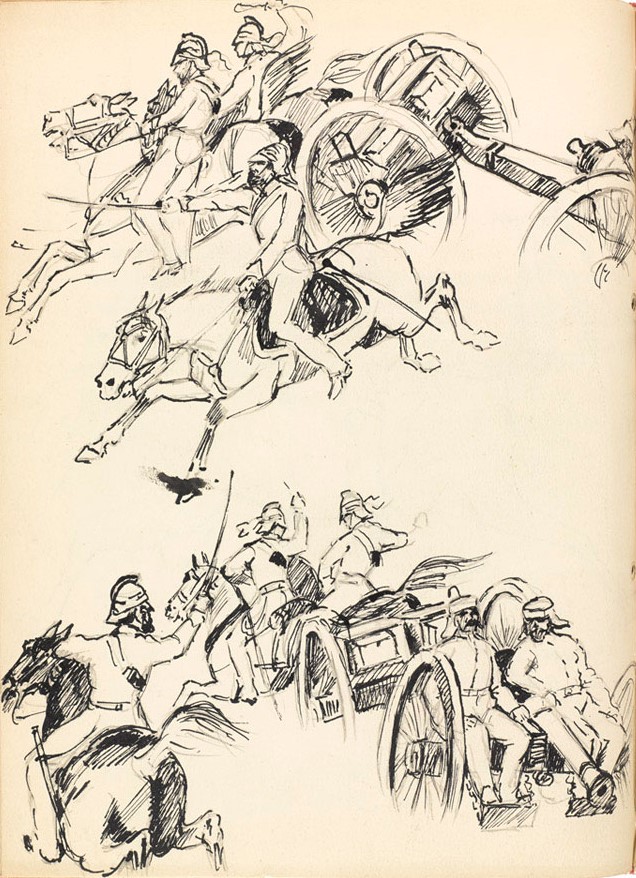
Colonel Brind at least had not taken leave of his senses and, realising what was happening, ordered the Horse Artillery guns to an exposed position on the edge of the jungle, to fire over the heads of the advancing infantry, and “sweep with shot and shell the bastion and curtain opposite or rather under which the 42nd and the other corps lay, so as, if possible, to keep down the heavy and destructive matchlock fire of the enemy; at the same time, he directed Lieutenant Harrington (VC) to bring up two 18-pounders and two 8-inch howitzers and place them in a position on the eminence to the south-west of the Fort and to confine the fire of the heavy guns on one spot and open a breach as quickly as possible, believing it was the General’s intention to storm the place.”
We must remember, Walpole, despite losses to sunstroke, still had upwards of 3’800 fighting men – some were guarding the baggage, but where were the rest? According to Alexander, they were about to have a meal.
“I myself, in command of No. 6 Company of the 93rd, was, with the headquarters of the regiment, the
remainder of the 42nd and the 79th Highlanders, in line a little beyond the brow of a hill overlooking the fort, in the direction whence we had come. About half-past twelve, we received orders to form in columns of battalions still further to the rear, pile arms, and let the men have their dinners.
Accordingly, the men’s cooking utensils were unloaded, and the native cooks proceeded to cook the men’s dinner and serve it out to them about half past one. All this time, we knew nothing of the tragedy that was being enacted in that ditch, not a quarter of a mile off. When attempts were then made by the 42nd to send their two companies their dinners, however, it began to be whispered about that they and the 4th Panjabis were losing heavily, in fact, being shot down like rabbits.”
Just as Alexander and the 93rd were settling down to their dinners, an order came up that he and his company were to escort two howitzers to the opposite side of one of the gates on the south side of the fort and batter it down. Alexander would write:
“This setting us all down to cook dinners in the middle of a serious attack on a fort, had seemed to us all, officers and men, so totally incomprehensible, that I received my orders, as pointing to some sort of action, with delight, and as the fire from the fort was too hot to trust to the bullocks, my men, when called upon to help the artillerymen to drag the two howitzers, being equally pleased to do something, started off with them at a run over very rough ground and through thick brushwood, never stopping till the artillery officer directed us to do so on the spot where he intended to bring the guns into action. The gate was protected by a high earthwork, but when the guns opened fire, it seemed to me that the shells were beautifully pitched, and they certainly knocked about the archway over the gate.
We had not, however, fired more than two or three rounds a gun, when a staff officer arrived with orders to cease firing and join headquarters. I pointed out to him what the artillery had already effected, but he reiterated his orders for me to escort the artillery back at once, which elicited the remark from one of my men, ‘ The man ‘ (meaning Walpole) doesna seem to ken his ain mind!’ The bullocks for the guns having followed us, we reluctantly obeyed orders, but as leisurely as we could, giving no hand in hauling the guns back again.”
It was General Walpole who ordered the guns to stop firing. As for the 93rd, they saw no action at all at Ruiya – the 79th and the remainder of the 4th Punjab Rifles were held in reserve in open ground behind the jungle, facing, of all things, the eastern side of the fort. Around to the rear of the fort, the cavalry with one troop of Remmington’s Horse Artillery had taken up their position on the edge of the jungle facing an open plain to intercept anyone fleeing Ruiya, once Walpole’s front and flank attack were successful, as this was the only route by which they could escape. As such, they would wait, and then wait a little longer until it became clear something was terribly wrong. Meanwhile, Brigadier Haggart of the cavalry was sending messages, repeatedly, to Walpole that the Ruiya was accessible and would be easy to capture if he moved his force from the north to the south and west flanks; Walpole blundered onwards prevented the artillery from opening a breach and“desired the officer commanding the artillery to keep up a dropping fire on the Fort from both the heavy and light guns in answer to, and to keep down that of, the enemy to which part of our infantry and several of our light guns were completely exposed.”
Colonel Brind was very aware that this whole affair at Ruiya was what he had suspected, considering the behaviour of the guides by leading them to the strongest side of the fort, base treachery. The day was passing by, and he was rapidly running out of ammunition. Brigadier Hope informed him that the 42nd were hopelessly caught in the ditch and they should either be allowed to assault by any means or retreat. Brind, on his part, decided to present Walpole with two courses of action – the artillery should be allowed to concentrate their fire at one point only, either on the north or the east, to breach the wall, preparatory for an assault; he would then use his light guns to provide cover for the storming party. The other course was that the engineers be allowed to proceed to the south side of the fort and find a position for the heavy guns to effect a breach in the curtain. Walpole agreed to the second proposal, and accordingly, Brind with Lennox and Maunsell proceeded to the south side – they had hardly reached when several things happened, seemingly all at once, that completely befuddled Walpole.
Firstly, his trusty guides disappeared, just as Brind had expected them to; then a company of the 42nd under Captain John Cheetham McLeod, ordered to advance close to the fort and examine the gate in the north wall were suddenly recalled, and the only man who appeared to still have any desire to knock sense into Walpole’s head was shot dead. This man was Adrian Hope. In this “state of perplexity and confusion,” Walpole utterly forgot he had sent Brind and the engineers to the south wall, and without sending any orders to either the artillery or the engineer officers, he ordered the infantry to retire.
Meanwhile, Brind and the engineers continued their reconnaissance of not only the south but also the west of the fort and selected a sheltered position for the heavy guns. They then decided on a spot where a breach could be made in the western wall, which was neither loopholed nor defended by bastions. Before returning with their report to Walpole, Lennox and Maunsell climbed up a small hill to make note of the best approach for the guns and the assaulting column, when to their surprise they saw the whole column moving off, away from Ruiya towards Rowdamow. Brind, convinced now that Walpole had indeed lost his mind, galloped to the head of the column to stop the retreat; he told Walpole he had found the perfect spot for a breach, and if he waited just a little longer, he could take Ruiya before nightfall. Walpole declined. The fort could wait for the next day, when another attack could be made “more thoroughly and safely”. Haggart quickly asked Brind what measures they should put in place to prevent Singh and his men from escaping during the night. Walpole did not consider this measure even moderately necessary and ordered the cavalry to return to camp.
The order to retire was greeted with just as much surprise from the troops who, having been apprised of Hope’s death, were now more eager than ever to tear Ruiya to pieces, with their bare hands if they had to, to avenge their beloved commander. Instead, as they marched away, they received a salute from Nirpat Singh’s garrison, who then proceeded to line the walls to jeer and laugh at them until they were out of sight.
Just as Haggart had surmised, during the night, Nirpat Singh and his men disappeared, swallowed up in the darkness of the vast Oudh country side – the next morning Walpole entered the empty fort and “looking down from the parapet of the wall to the spot where the men lay exposed all the previous day, and where Hope had fallen, remarked, ‘No wonder he was killed.’
 Mutiny Reflections
That’s whole heap of incompetence!
On an entirely different note I’ve just been reading about Ellen Wilkinson’s trip to India in the early 1930s. She gave a speech to students in the Hindu College Hall that included this anecdote:
A government official had said that he hoped that she would meet the best Indians (on her visit) She noted that 99 per cent of the best Indians seemed to be in jail.
LikeLiked by 1 person
Saying that the words “military intelligence is an oxymoron is probably usually must unfair. However – it seems that it would certainly apply to Walpole.
LikeLiked by 1 person
I tried to find something that would vindicate Walpole and show his treatment was unjust. However, this is one of those times I have to say the man really was not fit to lead. I read several accounts of Ruiya, went through the despatches (especially his), and it really seems he was being pampered since he came from a notable family. Even the Dictionary of National Biography desisted from calling him a good general. Personally, the whole Ruiya affair made me quite angry – what a senseless way to die.
LikeLiked by 1 person
He would make a textbook example of how not to lead anything. Let alone an army where lives are at stake. Anyone can make mistakes and blunder but his level of generally obtuse incompetence seems remarkable.
LikeLike
I absolutely agree. I can’t think of anyone except Windham at Cawnpore in November 1857, Mansfield at Cawnpore in December 1857 and Captain Dunbar (July 1857, the non-rescue of Arrah), who could be added to the Walpole Gallery of How Not to Lead. Dunbar is certainly up there with Walpole.
LikeLiked by 1 person