The Death of Adrian Hope
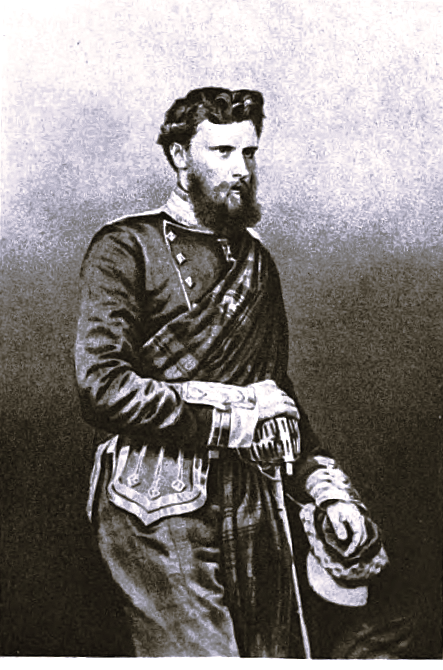
Justly concerned after the advance of the 42nd and the Punjabis Adrian Hope hastily rode up to Walpole – although no one can say for sure what he said to him as Walpole certainly did not mention it in his report, by all accounts, he held a long and apparently, strained conversation with Walpole who in his finite wisdom did not listen to a single thing Hope said.
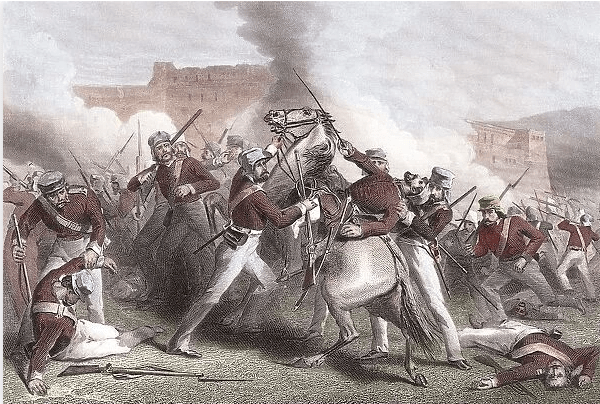
Hope then dismounted his horse and proceeded on foot, with his ADC, Lieutenant Archibald Butter, intent on “making himself personally acquainted, at every risk, with the situation.” He advanced with Butter to the part of the counterscarp where Captain Ross-Grove was stationed to see what could possibly be done to put an end to this abominable situation. While considering whether Ruiya could be stormed or not, Hope stood up to get a better view of the position when a bullet fired by a man hidden in a tree hit him in left side of his neck, and passed downwards to his chest towards his heart. He fell backwards against Ross-Grove, who laid him on the ground. Lieutenant Butter, horrified, knelt next to Hope, shouting out for someone to bring a doctor. Holding Butter’s hand, Hope whispered, “Say a prayer for me,” closed his eyes and died. Butter would write a letter to Hope’s brother, Charles, a few days later, presenting a suitably heroic version of his death with many more last words; the version he told Munro when he brought Hope’s body to him seems, when considered in the clear light of time, the most accurate. Curiously, the press received their own version, and a suitably heroic portrait of his death was soon in circulation. It would also be captioned, “Death of Brigadier Adrian Hope in the attack on the Fort of Roodmow, April 15th 1858”, and would appear in various publications of the day.
The son of General John Hope, 4th Earl of Hopetoun, Adrian Hope served with the 60th Rifles between 1838 and 1851. He fought in the Kaffir War and at Crimea, notably at the battles of Alma and Inkerman. He exchanged to the 93rd Highlanders, who would be one of the first regiments to arrive in India at the outbreak of the mutiny. Hope fought under Sir Colin Campbell at the relief of Lucknow and at the subsequent retaking of the city. During the mutiny, he was promoted to Colonel and received the cross of Companion of the Order of the Bath (CB). He was also universally liked, not only by the men of his regiment who revered him, but by everyone fortunate to meet him.
“Of all the leaders of men whom I have served under, he was the calmest and coolest under fire, and the most gentle and courteous in his manner to all with whom he was associated. He never uttered harsh or unkind words, but was generous in thought, speech, and act. He seldom found fault, yet, when he did so, his reproof was conveyed in the fewest words, and with the most refined consideration for the feelings of the offender; so that all, from the highest to the humblest, who served under his orders felt that he was a leader in whom they could trust, and a friend to whom they could willingly and unreservedly give respect and love. No position of danger ever seemed to move him in the least; no one ever saw him hurried, or knew from his demeanour if he was anxious under difficulties or not. He spoke to those around him in the hottest fire of battle in his usual gentle, courteous manner. Nothing escaped his notice; what had to be done by himself or at his order was done without hurry, at the right time and in the right way. One great peculiarity of his was that he often seemed to be asking advice while giving it.” (Surgeon Munro)
Being a large man with red hair, Hope was instantly recognisable; while he might not have had the same nearly magnetic power as a Nicholson, everyone agreed, “A gentler, braver spirit never breathed – a true soldier, a kind, courteous, noble gentleman in word and deed, devoted to his profession, beloved by his men, adored by his friends.” (Russell) Sir Colin Campbell trusted Hope, and the command of the division, many believed, should have been his. However, Hope was only 37 and a colonel, and Walpole, a general, outranked him. Hope should have gone on to greater things, a leader of men, a shining example of everything manly and good – it was just unfortunate that he would be the first star to fall out of Sir Colin Campbell’s tainted sky.
The funeral of Hope, Lieutenants Bramley and Douglas of the 42nd, and Lieutenant Willoughby of the 4th Punjab Rifles took place in the early evening of 16 April. They were laid to rest together with seven men of the 42nd in a double row of graves dug in a grove of mango trees.
I have seen and assisted at many military funerals, but I never saw one more impressive than this. Brigadier Hope was accorded the funeral of a General Officer, the whole division being present on foot – Engineers, artillery, cavalry and infantry—and even the sick and wounded who could walk stole away from the field hospitals to be present.
The massed bands of the three Highland regiments played the Dead March, being relieved by the whole of the pipers of the three regiments, playing ‘Lochaber no more, ‘ and ‘The Flowers of the Forest .’ Viewed from my grove of trees, whence the camp could be seen half a mile off, the procession was very imposing, and the wail of the bagpipes, alternating with the solemn strains of the Dead March, was most impressive.
Each Highland regiment having its own Presbyterian Chaplain, the Rev. Mr Ross, Presbyterian Chaplain of the 42nd Highlanders, read the 90th Psalm, and the Rev. Mr Cowie, Episcopalian Chaplain to the division, the Church of England Service. There was hardly a dry eye in that large assemblage.“
For Surgeon Munro, it was not only the saddest, but the most touching military funeral he had ever witnessed – “for the lives of the brave men had been so full of promise and their deaths humanly speaking, so unnecessary.”
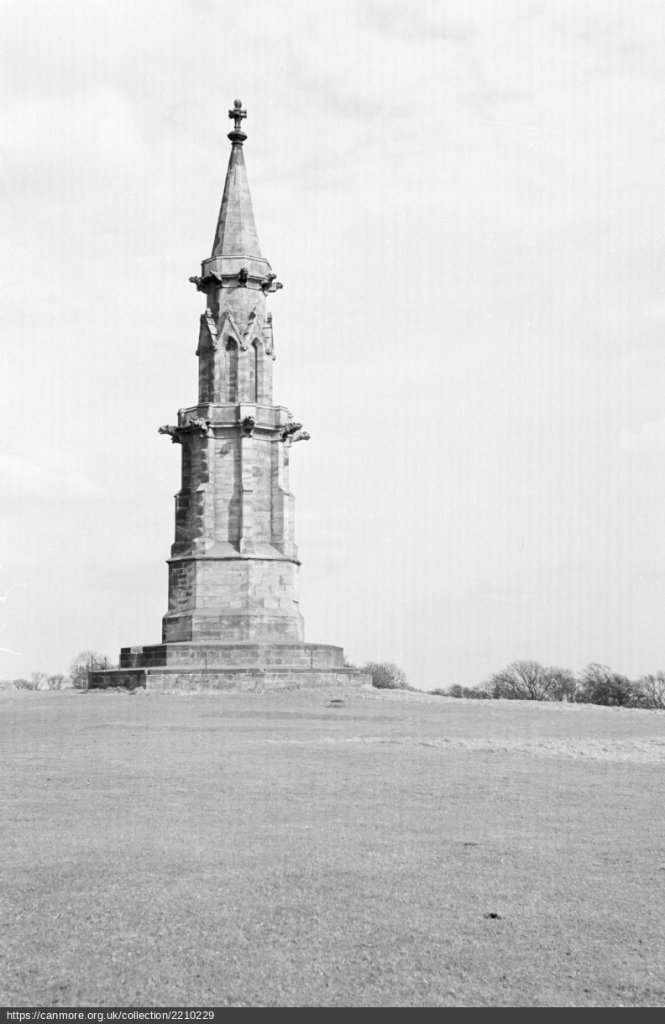
Back in Scotland, a memorial would be erected the following year that stands on a ridge between Linlithgow and Bo’ness, called the Hope Monument, and bears the following inscription:
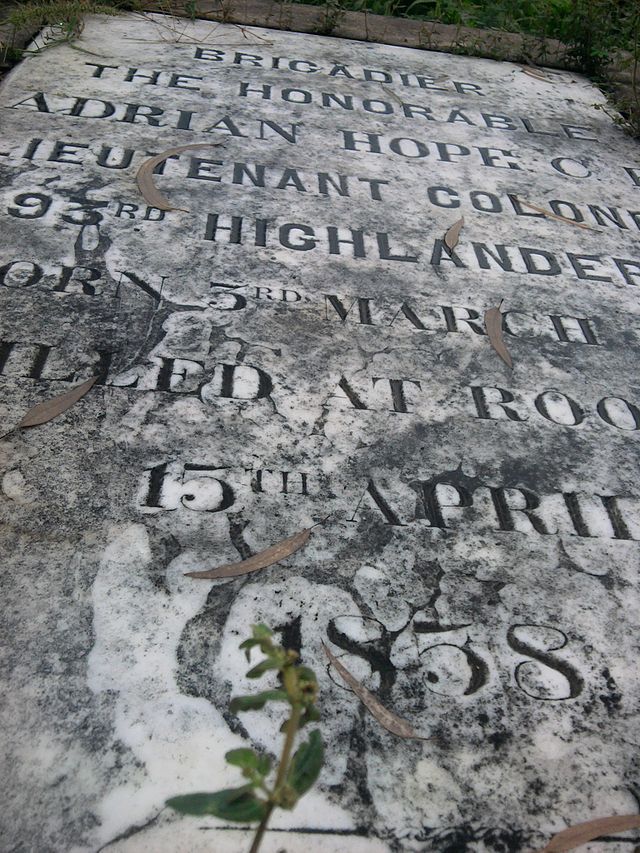
“To the glory of God and in memory of Brigadier the Hon’ble. Adrian Hope C.B. Lieutenant Colonel 93rd Highlanders, youngest son of General John, Fourth Earl of Hopetoun. Born March 3rd 1821 killed before the Fort of Rohya in Oude April 15th 1858.”
In the west aisle of the north transept of Westminster Abbey, there is also a memorial stone to Brigadier the Honourable Adrian Hope.
Returns for Ruiya
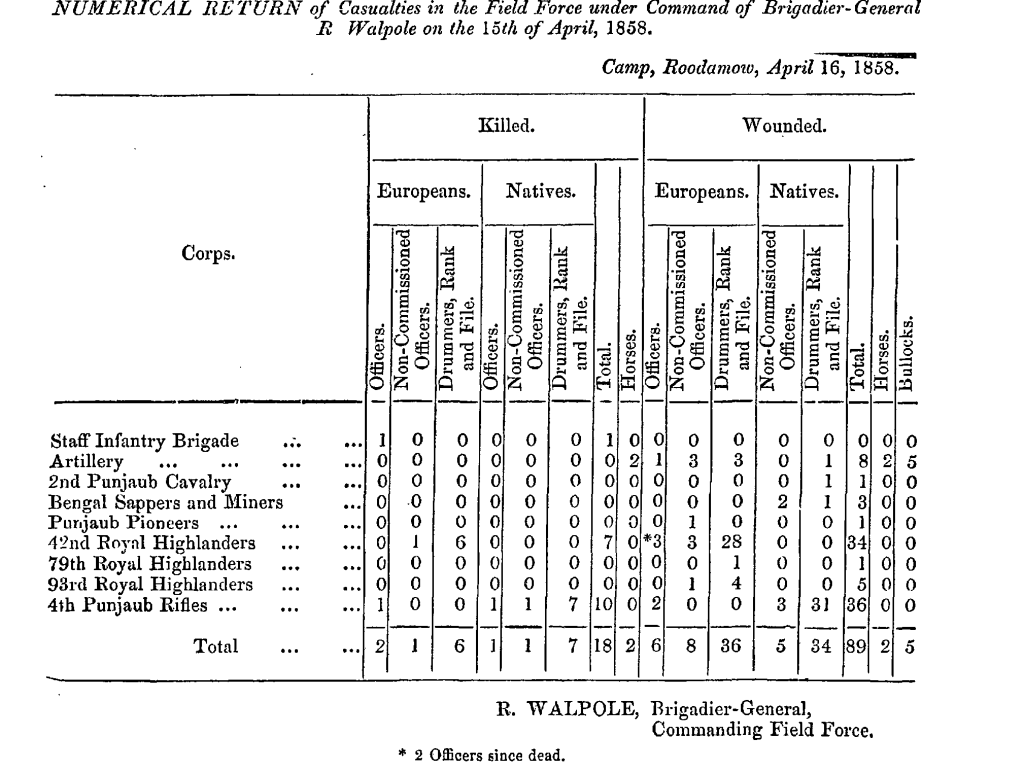
Staff
Lieutenant-Colonel Adrian Hope, 93rd Royal Highlanders – killed in action.
Bengal Artillery
2 horses killed; 2 horses, 5 bullocks, wounded.
1st Lieutenant H. E. Harington (VC) – severely wounded
Sergeant John Knox – severely wounded
Corporal Michael Brian – severely wounded
Bombardier Thomas Dwyer – slightly wounded
Gunner D. Somerville – mortally wounded
Private Brissal – slightly wounded
2nd Punjab Cavalry
Sowar Jewun Singh – slightly wounded
Bengal Sappers and Miners
Havildar Goordyall – severely wounded
Naik Pragut – severely wounded
Sepoy Perrun – severely wounded
Punjab Pioneers
Sergeant Allister – severely wounded
4th Punjab Rifles
Captain William Martin Cafe – severely wounded
Lieutenants
Sperling, F. V. H. – slightly wounded
Willoughby, Edward C. O. – killed in action (attached, 10th BNI)
Subadar Heera Singh – killed in action
Havildars
Atta Singh – severely wounded
Goormukh Singh – slightly wounded
Bood Singh – killed in action
Thakoor Doss – severely wounded
Sepoys
Abdool Mahomed – dangerously wounded
Amrah – slightly wounded
Ashruff Khan – mortally wounded, died of wounds
Bahadoor – severely wounded
Baneshah – killed in action
Bhadowur – killed in action
Bhole Singh – slightly wounded
Bhoota – killed in action
Bhurpoor Shah – severely wounded
Bussowah Singh – severely wounded
Dotto – severely wounded
Dutter (3rd) – severely wounded
Elahee Buxh – slightly wounded
Emaum Bux – slightly wounded
Emaum Bux – slightly wounded
Ghazee Khan – slightly wounded
Goolab (3rd) – severely wounded
Goolat – mortally wounded
Goolat (2nd) – slightly wounded
Gooroo Doss – severely wounded
Goordut – slightly wounded
Goordut Singh – severely wounded
Guffoor – dangerously wounded
Gunda Singh – mortally wounded
Hurzah Singh – severely wounded
Jumna – severely wounded
Jungre – severely wounded
Khan Mahomed – killed in action
Kukka Singh – dangerously wounded
Kooshead SIngh – severely wounded
Kurruk Singh – dangerously wounded
Madhoe – killed in action
Mushoom Shah – severly wounded
Nanuk – killed in action
Nuzzeer Singh – slightly wounded
Peenah – killed in action
Sham Singh – slightly wounded
Tutoo – severely wounded
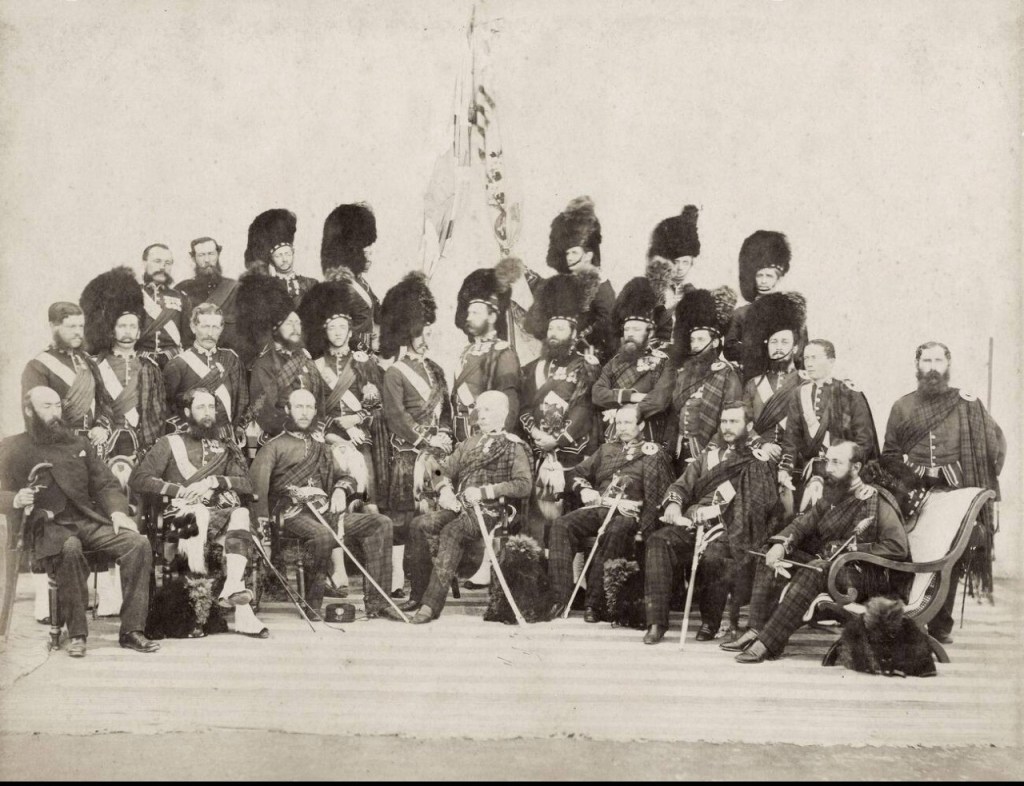
42nd Royal Highlanders
Lieutenants
Bramley, Alfred Jennings – killed in action. Aged 22. Son of Reverend Thomas Jennings Bramley of Tunbridge Wells, Kent.
Cockburn, G. W. – severely wounded
Douglas, Charles – dangerously wounded. Died of wounds, 16 April.
Sergeant James Fraser – killed in action
Colour Sergeants
Ridley, Thomas – dangerously wounded. Died of wounds
Stephens, John – slightly wounded
L. Sergeant Josh. Hartley – severely wounded
Corporals
McIntosh, James – severely wounded
Ritchie, Archibald – killed in action
Thompson, Thomas – killed in action
Drummer Andrew Morris – severely wounded
Privates
Bates, Joseph – dangerously wounded. Died of wounds
Brodie, Adam – killed in action
Brown, Charles – severely wounded
Brown, John – severely wounded
Clark, William – severely wounded
Corbet, Samuel – slightly wounded
Crosson Robert – severely wounded
Dixon (Dickson), Alfred – severely wounded in the arm
Duncan, William – mortally wounded. Died 16 April
Dunn (Duns), James – dangerously wounded. Died the same day
Eadie, James – killed in action
Forrester, William – slightly wounded
Fraser, Charles – killed in action
Gilderthorpe, Charles – dangerously wounded
Grimwood, David – severely wounded in the right groin
Hamilton, William – killed in action
Haynes, William – severely wounded
Hennessey, Dennis – dangerously wounded
Hepburn, John – killed in action
Hewitt, Robert – severely wounded
Jamieson, Robert – severely wounded
Leishman, Robert – slightly wounded
McIntosh, William – severely wounded
McKay, Andrew – killed in action
Mackie, Alexander – dangerously wounded. Died of wounds
McKenzie, John – severely wounded
McLeod, Donald – severely wounded
McMinimy, Hugh – slightly wounded
Miller, James – slightly wounded
Neave, David – slightly wounded
Nicholas, James – slightly wounded
Paul, Thomas – severely wounded
Sharp, James – slightly wounde
Sibbalds, Robert – slightly wounded
Spence, Edward – dangerously wounded, died of wounds
Sterling, Robert – severely wounded
Wagstaff, Charles – killed in action
Weir, John – severely wounded
Woods, James – slightly wounded
Wright, Robert – dangerously wounded. Died of wounds 5 May
79th Royal Highlanders
Privates
Dawson, David – died of smallpox
Kelly, Alexander – died of cholera
McGraw, Peter – dangerously wounded
Shedden, Richard – slightly wounded
93rd Royal Highlanders
Sergeant David Sim – severely wounded
Privates
Davidson, Robert – severely wounded
Harris, Alexander – slightly wounded
Lennant, James – slightly wounded
McKay, Hugh – slightly wounded
Walpole was quick to mention everyone he possibly could in his despatch.
“I have received the most willing support from all under my command during this operation; and I beg particularly to offer my best thanks to Brigadier Haggart, commanding the cavalry, and to Major Brind, commanding the artillery, for their most able and valuable assistance; also to Captain Lennox, the senior engineer officer, to Lieutenant- Colonel Hay, commanding the 93rd Regiment, who succeeded to the command of the infantry brigade on the death of Brigadier Hope, to Lieutenant- Colonel Cameron, commanding 42nd Regiment, Lieutenant-Colonel Taylor, commanding 79th Regiment; to Captain Cafe, commanding 4th Punjaub Infantry, who, I regret to say, was severely wounded; to Lieutenant-Colonel Tombs, and Major Remmington, commanding troops of horse artillery; to Captain Francis, commanding heavy guns; to Captain Coles, commanding 9th Lancers, and Captain Browne, commanding 2nd Punjaub Cavalry.
I beg also to return my best thanks to the officers of my staff, Captain Barwell, Deputy Assistant Adjutant-General; Captain Carey, Deputy Assistant Quartermaster-General; Captain Warner, aide-de-camp, and Lieutenant Eccles, Rifle Brigade, my extra aide-de-camp.
Enclosed, I beg to forward a list of the casualties, and likewise a sketch of the fort, which has been made in a hurry, but will afford information of the nature of the work.
I have, &c.,
R. WALPOLE, Brigadier-General, Commanding Field Force.
The fort at Ruiya was destroyed. With it should have gone Walpole’s reputation.
Sources:
Behan, T. L., ed. Bulletins and Other State Intelligence for the Year 1858. Part 3. London: Harrison & Sons, 1860.
Burgoyne, Roderick Hamilton. Historical Records of the 93rd Sutherland Highlanders. London: Richard Bentley & Son, 1883.
Bush, June. The Warner Letters. New Delhi: Rupa & Co., 2008
Gordon-Alexander, William. Recollections of a Highland Subaltern. London: Edward Arnold, 1898.
Groves, Percy. History of the 42nd Royal Highlanders: “The Black Watch”. Edinburgh: W. & A. K. Johnston, 1893.
Mackenzie, T. A., J. S. Ewart, and C. Findlay. Historical Records of the 79th Queen’s Own Cameron Highlanders. London: Hamilton, Adams & Co., 1887.
Malleson, George Bruce. History of the Indian Mutiny. Vol. 2. London: William H. Allen & Co., 1879
Munro, William. Records of Service and Campaigning in Many Lands. Vol. 2. London: Hurst & Blackett, 1887.
Munro, William. Reminiscences of Military Service with the 93rd Highlanders. London: Hurst & Blackett, 1883.
Russell, William Howard. My Diary in India. Vol. 1. London: Routledge, Warne & Routledge, 1860.
Supplement to the London Gazette, No. 22163, July 17, 1858 p. 3345-3346
 Mutiny Reflections
That’s whole heap of incompetence!
On an entirely different note I’ve just been reading about Ellen Wilkinson’s trip to India in the early 1930s. She gave a speech to students in the Hindu College Hall that included this anecdote:
A government official had said that he hoped that she would meet the best Indians (on her visit) She noted that 99 per cent of the best Indians seemed to be in jail.
LikeLiked by 1 person
Saying that the words “military intelligence is an oxymoron is probably usually must unfair. However – it seems that it would certainly apply to Walpole.
LikeLiked by 1 person
I tried to find something that would vindicate Walpole and show his treatment was unjust. However, this is one of those times I have to say the man really was not fit to lead. I read several accounts of Ruiya, went through the despatches (especially his), and it really seems he was being pampered since he came from a notable family. Even the Dictionary of National Biography desisted from calling him a good general. Personally, the whole Ruiya affair made me quite angry – what a senseless way to die.
LikeLiked by 1 person
He would make a textbook example of how not to lead anything. Let alone an army where lives are at stake. Anyone can make mistakes and blunder but his level of generally obtuse incompetence seems remarkable.
LikeLike
I absolutely agree. I can’t think of anyone except Windham at Cawnpore in November 1857, Mansfield at Cawnpore in December 1857 and Captain Dunbar (July 1857, the non-rescue of Arrah), who could be added to the Walpole Gallery of How Not to Lead. Dunbar is certainly up there with Walpole.
LikeLiked by 1 person