The Rebels of Bijnor
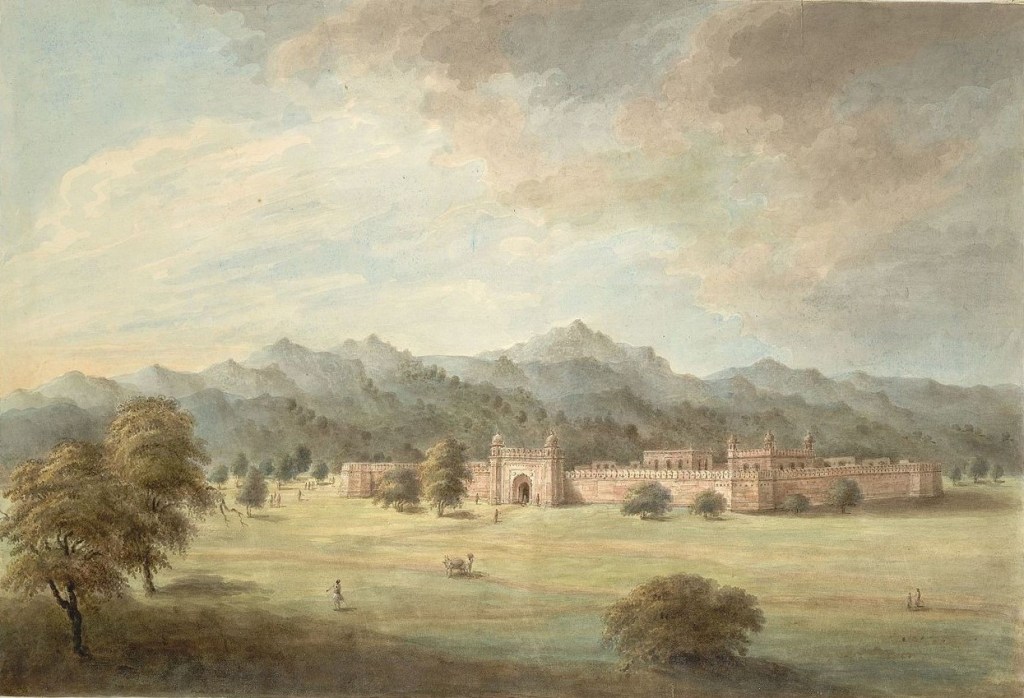
It begs the question here: who were the British actually fighting? In The Lay of the Land, we have explored some of the history of the district and events in Rohilkhand during the mutiny, and now turn our attention to Bijnor District. Brigadier Jones was now engaged in what the British were wont to call “pacification,” which would lead to some of the bitterest battles of the mutiny.
During the 1857 uprising, as district after district went up in flames, Najibabad came under the control of a local Rohilla leader, Nawab Mahmud Khan, who declared himself the governor of the district on behalf of the Mughal Emperor, Bahadur Shah, on 7 June 1857. He had been handed the keys, in just about every sense, by Magistrate Alexander Shakespear, who left Bijnor during the night of 6 June, handing over control to Khan.
Shakespear had tried to hold the district himself, but without British troops, and with an increasingly recalcitrant population, Shakespear decided his eventual death would serve no purpose, and he promptly left. Supported by his nephew, Ahmad Allah Khan (tehsildar of Najibabad), Khan was determined to take full control of Bijnor District. The Nawab did have support, but unfortunately, by announcing himself as governor under the banner of the Mughal Emperor, he alarmed the local landowner clans, the Chaudharies.
“…in the beginning of Nawab’s rule over the Bijnor District, Nawab Mahmud Khan and his nephew Ahmad Allah Khan, both, were eagerly waiting for the Hindu support, though the representative of the Hindus at Bijnor was there in the persons of Chaudhary Nain Singh and Chaudhary Jodh Singh. Both the Chaudharies were already suspicious of Nawab’s intention. To bring these Hindu representatives in Bijnor, out of suspicion, firstly, Ahmad Allah Khan went to the Chaudharies to make every assurance that the Nawab would remain unharmful to them. One more step ahead, Ahmad promised them to remain united against the British. He then got success in getting the Chaudharies’ assurance. The Chaudharies came into alliance by taking an oath on holy Ganga-water but they clearly refused to go to attend the Nawab at the Collectorate. Ahmad, then putting a seal on the Qur’an took the oath of fidelity and mutual alliance in the ensuing war against the East India Company’s rule. This worked in the right direction, and both the Chaudharies agreed to go to Nawab along with him. Again, both the Nawab and Ahmad Allah Khan putting a seal on the Qur’an, took an oath to never harm, but to support each other in the ensuing war of 1857 against the British forces.”
As it was, the Chaudharies were not buying it. The Nawab’s men (not the Nawab himself) engaged in looting several Hindu villages between Najibabad and Bijnor, and not long after, Khan himself began harassing the landlords themselves, mostly about money. So, the situation began to deteriorate. The Chaudharies started to gather up their forces to oppose the Nawab. Overtures by him to pacify the Chaudharies failed. Things were not improved when a Pathan, Munir Khan, arrived in Bijnor from Nagina, followed by 400 of his men who happened to be jihadis (religious fighters) and placed his allegiance with the Nawab. The Chaudharies did come to some kind of an agreement with the Nawab, with both sides swearing to leave each other alone, but unfortunately, the Nawab could not resist a little jihad himself as he attempted to take forceful control of the entire district, in which several Hindu villages were destroyed and their inhabitants killed. Looting and pillaging their way through the district, the Nawab finally declared a full jihad against the Hindus on 24 August 1857. What happened now was, in simple terms, a civil uprising and a localised war. The Chaudharies gave as good as they got and fought back. For a more detailed look into this, I recommend my readers to take a look at:
https://www.tajpurroyalfamily.in/bijnor-battle.php
The British were not fighting mutineers in the strictest sense of the words, but the men loyal to the Nawab, who, equal in his animosity against the Chaudharies, was only his dislike of British rule.
21 April 1858 — Nagina
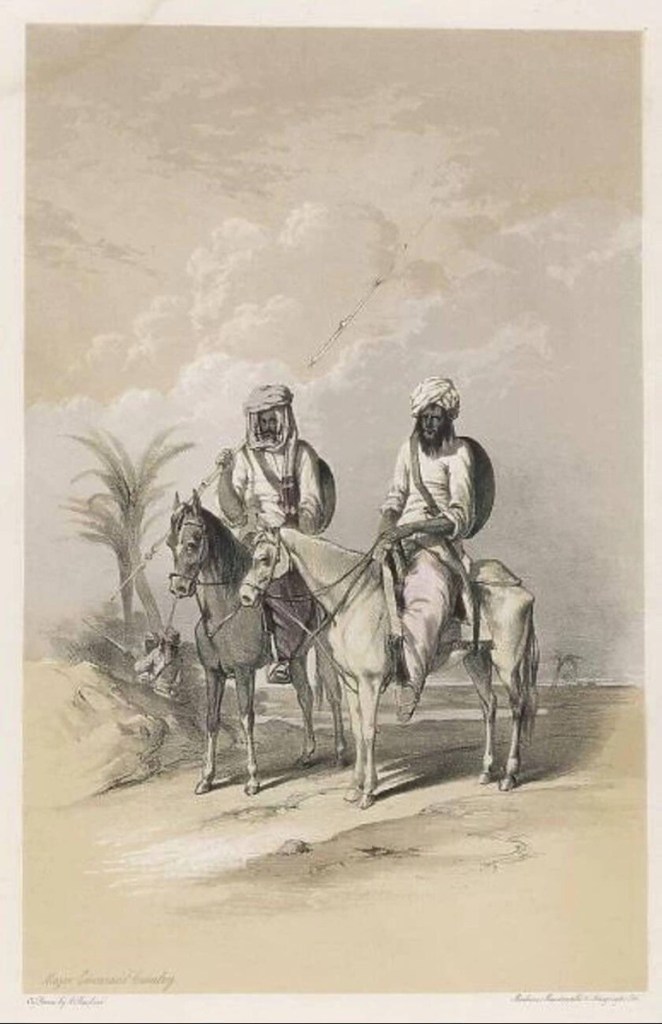
With an added reinforcement of four heavy guns and a squadron of Carabiniers, Jones marched to Naghina, where he had been informed there were no less than 10’000 infantry, 2000 cavalry, 15 guns and a very strong position. While the numbers were worrying, Nagina was worse. The front of the town was covered by a canal, liberally guarded by ten guns; to the left was a bridge protected by a further battery of five guns and to the right, thick groves of trees. However, if the rebels thought the British were having second thoughts, they were wrong, for the British marched straight towards the canal. Austin’s guns opened fire on the bridge battery, while the 60th Rifle and the 1st Punjabis, with the Multanis on their left, swiftly crossed the canal and formed up on the right, while the 1st Sikhs cleared the canal banks. By the time the banks were cleared, the force had already crossed over. The order now was to turn the rebel right and capture the guns. The 1st Punjabis were ordered by Coke to advance and take the guns in the flank, while the 60th Rifles moved to the front. However, the rebel cavalry, with their heads about them, now tried to attack Jones’ left, and the Multani Cavalry was ordered to charge.
Just as Cureton received the order, he was suddenly faced by a young Englishman, no more than eighteen years old, who asked for permission to join the charge; Cureton acquiesced and ordered his men to advance, at a trot. The young man fell in next to him. They continued on, in this menacing fashion, until within 100 yards of the rebels, when Cureton pushed his men to a gallop and then the charge. The remaining rebel cavalry put up a short resistance and then turned to flee. Although they had every advantage, inexplicably, the rebel gunners now fled. In a panic, they did not try to defend their guns, much less use them, but fled in confusion. Some of the rebels tried to retreat into the city, but Jones quickly changed “front to the right, throwing the left forward at the double”, thus cutting off their line of retreat and driving them to the left of the town. With their flank completely turned, the rebels were now chased for nearly two miles by the artillery, the 60th Rifles and the 1st Punjab Infantry. Simultaneously, Coke ordered the 1st Sikhs on the right to move down both banks of the canal to flush out any remaining rebels. The 17th Punjabis, who had been held in reserve, were now ordered to clear out the city.
The remainder would have to face the cavalry. It was, however, a hard day for the Multanis.
In the charge against the rebel cavalry, Lieutenant Williams’ horse was shot, throwing the rider to the ground, and he was forced to fight his way on foot; the young volunteer, with only a few Multanis, attacked a “knot of the rebels, and though the swords of the gallant three did good execution, the brave boy received some very severe and dangerous wounds.” However, with the guns taken, Cureton now crossed a small ravine to attack a band of rebels who had decided, after all, to stand and fight. He quickly reformed his regiment and advanced to charge when Lieutenant Gostling was shot full in the chest, a death wound. The Multanis were not in the mood for discussion; their officer’s blood demanded vengeance, and Cureton knew better than to stand in their way.
“Nothing now remained in his immediate front, Cureton, confident of victory, and with that happy instinct that made him so excellent a leader of irregular cavalry, determined to ascertain the rebels’ line of retreat. Sweeping at a rapid pace across the plain, in rear of the enemy’s position, he cut up many scattered fugitives as he went…” But he was a little too confident. “On reaching a spot about five miles in the rear of the enemy’s extreme left, he perceived the foe in full retreat, while immediately in front was a party of chiefs, mounted on six elephants, and surrounded by cavalry and infantry. ” There really was nothing for it; with the battle still rushing in the veins, the Multani Cavalry charged again and this time they not only slew the chiefs, but captured the elephants, scattering the guard. Amid the carnage, they found an Englishman, a prisoner of the rebels, who had been brought to the field to witness a British defeat, only to find himself a free man.
While one might well say it was enough work for Cureton and his Multanis, the day was not over yet for the main body of the rebels, still numbering some 800 infantry and 500 cavalry, with a few remaining guns, which were still to be dealt with. Cureton decided a ruse was in order. Drawing up into a grove of trees on the side of the road, and with the captured elephants in full view and some of his men loitering about, he hoped the rebels would believe the Multanis were friends and not foes. What should not have worked, worked like a charm. The rebels, who must at this point been very short-sighted indeed, did not pay the Multanis any heed but set their sights on the elephants; as they approached the grove, a voice suddenly rang out, “Charge!” and from the trees came the rest of the Multanis, much to the horror of the rebels, who, not interested in another prolonged fight, turned and fled. The few that did stand and fight, did so to the death; valour was still well alive in the 100 men who lost their lives to the fiendish Multani swords.
As for the Multanis:
“They may well be proud of that day; for to defeat cavalry and artillery, then infantry, then again cavalry, artillery and infantry combined, in the latter case contending against enormous odds, were exploits which even a veteran corps might boast. How much more, then, a young regiment only three months raised and engaged in its second action!”
The Multani’s casualties were few, amounting to 31 killed, wounded (among whom Emam Baksh Khan received two sword cuts) and missing, along with 58 horses; for the rebels, Nagina was a singular defeat. They lost 700 dead and wounded, and lost 15 guns. It was found they had prepared the town for defence, and barricades had been built up across the streets. Those who did manage to find shelter in the city but it was nothing short of a massacre. “Bodies of the rebels sought shelter in walled enclosures, and were there • cut to pieces: in one of these nearly two hundred! were shot; and, the town being afterwards entered by the 17th Punjaub Regiment, numbers were there killed and many taken prisoners.” Among the prisoners was the Nawab
For the young volunteer, Mr Hanna by name, he was a student of the Roorkee Civil Engineer College who had followed the adventure in his spirit and had joined Jones’ force. Rather startled to find out that he was not an officer or indeed even a trooper, Coke recommended Hanna be given an unattached commission, something which Jones agreed to. Hanna would soon find himself doing duty with the 1st Punjab Irregular Cavalry and would, by 1863, be an adjutant in Fane’s Horse. It was just as well it was a cavalry regiment, for the wound he received at Naghina would leave him with a pronounced limp for the rest of his life.
Return of Killed and Wounded which took place in the Roorkee Field Force, in action with the Enemy, on the 21st of April, 1858, at Nagina.
Detachment of 6th Carabineers—1 rank and file, 6 horses, wounded; 2 horses, killed; 1 horse, missing.
Multani Horse—1 European commissioned officer, killed; 1 European commissioned officer, 4 native commissioned officers, 3 native non¬ commissioned officers, 23 rank and file, and 38 horses, wounded; 20 horses, missing.
Cavalry attached to 1st Punjab Infantry— 1 rank and file, killed; 1 rank and file, wounded; 2 rank and file, missing; 2 horses, tilled.
1st Battalion 60th Royal Rifles—4 rank and file, wounded.
1st Regiment Sikh Infantry—3 rank and file, wounded.
1st Regiment Punjab Infantry—1 native non-commissioned officer, missing.
Total—1 European commissioned officer, killed; 1 European commissioned officer, 5 rank and file, wounded; 1 native rank and file, killed; 4 native commissioned officers, 3 non-commissioned officers, 27 rank and file, wounded; 1 non-commissioned officer, 2 rank and file, missing; 4
Names of Officers Killed or Wounded.
Lieutenant Frederick Campbell Gostling, 5th Bengal Native Cavalry, attached to Multani Regiment of Cavalry, killed. Aged 25. Son of W.F. Gostling, of Palace Gardens, London. Attended Harrow School (1847 – 1848)
Lieutenant Williams, Multani Regiment or Cavalry, contusion.
In the next post, we shall continue to follow Brigadier Jones and turn our attention, but briefly, to Major General Penny.
Sources:
Akhtar, Shamim. “SYED AHMAD KHAN AND THE REVOLT OF 1857.” Proceedings of the Indian History Congress 81 (2022): 755–61. https://www.jstor.org/stable/27388822.
Behan, T. L., ed. Bulletins and Other State Intelligence for the Year 1858. Part 3. London: Harrison & Sons, 1860.
“The Indian Cossacks.” The Cornhill Magazine 7 (January–June 1863): 52–63. HathiTrust Digital Library.
Brodkin, E. I. “The Struggle for Succession: Rebels and Loyalists in the Indian Mutiny of 1857.” Modern Asian Studies 6, no. 3 (1972): 277–90. http://www.jstor.org/stable/311935.
Forrest, George William. A History of the Indian Mutiny. Vol. 3. London: William Blackwood & Sons, 1912.
Jocelyn, Julian R. J.The History of the Royal and Indian Artillery in the Mutiny of 1857. London: John Murray, 1915.
Malleson, George Bruce. History of the Indian Mutiny. Vol. 2. London: William H. Allen & Co., 1879.
Links:
https://josselin.org.uk/wp-content/uploads/2023/02/4.-Josselin-Society-Reference-Manual-2002_82-end.pdf
https://jndmeerut.org/wp-content/uploads/2024/01/2-3.pdf
https://franpritchett.com/00urdu/asbab/bijnor/index.html
 Mutiny Reflections