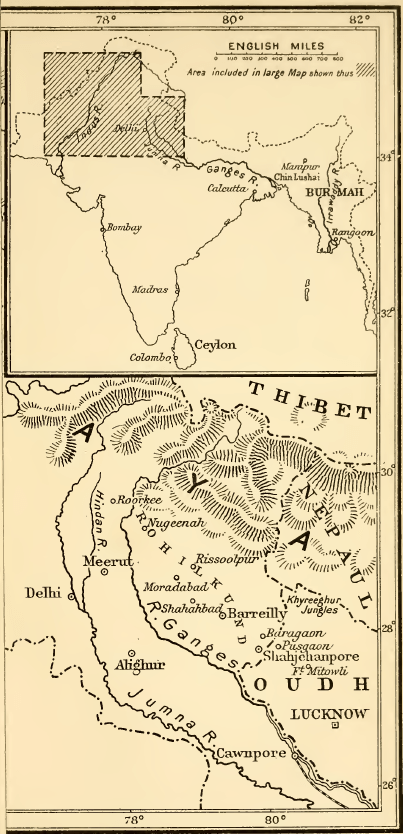
By April 1858, it was clear that to end the Rohilkhand Campaign, Sir Colin Campbell would need to take Bareilly. His army was undoubtedly powerful enough for the task at hand, and he had taken great pains to secure the line of the Ganges and Jamuna, safeguarded by Allahabad, Fatehpur, Cawnpore and Fatehgarh. Although he was still convinced that taking Oudh should have been the priority, Lord Canning strenuously disagreed and he insisted Campbell march on Bareilly as soon as he was done taking Lucknow.
So, while still in Lucknow, Sir Colin Campbell gave the following orders:
Brigadier Sir Edward Lugard was to march to the Benares District and Bihar
The defences in Lucknow were to be improved
Major-General James Hope Grant would remain at Lucknow, in command of a force not only strong enough to garrison the position but also to act as moveable columns for operations in the surrounding district
And he himself prepared to take Rohilkhand.
As we have seen, Sir Colin Campbell ordered Brigadier Robert Walpole to advance from Lucknow, sweep the left bank of the Ganges directly to the Rohilkhand frontier – Walpole did so, but with rather abysmal consequences at Ruiya.
A force was to be assembled under Major-General Nicholas Penny at Meerut and march to Rohilkhand, and another, under Brigadier J. Jones (60th Rifles) would advance from Roorkee to Rohilkhand.
At the same time, a siege train would be assembled to march from Cawnpore via Fatehgarh and Aliganj.
If all went to plan, Sir Colin Campbell, at the head of any troops that could be spared from Lucknow and Cawnpore, would join Walpole at Aliganj; then, with the siege train and Penny’s force, they would take Bareilly from the south, while Jones would attack from the north.
The Roorkee Field Force
For his plan of attack on Rohilkhand to work, Sir Colin Campbell needed reinforcements, as he could not draw too heavily from either Lucknow or Cawnpore, without inviting disaster. So these would come in the form of two field forces, one advancing from Roorkee and the other from Meerut. Both were to converge for the attack on Bareilly; however, they first had to get there.
Major General Penny was ordered to march with his force, from Meerut through Badaon to Miranpore Kutra with the following troops from Meerut:
6th Dragoon Guards (Carabiniers) – 2 squads
HM’s 64th Foot
22nd Punjab Infantry, Baluchi Battalion
Multani Horse
No. 14 Field Battery 3/3 Bengal Artillery (Captain & Brev. Major, H. Hammond)
2/4 Bengal Artillery (two 18-pounders, two 8-inch howitzers under Lieutenant H.M. Cadell)
We shall return to the fortunes and misfortunes of Brigadier Penny shortly, but now let us take a look at Brigadier John Jones, 60th Rifles.
Meanwhile, the Roorkee Column, composed of troops stationed at Roorkee and Brigadier John Jones and a detachment of troops from Manglaur under Lieutenant-Colonel J.H. Smyth (Bengal Horse Artillery:
At Roorkee
6th Dragoon Guards (Carabiniers)
60th King’s Royal Rifles
1st Punjab Rifles
17th Punjab Infantry
Multani Horse
No. 7 Field Battery 1/1 Bengal Artillery (Captain A.G. Austen)
4/4 Bengal Artillery and detachments of the 1/4 and 3/4 Bengal Artillery with the following;
two 18-pounders
two 8-inch howitzers
two 8-inch mortars
two 5 1/2-inch mortars
At Manglaur
Detachments of 6th Dragoon Guards, 1st Punjab Cavalry, 1st Sikh Infantry, 5/1 Bengal Horse Artillery (Lieutenant G.A. Renny)
 Mutiny Reflections