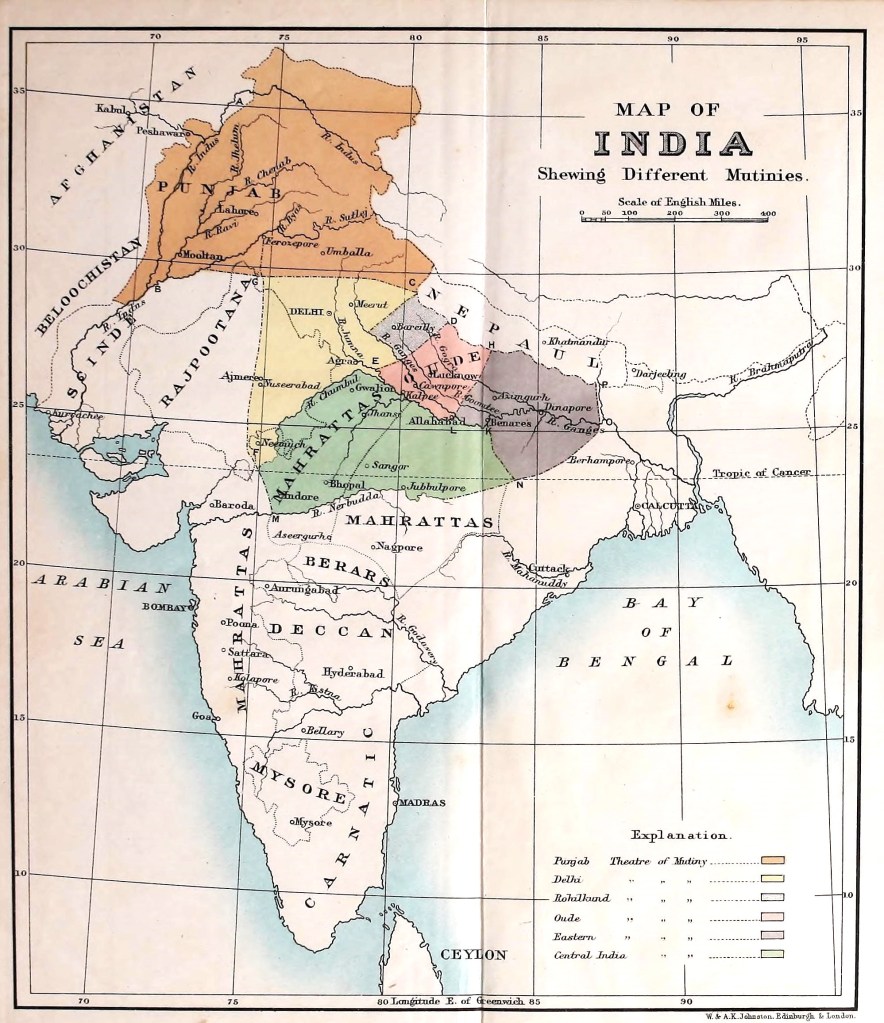
It was hoped that March 1858 would be the end of the rebellion; however, this was far from the case. While Lucknow was back in British hands, the actual fall of the city had not solved their problems. Thousands of mutineers had been allowed to flee the city – injudicious minds believed Sir Colin Campbell had let them go to secure for himself some future glory – the Oudh Talukdars were reluctant to put down their swords, faced with choosing between rebellion and ruin. Canning’s proclamation was viewed by many as intolerable, and now, for the first time, many would rise in true rebellion. They would put to use their mud forts and jungle strongholds, and their armed followers would swell the ranks of the mutineers for months to come.
Some of the leaders of the mutiny, thus far, were facing mixed results. The Nana Sahib, for all of his posturing in 1857, was making sure he did not personally come in contact with the British and was spending an inordinate amount of time galloping hither and tither to avoid them. His brother, Bala Rao, had taken to the field with a sizeable army at his beck and call; Tantya Tope, after his singular defeat at Cawnpore in December, was now rumoured to be in Central India, attempting to rally up discontent and put to the test old friendships – he would shortly meet Sir Hugh Rose. The Moulvie of Fyzabad, too, was still on the move, surrounded by hordes of fanatics, and Begum Hazrat Mahal was trying to breathe new life into her chaotic army. While all of this was a cause for concern, the entire province of Rohilkhand had until now escaped British pacification, and rebellion still reigned triumphant. While Sir Colin Campbell was busy flattening Lucknow, flames of mutiny rekindled in Bihar with the reappearance of Kunwar Singh.
Sir Colin Campbell, of course, had a plan, but he had very much lost the entire winter season with his delay in Fatehgarh; Lucknow had taken the last two weeks of decent weather, and now, he was faced with pre-monsoon India when day temperatures, which could crawl over 40°C in the shade, would wreak havoc on his men and their constitutions. However, loath to take anyone’s advice but his own and utterly convinced of his actions, Sir Colin Campbell remained at Lucknow for nearly three weeks after the fall of the city, considering his next move. Lord Canning, for his part, refused to stay out of Campbell’s business, which he believed was the pacification of Oudh. Canning’s concern, however, was with Rohilkhand, a project Campbell had planned to undertake at the start of the next cold weather, in November. Canning saw in Rohilkhand two parties – on the one hand, fanatical Mohammedans who were mostly hostile and Hindus who were mostly friendly to the British. His worry was that those fragile friendships would be too sorely tried the longer Campbell kept his army in Oudh. Canning wanted decisive action from a man the press were now openly calling Sir Crawling Camel, and Canning believed the next blow Campbell should strike must be at Bareilly.
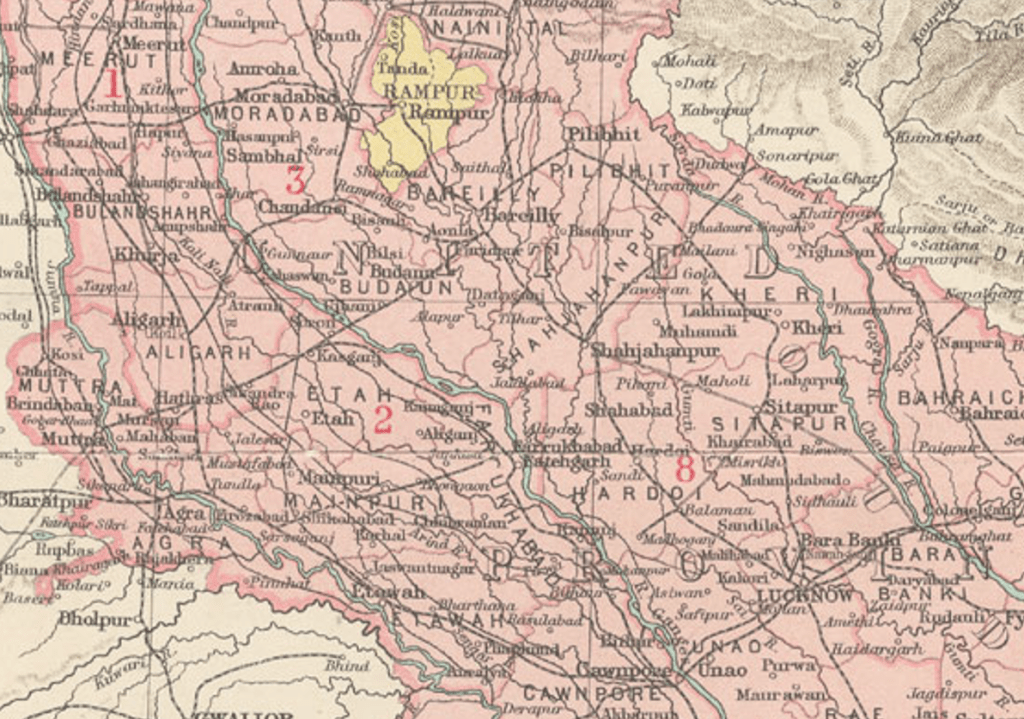
Bareilly and Rohilkhand: A Brief History
Bareilly, situated 152 miles east of Delhi in the North-Western Provinces, served not only as the district’s administrative headquarters but also for the entire Rohilkhand Division. Its history was certainly older than the legend of its founding – the Sultanate of Delhi had ruled the region until the 12th century from neighbouring Badaon, and had found, to their displeasure, the local chieftains, the Katheriyas, who ruled Bareilly’s forests, had little time for sultanates. In 1379, they decided they really had had quite enough of it and, to prove their point, murdered the local governor of Budaon. Firoz Shah Tughlaq did not have patience for their shenanigans and invaded, thrashing the Katheriyas and turning the rich forests into the favourite hunting grounds for the Delhi Sultans.
Located on the Ramganga river, the city was founded, according to legend, when a Katheriya chieftain established a village named Jagatpur in the 1500s, and shortly after, in 1537, his sons, in 1537, Bans Dev and Barel Dev, turned it from a village into a town, giving rise to Bareilly. Bareilly must have been prosperous enough for, in 1577, it was given as a gift by the Mughals to an Iranian nobleman. It would eventually become the last stronghold of the Mughals on the outer-extremities of their north-western frontier. In 1657, Raja Manik Chand, a Khatri noble and appointed by Shah Jahan as Governor of Bareilly, decided he would very much like a new city, so he found another, quaintly using the same name, Bareilly – but to do this, he ordered the forests west of the old town to be chopped down, and the Katheriyas were pushed out.
From here on, Rohilkhand was well known for being one of the most quarrelsome places in India. From 1660, the Mughals continued to rule over the land, but in 1707, on the death of Aurangzeb, the Rohillas, under their chief, Daud Khan, seized control. The Rohillas themselves were technically not native to the land but had migrated from their hilltop homes in Khyber-Pakhtunkhwa (Pakistan), bordering Afghanistan, during Mughal rule. They had set themselves up in the region (hence, Rohilkhand) and expanded their authority to include the Kumaon Hills. Their main city was not Bareilly, however, but Aonla, just some 20 miles to the south-west of it. The gradual dismantling of the Mughal Empire, however, saw now the rise of the Bareilly Hindus, who, fairly fed up with Rohillas, Muslims and just about everyone else, threw off the “imperial yoke,” refused to pay tribute or indeed fall for bribery and commenced quarrelling amongst each other as to who would rule the district. While they were thus occupied, in 1744, Ali Muhammad Khan, a Rohilla leader, defeated both the governors of Bareilly and Moradabad and declared himself the supreme leader of Rohilkhand. He was not satisfied with the plains and marched right up the Kumaon Hills – but Emperor Muhammad Shah decided this was really a little too much, so two years later, he marched against him, and Ali Muhammad Khan ended up in a prison in Delhi. However, his removal only made things worse in the district, so he was reinstated in 1750, just in time to die a year later. Then, as it goes, there was a problem with succession. Hafiz Rahmat Khan, the guardian of the dead leader’s sons, decided he liked the idea of ruling, so he seized the throne. Muhammad Shah sent the Nawab of Farrukhabad against him, but Hafiz not only defeated and killed the Nawab, but he also marched northwards and took Pilibhit and Terai. Of course, the Nawab of Oudh (and a Vizier of the Delhi court), Safdar Jung, could not keep his fingers out of the pie, and he promptly plundered the property of the deceased Farrukhabad Nawab, leading the Rohillas to unite with those in Farrukhabad. Hafiz wasn’t quite finished – he defeated the Oudh Nawab, besieged Allahabad and then took a sizeable part of Oudh as a trophy.
And we have to remember, the British had nothing to do with this, as yet.
To continue.

The Nawab, however, had friends, and he now called on them for a helping hand. The Marathas heard his pleas and defeated the Rohillas at Bisauli, near Aonla. Then, for four months, the Rohillas were besieged in the foothills by the Nawab, but his attention was suddenly called away by the invasion of Ahmad Shah Durani, who turned about and made Hafiz the governor of Pilibhit. This did not solve the problem, for Hafiz was not at all a follower of the new (third) Nawab of Oudh and Vizier of Delhi, Shuja-ud-Daula, and he promptly attacked him. Shuja decided it made more sense to pay a subsidy to Hafiz, who now made inroads into the Doab himself and made himself master of Etawah. Meanwhile, Shuja was having problems with the rise of British power and began strengthening his own strongholds and fortifying his towns.

In 1770, things took another turn when Najib ad-Dawlah, an Afghan Yousafzai Rohilla (who was once a favourite of the Mughals before he deserted them to join in the plunder of Delhi and fight the Battle of Panipat), joined forces with Holkar and Scindia and the Maratha Army to defeat Hafiz once and for all, forcing the Rohillas to beg the Wazir of Oudh for help. Shuja became a surety for a bond of 40 lakhs to induce the Marathas to leave Rohilkhand – the Rohillas could not pay the bond, and Shuja, after ridding himself of the Marathas, attacked Rohilkhand with the help of an English force lent to him by Warren Hastings. The Rohillas admitted defeat; Hafiz was killed, but his son escaped to the north-west to take up the reins as the leader of the Rohillas. He finally managed to forge a treaty with Oudh through which he gave up most of Rohilkhand. Of course, this uncertain peace would not last, for the Oudh Nawab, heavily in debt to the British, who were not known to do things for free, agreed to accept Rohilkhand in lieu of hard cash in 1801 as payment.
The first President of the Board of Commissioners with his seat at Bareilly was Mr Henry Wellesley, brother of the Governor-General. Until the mutiny, the British would face a slew of disturbances by errant adventurers and recalcitrant Rohillas, but managed to somehow keep their hold over Rohilkhand. The last fight they had was in 1842, and until 1857, the district was relatively peaceful.
In 1857, after the sepoys mutinied and the British were kicked out of Bareilly, it would be Khan Bahadur Khan, a grandson of Hafiz Rahmat, who would declare himself Nawab Nazim of Rohilkhand.
He quickly organised a new government and paraded the streets of Bareilly mounted on a splendid elephant, with bands playing, banners flying and cheering followers. While all the pomp served to solidify the image of a nawab in front of the people, Khan Bahadur Khan was not a fool. He established a working administration and collected revenue in the name of the Emperor of Delhi. Reverting to the older laws of his ancestors, he thought he would bring peace to Rohilkhand. Unfortunately, he was wrong. Disorder and violence continued, and the problem was not the Rohillas but the Bengal sepoys. They had little interest in Khan Bahadur Khan as a leader and were keen to establish their own candidate in his place, one Mobarik Shah, who was supported by General Bakht Khan, who, in turn, was greatly admired by the sepoys as the man who had ousted the British from Bareilly. Khan Bahadur Khan realised early on that if the sepoys remained, he would eventually have to fight the general; instead, he opened up negotiations with Bakht Khan and persuaded him that he really had nothing to lose in Bareilly. If he wanted to fight, then he should go to Delhi and continue his quarrel with the British. Khan agreed, and the Bareilly Brigade marched to their doom while Khan Bahadur Khan took control of Rohilkhand. If that was not enough, he also wanted to retake Kumaon.
There are two very conflicting ideas regarding the government of Khan Bahadur Khan. Malleson asserts most vocally that it was “the sway of disorder” with murder and mayhem the order of the day. He further states Khan’s politics were abysmal at best.
“Nor was the political condition of the province more flourishing. Over the Thakurs, or barons, the authority of Khan Bahadur Khan was for a long time disputed. These Hindus were just as greedy of plunder as had been the sepoys, and they rejoiced for the moment at the sudden acquisition of power to
attack villages and towns. But from some cause or other, they and their followers were very badly armed—their weapons consisting mainly of bludgeons and matchlocks, antique in form, and rusty -from long disuse. Their power, then, was not equal to their will. Badaon, thrice threatened, successfully resisted them. They had no guns. They were, therefore, unable to combat the trained troops of the native viceroy. Whenever these trained levies marched against them and beat them, they, their relatives, and their followers experienced no mercy. Mutilation and murder followed defeat, and confiscation followed mutilation and murder. Sometimes stories of these atrocities induced several Thakurs to combine, but never successfully. Badly armed and untrained, the peasantry whom they led, even when they obtained a transient success, dispersed for plunder. In the end, they were always beaten.”
Kaye, however, is rather more objective. After the sepoys left the district, Khan Bahadur Khan did in fact establish a government – it was imperfect, but it worked. District officers were appointed, each one with their legion of assistants and subordinates to take up the work of collecting revenue and dispensing justice, but like the British, they could not reconcile the different religious factions in Rohilkhand, for everyone, it seems, had a grudge against everyone else. Khan Bahadur Khan decided, in a series of proclamations, to unite the people of Rohilkhand against one common enemy – the infidel Christian British. He promised the Hindus that if they joined in the fight, then the slaughter of cattle would be banned in Rohilkhand forever; however, if they decided this was not enough incitement, then any Hindu caught aiding and abetting the British would face heavy fines and imprisonment. The Muslims of Rohilkhand needed little encouragement to join his banner – they were far from being the dominant population in Rohilkhand, but having a decided boorishness about them and armed to the teeth, had little trouble in pressing the Hindus, who were mostly unarmed peasants, into any variety of agreements without fear of reprisal. In this respect, the old Indian proverb, “The bullock is owned by he who wields the bludgeon,” was very much a fact. Khan Bahadur Khan, however, did consider the British might not be above issuing promises and bestowing favours of their own, and he strongly urged the Hindus to desist from having truck with the British – they were well known to be liars, “deceitful impostors” who never kept their promises. This was not dissimilar to what the British had promised whole swathes of Indians – Mohammedan rule was rotten to the core; they would be far better off under the British. Khan Bahadur Khan reminded them that the British had done away with sati, allowed the remarriage of widows and had deprived many a raja of his estates by not recognising adoption – all the British wanted, ultimately, was to put an end to all religion except their own and butcher everyone in sight. For the benefit of the Mohammedans, Khan Bahadur Khan simply declared a jihad against the British. Yet somehow, the government ticked along, month after month, and while it could hardly be said Rohilkhand was peaceful, at least it was not all-out war.
As such, the British were hoping that the people of Rohilkhand, especially the Hindus, would turn to their favour; if they could play off the various factions against each other, if they could win the support of those leaders who were out of favour with Khan Bahadur Khan, then perhaps taking Bareilly and pacifying Rohilkhand would not be as complicated – this, however, was not Sir Colin Campbell’s problem. He had to march an army through the heat of an Indian summer to fight a war he had not planned for. The pacification of Oudh, in his estimation, would have been easier, and Rohilkhand could have waited until the winter. Lord Canning would, however, have his way, and Sir Colin was forced to redraw his plans and make himself ready to take Bareilly. Politics was not his strength, but he knew a thing or two about war.

The Army of Oudh is broken up
Sir Colin Campbell could not take the entire Army of Oudh with him to Bareilly as there were still other places of interest that required attention – as he could not personally attend to everything, all at once, he entrusted the clearing of Bihar to Brigadier Lugard; he ordered Lucknow to be put into order and stay on the defensive with Major-General Sir James Hope Grant in military charge, to not only garrison Lucknow but organise moveable columns for district operations. Sir Colin Campbell planned the advance on Rohilkhand in the following stages.

Brigadier Robert Walpole was to advance from Lucknow and “sweep the left bank of the Ganges up to the frontier of Rohilkhand.”
Major General N. Penny was to move his force from Meerut and form a juncture with Walpole.
The newly formed Roorkee Brigade under Brigadier J. Jones was to march from Roorkee into Rohilkhand.
At the same time, a siege train was to march from Cawnpore to Fatehgarh and take up a position at Aliganj.
All the troops that could be spared from not only Cawnpore but Lucknow were ordered to join Walpole near Aliganj and then march under his command into Rohilkhand from the south with Penny’s force and the siege train, while Jones would attack from the north.
There would also be changes in the Lucknow administration. Sir James Outram, understandably, no longer felt he could continue effectively in a civilian position as Chief Commissioner and requested to return to Calcutta. On April 3, 1858, Robert Montgomery arrived to take his place. Outram left the next day.
Having staid the crisis in the Punjab, Montgomery was more than equal to what lay ahead of him in Oudh. However, William Russell, that astute correspondent, was all in his favour.
“He is a man of particular smoothness of manner and appearance — a large vigorous head, a clear, good eye, and great firmness of mouth and lip. He is understood to have obtained permission from Lord Canning to modify the menaces of the Proclamation and to offer considerable concessions to the rebels in Oude. Indeed, it is felt by all who know anything of the country and of the circumstances of the case, that the zamindars of Oude require more consideration than the chiefs in other parts of India who have revolted against us. Mr Montgomery has a grand task before him, but he is believed to be suited to the work, and the glory of accomplishing it will be great as the labour.” (Russell)

Montgomery was no stranger to India nor to Indian politics, or the machinations of the company he served. Born in 1809 into an Ulster-Scots family, his early ambitions appear to have been military as he completed his education at Addiscombe Military Seminary in 1825; however, when he sailed for India in 1828, Montgomery was already destined for the Bengal Civil Service, working his way up from writer to magistrate collector at desultory posts all around the North-Western Provinces, including Azamgarh, Cawnpore and Mirzapore, until finally ending up in Allahabad, where he remained for two years. In 1839, he transferred to the Punjab. Here he remained – in 1851, Montgomery succeeded Mr C.G. Mansel as Member of the Punjab Board of Administration; in 1851, he was nominated Judicial Commissioner, the role he still maintained in 1857. It was due to Montgomery’s quick thinking and Lawrence’s definite action that prevented an all-out uprising in the Punjab; Montgomery was instrumental in not only the disarming of several of the Bengal regiments but for the warnings he sent to Kangra, Multan and Ferozepore, actions which secured him a knighthood.
On 8 April, Sir Colin Campbell made a flying visit to meet with Lord Canning, who had judiciously disentangled himself from his Calcutta advisors and set himself up in Allahabad, where he was closer to the scene of war and could view the situation with more clarity. For Campbell, it was a last-ditch effort to persuade Canning that Rohilkhand could wait. His efforts failed, and a general order issued just at Lucknow on 10 April directed the forces who would remain with his brigade to march to Cawnpore without delay. The same day, Hope Grant left Lucknow with his column, which was bound for Bitowli, one of his first expeditions into Oudh and mixed success. Robert Walpole, too, had set off from Lucknow towards his subsequent misfortune. Of Brigadier Lugard, we shall see later. Victory now would be mixed with disasters, and the Rohilkhand Campaign opened for Sir Colin Campbell, under very mixed stars.
Sources:
Campbell, Sir George – Memoirs of my Indian Career, Vol. I, edited by Sir Charles E. Bernard (London:Macmillan & Co., 1893)
Forrest, G. W. – A History of the Indian Mutiny, Vol. III (Edinburgh & London: William Blackwood & Co., 1912)
Hunter, W. W. – The Imperial Gazetteer of India, Vol I, Abar to Benares (London: Trübner & Co., 1881)
Jocelyn, Col. Julian R. J. – The History of the Royal and Indian Artillery in the Mutiny of 1857 (London: John Murray, 1915)
Kaye, John William – A History of the Sepoy War in India, Vol. III (London: Longmans, Green & Co., 1896)
Malleson, Col. G. B. – History of the Indian Mutiny, Vol. I (London: William H. Allen & Co., 1878)
Malleson, Col. G.B. – History of the Indian Mutiny, Vol. II (London: William H. Allen & Co., 1879)
Russell, William Howard – My Diary in India, Vol. I (London: Routledge, Warne & Routledge, 1860)
Links:
https://www.peepultree.world/livehistoryindia/story/places/bareilly-taming-a-provincial-capital