The Advance of Brigadier John Jones, 60th Rifles
Sir Colin Campbell had intended, initially, that the force marching from Roorkee would cross Rohilkhand and onto Bareilly would be a brigade force, and he appointed Colonel John Coke, of the 1st Punjab Infantry, to lead it. He was an obvious choice; Campbell would be hard-pressed to find a better-known or more distinguished officer than Coke. Not only was Coke a veteran of India, with an unsurpassed command of native languages, he had also seen extensive service — under Sir Charles Napier in Upper Sind, with Gough at Chillianwala and Gujerat, and with Gilbert when he was pursuing the Sikhs. Following the conclusion of the 2nd Sikh War, Coke turned his attention to the Northwest Frontier and, until the outbreak of the mutiny, was scarcely out of the saddle. “There, his name became a household word. Scarcely an expedition was undertaken against the wild border tribes, but Coke bore a part in it. Twice was he wounded; but his unflinching demeanour, his power of leadership, whilst it gained the supreme confidence of his men, extorted respect and admiration from his enemies. Wherever he might be, his presence was a power.” It was then no surprise that in August 1857, Coke was before the walls of Delhi, where he fought with distinction in the retaking of the city. He was now asked to take command of a troop of the 9th Lancers, Cureton’s Multani Cavalry, a wing of the 60th Rifles, the 1st Punjab Infantry, the 1st Sikhs, a detachment of the 17th Punjab Infantry, Austin’s Light Field Battery and two 18-pounders. He arrived in Roorkee on 22 February, but it would take two months, with the able assistance of Baird Smith of the engineers, before Coke was able to complete the barest of commissariat arrangements. There was nothing procurable, far and wide; the land had been destroyed, as if by locusts, so thorough had been the ravages of war that not even carriage was available.
“In this dilemma, Coke’s practical knowledge and fertility of resource came into play. He had read how, in His practical the olden clays of Indian warfare, the Brinjaris—dealers who carry their grain on pack cattle—had made themselves eminently serviceable. Calling to mind, then, that at the actual season these men were accustomed to pasture their cattle in the Terai, he sent thither, found them, and made such arrangements with their head men as enabled him to conquer a difficulty which many another man would have found insurmountable.”
With carriage arranged, provisions prepared and the force read to march, like a thunderbolt, Coke was superseded, for reasons known to Campbell but not to Coke, he had suddenly decided to make the command of a field force a divisional command. He ordered the other wing of the 60th Rifles to join up, and with that wing came Colonel John Jones, who, with the rank of Brigadier-General, was that step higher than Coke. Coke was relegated to act as brigadier and second-in-command under Jones. While this might have caused great consternation among other men, it was a “change in name only.” No one doubted Jones was a brave and valiant man, but he was “unwieldy in body” and “incapable of great activity.” He was, fortunately, blessed with enough common sense to know that if work needed to be done, it would be done by Coke. For his part, Coke was neither jealous nor resentful, and Jones, who would reap the credit for the subsequent campaign, never interfered with Coke’s arrangements.
On 13 April 1858, Jones arrived in Roorkee and took command of the Field Force. That very evening, he dispatched a party of artillery, 2 companies of the 60th and one wing of the 17th Punjab Infantry, under Major Churchill of the 60th Rifles, to Kunkhul to protect a bridge the engineers were still in the process of constructing over the Ganges. The next morning, the headquarters of the 60th Rifles arrived by forced marches and by the 15th, the entire column was encamped by the bridge of boats. Jones ordered the heavy guns and stores to be sent to the ford opposite the village of Nagul, and Major Smyth was instructed to “make a show of it” to divert the rebels’ attention by pretending to cross over. Jones himself and the remaining force crossed on the 17th and moved into a nearby forest in the following order (from dispatches):
Advance Guard.
One company 60th Rifles, in skirmishing order.
One company 60th Rifles, in support of two guns.
Sappers and Miners and a troop of Cavalry.
Main Body.
One troop Cavalry, Captain Austin’s Battery.
60th Rifles, Punjaub Infantry Brigade.
Ammunition and treasure, the Mooltanee Regiment of Cavalry.
Rear Guard
One Company Punjab Infantry, a troop of cavalry
On each flank of the main body was a patrol of a company of Native Infantry, and a half troop of Cavalry.
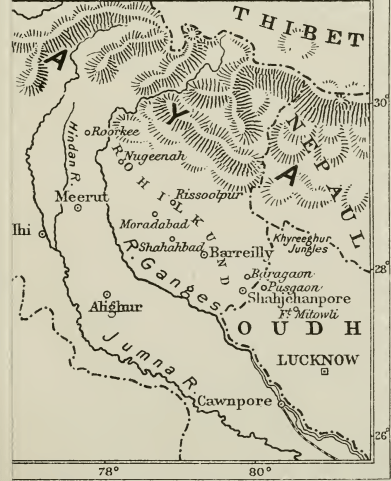
The Action at Bhogniwala — April 17th
Coke now pushed on rapidly with the advance, but had barely moved four miles when he and the advanced guard came upon the rebels. Surrounded by thick jungle, it was impossible to say how strong the force was, but it was, as they would soon find out, considerable. Coke reported the rebels had six guns; the main body was in the jungle itself, close to Bhogniwala, and their front was covered by a canal. Without waiting for an invitation, and having seen the British, the rebel artillery opened fire. In reply, Austin brought up his field battery, while the infantry, in skirmishing order, advanced. When they came up to the canal, which was nearly dry, they finally had a good look at the rebels. It was only for a moment, for now up galloped Lieutenant Gosling, commanding a troop of Multani Horse. He let his men loose, and the rebels fell back. Coke quickly brought up the main body of Multani Horse under Cureton and, with Austin’s battery, advanced rapidly, charging the rebels wherever they attempted to form up.
“The din of battle becomes louder and louder, and soon in the distance one or two wounded rebels break from the jungle, dragging themselves painfully along in the direction of the village. In a few minutes a score of fugitives follow, and shortly after a large body of the enemy’s artillery, cavalry and infantry, numbering some 1600 men, in order retreat, appear in the open space about half a mile from the British cavalry. On catching sight of the foe, the officers take post in front of the line, while the haughty Pathans they lead, with eyes flashing from excitement, raise their hangs towards heaven…the next instant the quiet-looking English officer, their leader, gives word to draw swords and charge. Onwards, like a torrent, rush the gallant band, officers, native and English, in front; while the six kettle-drummers beat their drums with energy. As the line approaches the enemy, some three or four Mooltanees, anxious to gain the approbation of their officers, rush to the front and plunge into the hostile ranks. A second after, their comrades are with them. The enemy, meanwhile, finding flight impossible, stand at bay, fire a scattered volley, draw their swords, and with sullen desperation, await the onset. For a few moments, nothing is to be made out but the surging, shifting crowd of mingled horsemen and infantry engaged in mortal combat…Swords, bayonets, and lance-heads gleam in the sun, groans and curses rise up to heave,, while here and there a figure sinking amidst the waves of this human sea, shows that some brave Mooltanee, some base rebel, has fought his last fight.”
The infantry, formed up in line, covered his flanks with skirmishers and commenced their advance; the rebels had left their attack too late; if it was a surprise they were intending, Coke was quicker to the mark. The relentless firing of his artillery, the advance of the infantry and a well-executed charge of the Multani Horse, Lieutenant Gostling ever in the fore, took the rebels in their left flank, forcing them to withdraw their guns and retreat. “He (the rebels) was charged by Captain Cureton, wherever he attempted to stand, and the guns, unlimbering as they came up, opened with shrapnel. The enemy, thus pushed over positions of great natural strength, and unable to show front even on the bank of stream where he had erected stockades, and behind which his camp was pitched, fell more and more into confusion.” The retreat turned into a rout, and abandoning their guns, the rebels dashed pell-mell through the jungle, some throwing down their arms as they ran, others “throwing off even their clothes to facilitate their escape.” They left behind four guns on the road, all their ammunition and camp equipment.
The Multanis drove the point home, chasing the rebels for several miles, with Gosling killing eight with his revolver. When the day was done, the British had lost one man killed and sixteen wounded, but the rebels left behind 200 dead. As late as 1863, local villagers claimed the ghosts of the mutineers haunted the scene, and their groans could still be heard.
Jones pitched his camp five miles from Nagul, and while the night would be peaceful, the morning brought new surprises. Captain Cureton was certain the rebels they had defeated the day before where most likely not as far away as thought and suspected they were hiding in the jungles just north of Najibabad. As such, he sent Jemadar Emam Baksh Khan with forty troopers to reconnoitre. While proceeding in the appointed direction, Khan was apprised by some villagers that some miles off was a small fort, complete with a rebel Nawab and five hundred followers. The Jemadar, without hesitation, marched to the fort and surrounded it. He then called on the garrison to surrender and send out their Nawab. His language must have had some persuasion, for he let the garrison know, with clear terms, if they did not do as ordered, he would put them to the sword and spare no one. Something in Khan’s bearing was convincing enough for the Nawab, for he came out and gave himself up. Khan disarmed him and took possession of the fort. He placed a guard over the gate and, before turning the garrison out, he took their arms and accoutrements. He then sent information back to the camp of his doings, and much to Jones’s satisfaction. Jemadar Emam Baksh Khan was awarded the Order of Merit.
The same day, Jones pushed on towards Najibabad and found the town abandoned; he then moved onto a nearby fort of Patthargarh, which likewise was empty, added eight guns to his arsenal and a welcome quantity of grain. However, things were about to change.
 Mutiny Reflections