Following the Battle of Nagina on 22 April, Brigadier Jones moved his column to Dhampur; the next day, they struck the high road — that ran between Muzaffarnagar and Moradabad — at Noorpur, with the intention of approaching the Ganges. The objective was to cut off any fleeing rebels who might attempt to cross Jones’ right flank and thus escape into the Bijnor District.
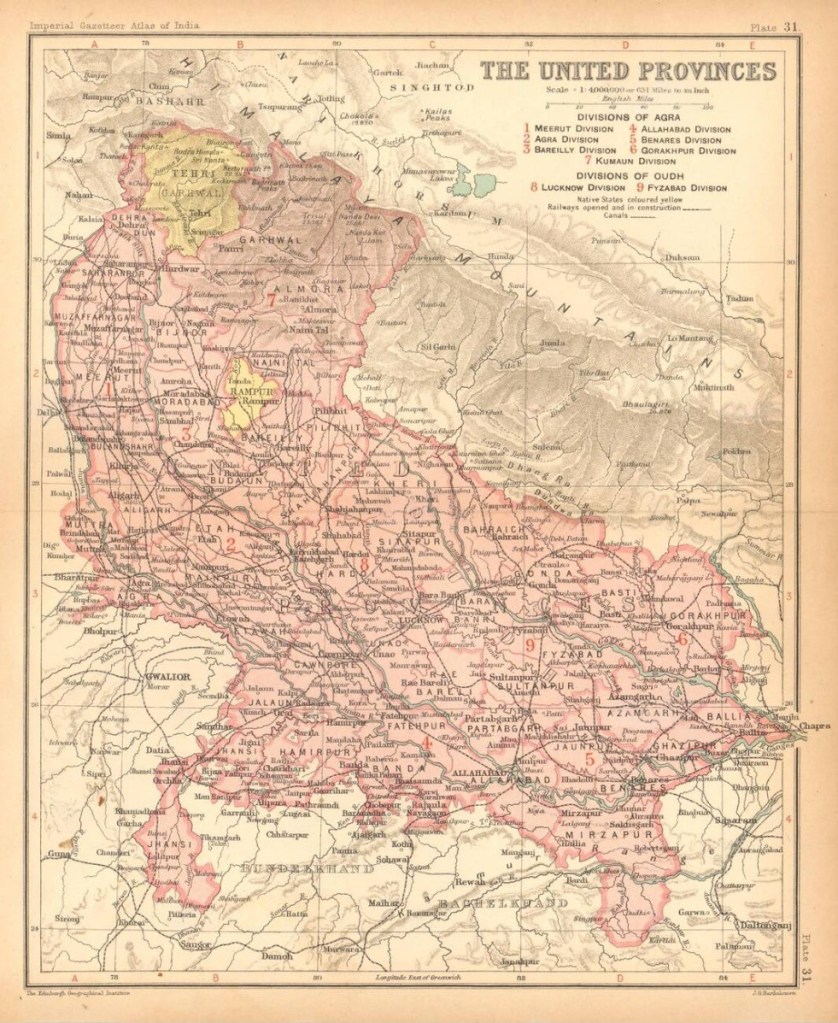
Moradabad and the Raja of Rampur
Unlike other princely states in Rohilkhand, the Rampur Nawab, Yusef Ali Khan, was determined, from the start, to maintain a stance of calculated loyalty towards the British, and we have met him before — in the Hills of Kumaon, where, without his support, Naini Tal and indeed, the British would have lost. His support of the British was less of a military nature but more of a logistical one – he provided essential supplies to keep British troops in the field, gave them intelligence regarding troop movements, and kept up a who’s who of Rohilkhand – who was supporting the rebels and who was not. At the same time, he had to be careful not to enrage his own people by his actions, or, for that matter, upset his neighbours. He would have to maintain a delicate balancing act, quelling local disturbances that cropped up in Rampur from time to time with swiftness and keep his own troops from cutting his throat. The Nawab’s main concern was to prevent fighting, which was rampant in Rohilkhand, from spilling over into his territory, and he succeeded in preventing Rampur from suffering the devastation of war waged either by the Rohillas or the British. His support for the British was not open, like that of the Jhind Rajas, but calculated to protect his state from disaster.
At Moradabad, in the confusion following the departure of the British, Nawab Majju Khan, a nobleman of Mughal descent, had proclaimed himself governor. Not everyone agreed with his sudden ascent; one Asad Ali Khan attempted to dispute it, and on 4 June, the Rampur Nawab sent his uncle, Abdul Ali Khan, to take control of Moradabad. Realising there was local support for Majju Khan and not wanting to risk a local uprising, Abdul Ali Khan nominated Majju Khan as nazim and gave minor posts to others in his fledgling cabinet. However, it would take the arrival of Bakht Khan and the Bareilly Brigade to throw a spanner in the works. Knowing full well that the Nawab of Rampur was sympathetic to the British, Bakht Khan set his sights on Rampur. Eager to protect his city, the Nawab recalled his troops from Moradabad. With the Nawab occupied and his uncle weakened, Majju Khan again declared himself governor. This changed again when Bakht Khan, on 14 June, showed up in Moradabad.
He swiftly accused Majju Khan of having protected Christians during the mutiny at the station, and impeached him. Eager to prove Bakht Khan was wrong, Majju ordered a search of the city for the remaining fugitives, and several Anglo-Indian clerks were found and put to death, and their families were imprisoned. Bakht Khan left Moradabad three days later, taking with him some of the 29th BNI, and Majju Khan again proclaimed himself ruler. However, Asad Ali Khan now rushed in, waving a Sanad or decree from Bakht Khan, stating he was to be governor. It would take an attack by marauders from Bijnor for them to put their differences aside, but it left Majju Khan, with popular support, the leader at Moradabad. Now his problems began in earnest.
It is difficult to be a ruler without money, and while he had the support of the people, Khan’s coffers were hardly brimming over. He attempted to coerce the bankers of Moradabad to part with theirs, which only led to armed conflicts between Hindus and Muslims, the former backed by the Rajputs of Katghar. Then on 23 June, the Nawab of Rampur decided to send Abdul Ali Khan back to Moradabad, this time with 2000 men and four guns. Majju Khan was once again deposed; however, he accepted to be nazim of a place called Sambal and left to plan for another day.
The Nawab of Rampur now tried to put things right in Moradabad. His men released the families of the dead clerks from captivity and sent them with some haste to Rampur, from whence they were packed off to Meerut. His idea was to style Moradabad on Rampur rule and accept the city under his protection, which, with his calculated loyalty towards the British, he wanted to save from further strife and suffering. However, it would take a scuffle in a bazaar over the price of a pumpkin between a local vendor and a Rampur soldier to put all of that to an end. A slap across the face and an accusation of cheating rapidly spun out of control, leading to a full-scale riot and 40 of the Rampur Nawab’s soldiers dead. Only when Dhaukal Singh of Katghar sent assistance of the armed kind to Moradabad, did the riot end. It was not a good start for the Nawab of Rampur, and it did not improve.
“His rule, however, was little recognised, for in the district all was chaos. In the Thakurdwara tahsil, the Pathans and Julahas had risen in revolt and expelled the tahsildar, though the munsif, one Azraat-ullah, held Thakurdwara itself and saved both the records and the treasury. The Bilari tahsil had been plundered by a party of mutineers on the 15th of June, and the villagers had looted both Chandausi and Sambhal. The Nawab had sent troops to restore order, but these emissaries had merely enriched themselves by levying money from the principal Hindu residents.”
However, Majju Khan was not sitting quietly, and he returned to the city, throwing off the title of nazim and once again styling himself governor. He framed the war against the British as a jihad, something that certainly appealed to his followers. While the Nawab’s uncle remained in control and kept the wheels of government turning, on behalf of the British, his rule was technically a paper one, and it was Majju Khan, with all of his posturing, who took over as the leader on the streets. Technically, Moradabad had two governments – the rule of the Nawab of Rampur, whom everyone in Moradabad agreed they did not like but could not depose, and Majju Khan, who, although he was popular with the common man, was not particularly good for the economy of Moradabad. While he controlled the judiciary and had his own army, Majju Khan quite brazenly demanded taxes from local landlords; those who could not pay had their lands seized, and as Khan’s demands became more and more outrageous, the remainder were faced with poverty. On the streets of Moradabad, where Khan held sway, he issued proclamations against the Nawab and ran his parallel government from the mosques. While the Rampur Nawab was keeping supply and communication lines to places like Naini Tal open, Majju Khan was arming and supplying the mutineers crossing the roads between Bareilly and Delhi. Clashes between the various factions were not uncommon, and by April 1858, the people of Moradabad had had enough.
We have already met Firoz Shah Shahzada in Malwa and through to the Battle of Mandsaur. Beaten but not utterly defeated, he managed to regroup at Rahatgarh, only to be tossed out by Sir Hugh Rose in January 1858. With Central India out of his grasp, the Shahzada made his way to Rohilkhand and joined hands with Khan Bahadur Khan at Bareilly. With a force supplied to him by Khan, Firoz Shah seized Sambal and, on 21 April, entered Moradabad. He managed to overpower the Rampur troops, albeit briefly, but his objective was not the city itself; it was plunder. This time, two bankers, Rai Parduman Kishan and Qasim Ali Khan, rallied their personal levies and, with the people of Moradabad, stoutly refused to acquiesce to Shah’s demands. Shah first demanded, then he negotiated and finally, with brute force as his last option, he was thwarted not just by the stubborn people of Moradabad but by the news that Brigadier Jones was closer than he had imagined. Seizing the opportunity, the brother of the Rampur Nawab marched up a body of troops from Rampur and took the fight to the Shahzada. He was summarily booted out of Moradabad, leaving him with no choice but to race off to Bareilly with his troops, a gun he had stolen and some plunder, narrowly escaping capture by Jones.
Jones Arrives Before Moradabad
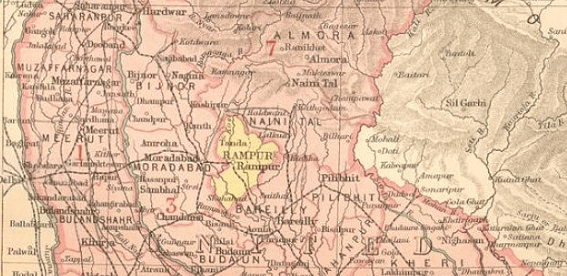
Jones and the Roorkee Column arrived outside Moradabad on 26 April. There would be no fighting here – the city was still in the hands of the Rampur Nawab, and the Shahzada was gone. Jones was informed by Mr John Forbes Inglis of the Civil Service (who was in charge of the civil department for the field force) that several rebels were hiding in the city. The deputy collector of Moradabad, Wilayat Khan, confirmed Inglis’ information, and Jones promptly ordered Colonel John Coke to take the matter over. Together with Inglis and Khan, Coke first made an inspection of the city to settle his plan, which, though dangerous, was not a complicated one. With Jones’ approval, he gathered together a sufficient force to carry out the objective. With parties of the Multani Cavalry surrounding the city to prevent any rebel from escaping, at noon, Coke proceeded with two of Captain Austin’s guns, a party of Sappers and the 1st Punjab Cavalry to search for Nawab Majju Khan, using information provided by the deputy collector. It did not take them long to find him.
“The capture of the Nawab was effected by Lieutenant Angelo, doing duty with the 1st Punjaub Infantry, who deserves great credit for his spirited conduct on this occasion. This officer, having burst open the door of the room in which the Nawab and his sons were concealed, and having captured them, was fired on by the guard of the Nawab, who were in a room on an upper story, commanding the house in which the Nawab was concealed. Lieutenant Angelo rushed up the narrow stairs leading to this room, burst open the door, and, single-handed, entered the room, shot three men with his revolver, and, on being joined by some of his men, captured the rest of the guard.”
In all, Coke captured 21 rebels.
List of Rebels Captured in the City of Moradabad on the 26th April 1858.
Mujjo Khan
Shaik Eneautoollah Yakeel
Abid Ali Khan, i Sayud Ali Khan
Niaz Ali Khan
Jhubbur Ali Khan
Abdul Kurreem Khan
Ala Ali Khan
Shaik Goolam Hussein
Nusuroodeen
Mirza Yakoob Beg
Mirza Jahangeen Beg
Hoosain Bux
Kurreemoolah
Elahie Bux
Jafur Hoosein
Rugwedeen Shah
Muddut Khan
Shuffaoodeen
Ahmud Hussein
Looman
Killed in the City During the Capture.
Nugeemoodeem, son of Mujjoo.
Noobarik Allie Khan, grandson of Mujjoo.
Emaum Shah and Moona } Servants of Mujjoo
Coke then sanctioned his troops to engage in plundering, taking for themselves a quantity of property belonging to the captured men and some horses; an elephant belonging to the Rampur Nawab was given over to the Commissariat.
It is a matter of much conjecture what happened to Nawab Majju Khan’s remains after he was hanged. (Imperial Gazetteer, Vol. XVII, 1908 p 423). The official despatches of Jones and Coke make no mention of Khan’s fate; Malleson says nothing, nor do Forrest or Holmes; Cracroft Wilson mentions the hangings as a stern and brutal warning, but without embellishments. Hanging was, unfortunately, a common practice during the Indian Mutiny; mutilating dead bodies and inventing creative ways to execute people were not. So we shall not engage in conjecture or folklore or discuss stories of Khan’s dead body being paraded through the streets of Moradabad, dragged by an elephant and then hanged from a tamarind tree. Nor shall we discuss the tale of Khan being thrown alive into a lime furnace (Iqbal Husain, citing Sa’adat Ali Siddiqui) or being hanged first and then immersed in lime and then paraded and then hanged again and then tossed in a field. While there is no doubt the British executed Majju Khan and the others, we cannot begin adding on pieces of details, such as lime furnaces and elephants, based on the current trend of unsubstantiated revisionist history.
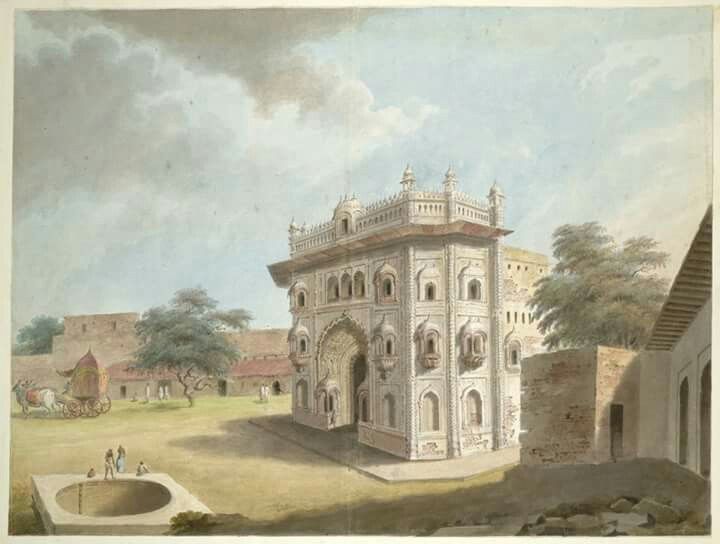
A few days later, Jones put an end to the halt at Moradabad and recommenced his march on Bareilly. We shall now resume our narrative and turn our attentions to Major-General Penny.
Major-General Penny and the Meerut Column
In April 1858, Brigadier Nicholas Penny began his move from Bulandshahr towards Rohilkhand to join in the operations at Bareilly. The Meerut Column consisted of
6th Dragoon Guards (Carabiniers) – 200 men
HM’s 64th Foot – 350
22nd Punjab Infantry, Baluchi Battalion – 360
Multani Horse – 250
2nd Punjab Infantry – 299
No. 14 Field Battery 3/3 Bengal Artillery (Captain & Brev. Major, H. Hammond)
2/4 Bengal Artillery (two 18-pounders, two 8-inch howitzers under Lieutenant H.M. Cadell)
Initially, the main duty of his column was to safeguard communication lines and keep the roads open to Oudh, services Penny performed for nearly six weeks, with much patience and forbearance. “With all the anxiety of a young man for military distinction,” Penny braved the fierce April heat and rode to Fatehgarh to consult directly with Sir Colin Campbell and on returning to his column, ordered their next march – they were to cross the Ganges and proceed, like Jones, towards Bareilly.
It is worth noting the long career of Major General Nicholas Penny, which would, in a matter of days after seeing Sir Colin Campbell, come to a swift and unsatisfactory end.
Born in 1790, the son of Robert Penny, of Calcutta and then of Weymouth, Dorset, he was nominated by J. Hudlestone to a direct appointment in the East India Company army in 1806, arriving in Calcutta on 21 July 1807. He must have been of the studious mindset, for he received a gratuity of Rs 1000 for his near-perfect examination in not only Hindi but Persian; his first posting, as ensign, followed in July 1808, to the 1/14h Bengal Native Infantry. From here, his career reads like a history of EICo warfare and promotions in India.
Cadet 1808. Arrived in India on 21 July 1807.
Ensign (5 Feb. 1807) 16 Aug. 1807.
Lieut. 19 Dec. 1812.
Capt.13 May 1825.
Major 2 Feb. 1842.
Lt. Col. 29 July 1848.
Col. (7 June 1849) 15 Sept. 1854.
Maj. Gen. 28 Nov. 1857.
Starting with the Nepal War in 1814, he then served through the Third Maratha War (Mandala and Garhakota); went home on furlough in 1823 and returned in time for the siege and capture of Bhurtpore, serving as DAQMG with the 2nd Division, leading to his second India Medal (the first for Nepal) this time with a clasp. Postings as Brigade Major at both Agra and Dinapore (1826-1828) and Presidency Divisional command from 1832-1841, until Penny took command of the Nasiri Battalion from 1841 until 1848. With the Nasiris, Penny saw out the First Sikh War (Aliwal and Sobraon, where he was wounded). For Aliwal he was mentioned in Sir Harry Smith’s dispatch to the Governor-General:
” The intrepid little Ghoorkas, of the Nusseree and Sirmoor battalions, in bravery and obedience can be exceeded by none. I much regret that I had no brigade to give to Brigadier Penny, who is in orders for one. I can only say that when he gets his brigade, if he leads it as he led his gallant band of Ghoorkas, it will be inferior to none.”
Sir Hugh Gough, after Sobraon, recommended Penny, “…in the most earnest manner to the notice of the Governor-General, for the spirited manner in which he and his gallant troop had overcome “the most formidable opposition.” For this campaign, he received the Aliwal medal with a clasp for Sobraon, and was created a CB on 30 June, 1846. His next transfer was to the 69th BNI and ordered to Lahore in 1848. During the Second Sikh War, where he commanded the 6th Brigade (reserve) at Chillianwala, for which he received another mention in despatches for his support in the advance of Sir W.R. Gilbert, in which Penny carried a village – “the key of the enemy’s position by a most spirited attack, executed in in brilliant style“. He commanded the 3rd Brigade at Gujarat, and the 2nd Brigade in the pursuit of the Sikhs and Afghans to Peshawar.
Penny took command of the 2nd European Bengal Regiment on 31 March 1849 and was appointed as ADC to the Queen, besides being granted a brevet rank of colonel for his Punjab services. His medal would sport clasps for Chillianwala and Gujerat. He transferred to the 40th BNI in 1850 and saw out 1851 as the second-in-command of the Rohilkhand district. After a brief stint in Ambala, he joined the Jalandhar Frontier Force in 1852, served in Sindh Sagar district in 1853, before taking command of the Sialkot Brigade in 1854. Penny then transferred to the 19th BNI in 1852, the same year, another transfer to the 61st, and his colonelcy followed in 1855 in the 12th BNI. Shortly before the mutiny, Penny commanded the Cawnpore division (1855-1856) and was appointed as Major General Divisional Staff of the Army and posted to Meerut on 30 June 1857, taking over from Hewitt. He took command of the Delhi Field Force in conjunction with the force from Meerut on 30 September 1857. Now a Major General (28 November 1857), his final transfer was to the 2nd European Bengal Fusiliers on 22 January 1858.
Besides an active career, Penny was also married man. His wife, Louisa, was a daughter of the army, her father being Major John Gerrard, who had served during the Second Maratha War; Penny’s sister-in-law (Gerrard’s eldest daughter) was the second wife of Sir Alexander Knox. His brother-in-law was John Grant Gerrard, the flamboyant Lieutenant Colonel who, wearing all his medals and his red coat in battle, was mortally wounded at Narnaul in November 1857.
Nor was he the only Penny to serve in India, but his brother, Major General Gabriel Richard Penny died in Dinapore in 1842, aged 58, after a singularly busy career, serving not only in the operations in the Jumna Doab in 1803 but the Second Maratha WarerAligarh, Delhi, Agra, Laswari, Battle of Dieg), at Bhurtpore, the Macao Expedition, the Nepal War and the Third Maratha War.
The Surprise Attack at Kirkrowlie
On 29 April 1858, Major-General Penny and his force moved from the position at the village of Naroli towards the town of Ushait. It was a night march, commencing at 8 pm. It had been reported that the town was in the hands of a considerable rebel force, who had no less than two guns. The objective was to launch a surprise attack, and as the despatch states, “to cut them up.” However, owing to delays, the force did not complete the march until nearly midnight, although the distance was only seven miles.
The column had proceeded in military formation, with an advance guard, followed by artillery supported by cavalry and the infantry taking up the rear, with the heavy guns and baggage having been sent on ahead with an escort directly to their next objective, Kirkrowlie. When within sight of Ushait, Mr Cracroft Wilson, one-judge of Moradabad and now serving in a civilian capacity to Penny’s force, informed Penny that the rebels had already left and retired to Dataganj. Wilson’s intelligence had been provided to him by the townspeople, and he saw no reason to disbelieve them. So, instead of halting, the column continued its march.
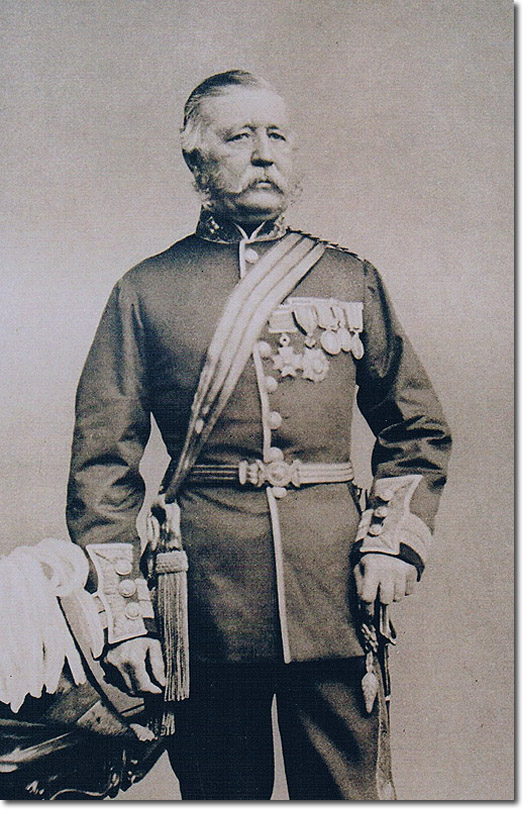
However, it would appear, perhaps owing to the darkness of the night or the tiredness of the troops, or perhaps just bad management, that military precautions seem to have suddenly gone out the window. The cavalry was allowed to proceed far ahead of the infantry, and “eventually, though the advanced guard was kept up, it was held back immediately in front of the artillery,” with Major-General Penny, his staff and their guide, Mr Wilson, riding ahead of the advanced guard. It was now 4 in the morning. Suddenly, when within 200 yards of Kirkrowlie, some horsemen were seen in the distance and some unidentifiable lights. Little inquiry was made to ascertain their identities, but “it was supposed they must be a portion of our own force that had marched by the direct route to Kukerowlee”, and the advance continued without any additional precautions. Then, without warning, came a burst of light as a gun opened up on the column from the right with grape and round shot at 40 yards. Before any orders could be given, the rebel cavalry charged from the left and their infantry opened from the front. In the din of the battle and the confusion that followed, no one saw Major-General Penny fall, but they also never saw him alive again. Lieutenant A.H. Eckford (D.A.A.Q.G) was somewhat luckier. The discharge from the gun hit his horse, sending Eckford to the ground. He managed to get to his feet and grab another horse, but no sooner had he mounted when some Ghazis attacked him, one of them stabbing his horse, unmounting Eckford. Dazed and wounded, Eckford struggled to his feet, but a Ghazi slashed him across the shoulder, and Eckford fell. Fortunately, they left off and melted back into the darkness. Surgeon Jones found Eckford and helped him up, but “…The next moment, they saw the enemy coming down upon them, and they threw themselves on their faces as if dead. The rebels passed by without heeding them. Some soldiers of the advancing infantry found them, and Eckford was moved to a safe spot.”
Unable to find Penny, Colonel Henry Richmond Jones of the Carabiniers took command. He swiftly ordered Captain Hammond’s Light Field Battery to the front, “and nobly did this officer and his men respond to the call. The ground, however, where the enemy had taken up their position, was, to our left, nothing but a mass of sand hills, while, to our right, they were protected by thick groves of trees, and immediately in their rear, they had the town of Kukerowlee to fall back upon.” The nature of the ground and the darkness made Hammond’s battery less effective than it otherwise should have been, and the same held for a charge by the Carabiniers, who quickly gave it up as a bad idea. No one could see the rebels nor ascertain their numbers, and all the British could now do was hold their ground until daylight.
As the infantry was some considerable distance in the rear, and there was soon enough light to start an artillery attack, Jones ordered the guns to open fire — as soon as Lieutenant-Colonel Bingham and HM’s 64th came up, the guns ceased and Bingham charged. Dislodging the rebels from his front and the right, Bingham then drove straight through the town, forcing the rebels out the far end. Jones was not in the mood for pleasantries – he ordered the Carabiniers and Lind’s Multani Cavalry to gallop with speed and overtake the rebels. One squadron of the Carabiniers, under Captain Foster, charged the rebel gun, captured it and rushed on, but a 100 yards onwards, and their horses stumbled, inadvertently, into a deep ravine, full of Ghazis. Lieutenant Foster, trying to get control of his struggling horse, was attacked by three men, who all succeeded in wounding him; but Troop-Sergeant Major Bouchier, seeing Captain Foster in a precarious position, dashed forward and saved his life. Captain Betty and Lieutenants Davies and Graham were wounded, and several troops likewise, before they could extricate themselves from the ravine. Meanwhile, the other squadron of the Carabiniers and Lind’s Multani Horse had managed to evade the ravine and continued the pursuit of the fleeing rebels —“This duty was performed by both, thoroughly and zealously: they drove the enemy in confusion with them, and succeeded in cutting up many, capturing one of his guns, and two carts containing powder.” Jones called a halt and ordered the camp to be pitched. The column had marched 25 miles that day and had had neither food nor rest since the night before. The next morning, they recommenced their march and, without further incident, joined up with Sir Colin Campbell at Miranpur Katra on 3rd May.
Although no one could say for sure what had happened to Major General Penny, it was presumed that his horse, either wounded by the discharge or frightened by the sudden noise, became unmanageable and carried Penny into the enemy lines. His body was found after the battle, shot, hacked and mangled by sabre cuts and stripped of its clothes. Instead of leaving him in a lonely grave, Captain E.J. Simpson, assistant of the commissary department, contrived to have Penny’s remains taken to Meerut, where he was buried in the cantonment cemetery.
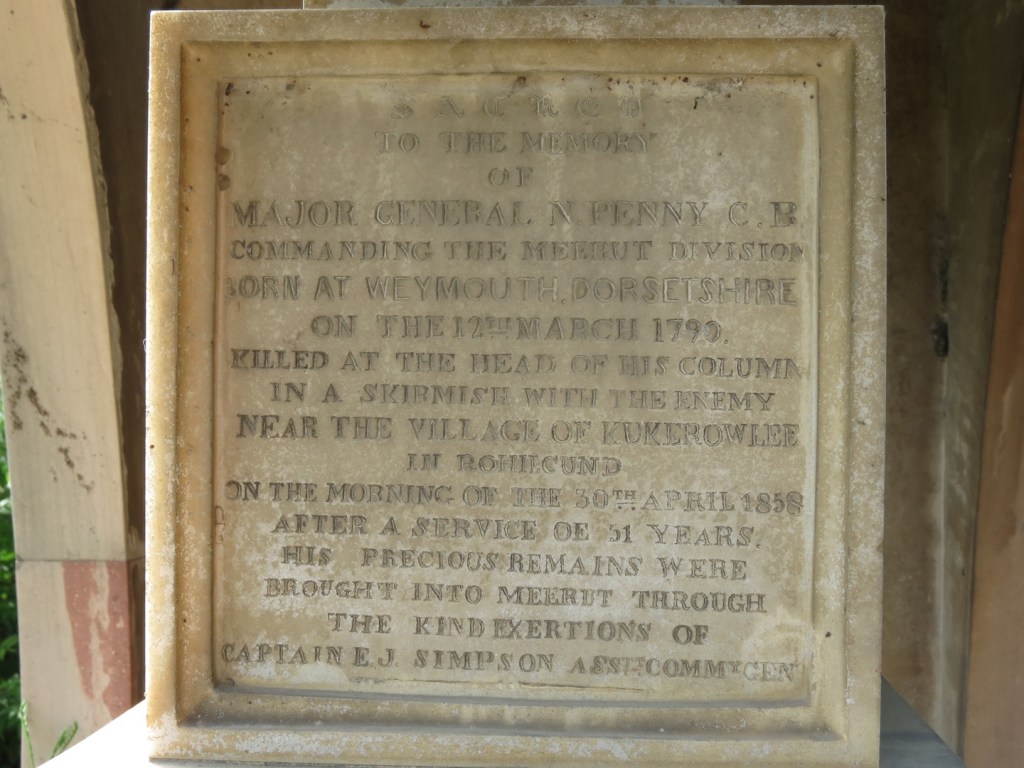
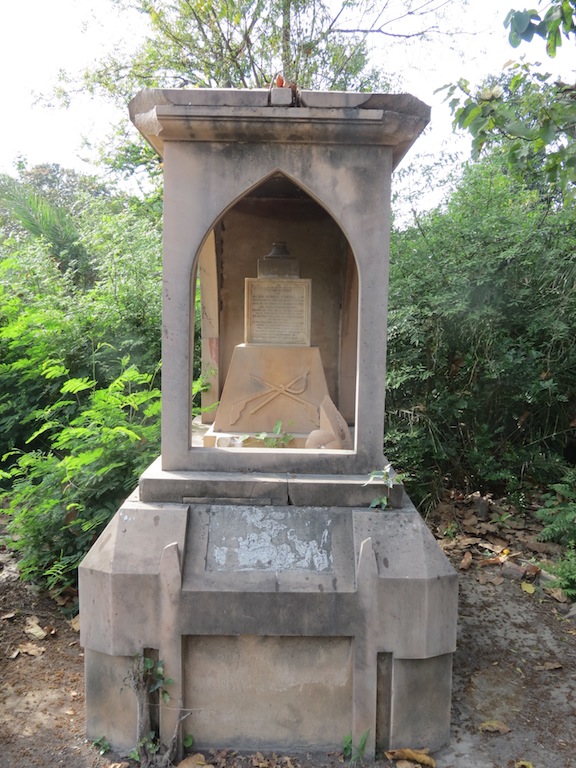

Sacred to the memory of
Major General N. Penny, C.B.
commanding the Meerut division
Born at Weymouth, Dorsetshire
on the 12th March 1790.
Killed at the head of his column
in a skirmish with the enemy
near the village of Kukerowlee
in Rohilcund
on the morning of the 30th April 1858
after a service of 51 years.
His precious remains were
brought into Meerut through
the kind exertions of
Captain E.J. Simpson Asstt. Commy. Gen.
When Sir Colin Campbell was apprised of Penny’s death, he was heard, by William Russell, to remark, “Yes, you find civilians are continually deceiving us, or allowing themselves to be deceived by the natives. They will insist on it that the people are not against us….It is astonishing that an old soldier like General Penny could have been so indiscreet! Poor man!” There was, however, no time for grief – all was set now for the Battle of Bareilly, and the position of that wily rebel, Khan Bahadur Khan, is about to become very difficult indeed.
General Return of Killed and Wounded of the Moveable Column under the Command of Colonel Henry Richmond Jones, 6th Dragoon Guards, in Action at Kukerowlie, on the 30th of April, 1858.
General Staff—Major-General N. Penny, C.B., Commanding Meerut Division and Moveable Column, killed; Lieutenant A. H. Eckford, Deputy Assistant-Quartermaster-General, severely wounded, charger killed
Artillery Division— 2 horses, killed ; 4 horses, wounded; 2 horses died of heat and exhaustion.
Gunners
Beggan, James – slightly wounded
Bunting, William – slightly wounded
McGillicuddy, Thomas – slightly wounded
Moore, Morgan – killed in action
6th Dragoon Guards— 7 horses, killed, 12 horses, wounded; 3 horses, missing.
Captains
Betty, William Thomas – severely wounded. Captain Betty’s charger wounded.
Forster, John – Severely wounded
Lieutenant G. S. Davies – contused
Lieutenant & Adjutant WIlliam Graham – slightly wounded
Troop Sergeant Major Henry Bouchier – slightly wounded
Corporals
Withers, John – slightly wounded
Pelham, E. – slightly wounded
Ahern John – severely wounded
Warren, Thomas – dislocation
Privates
Banks, George – severely wounded. Died of wounds
Davies, John – severely wounded
Dunbar, William – severely wounded
Fairburn, Thomas – slightly wounded
Macdonald, Felix – slightly wounded
McDermott, Patrick – severely wounded
Paims, Edward – slightly wounded
Purnell, Fred. – severely wounded
Randall, John – slightly wounded
Ratcliffe, Thomas – slightly wounded
Sinker, Thomas – slightly wounded
Tofts, William – severely contused
Thhwaite, John – slightly wounded
Watson, Richard – severely contused
H.M.’s 64th Regiment
Privates
Black, Alexander – severely wounded
Mealwin, John – severely wounded
Mooltanee Horse—1 rank and file, 2 troopers, killed ; 3 native officers, 5 rank and file, 2 officers’ chargers, 8 troopers, wounded; 2 troopers, missing.
Major Bickerstaff’s charger wounded.
Sources
The Argus (Melbourne, Vic.). “Our Indian Generals.” January 13, 1858. https://trove.nla.gov.au/newspaper/article/7144978.
Behan, T. L., ed. Bulletins and Other State Intelligence for the Year 1858, Part III. London: Harrison & Sons, 1860.
Brodkin, E. I. “The Struggle for Succession: Rebels and Loyalists in the Indian Mutiny of 1857.” Modern Asian Studies 6, no. 3 (1972): 277–90. http://www.jstor.org/stable/311935.
Forrest, George William. A History of the Indian Mutiny. Vol. 3. London: William Blackwood & Sons, 1912.
Hodson, V. C. P. List of the Officers of the Bengal Army, 1758-1834, Part III. London: Phillimore & Co., Ltd., 1946.
Husain, Iqbal. “The Gentry and People in Muradabad and Badaun, 1857.” Proceedings of the Indian History Congress 54 (1993): 563–73. http://www.jstor.org/stable/44143029.
The Imperial Gazetteer of India. Vol. 17, Mahbubabad to Moradabad. Oxford: Clarendon Press, 1908.
“The Indian Cossacks.” The Cornhill Magazine 7 (January–June 1863): 52–63. HathiTrust Digital Library.
Jocelyn, Julian R. J. The History of the Royal and Indian Artillery in the Mutiny of 1857. London: John Murray, 1915.
Malleson, George Bruce. History of the Indian Mutiny. Vol. 2. London: William H. Allen & Co., 1879.
Nevill, H. R. Moradabad: A Gazetteer. Vol. 16 of District Gazetteers of the United Provinces of Agra and Oudh. Allahabad: Government Press, 1911.
Russell, William Howard. My Diary in India. Vol. 1. London: Routledge, Warne, & Routledge, 1860.
Siddiqui, Mansoor Ahmad, and Atree Tripathi. “Rampur’s Pivotal Role in the 1857 Rebellion in Rohilkhand.” International Education & Research Journal 10, no. 8 (2024): 3–6. https://ierj.in/journal/index.php/ierj/article/download/3563/4026/7428.
Links
https://www.britishempire.co.uk/forces/armyunits/britishcavalry/14thhussarshenryjones.htm
 Mutiny Reflections
“…we cannot begin adding on pieces of details, such as lime furnaces and elephants, based on the current trend of unsubstantiated revisionist history.”
LikeLike
Brilliant. As always.
(The entirely fictional Major Barrington St.John Gibley, DSO, retired, formerly of the Honourable Company of London Rifles and the Deccan Lancers would be most interested.)
LikeLike