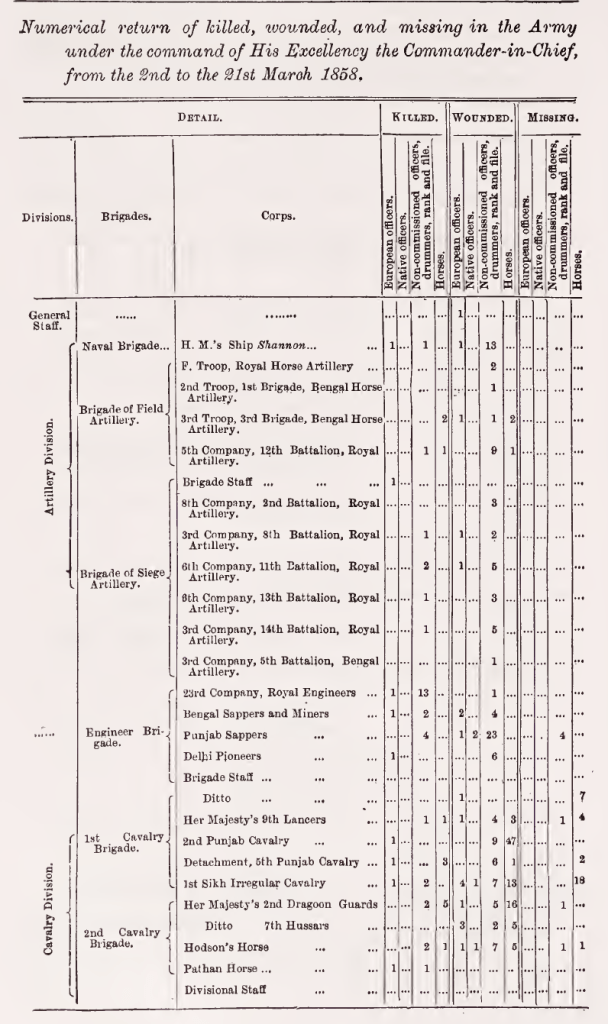
20 March
Divisional Staff
Lieutenant O.D. Thackwell (15th BNI), Assistant Baggage Master to Siege Artillery – killed
Lieutenant Jonathan Cape (30th BNI), Assistant Baggage Master to Engineer Brigade – killed
They had proceeded to the city for reasons unknown and were murdered. Their headless bodies were discovered down a street the next day. It is was presumed the culprits were sepoys whom the two men accidentally stumbled upon.
21 March
1st Battalion 20th Regiment of Foot
Private William Magee – slightly wounded 21 March
93rd Foot
Privates
Armstrong, John – severely wounded<
Barrie, Alexander – slightly wounded
Beath, Alexander – slightly wounded
Ferguson, James – slightly wounded
Laughlin, Francis – severely wounded
Lyons, James – slightly wounded
McBirnie, John – severely wounded
McBirnie, Samuel – severely wounded
McDonald, James – severely wounded
McLeod, Alexander – slightly wounded
Marshall, Thomas – slightly wounded
93rd Highlanders
Sergeant John McKay – slightly wounded
Privates
Armstrong, John – severely wounded
Barrie, Alexander – slightly wounded
Beath, Alexander – slightly wounded
Ferguson, James – slightly wounded
Lauchlan, Francis – severely wounded
Lyons, James – slightly wounded
McBurnie, Samuel – severely wounded
McDonald, James – severely wounded
McLeod, Alexander – slightly wounded
Marshall, Thomas – slightly wounded
1st Bengal European Fusiliers
Private Angus Cameron – shot in the city
2nd Punjab Infantry – 1 native officer dangerously wounded. Died of wounds
4th Punjab Rifles
Major A.R. Wilde – wounded (attached from the 19th Madras Native Infantry). He had been advancing up a street parallel to Hood when he was shot in the groin. He was brought to Fairweather just as the surgeon had begun dressing Hood’s wounds. Fearing Wilde’s wound was mortal, Fairweather found it was not. He had been fired at from an upper window, and the bullet had gone downwards instead of horizontally, which would have penetrated the abdomen.
Captain J. Cockburn- Hood- dangerously wounded. (Attached from the 49th BNI)
Injured in the attack on the Moulvie. As his regiment moved on in the advance, Hood suddenly found himself facing two guns pointing down the road. He believed he could have taken the guns before they fired, but to his intense horror, he found his men did not share the same sentiment and they quickly made a retreat, leaving Hood alone. He pressed himself as flat as he could against a side wall but the subsequent grape shot caught him in the face, “carrying away all the cheek bone, making a ghastly wound.” Fairweather, the regimental surgeon, when he first saw him, thought Hood lost half his head as there was a flap of skin hanging over his mouth, and another was turned up over his eye. “Hood took it bravely, poor fellow, and asked me to tell him at once if his wound was mortal? I was able to relieve him on this point, but had to hold my tongue as to the probable effect on his appearance. He was a good-looking fellow, and it marred the look on that side of his face terribly, besides giving him great trouble for years by pieces of small bone of the face coming away. He was naturally of an irritable temperament, but the quiet way in which he bore the wound raised him much in my esteem.” Surgeon Munro assisted in stitching up Hood’s face – years later, when he saw him in London, Munro recognised him by his scars.
1 Native Officer killed, 6 rank & file wounded
There was another injury in the Rifles that day, but it was not in battle. In the evening, Fairweather’s orderly returned to his tent, covered in gashes, his uniform cut to ribbons, and he was soaked in blood. He was also most crestfallen and, as Fairweather could see, intensely embarrassed. As Fairweather dressed his wounds, the man told him he had gone to a house that he had supposed was empty, with the intention of doing a little looting. Instead, just as he entered an upper room, he saw some men leaving by another door. He ran after them and gave one a slash with his sword, and then went back to rummaging around. While thus occupied, he failed to notice that one of the men he had just chased had come back and was eager for a fight. Realising his own sword was broken at the hilt, the orderly launched himself on the man anyway, fists flying, the other slashing at him with his sword. He finally got the upper hand, and with what remained of his own sword, he managed to cut his opponent’s throat. By this time, the rest of the band had returned, but “when this little blood-stained fury attacked them, they fled and the orderly returned to camp, crestfallen, bringing his enemy’s sword with him.” Fairweather tried to soothe his wounded pride by telling him he had acted gallantly and had nothing to be ashamed of – if this had been in battle, he would no doubt have been raised to Sirdar Bahadur.
Years later, Fairweather met him again, quite by chance, when he was posted as Civil Surgeon in Lahore. While walking down the street, a man hailed him, saying, “Sir, don’t you remember me? I am your old orderly.” During the long conversation that followed at Fairweather’s house, it transpired he had remained with the regiment and had risen to Subedar Major.
Sikh Irregular Cavalry
Captain Frederick Wale – killed in action (Attached from the 48th BNI). 6th son of Gen. Sir Charles Wale, K.C.B., aged 35. He served as Adjutant of the 48th Bengal Native Infantry throughout the Sutlege Campaign of 1846, where he was severely wounded. At the instigation of John Lawrence, he raised the 1st Sikh Irregular Cavalry “Wale’s Horse” in 1857 at Peshawar. According to Lord Roberts, Sir Colin Campbell was persuaded by Wale to allow the chase, which cost Wale his life.
“The gallant Captain Wale fell, mortally wounded by two slugs, one which passed through his beard into his throat, the other into his mouth. He was instantly avenged, for as the rebel sepoy turned to fly, he also fell dead, hit in the spine by a bullet from the revolver of Captain Chichester.” (Mackenzie)
Algernon Chichester, who was a close friend of Wale’s, returned to camp and wrote “several sheets of paper to his widow, describing how he had wreaked his vengeance on the slayer of her husband, and almost forgot to offer his sincere condolences on the loss she had sustained, as if her bereavement was quite dwarfed in comparison to the intense satisfaction he derived from his success.” (Wilkinson, relating a conversation with Chichester)
Lieutenants
Godby, C.J. – slightly wounded (Attached from the 36th BNI)
Montgomerie – slightly wounded
Robert Groves Sandeman – slightly wounded
“I was with Wale at the time he was shot, and when his orderly, Gowrie Shankar, was also killed. There was an old Sikh who fought with us right well and hard. I was twice wounded with sword cuts – one cut on my leg and the other on my arm. My horse was also badly wounded. Wale was shot on the bank of a nullah, and we had to get at the fellows in the nullah and have a regular hand-to-hand fight. The old Sikh who was with me is now, I think, an ADC to the Chief, but of this I am not sure. After this fight, I was just able to crawl to poor old Wale, who was then breathing. I then got help, and took or rather was carried in a doolie along with the body (in another doolie) to the camp.” (Sandeman to Mackenzie, 1891)
According to Lord Roberts, the Sikh, who was named Ganda Singh, saved Sandeman’s life. Two years later, he saved the life of Sir Charles Macgregor during the China War. When Roberts was appointed C-in-C of India, he appointed Ganda Singh his ADC. When he retired, with the rank of Captain, the title of Sirdar Bahadur was bestowed upon him; besides his pension, which Roberts was assured was a handsome one, he was granted a parcel of land.
2 rank & file killed, 3 rank & file wounded
Punjab Pioneers
Ensign Knowles – severely wounded, gunshot to the knee
22 March
Royal Artillery
Shoeing Smith James Farrell (F Troop) – killed by a falling archway
23 March
1st Punjab Cavalry
Captain John Peloquin Cosserat – Dangerously wounded. Died 18 April 1858 (attached from the 34th Madras Native Infantry). He was shot in the face.
Aged 33. 1st Punjab Cavalry. Son of Revd. George P. Cosserat, Rector of Drinkstone, Suffolk.
2nd Punjab Cavalry
Lieutenant F.J. McDonnell – Killed in action – shot dead while engaged against a sepoy. Aged 25. Born in Dublin. Joined the Bengal Army in 1853.

Sources:
Forrest, G. W. A History of the Indian Mutiny. Vol. 2. Edinburgh & London: William Blackwood & Sons Ltd., 1904.
Knollys, Henry, comp. Incidents in the Sepoy War, Compiled from the Private Journals of General Sir Hope Grant. Edinburgh & London: William Blackwood & Sons, 1873.
Lang, Arthur Moffatt. Lahore to Lucknow: The Indian Mutiny Journal of Arthur Moffatt Lang. Edited by David Blomfield. London: Leo Cooper, 1992.
Lieutenant-General Sir James Outram’s Campaign in India, Comprising General Orders and Despatches. London: Smith, Elder & Co., 1860.
Mackenzie, A. R. D. Mutiny Memoirs. Allahabad: The Pioneer Press, 1892.
Rana, Pudma Jung Bahadur. Life of Maharaja Sir Jung Bahadur of Nepal. Edited by Abhay Charan Mukerji. Allahabad: Pioneer Press, 1909.
Roberts, Lord. Forty-One Years in India. Vol. 1. London: Richard Bentley & Sons, 1897.
Russell, William Howard. My Diary in India, in the Year 1858-9. Vol. 1. London: Routledge, Warne & Routledge, 1860.
Strange, Thomas Bland. Gunner Jingo’s Jubilee. London & Sydney: Remington & Co., 1893.
Wilkinson, Osborn, and Johnson Wilkinson. The Memoirs of the Gemini Generals. London: A. D. Innes & Co., 1896.
Wright, William. Through the Indian Mutiny: The Memoirs of James Fairweather, 4th Punjab Native Infantry, 1857-58. Stroud: Spellmount, 2011.
 Mutiny Reflections
Surgeons medical equipment, fit for a bugers shop; one could only imagine the pain during those operations.
LikeLiked by 1 person
A good surgeon could amputate a limb in no time at all, but yes, the horror of it all. It was all quite grim!
LikeLiked by 1 person