
At Cawnpore, Brigadier Inglis in the intervening months, since the departure of Sir Colin Campbell in December, had not been idle. Two bridges of boats had been constructed half a mile apart; one just opposite the entrenchment and the other lower down at the canal junction. This would shorten the passage of troops, material and stores across the Ganges, and allow for swifter distribution to camps and depots and eventually for the recrossing back into Oudh. Inglis had managed to keep Cawnpore quiet and had taken on the enormous task of supplying the Alambagh with munitions and stores. The convoys had been plying the road between the two places for months, with the Alambagh sending an escort and empty carts to Cawnpore, to return, with their escort and fully laden. Therefore, any trouble at Cawnpore was swiftly dealt with. However, the rebels had given up on their attempts to attack Cawnpore since their thrashing in December, and those who were in the vicinity gave the city a wide berth.
The entrenchment by the river had been strengthened and improved, new walls, ditches and fortifications built. Above all, Brigadier Inglis was making sure, that when Sir Colin Campbell returned, he would find Cawnpore improved.
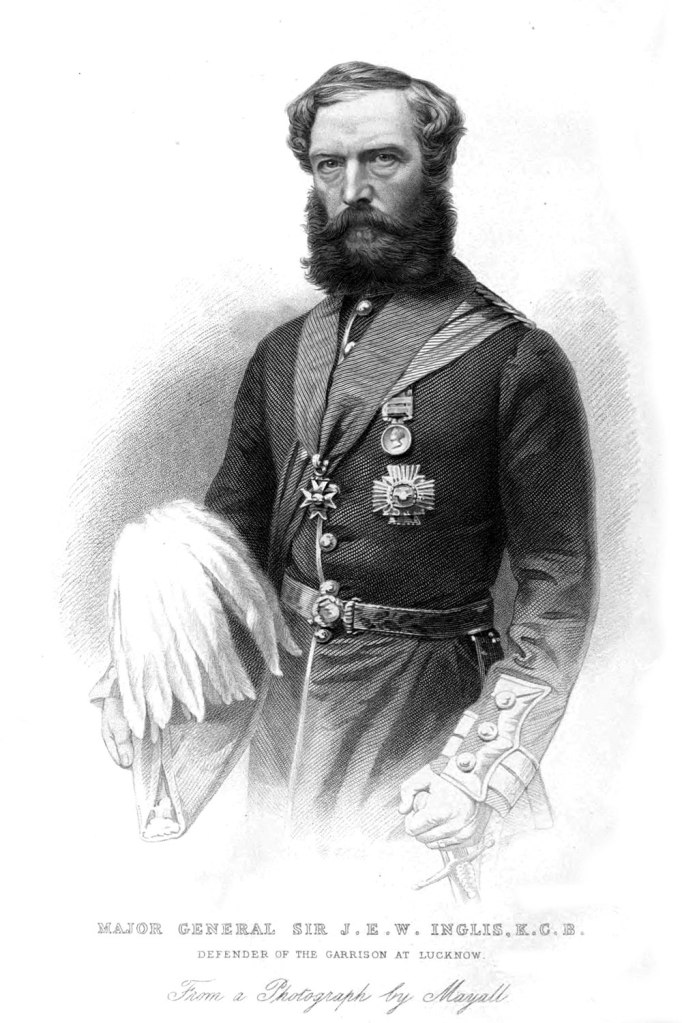
Brigadier Inglis, even after his hardships at Lucknow the previous year, was found to be a “delightful man to have in command – pleasant-tempered, agreeable-mannered, attending to anything asked, giving it if possible — saying at once why it could not be given if he thought it unadvisable.” He was not adverse to a schoolboy tendency to easy amusement and occasionally set out on small forays of his own. One of these was to destroy an illicit distillery on the other side of the river. What Inglis did not need was a horde of drunk troops, and while he allowed their daily rations of grog, he was not happy to find they were still getting liquor by other means. One morning, taking John Sherer (the magistrate) with him, they went to look for their source.
“We crossed, and got into a knot of little houses, and in an unlikely-looking out-house we found a still. Inglis was as eager as a schoolboy at a badger hunt and shouted at the discovery. We had some people with us, and we encircled all the villagers we could find with a rope, and brought them over the water to frighten them, setting the still on fire; and this, spreading to others we had not seen, made a clean sweep of the smuggling hamlet.” Inglis could only hold Cawnpore if he maintained discipline in his own troops and in those arriving in dribs and drabs from Allahabad.

There was little he could do about the desolate appearance of the station itself. Wheeler’s Entrenchment was still there, but the rains had beaten down the sad embankment and the ditch, and the ruined buildings were crumbling, the holes in the walls becoming bigger with each passing day. To make matters worse, vultures had taken to residing in clusters in the leafless trees nearby, for the rooms had been converted, not to places of memorial, but given over to all manner of trash, deposited by camp followers and servants. Remnants of books, a shoe or two, a few sheaves of sheet music, and a pile of rags were all that was left of the siege, but mixed in it was the refuse of recent and very alive humanity. Camp followers had been assigned a spot for their camp just outside the walls of the entrenchment and had taken it as a decently private place to perform their daily ablutions.
Soldiers could still be seen digging around in the ruins, looking not for mementoes, but for treasure. One came away with a small box that contained Rs. 300, giving further credence to the story that there was loot buried somewhere in the grounds of the Entrenchment.
Every house that had once belonged to a European had been razed to the ground – not a single bungalow remained, and the ruins, gutted by fire, stood desolate in unkempt gardens given over now to wilderness. The churches were destroyed, their altars burnt, and their roofs gone. Even the racket courts and the riding school had been demolished. Scarcely 10 months earlier, Lieutenant Edward Vibart had bid goodbye to his family at Cawnpore – now he returned to find he could hardly find his parents’ house. From what he could discover, when talking to people in Cawnpore, was that his father had been the last man to quit the Entrenchment – it was a cold comfort.
At the Bibighar, the house was still standing, but the dreadful well had finally been filled in completely and closed for eternity. Until a fitting memorial could be installed, the 32nd Regiment had raised a small one of their own in the form of a carved Greek cross in memory of their lost women and children.

Another man who had ties to Cawnpore was Major Octavius Anson. Writing to his wife, whom he had married in Cawnpore, he noted,
“You have no idea what a waste the poor unfortunate station is—compounds eaten up, trees all cut down, walls all broken down—it is quite difficult to find one’s way about, so utterly changed is the whole aspect of the place. The spirit of judgment and the spirit of burning has passed over it. Familiar as I was with every turn, I was constantly thinking what turn to take. The assembly-room is roofless, and one vast mass of bricks and rubbish inside, with huge beams, charred all over, lying about. Huge shot-holes are visible in nearly every large house.”
On his first stay in Cawnpore in November, he had managed to find the house of his in-laws and managed to salvage four Fanoose holders from the walls and a few ornaments. He went through every room, looking for anything that could be of value, tokens of remembrance for his wife, but found nothing but broken glass and charred wood. Although roofless, a distinguishable house was still standing, where bees had made an admirable home among the ruins.

Another man who was still in Cawnpore and attached to the Commissariat but hardly fit for work was the unlucky Jonah Shepherd. He had left his family behind in the Entrenchment, while he, in disguise, had attempted to bring information back to Wheeler – the deal they had struck was quite simple. If Shepherd returned, he would be allowed to remove his family from the Entrenchment. Unfortunately, it was already 24 June when Shepherd embarked on his fool’s errand. He never made it more than a few steps from the Entrenchment when he was caught, arrested and flung into jail, where he remained until Sir Henry Havelock entered Cawnpore.
Three months after the massacre, in October 1857, Jonah was finally able to begin looking for any trace of his family. The first information he received was that writing had been found on the walls of the Savada Kothi. The house had held not only the ill-fated survivors from Fatehgarh in June but all those who had survived the boats from Satichaura Ghat. Eagerly, he proceeded to the house.

A friend, Mangal Prashad, accompanied him and on their way, Prashad related to Jonah the story of a tall European, whom he knew to be Cawnpore’s Civil Surgeon, Dr. Harris. Harris had been murdered by some trees within the compound and Prashad declared the body had never been disposed of.
Dr. Harris had luckily managed to save himself after Satichaura Ghat, but it was unclear whether he had been on one of the boats or if he had swum away. However, on reaching the shore, some villagers took him out of the water and promptly bound him hand and foot and returned him to Cawnpore. Harris appeared before the Nana – not to plead for his life, but, according to Prashad, to warn the Nana that in not many months, an army would appear to avenge his blood. Unswayed by Harris and his rather prophetic words, the Nana ordered him to be taken outside and beheaded.
It was, in all, a very curious tale that Prashad had to tell. The son of the landowner who had ordered Harris to be brought to the Nana was ordered, with the sword he held in his hand, to perform the task. Astonished, the young man baulked. He had done his duty, he said, by bringing Harris to the Nana, but he would not strike down a defenceless man. Harris should be unbound and a sword placed in his hand, and the young man would kill him in a fair fight. “What,” said he to the Nana,” am I a Thakoor or a butcher, and you order me to commit so foul a slaughter?” and refused to take Harris’ life unless the doctor was armed.
The Nana was in no mood to listen to fine speeches. Ignoring the young man, he simply ordered one of his own retainers, who dared not disobey, to perform the deed instead. Harris was taken outside and murdered.
Before searching for Harris’ bones, Jonah carefully went over the walls in the Savada Kothi. There had been writing, no doubt, but only a few words were now legible. He found the word, “‘treacherously’ and a good deal below that was another – ‘our blood.’ …(I) endeavoured my best to decipher some more of the writing, but save for a few disjointed letters and some small words, such as ‘we’ or ‘and’, I could not make out any more.” The Nana Sahib, so Jonah presumed, had ordered to have the writing removed, and his retainers had done well – they had not just rubbed at the walls with cloth but with water, which, having mixed with the paint, had effectively erased whatever message had been left behind. Disappointed, Jonah realised he would never know if his family had been among those brought to the Savada Kothi.
Outside, the day of horrors was hardly over.
Crossing over the far side of the compound close to the spot where Harris was killed, Jonah saw some eight or ten human skulls “huddled up together in a hollow place along the edge of the wall, and on looking about me a little further, I found a great quantity of human bones strewn all over the place, together with fragments of many more skulls.” They could only be, he believed, bones of the officers murdered there on the 30th of June, as, according to Prashad, no one had bothered to clear away their remains.
If this was not bad enough, Jonah now examined the area around the tree where Harris had met his end. Sure enough, he found a skull under a bush growing in a dry ditch, and hardby, some bones. As there were several ditches in the vicinity, many of which were still in use by Cawnpore’s washermen, Jonah decided to ask them what they knew. The men replied that nearly all the remains of the Europeans had been dismembered by jackals and “other wild beasts”, and bones were strewn all about the place. They were right. Close by, Jonah found a few more, one on the brink of a ditch. Not far from it, he discovered what looked like a towel just visible in the clay. Frantically, Jonah dug it up and found it was a portfolio wrapped in cloth. The object had been drenched in water, and on opening it, he found it contained “fancy note paper and envelopes, also many fragments of poetry apparently written in a neat lady’s handwriting.” Unfortunately, most of the papers were so badly damaged by the water, they had become stuck together and were impossible to tear apart. However, in one of the compartments of the portfolio, he found a dozen or so visiting cards, but these too had been destroyed, and the writing on them was no longer legible. Only one had escaped; on it, he could still discern the words, “Mr.H.R. Cooper.”

Not wanting to leave the skeletons so exposed, he ordered all the bones and skulls collected. In all, he counted seventeen skulls and filled 30 baskets with bones. He then pocketed the card and carried the portfolio back to Cawnpore. The next day, he returned and, in a hole expressly dug for that purpose, the remains were buried near the spot where Harris had met his end and covered it over. The Savada Kothi was eventually blown up, and a memorial was placed at the top of the stairs.
After returning from Savada Kothi, in his anxiety to learn of his family’s fate, Jonah finally entered the Bibighar.
” I most carefully searched high and low all over the walls, behind the doors and in every corner and pillar of that building, for some trace of my lost ones; but no writing of any kind met my longing eyes, except a few dates and days of the week scrawled over and there in charcoal or fragments of broken earthen vessel, such as – ‘Arrived here on the 4th of July, Saturday,’ then below it continued, ‘5th, Sunday,’ and so on, up to the 14th of July…All my endeavours to obtain any information regarding the fate of my beloved ones proved futile…It would be some consolation to me to be certain in what particular post their dear remains have been deposited, for killed they are without a doubt. I have reasons to believe that they met a watery grave, and what strengthens my belief is that not one of their names is included in that list found near this building.”

With nowhere else to go and the Commissariat still generously providing him with pay, Jonah turned his stay at Cawnpore into a crusade. He interviewed witnesses to the massacre, tracked down Thakurani, his family’s nursemaid, who had been prevented from going to Satichaura Ghat, and started the slow process of compiling a list of all those who had been in the Entrenchment. He even managed to find a few Eurasians who had refused to enter the Entrenchment and, by some miracle, had survived hiding in the city. He would eventually turn over his documents to Mr. Williams, who was tasked, many months later, to investigate the massacres.
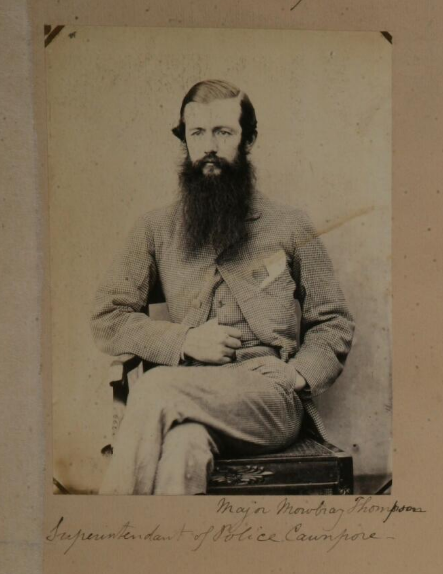
Mowbray Thomson, one of the few survivors of Satichaura Ghat and the man who famously went, after his tribulations were over, to report himself for duty, was finding relish in his new position as captain of Cawnpore’s police force. The position had been conferred upon him by Sir Colin Campbell, and Thomson was determined to make the best of it. He had, at his disposal, 100 cavalrymen and 400 infantry, all recruited from local Indian levies. They were trained to use the musket, and their main duty was to patrol the city, but when necessary, they performed military duties. One of Thomson’s first missions with his new troop was to reconnoitre down the road in the wake of the Gwalior mutineers who, after their summary expulsion from Cawnpore in December, were still said to be prowling about in the vicinity. The few that remained were rumoured to be planning to attack the convoys intended for the Alambagh.
” I had two illustrations that night of the peculiar risk attaching to the command of native forces in these troublesome times. In the first instance, the dak driver quietly surrendered the mails to us without firing a shot; and subsequently, as we were quietly cantering round a sudden turn of the road, we received a volley from the vanguard of the escort. It appeared that they had received no intimation that we were acting as pioneers. I rode up and speedily made it evident that we were not rebels, having first happily prevented my men from returning fire. Had they brought down any of the escort, it would have cost me dear.”
Of mutineers, from Gwalior or otherwise, even 48 miles outside Cawnpore, there was not a trace.

Other duties included escorting treasure from the surrounding districts, for Magistrate Sherer was quite busy himself, collecting all the arrears of revenue. Sometimes Thomson sallied out with his men to make arrests of mutineers or otherwise. Until the “re-adjustment of Civil Power” in the Cawnpore district, and with no official executioner appointed, the rule in place was very much a Lynch Law with soldiers deputed to man the gibbets. Thomson found the whole business inefficient, for the soldiers had little interest in hanging the convicted, but preferred to let them strangle to death. While Thomson claims the only people hanged outside Cawnpore were those convicted of murder of Europeans, his investigations were often based on little more than suspicions rather than fact. Sherer at least understood that while there were undoubtedly guilty parties, what was transpiring was well beyond any rules of law. As soon as he could, he established a regular court, attempting to put an end to vigilante justice. While the hangings did not end, they were no longer being meted out by angry British soldiers but by a government-appointed Indian hangman. For his pains, Sherer would be called “lenient,” which, sadly, was not meant as a compliment.
There was undoubtedly something unsavoury in the air of Cawnpore. The journalist, William Russell of Crimea fame, arrived in Cawnpore on 13 February 1858. After settling himself in, he proceeded to explore Cawnpore. What struck him, besides the obvious destruction, was the native city. He described it as “the worst part of Gallipoli, narrow torturous streets of tumble-down houses, which must have been built of the materials of some city that perished from rottenness.” Vivian Majendie (whom we last met in “At Year’s End”) agreed.
“The native bazaar, from its great size and the insatiable craving for everything and anything which characterizes the British army, and which must long ere this have raised the not over conscientious buneahs to an unprecedented state of affluence, is even noisier and more crowded than these pandemoniums usually are...(a) “tatt” (a tattoo or Indian pony) en route overturns a jeweller’s table, a money- changer’s stock – in -trade, and steps into a basket or two of vegetables, all of which articles-jewels included-are exposed in the street for sale, after the manner of the baked chestnuts and veal- pies “all ‘ ot !” of London notoriety, and subsides into a graceful attitude among some hookahs and pipes, the property of a Cawnpore ” Milo, ” manifestly to their detriment; the camel trots by- ” tatt” narrowly escapes hysterics as it passes after which he recovers. British officer rides forth once more, probably, with true Anglo-Saxon sense of justice, abusing the jeweller, the money-changer, the vendor of vegetables, and the pipe-man, whose shop he had ridden into backwards, for not getting out of the way!”
However, Russell noticed a distinct scowl on the faces of everyone he saw. The shopkeepers salaamed him, but he could not help thinking they were not very happy about it, for their eyes were cold. In all, he found Cawnpore abhorrent.
“1 confess that the dust at Cawnpore always repelled me from those morning rides. One got hot, stuffy, and powdered all over with impalpable, but visible leg-bones, and skulls, and mud, and nastiness, which the bath could scarcely clear away.”
A casual walk down to the river after breakfast caused him to see an island in the midst of it, covered in human skeletons, and he could not help thinking they were of those killed at Satichaura Ghat. However, presently, a few bodies floated by, the remains of funerals upstream, and some snagged on the island, leaving him in a different frame of mind. He further saw bones along the riverbank, now being picked clean by adjutant birds, and to make matters worse, during a fishing expedition a few days later, the net brought up a skeleton which still had remains of flesh clinging to its bones. Russell resolved never to eat river fish in India again.
On the other side of the river, well away from the bazaar and city of Cawnpore, troops were setting up camp. Everything was being put in place for the recapture of Lucknow. The Siege Train from Agra slowly trundled its way towards Cawnpore, all fifteen miles of it, laden with munitions, stores and supplies for the new army. Tent manufacturers, furniture sellers, and merchants providing all manner of goods sprang up around Cawnpore, all eager to make good business from what appeared to be a long campaign. The leatherworks for which Cawnpore had been famous before the mutiny were back in business. Where the leather was concerned, however, not everyone was impressed. Vivian Majendie
had very little complimentary to say.
“The saddles are not badly shaped, being made on English trees, or correct models of the same; but the leather! I should like to see the face of the pig, if he was told that it was the skin of one of his brethren!“
The tailors were certainly prospering. Orders had come in to make summer clothes for the troops, with regiments sending in for up to 900 suits at a time, and on top of that, wicker helmets were in high demand. One tailor, Gopal Das, who had received orders for thousands of “helmets, coats, inexpressibles and turbans, is literally up to his eyeballs in khaki…Another tailor appeared to be gradually becoming a drivelling idiot, under the combined effects of pressure of business, and the prospect of incalculable wealth.”
War was certainly proving to be a profitable business.

As for Cawnpore, Russell had this to say:
“It seems to me almost a mistake to re-establish our station here. We could easily move it a few miles away and let the city perish altogether, but the railway station will determine that point. The lesson for the day seemed to me, in the state of mind in which I was, to have peculiar significance, though, perhaps, it was not more applicable to Cawnpore than to any place wherein it was read today, —“We will destroy this place, because the cry of them is waxen great before the face of the Lord.’’
Sources:
Anson, O. H. St. G. With H.M. 9th Lancers During the Indian Mutiny. London: W. H. Allen & Co., Ltd., 1896.
Majendie, Vivian Dering. Up Among the Pandies: Or, A Year’s Service in India. London: Routledge, Warne, and Routledge, 1859.
Russell, William Howard. My Diary in India, in the Year 1858-9. Vol. 1. London: Routledge, Warne, and Routledge, 1860.
Shepherd, W. J. A Personal Narrative of the Outbreak and Massacre at Cawnpore, during the Sepoy Revolt of 1857. Lucknow: Methodist Publishing House, 1894.
Sherer, J. W. Daily Life During the Indian Mutiny: Personal Experiences of 1857. London: Swan Sonnenschein & Co., 1910.
Thomson, Mowbray. The Story of Cawnpore. London: Richard Bentley, 1859.
Vibart, Edward. The Sepoy Mutiny as Seen by a Subaltern: From Delhi to Lucknow. London: Smith, Elder & Co., 1898.
 Mutiny Reflections