“I myself passed a most miserable night, having found in one of the dhoolies, amongst the ‘ hopeless cases of mortally wounded men whom the doctors had no time to attend to, a poor fellow of the Light Company in great agony with a bullet in his abdomen, but clear-headed and intelligent to the last. He constantly cried for water, which I obtained for him from the hospital water carriers at intervals throughout the night. He begged me continually either to shoot him or to lend him my revolver to shoot himself. I was so dreadfully
fatigued that I two or three times fell asleep with my head on his shoulder, and he woke me on one of these occasions by trying to reach my revolver, which I had thrust round to my back to prevent him laying hold of it. Towards sunrise, I had again fallen asleep, and when I afterwards awoke, he was dead, after enduring quite ten hours of excruciating agony. Why, in such hopeless cases, might not the surgeons of regiments be authorised to put the sufferer, at his own request, out of pain?” (Alexander)
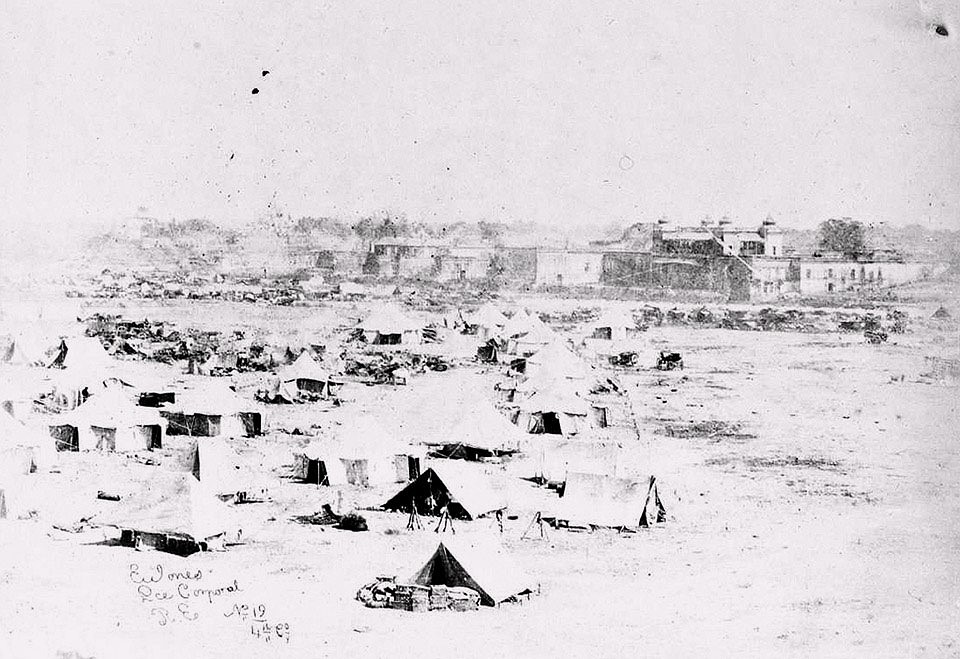
Photograph by Lance Corporal E.W. Jones, Royal Engineers
For more details of the events, readers are requested to turn to The Fall of Lucknow, Part III
15 March
1st Battalion, 20th Regiment of Foot
Private Robert Nicholson – slightly wounded
90th Regiment of Foot
Private Brennan, M. – killed in a powder explosion
97th Regiment of Foot
Privates
Ainsworth, William – slightly wounded
Basketfield, B. – slightly wounded
Browne, J. – slightly wounded
Charnock, T. – slightly wounded
Coyle, J. – slightly wounded
Hart, R. – missing. Supposed blown up in an explosion of gunpowder
Kendall, George – slightly wounded
Prescott, John – killed in action
Reece, W. – severely wounded
1st Bengal European Fusiliers
Captain Frederick Octavius Salusbury – slightly wounded
Royal Artillery
Gunner & Driver John Saunder (5/12) – slightly wounded
Shoeing Smith George Laver – severely wounded in a powder explosion. Died 20th March
The orders had come from Robert Napier to clear casks of powder found in the Kaiser Bagh. With half a dozen gunners of his company, Lieutenant Strange was charged with carrying out the task for which Shoeing-Smith Laver, acting Bombardier, immediately stepped forward and volunteered his services. While the men were engaged in the task of throwing the powder down the well, Strange and Laver found a second such store in an adjacent room, of ammunition, which Laver set to clearing. Unfortunately, with a fire nearby, the powder ignited before Laver even entered the room – Strange was hit by falling debris but remained otherwise unhurt. As soon as he was on his feet, he ran to find Laver.
“He could see nothing for the volumes of smoke, but shouted the Bombardier’s name, to which came a faint answer from within. The poor fellow appeared at a window, clutching the iron bars, his clothing in flames. The Lieutenant went close up and told him to turn to his left and make for the open doorway. But he must have been bewildered and so took the wrong direction, for he never came out until he was brought forth in a doolie. Jingo entered the ruins but could not find him. The doolie-bearers were on the spot immediately, and Jingo had a horrid vision of poor, charred, wounded men, groaning as they were put into the doolies.”
Horrified and saddened by what he had witnessed, Strange then tried to find Laver in the hospital at the Dilkusha.
” Round the lofty rooms were ranged the wounded. No neat skilful sisters glided round the charpoys of the suffering soldiers, but here and there crouched a half-naked native, fanning away the flies in such a perfunctory fashion that they crawled undisturbed over many a poor fellow’s face and eyes, whose hands were too feeble to brush them away. Among these was the Bombardier, an unrecognisable mass of cotton wool and crawling flies. He knew the voice of the Lieutenant, who bent over him to catch the weak, muffled response, and he put his arms about his officer. Ranks are not in the army of martyrs.
“Tell my mother I died like a soldier.”
” No, not yet, you must live to see her.”
Tears were not in Jingo’s line, but he turned away his face from the hospital orderly as he walked out and went off to write the following letter:—
” Camp Badshabagh,
1 8th March, 1858.
” To Lieut.-Colonel Maberly,
Late Commanding Royal Artillery of Siege Train, Lucknow. Sir, — I have the honour to bring to your notice the steadiness displayed by Shoeing-Smith Lever, of Captain Le Mesurier’s Company, 3rd Company, 14th Battalion, Royal Artillery.
On the 16th of March, 1858, he was mainly instrumental in emptying into a well a quantity of captured powder in a room of the Kaiser Bagh while the building was on fire at no great distance from him.
A second room was then reported to contain a large quantity of ammunition. To this he was proceeding when an explosion took place, which has, I believe, rendered him helpless for life, if he recovers at all.
I beg to request that the circumstance be reported to the Brigadier Commanding, in the hope that some consideration of his conduct may affect the amount of pension awarded, or that a situation, if he is ever fit to fill one, may be requested for him, or at least a record of his service kept.
(Signed) T. J. Lieut. Royal Artillery, and Quartermaster Artillery Division.
Forwarded to the Adjutant-General of Royal Artillery, for record in the office of the battalion to which Shoeing- Smith Lever belonged.
“I regret to say that the man has since died of the injuries received.
(Signed) ‘]. E. Dupuis. Major-General Commanding.”
 Mutiny Reflections
Surgeons medical equipment, fit for a bugers shop; one could only imagine the pain during those operations.
LikeLiked by 1 person
A good surgeon could amputate a limb in no time at all, but yes, the horror of it all. It was all quite grim!
LikeLiked by 1 person