The Battle of Phulpur
The next morning, the rest of the force crossed the river, with Lieutenant Grant (RN) pushing the spare ammunition and stores over with alacrity to prevent any want should the rebels decide to put in an appearance. By noon, the Sarun Field Force was augmented by a brigade of Gurkhas with a further six guns. Everyone, however, was jittery. A few shots were heard, and the men were quickly formed up, but it turned out it was only the advance picquet, seized with a case of nerves, had fired on an imaginary reconoittring party. Rowcroft now received orders from Macgregor to bring his fleet up to Phulpur to allow for the rest of the Nepal troops to be ferried across the river. Once again, Rowcroft received word that Phulpur was undoubtedly in the hands of the rebels. “About two o’clock, the force, including the
Naval Brigade and four guns, with Royal Marines, 190 men, 44 Sikhs, and 1300 Gorkhas with six guns, attached to which were European artillery sergeants, left the camp, and marched six or seven miles to
attack the rebels at the village of Phoolpore, three companies of Gorkhas and a few men of the Naval Brigade having been left to protect the baggage.”
Rowcroft ordered the men to form line half a mile from the camp, with the Ramdhul Gurkhas on the left, the Naval Brigade with four guns in the centre and the rest of the Gurkhas with a light field battery of six guns on the right. Once again, there were misunderstandings with the Gurkhas. Although they were commanded by their regimental officers, a European officer was in military charge, but he was unable to give orders, and the Gurkhas wanted to have things their way.
The line advanced, with a detachment of the Royal Marines under Lieutenant Pym, and Lieutenant Burlton commanding the Sikhs pushed forward on the right in skirmishing order, and 2 companies of Gurkhas on the left. They passed through several small villages and topes without meeting any resistance, and the advance continued until they reached the village of Phulpur when, coming in range of the rebel guns, the rebels greeted them with a furious cannonade from their guns. Almost predictably, the rebels had posted their guns near and within the woods, with broken ground and high crops to their front, and their left was covered by the river. Lieutenant Turnour and the Nepalese guns returned the compliment.
“…but among the Gorkhas, no little confusion ensued. It is said to be their custom in action to rally round their guns. This probably arises from the fact that they place more confidence in their long range than in the close quarters required for the use of the bayonet. Without pretending to account for the fact with any degree of accuracy, it is, however, quite certain that in a short time after the commencement of the action few of them were to be seen in the line—in fact, they disappeared. Those on the left went over to the right, where the Gorkha Brigadier was commanding, and after the first violence of the fire had a little abated, they might be seen returning stealthily to their ranks.”
It was surmised the Nepal Gurkhas were unaquainted with the European style of fighting and above all, they were unaccustomed to cavalry and were difficult to manage in the field.
If the Gurkhas were finding this all somewhat confusing, the elephants with the spare ammunition were thrown into a complete fit of fury by the sound of the cannons – of the three, one fled preciptously from the field to the rear, regardless of all entreaties by his mahout, while the other two stamped about, roaring and snorting until their mahouts managed, by dints of threats and coaxes, to calm them. Back at the battle, things were about to take a curious turn.
The rebels were said to be some 2500, with a few troops of cavalry and five guns under the command of Gholam Khan and Ali Hyder. Had they held their ground, things might have gone differently. The Marines and the Sikhs on the right pushed on in skirmishing order, advanced “with such rapidity and daring” that they were soon close the rebel guns – one look at the Marines caused the gunners to shriek, “Gora log!” (white people!) and in their surprise, abandoned their guns and ran. The Marines took the guns, passing the first and bursting the second. Then, concealed by the river bank, they moved around the rebel position until they were within 100 yards of them and, at the point of the bayonet, rushed the next gun. The Marines turned the gun on the now-flying rebels, seeing them off with several rounds of grapeshot. Together with the Sikhs, they then gave chase, while the seamen on the left pushed forward, leaving Jung Bahdur’s Gurkhas in the rear, while the Ramdhul Gurkhas kept up with the seamen and the Naval Artillery. The Ramdhul Gurkhas impressed the seamen to no end, with their bitter blades, the kukri, for
“When preparing for the charge, the line forms in open order, either two or four deep, and with a fierce
yell, brandishing their formidable weapons high in mid air, they rush wildly on. After the first sharp volley was over, and the enemy had retired to a little distance, our line advanced, and the Ramdhul regiment was persuaded to try the effect of a charge through some thick crops and a tope where it was possible a few of the enemy might have loitered behind; but on dashing on, brandishing their kookries, and uttering piercing yells, they approached the wood. fired their muskets, and entered, but found the enemy had gone.”
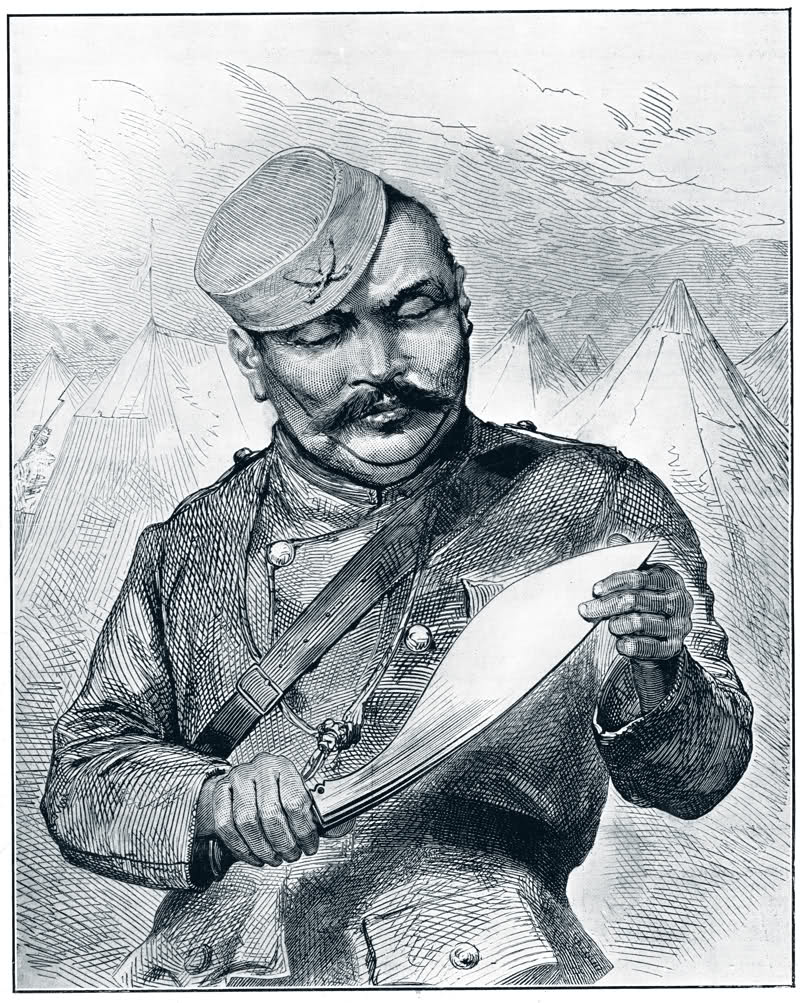
“The terrible kokre, which, parenthetically described, is a massive curved knife some twenty inches long and about five broad, manufactured from the finest-tempered steel, and whetted with an edge as sharp as that of a razor.A more useful weapon it would be impossible to place in the hands of any man than the kokre is in those of the Nipale” -Nash
By nightfall, Sotheby called off the pursuit and the force camped for the night Phulpur, leaving the Jung Bahadur’s Gurkhas seven mile distant, as they had refused to march back to the camp.
“Thus ended the action at Phoolpore, in which, after a contest of an hour, the rebels, who had occupied the right bank of the Gogra for some days, in the presence of Jung Bahadoor’s army, were overthrown
and dispersed. Three guns were taken, and camp equipage was destroyed, and ‘by the skilful dispositions that were made, and the admirable manner in which they were carried out,’ complete success followed, and the passage of the river was secured.”
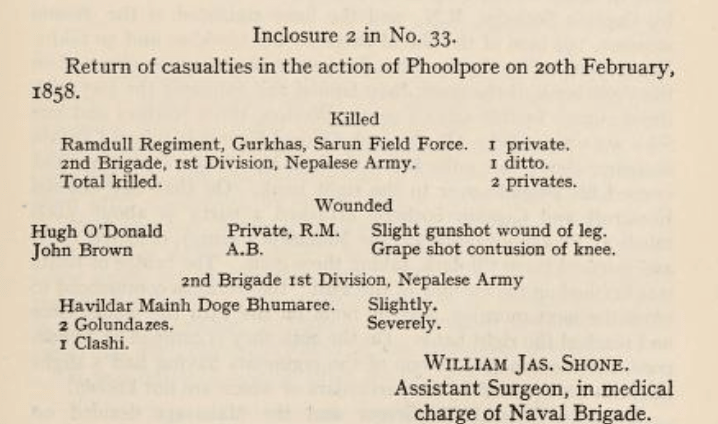
For the next two days, the seamen and the marines of the Naval Brigade constructed a bridge of boats to facilitate the crossing of the Nepalese Contingent who, under the orders of the Commander-in-Chief, Sir Colin Campbell, were to proceed to Lucknow via Sultanpur, while Rowcroft’s field force, the Naval Brigade and the Bengal Yeomanry Cavalry with two Nepal regiments would occupy Gorakhpur to keep open the line of communication. It was a sore blow, but they were not too sorry to see the backs of Jung Bahadur’s Gurkhas. While they had formed a strong bond with the Ramdhul Gurkhas, who, like the Goraknath Regiment of Gurkhas, were of the 5000 contracted to fight for the East India Company, each regiment kept its distinctiveness – the Goraknath Gurkhas had blue coats, and the Ramdhul, red. While the Goraknath Regiment were confirmed Hindus, Sotheby ensured that no oxen were slaughtered in the vicinity of the camp to avoid any offence, but the Ramdhul Gurkhas, who were raised in the regions bordering Tibet, held no such prejudices and freely ate the same food as the seamen. However, the Nepal Contingent were a new mystery. The European officers, as long as Jung Bahadur’s men were in camp, desisted from eating beef in any form for fear of offending the feisty men, but more than one frivolous complaint regarding the eating habits of Rowcroft’s men was brought to his attention. During the river crossing, the oxen were led across by Rowcroft’s herdsmen – some of the Nepalese Gurkhas, seeing the cattle being thus moved off, surmised they would be killed for food out of view and leapt to their defence with kukris drawn. Consequently, however hard it was to be left behind in Gorakhpur, it was finally decided that going on a long march anywhere with such “troublesome allies” was injudicious. While things may not have been smooth in camp, and the Naval Brigade found the Nepal Gurkhas tiresome, Jung Bahadur did have his men in check – they paid for everything on the line of march and in camp, nor were they tempted to plunder. As such, the country people were eager to do business with them and the regular “flying bazaar” formed up in the rear of the line to cater to their wants.
Jung Bahadur Holds a Darbar
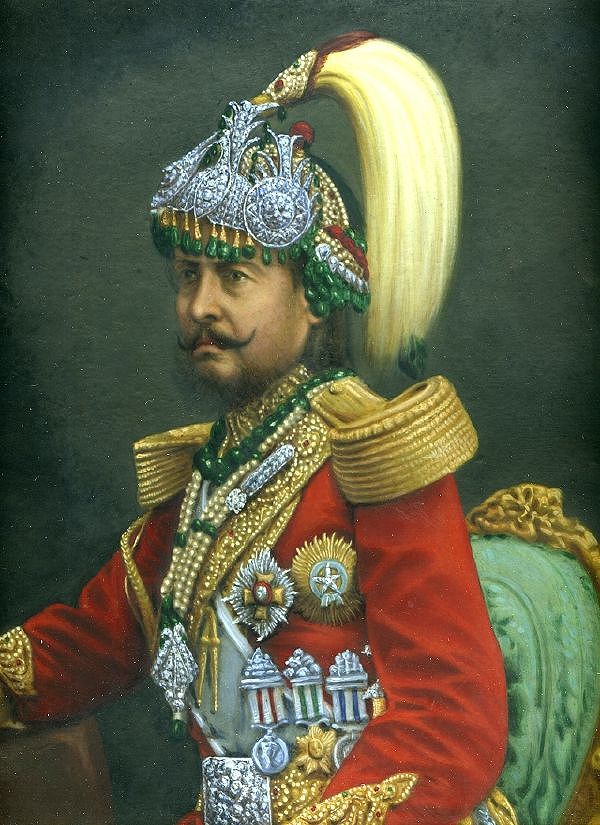
While his men might have presented a problem for the Europeans in the long run, Jung Bahadur himself was perfectly at ease with his allies. The distinction of leading his men to Lucknow was not lost on him, so on 24 February, he held a grand darbar for Sotheby and his men, a singular gesture of friendship before parting. He was not particularly pleased to be ordered to Lucknow, but Jung Bahadur “was too good a soldier” to admit it in public.
He held the darbar in the confines of the courtyard, which was set up around his own tent – the courtyard itself had been built using rows of canvas sheets to make a wall – and he came to the entrance to greet his guests in person. As each man was introduced, Jung Bahadur shook hands with him. As they entered his tent, his courtiers quickly informed the Europeans that at Jung Bahadur’s darbar, they did not need to remove their hats or take off their shoes. He then took his place at the head of the congregation and proceeded to engage the officers in all manner of talk -from the Crimean War to the current situation. Some officers were quite surprised that Jung Bahadur was well up on all events, modern and ancient. After a short time and some refreshments, Jung Bahadur escorted his guests to the door of his courtyard and, shaking hands with all of them, he bid them farewell. The next day, he broke camp and marched with his force to Akbarpur. Here, he stormed the fort, which was held by 34 men who defended it with such “force and vigour” that his force suffered 34 wounded and seven dead – but the rebels all bravely died at their posts. Two days later, he took another fort, which had been defended by 200 men, but these were less willing to engage the Gurkhas, and they left before Jung Bahadur could reach them. He aimed to form a juncture with the Brigadier-General Franks coming up from Jaunpur, two marches ahead of him. Jung Bahadur crossed the Gumti near Sultanpur and reached the vicinity of Lucknow on 10 March.
Sources:
Malleson, G. B. History of the Indian Mutiny, 1857-1858, Commencing from the Close of the Second Volume of Sir John Kaye’s History of the Sepoy War. Vol. 2. London: W.H. Allen, 1879.
Malleson, G. B., ed. Kaye’s & Malleson’s History of the Indian Mutiny of 1857-8. Vol. 4. London: W.H. Allen, 1889.
Nash, John Tulloch. Volunteering in India: An Authentic Narrative of the Military Services of the Bengal Yeomanry Cavalry During the Indian Mutiny and Sepoy War. London: George Philip & Son, 1893.
Rowbotham, W. B. The Naval Brigades in the Indian Mutiny 1857-58. London: Printed for the Navy Records Society, 1947.
Williams, E. A. The Cruise of the Pearl Round the World, with an Account of the Operations of the Naval Brigade in India. London: Richard Bentley, 1859.
Further Reading on Mutiny Reflections:
For Fyzabad:
https://mutinyreflections.wordpress.com/category/fyzabad-sultanpore-and-salon/
For Gorakhpur:
https://mutinyreflections.wordpress.com/2022/03/25/a-most-indifferent-regiment/
https://mutinyreflections.wordpress.com/category/gorakhpur/
For Sagauli:
https://mutinyreflections.wordpress.com/2024/10/04/disasters/
 Mutiny Reflections