The Action At Sohunpore
On Christmas Day, the Field Force received a reinforcement of the Gorucknath Gurkhas, 500 strong. They had come by forced march from Segauli but were armed with old flint-lock muskets; after the long march, they were footsore and hungry. Rowcroft decided the rebels could wait another day for the thrashing he meant to give them, and on the 26th, the force left camp at 8 am, battle-ready. He had 100 Gurkhas of the Nepalese Contingent, 50 matchlock men provided by the Hutwa Raja, 180 men of the Naval Brigade, 30 of the Royal Marine Light Infantry under Lieutenant Pym, Lieutenant Burlton and 50 Sikhs, 500 of the Ramdhul regiment of Gurkhas, and 350 of the Gorucknath regiment, under the command of Captains Weston and Brooks. “The Hon. Victor Montagu, midshipman, was appointed acting aide-de-camp to Colonel Rowcroft, and Mr F. H. Stephenson, midshipman, was acting aide-de-camp to Captain Sotheby, R.N. This duty they continued to fulfil throughout both campaigns. Mr Foot, midshipman, was attached to Lieutenant Turnour’s light field battery, and Lieutenant Radcliffe was in command of the naval column.” A few seamen were left behind to guard the camp and the Jarrai Bridge.
The force marched in column of sections, preceded by the Sikhs in skirmishing order, and the Marines followed as reserve to the Sikhs. When they arrived a mile from Sohunpore, the force deployed into line, taking the ground to the right, while Pym and the Royal Marines, Lieutenant Grant with a detachment of seamen, advanced skirmishing from the right, with Burlton and the Sikhs on the left.
Rowcroft positioned the four 12-pounder howitzers in the centre to the right of the guns. The naval column then deployed into line with a detachment of the Gorucknath Gurkhas between them and the Marines: the Ramdhul Regiment formed up left of the guns, and two reserve companies of Gurkhas remained at the rear of the line, while the artillery bullocks, the ammunition carts and elephants were drawn up behind the reserve with the rear-guard. The first gun opened fire at 10 am, forcing the rebels to show their hand. Their cavalry rode off to the left, while the right and front rapidly filled up with sepoys.
“Our force deployed into line in a large open maidan or plain; but intervening between our men and the enemy were fields of high crops, such as sugar-cane, dal, and other grain, and which grew so high that a large army might lie concealed in it, while the country would present the appearance of the most placid repose. The enemy pushed forward numerous skirmishers into the topes (woods) and high crops, opening a heavy fire of guns and musketry. Our skirmishers, though few, also advanced, steadily and boldly, driving them back, and doing much execution with their rifles. Notwithstanding the thick cover by which they might have been concealed, the noise and tumult which prevails in a native camp soon discovered the position of their main body.”
With their left on Sohunpore, they placed their guns on a small village to the right. As soon as Rowcroft’s line had advanced within range, they were met with a heavy fire as the guns enfiladed his line. His artillery answered with rounds of shot and shell, and the line advanced towards the musketry fire from Sohunpore. Now the rebels let loose their other guns, and for a moment, the field was alive with a brisk cannonade which carried on for half an hour until Turnour had managed to silence two of the rebel guns. The rebels were firing blind – the balls passed high over the men’s heads before tearing up the ground and ricocheting harmlessly in the rear. The rebel cavalry hung on the sidelines, unable to charge, and a few well-directed shells soon put them to flight. Meanwhile, the rebel infantry moved towards the small village on the left and tried to outflank Rowcroft, but the Sikhs with two companies of Gurkhas advanced and took the village. At the same time, Pym and the Royal Marines stormed through Sohunpore, with Lieutenant Grant and the seamen following up from the right. “After a three-hour hard fight, the enemy was completely dispersed and driven off the field. They were expelled from the topes and village, which was then entered. Their camp was taken and burned, some tents were carried off by the Sikhs, while their dinner and other articles, including earthenware culinary utensils, were left on the ground.” The rebels were seen, in full flight, making their way towards Mujhowli. Without cavalry, a pursuit was fruitless, but the Sikhs of the advanced guard were game for a run, and Rowcroft ordered the Marines, some of the Naval Brigade and four companies of Gurkhas to go in pursuit of the Sikhs. The Sikhs pounced on the rebels as they tried to ford the river and captured one large iron gun with the limber complete and full of ammunition, and two tumbrils – one filled with ammunition and the other with powder – made up the remainder of the catch. Several sepoys unluckily fell at the hands of the Sikhs. The fight had cost the Sarun Field Force one camp follower killed and several men wounded, among them, two Gurkhas severely.
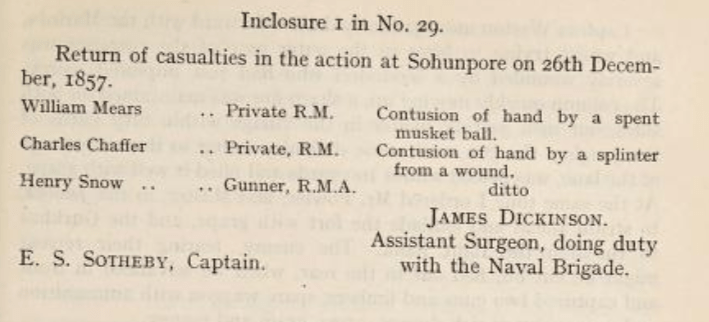
After the battle, the Sarun Field Force returned to Mujhowli to the rapturous greetings of the raja himself, who came to the camp to express his thanks to Rowcroft himself. The villagers stood on the side of the road as the men marched in hot and dusty and plied them with small pails of water and sweets.
“They were, at any rate, glad to make friends with the winning side, and no doubt felt the difference between the conduct of our troops and that of their own countrymen, who for several days had been looting all the villages in the vicinity of their camp. On the other hand, a locomotive bazaar or market having been established, marched when our force marched, and the natives, finding the trade so lucrative, were glad to bring their goods, knowing that they would obtain a ready sale and a good price.” (Williams)
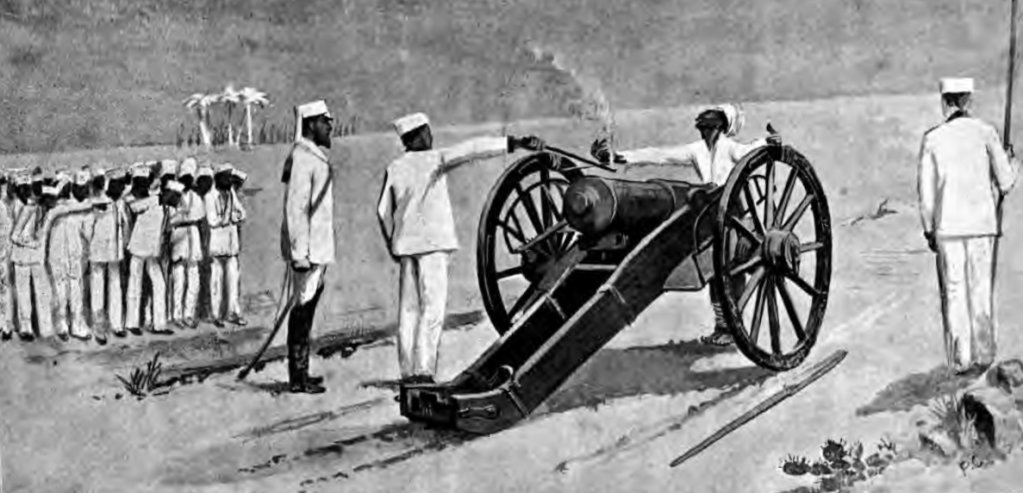
For several days following the battle, prisoners were made of fleeing sepoys – one in particular garnered enough attention to be blown from a gun. The unfortunate man had once belonged to the 10th BNI, who had mutinied at Fatehgarh on 18 June 1857. Rowcroft was particularly careful to explain to the horrified Gurkhas that this was not a usual English practice but reserved in wartime for men whose crimes were considered so heinous, such as mutiny and murder, that it was seen as a fitting punishment. In the mutiny at Fatehgarh, which did ultimately lead to the destruction of practically all civilians and all the officers of the station, the 10th BNI had stated they would not kill their officers but had invited the malicious 41st BNI from Sitapur to do so in their place. This act of betrayal on the part of the 10th was considered heinous in its own right; although they had not murdered their officers outright, they had done nothing to prevent the siege of the fort and had done nothing to assist the besieged. They then joined forces with the Nana Sahib at Cawnpore.
Jung Bahadur crossed the British frontier and reached Bhetia on 23 December, 82 miles east of Gorakhpur. Joined by Brigadier General MacGregor, they resumed their march, crossing the river Gandak on 30 December and arriving at Gorakhpur on 5 January 1858. They put the rebels to flight, who fled across the River Rapti, leaving the British to re-establish civil administration in Gorakhpur. A detachment of the Nepal force at Azamgarh in the meantime would now cross the Oudh Frontier to cooperate with General Franks and his force; MacGregor sent orders to Rowcroft to move his force by river to form a junction with Jung Bahadur. Before Rowcroft set off, Jung Bahadur marched his force to Barari on the left bank of the Gogra, reaching on 19 February. Around the same time, the Bengal Yeomanry Cavalry crossed the Ganges at Patna into the Tirhut District.
Rowcroft remained encamped at Majhowli until 30 January; he then struck camp, crossed the Chota Gandak and pitched camp on the right bank of the river near Salimpur. During the halt, which was to ascertain what had become of the Gorakhpur rebels and where they were heading, many of the inhabitants of the village showed up in camp, complaining bitterly that the rebels had rampaged through the district and Rowcroft, seeking to resupply his commissariat, soon found the allegations were not unfounded; provisions were scarce, and the people were terrified. Inevitably, the answer was always the same – they had nothing to sell, the rebels had stolen everything.
The Sarun Field Force arrived in Rudrapur on 11 January to find the raja had fled in their wake, taking everything with him which could be carried – they found the town deserted and the houses locked as the citizens had followed the raja in his flight. However, he was not very careful of his possessions or his treasure, and a great deal was found scattered along the road. Everything was gathered up and promptly sold off to restock the treasury. On 22 January, Rowcroft moved off, leaving behind the British magistrate and a small police force to settle the surrounding countryside on his own.
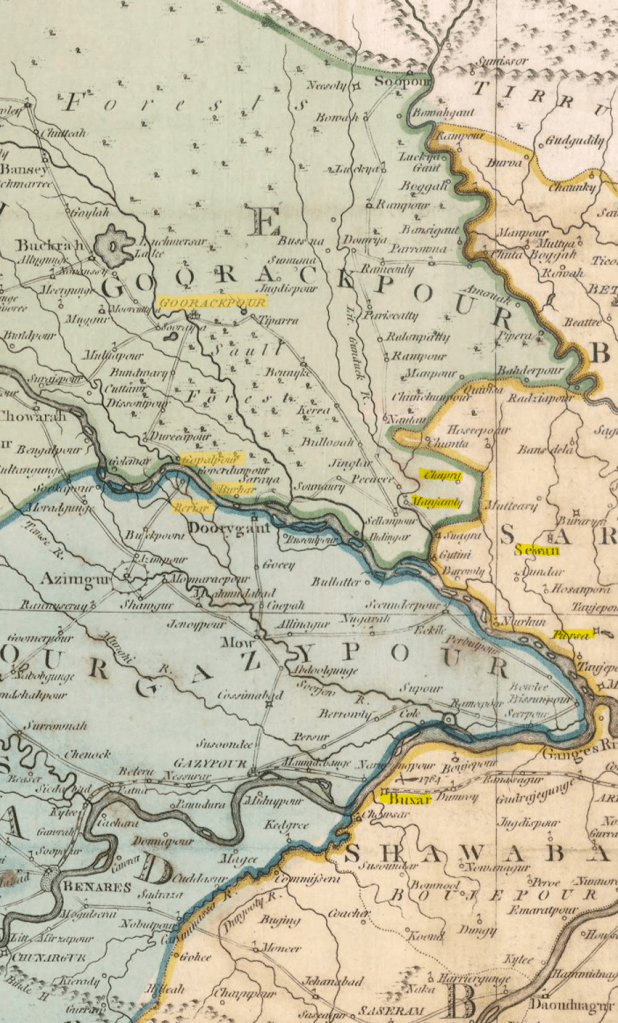
To follow the Trans-Gogra Campaign, FIBIS has complied a modern day map which can be found at this link:
https://www.google.com/maps/d/viewer?f=q&source=s_q&hl=en&geocode&ie=UTF8&hq&hnear&t=p&msa=0&z=8&mid=15gZy_L1UvFXW6LR4B7wguNF3y9U&ll=26.423502737961396%2C83.0807882357232
 Mutiny Reflections