November 1857-February 1858
The Pearl
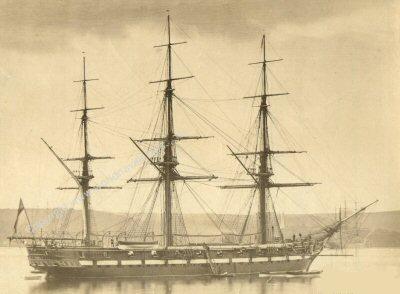
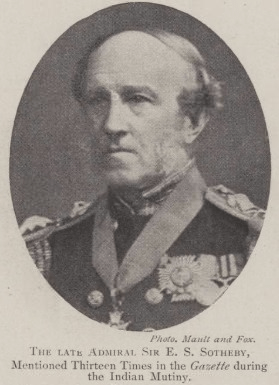
The Pearl was commissioned on 24 December 1855 by Captain Edward Southwell Sotheby, Royal Navy, at Woolwich. When she was ready for service, she proceeded to Portsmouth, where she should have joined the fleet for the third expedition to the Baltic.
“The Pearl was the first of the new class of 21-gun corvettes, which had been commissioned. Her armament consisted of 8-inch guns, having one 95-cwt. pivot gun; and, considering her tonnage, draught of water, weight of metal, and steam power, she was regarded as a most effective ship, and well suited to the Baltic, and, consequently, likely to see much active service. For these reasons, the command of her would naturally present more attractions to an enterprising officer than a line-of-battle ship, which would in all probability spend most of her time at anchor.”
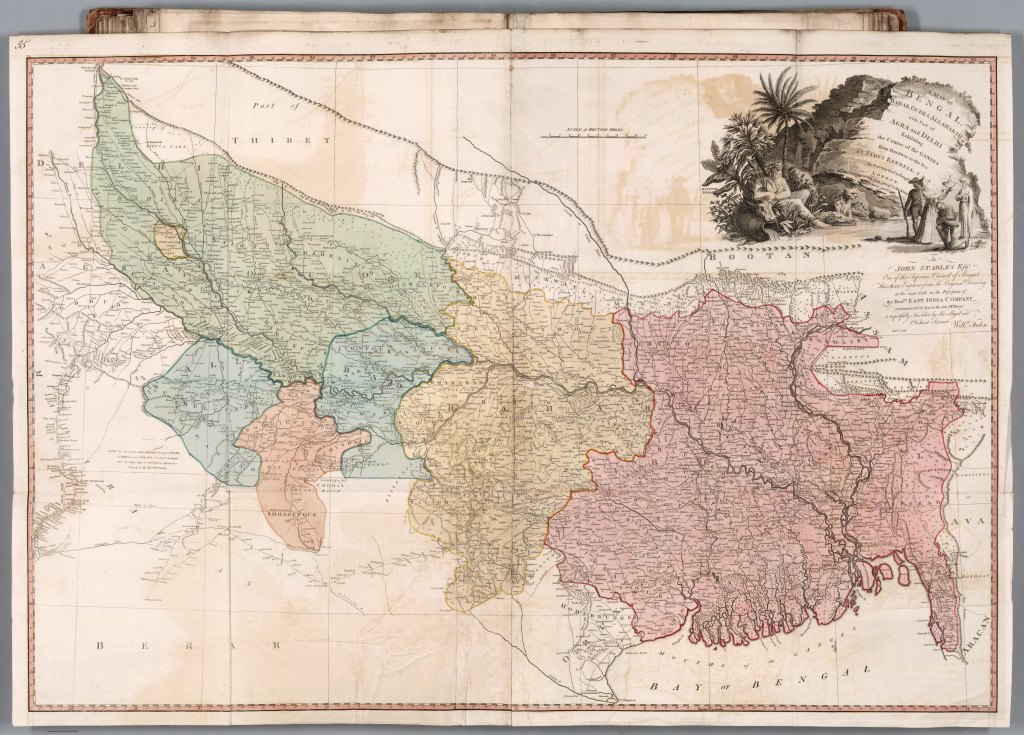
However, by the time the Pearl was ready, the Crimean War was over, and instead of the Baltic, she set off towards South America and the Pacific. Their next destination would be China, and the Pearl made it as far as Hong Kong when she was called for service in India. She arrived in Calcutta on 12 August 1857. The crew then watched as the Royal Marines they had brought with them were sent off to Fort William, and their passengers, H.M.’s 90th Regiment of Foot, were pushed up country. Captain Peel of the Shannon were already making their way towards Benares and Allahabad. Although Captain Sotheby had volunteered his crew and services to the government, the men of the Pearl remained in Calcutta until 12 September. Sotheby embarked part of his crew on the paddle-steamer Chunar – further 158 men of the Pearl (both seamen and marines) with one 12-pounder howitzer, one 24-pounder howitzer and a 24-pounder rockets; another company followed a month later. The journey was monotonous at best and, what with the water receding after the monsoons, slow. They arrived in Dinapore on 7 October, where Sotheby received orders to proceed to Buxar and garrison the fort. Although it had once been a civil station, more importantly, Buxar housed the government stud that supplied horses for the cavalry. The Naval Brigade arrived on the 10th, and Sotheby was determined his men would be fighting fit after such a long time on the Chunar. He ordered daily drill and gunnery exercises to which he added field guns; then, just in case they had any spare time, every man of the Pearl was trained in the management of artillery horses. On 23 October, they were called to Chupra, where it was rumoured a horde of rebels was hovering around the borders of the Sarun district.
The station they marched to was Sewan, which had been abandoned by the European residents but was presently occupied by a regiment of Gurkhas. As such, there was no fighting in Chupra, but 26 miles away, the Rajah at Mujowli was being threatened by a formidable horde on the borders of his district. So Sotheby ordered the Naval Brigade to accompany the Gurkhas to Mywra. The rebels, however, were not in the mood for a fight, and the advance was enough to send them scarpering off in a different direction. Although augmented by another company under Lieutenant Radcliffe, the Naval Brigade numbered only 250 men: some of these were volunteers from the merchant seamen of Calcutta and the the Royal Marines. It was hardly formidable and barely a brigade, but their duty was to watch over the rivers and prevent any incursions by the rebels. For some weeks, they sat it out in Mywra, waiting for the rebels, but none of them came. Occasionally, a spy or, by chance, a sepoy would be captured and executed, but slowly, the men of the Pearl began to think they had been brought up country for nothing. While Captain Peel and the men of the Shannon were having it out at Khajwa and in the streets of Lucknow, Sotheby was sitting in Bihar. On 27 November, Colonel Rowcroft arrived in Mywra to take command of the Sarun Field Force, but to their great disappointment, “operations were to be carried out entirely on the defensive…on no account was Gorakhpur to be entered, as the force was not strong enough to attack the enemy…” So, it was back to waiting.
On 13 December, things changed. A report stated that the rebels had attacked Guthni, a village eight miles away, had plundered the magazine and chased out a small garrison of Sikhs, who were now defending the town. Rowcroft ordered a detachment of the Naval Brigade with four guns, a detachment of the Ramdhul Regiment of Gurkhas, and a detachment of Royal Marines to march on the place without delay and drive the rebels out. Ready for a battle, with spirits rising, the men marched with swift steps and arrived at Guthni at noon. When they arrived, instead of a clamouring rabble of mutinous sepoys, they were met by sheepish Sikhs. A small force of rebels had indeed crossed the river the night before, catching the Sikhs off guard. The Jemadar “maintained no discipline, and allowed them to live in a disorderly manner; and who, when the Sikhs were assembled, would not lead them out against the insurgents.” So, all there was to do was to arrest the Jemadar and send him to Dinapore for trial and scold the Sikhs. In their turn, they threw all the blame on their derelict commander, apologised profusely for leaving their post and said they would wipe out their shame by volunteering for any service given to them. Meanwhile, the rebels camped out across the river in numbers; they stared and made the most provoking gestures. Without enough men, it was thought wiser to return to Myrwa instead of taking up their challenge. Disappointed, they marched the wearisome 8 miles back to the loathsome station. Meanwhile, Rowcroft and Sotheby, who had just about as much as they could take of Myrwa, decided to move onto the left bank of the river Jurrai. With information as unreliable as this, with the numbers of rebels fluctuating wildly, it was deemed necessary to have a river as a defence in the front instead of as a barrier in the rear of the camp. The rebels, in a moment of short-sightedness, misinterpreted the move as a retreat and were emboldened to advance. They crossed the little Gundak River at Mujowli on 22 December and, two days later, took up a position seven miles in the advance of Rowcroft near the village of Sohunpore, where they rapidly threw up earthworks in front of their camp. Unwittingly, they would be drawn up to an engagement in the open field.
 Mutiny Reflections