On the Move
With Macgregor’s orders in hand, Rowcroft, who had been engaged in various petty engagements of punishment for the past few weeks on both sides of the river, now organised a river fleet to move his men up Gogra. By 8 February, 150 boats had been procured, and a small steamer, the Jumna, was made ready.
“Along her sides, bulwarks, and around her upper decks fascines were attached, to protect her as much as possible from shot, and the fire of musketry, presenting, in some degree, the appearance of a moving battery.” The fleet set off two days later. However, intelligence regarding the state of the Oudh side of the river was hardly favourable. Reports began arriving that the rebels had taken up positions in forts along its banks and could, if they were so inclined, sink Rowcroft’s fleet with a few well-aimed rounds of shot and shell; however it wa feared before that would happen, the jittery boatmen would flee in alarm leaving the fleet to its fate. It was considered quite certain that no less than 5000 rebels were scouring the river bank and could, at their leisure, attack Rowcroft’s fleet. An escort was therefore required.
“After different plans were proposed and rejected, according to instructions received from Brigadier-General Macgregor, it was finally decided that the troops intended for the escort should be placed under the command of Captain Sotheby, E.N. They consisted of 145 seamen and marines, 100 Gorkhas, and 50 Sikhs, with one 12-pounder howitzer, in addition to the steamer “Jumna” with two small guns. It was supposed that sailors would then be in their element, and in the event of getting into a difficulty, would, no doubt, be well able to get out of it.” They sailed off with the fleet on 13 February while the headquarters under Rowcroft proceeded to Chupra Ghat on the Gogra where a brigade of Jung Bahadur’s Gurkhas were waiting to provide any assistance the fleet might require, “…but being completely bound down by
the orders of their chief, the European officers in military charge had little control over them, and were utterly unable to force them to yield their aid in the manner most required and most serviceable, rendering their assistance of little value.” The next day, Rowcroft was able to persuade on regiment of the Gurkhas to march to Chanderpore, a well-fortified fort on the river, but having sworn to obey Jung Bahadur’s orders, the Gurkhas refused to cross the river, “…except in company with the whole force, and the only advantage derived from their presence was, that they were present as spectators of the capture of the fort from the opposite bank.”
The Taking of Chanderpore Fort
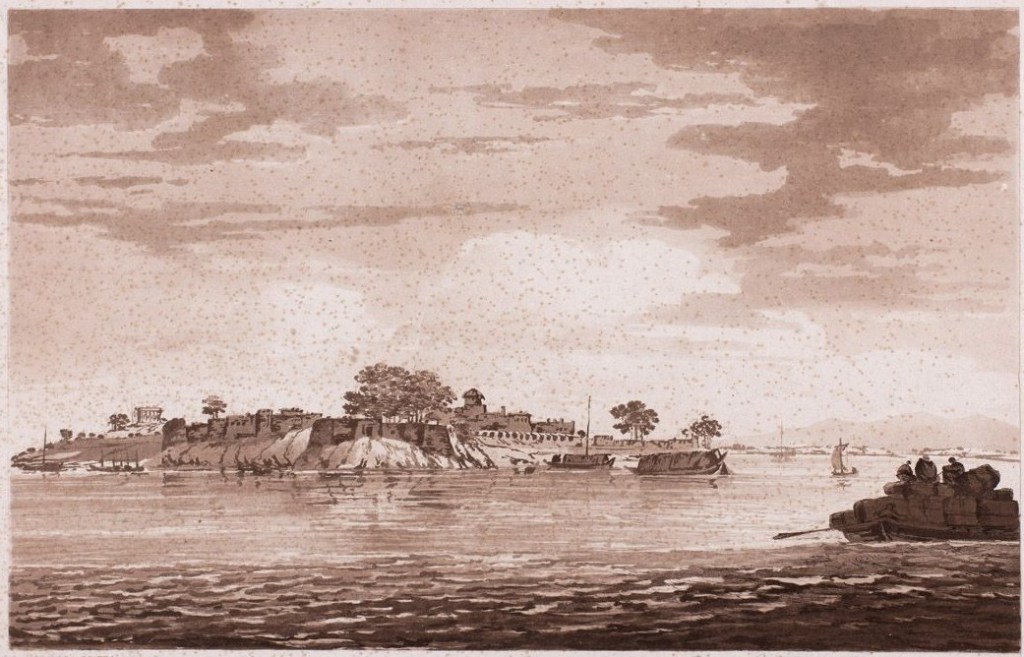
However, Rowcroft did not take the fort by himself. Captain Sotheby, with the escort, who had been delayed due to “…a strong wind blowing down the river; but after ceaseless energy and perseverance,
notwithstanding the obstacles of wind, current, the absence of a pilot, and clouds of sand, the boats constantly running foul of each other, and sometimes creating the utmost confusion, and notwithstanding the absence of both chart and pilot, the fleet advanced on the 17th as far as the strong fort of Chanderpore, on the right bank, at ten o’clock in the morning.” Sotheby landed two miles below the fort with 130 men of the Naval Brigade, 35 Sikhs and 60 Gurkhas.
The fort was, like many others in Oudh, well constructed with a deep ditch and a high embankment on three sides. The riverside was protected by the height and steepness of the embankments, making a further ditch unnecessary. Inside the fort were rifle pits and dangerously loopholed breastworks. These could only be approached by a zig zag path that ended in a set of gates that led to a second set of breastworks. The strong bastions and the parapet with the loopholed buildings in the centre gave the fort a formidable appearance. Just to make sure no one would be foolhardy enough to approach the place, a thick jungle of “prickly bamboo” grew in thick, lush abundance around it, making a stealthy approach practically impossible, but could equally provide anyone escaping from the fort sufficient cover to leave without being seen.
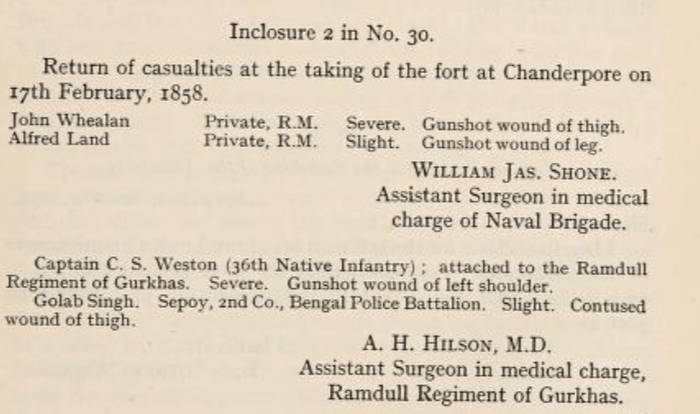
As soon as Sotheby disembarked his men, he formed the seamen in line and they advanced with a 12-pounder mountain train howitzer under Lieutenant Turnour. A body of marines and seamen were then deployed in skirmishing order, supported by Captain Weston a a body of Sikhs, while the 36th BNI were pushed forward. They quickly passed through an abandoned village but the skirmishers received such a galling fire of musketry from the fort and the rifle pits that Captain Weston dashed forward with the Sikhs to try and take the gate. He was almost instantly severely wounded by a well-aimed shot from within and carried to the rear. Turnour brought up his gun to within a hundred yards of the gate and attempted to blow it in while Sotheby ordered Mr Fowler, RN, to advance in the Jumna and throw “a few rounds of grape and shot” through the bamboo, at the fort, “while at the same time the Gorkhas threatening their right, the defenders being afraid lest their retreat should be cut off, fled with all speed through the jungle in the rear, as the marines and Sikhs entered in the front.” With no cavalry to pursue the approximately 300 men who scrambled out of the fort as the Sikhs came in through the gate, they fled through the bamboo jungle and disappeared.
The Sikhs took the lion’s share of the plunder found inside the fort, but Sotheby secured two guns – a six and a four-pounder, with limbers and a spare ammunition wagon. As for casualties, two men were severely wounded and three slightly – the rebels had fired too high to cause much more damage and much of the bullets had gone over the heads of Sotheby and the men. Chanderpore Fort would not be held but the buildings within the walls were torched and the men then re-embarked.
“I would beg to bring to the notice of his Lordship in Council the gallant and spirited conduct of all the officers and men engaged on this occasion, and particularly that of Captain Sotheby, R.N., whose performance of the very arduous duty of escorting that large fleet up so rapid and difficult a river, with one bank crowned with forts, manned by the enemy, has been such as to merit the very best acknowledgments that I can bestow. The crowning exploit of attacking and capturing the strongest fort on the river with his handful of me, will recommend itself at once to the notice of his Lordship in Council.” (Brigadier-General Macgregor to the Secretary of the Government).
The fleet left the burned-out fort behind them and proceeded on their way, arriving at Nourainie Ghat on the evening of 19 February. Here, another fort presented itself, and it was said no less than 5000 rebels were nearby. Five miles further up, Jung Bahadur was encamped at Gai Ghat with his 9000 troops and artillery. Jung Bahadur had fruitlessly attempted to effect a river crossing with his men before the arrival of Rowcroft and Sotheby, but “owing to some mismanagement”, he had succeeded in bringing himself to the attention of the rebels across the river who fired at the raftsmen. Rightly terrified, these fled, leaving Jung Bahadur no choice but to wait. A river crossing was therefore decided upon for the following night, just in case the rebels got wind of the arrival of the fleet and should be disposed to launch an attack.
The crossing commenced at nine pm, and an hour later, the Naval Brigade of the escort with two 12-pound howitzers, five companies of Gurkhas and the Sikh detachment landed on the opposite side of the river. The other two guns of the Naval artillery were brought down to the river’s left bank, just below the fort to cover the landing party; “and notwithstanding a long march that day of twenty miles under a burning sun, and the men having this fatiguing duty of pulling the guns along a heavy sandbank, and wading up to their waists in water, they performed it with their usual good spirit and zeal; and about midnight the village and fort were seized and occupied.” Once again, good intelligence regarding the fort’s strength was lacking, so Sotheby proceeded cautiously, taking it for granted it was most likely well-manned and entrenched. His men moved on in perfect silence, creeping from a thick forest into the bamboo jungle, passed the rifle pits and right up to the main gate, where they found a sepoy sleeping on his charpoy next to a small fire. “He was seized by the throat” before he could sound the alarm, and the men proceeded onwards to find the gate was unlocked. There was no need for further stealth. The fort was empty. With no enemy and no fighting, the men settled down for the night under trees on the bare ground.
 Mutiny Reflections