General Thomas Harte Franks
Thomas Harte Franks was born in 1808, the second son of William Franks of Carrig Castle, close to Mallow in County Cork, and his wife Catherine (née Hume), the daughter of William Hume, MP for County Wicklow. He was commissioned in the HM’s 10th Regiment of Foot in 1825, promoted lieutenant in 1826 and captain in 1839. He attained the rank of major in 1843 and lieutenant colonel in 1845. He sailed with his regiment to India in 1842 and had his first taste of action during the First Sikh War when the 10th was called up to fill in for the losses suffered at Mudki and Ferozeshah.
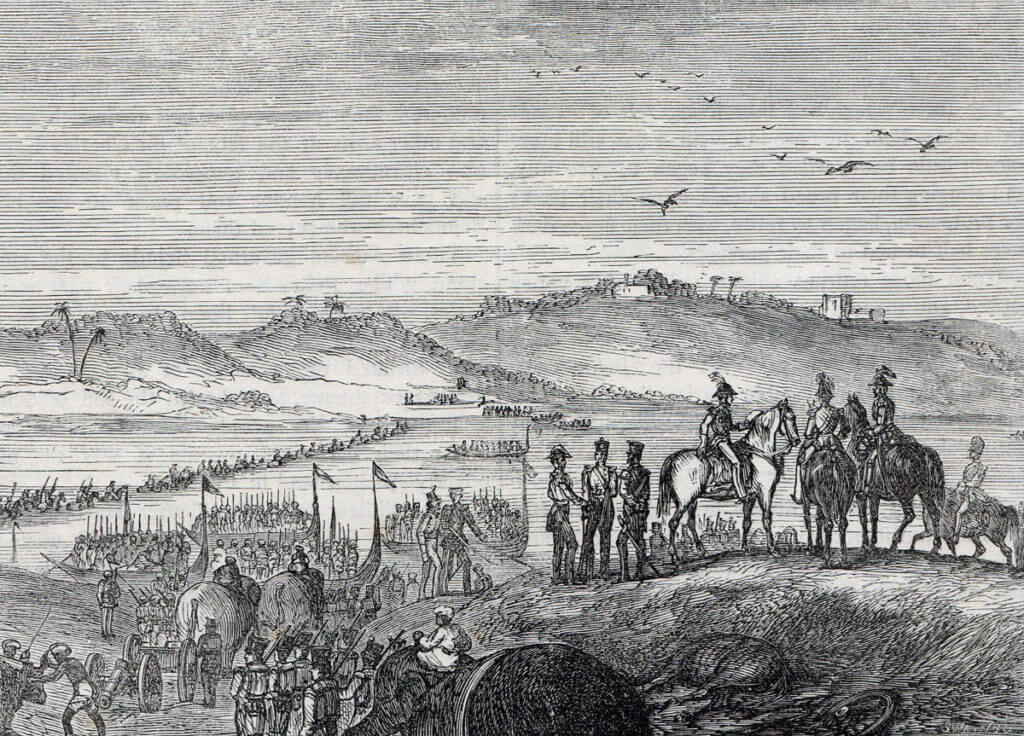
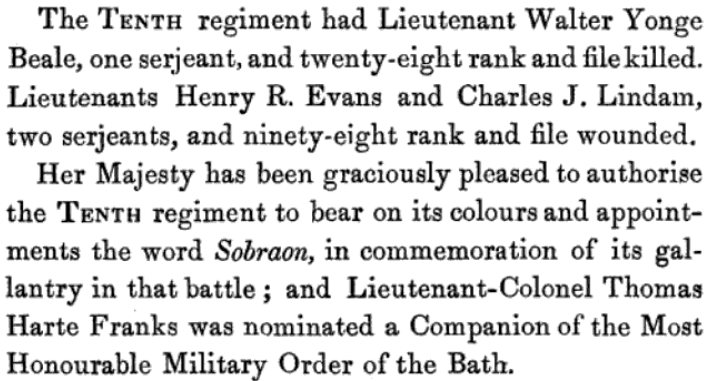
They marched from Meerut under command of Lieutenant Colonel Franks on 16 December 1845 and joined the Army of the Sutlej on 8 January 1846. Their first engagement would come at Sobraon. From the despatch of General Sir Hugh Gough, the 10th, under Franks, behaved admirably, for, with coll and steady courage, the regiment marched on with the “precision of a field day” (Historical records) and “never fired a shot until within the works of the enemy.” (Gough) Franks was wounded and had his horse shot under him, but the 10th carried the Sikh position in their front.
During the Second Sikh War, the 10th, with Franks, was the first British regiment to come up to the Siege of Multan; Franks would then serve with distinction at the Battle of Gujerat – he was promoted to colonel in 1854, and in 1855, took command of the Jalandhar Brigade.
There were many stories surrounding Franks, who by all accounts was as strict with himself as he was with his men, and two of these hark back to the Sikh wars:
“When firing blank one day, a bullet whistled past Colonel Franks. He did not stop the firing, but when the number of rounds ordered had been completed, he rode up to the regiment and said—
”Boys, there’s a damned bad shot in the 10th. He nearly shot my trumpeter, and what should I have said to that boy’s mother? I don’t want to know the blackguard’s name, the officers will not examine the men’s pouches.”
They were on the eve of a campaign and the Senior Major came to him before an action and said —
“Don’t put yourself in front of the regiment to-morrow. Colonel, you know there are always one or two bad men in a regiment.”
‘Thank you. Major, it’s very kind of you. I might have given you a step.”
When the 10th were drawn up for the final advance, he put himself at their head, and said —
Boys, I’m tould ye mane to shoot me to-day. Take my advice, and don’t shoot Tom Franks till the foighting’s done for ye won’t find a better man to lade ye.”
The regiment answered with a cheer, and carried the Sikh batteries with the bayonet rather than run the risk of shooting the old fire-eater at their head.”
Ill-health forced Franks to give up his command in 1857, and he was supposed to return to England on sick leave; however, the mutiny broke out before he set sail, and Franks opted to remain in Calcutta until he was well enough to be of service. Finally, in January 1858, fighting fit, Franks was appointed commander of the 4th Infantry Division with the rank of brigadier general. We have already seen his career with the Jaunpore Field Force, where he proved himself to be an officer of singular merit. Unfortunately, the incident at Dhowrara provoked such a reaction from Sir Colin Campbell that, following the final retaking of Lucknow, he refused to give Franks another command. Instead, Franks set sail for home. On 20 July 1858, he was promoted to major-general, received his KCB and thanks from parliament for his services. Unfortunately, there was very little time left for Sir Thomas Harte Franks. He was a widower, having married in 1842 to Matilda Kay (widow of Rev. W. Fletcher). However, it would appear the union was short, and there were no children, and Matilda died before Franks left for India. In 1859, he remarried, this time to the widow of the late Samuel Brewis Esq, Rebecca Constantia Elizabeth. The final campaign had ruined Franks’ health beyond the power of healing, and he died, aged 54, at Ibstone House, Tetsworth, Oxfordshire, on 5 February 1862. Lady Franks outlived her husband by 21 years – they had no children.
As Malleson says,
“Franks was known as one of the best regimental officers in the British army. This short campaign stamped him as qualified to take a very high rank among its generals.”
Unfortunately, men like Thomas Harte Franks rarely have a chance to shine and disappear under the shadow of Sir Colin Campbell; their campaigns, no matter how successful, are swiftly forgotten.
Sources:
Caine, Caesar, ed. Barracks and Battlefields in India; or the Experiences of a Soldier of the 10th Foot (North Lincoln) in the Sikh Wars and Sepoy Mutiny. London: C.H. Kelly, 1891.
Franks, T. H. Operations of the Jaunpore Field Force and the Fourth Division under the Command of Brigadier-General T.H. Franks, C.B. in its Progress from Benares to Lucknow in the Months of January, February and March, 1858. London: Printed for Private Circulation, 1858.
Great Britain. Parliament. Further Papers, No. 7 & No. 8, Relative to the Mutinies in the East Indies. London: Harrison & Sons, 1857–1858.
Malleson, G. B. History of the Indian Mutiny, 1857-1858, Commencing from the Close of the Second Volume of Sir John Kaye’s History of the Sepoy War. Vol. 2. London: W.H. Allen, 1879.
Malleson, G. B., ed. Kaye’s & Malleson’s History of the Indian Mutiny of 1857-8. Vol. 4. London: W.H. Allen, 1889.
Strange, T. Bland. Gunner Jingo’s Jubilee. London: Remington & Co., Ltd., 1893.
 Mutiny Reflections
I have taken part in a short story competition please put your valuable opinion through the link by Google account 🙏😊
LikeLiked by 2 people
Hello Priti
I have read your short story and left my comment! I wish you every success, the story is wonderful!
LikeLiked by 1 person
Brave soldier 💪 well shared
LikeLiked by 1 person
Thank you so much! I am glad you are enjoying reading the posts!
LikeLiked by 1 person