Dhowrara Fort, March 4th 1858
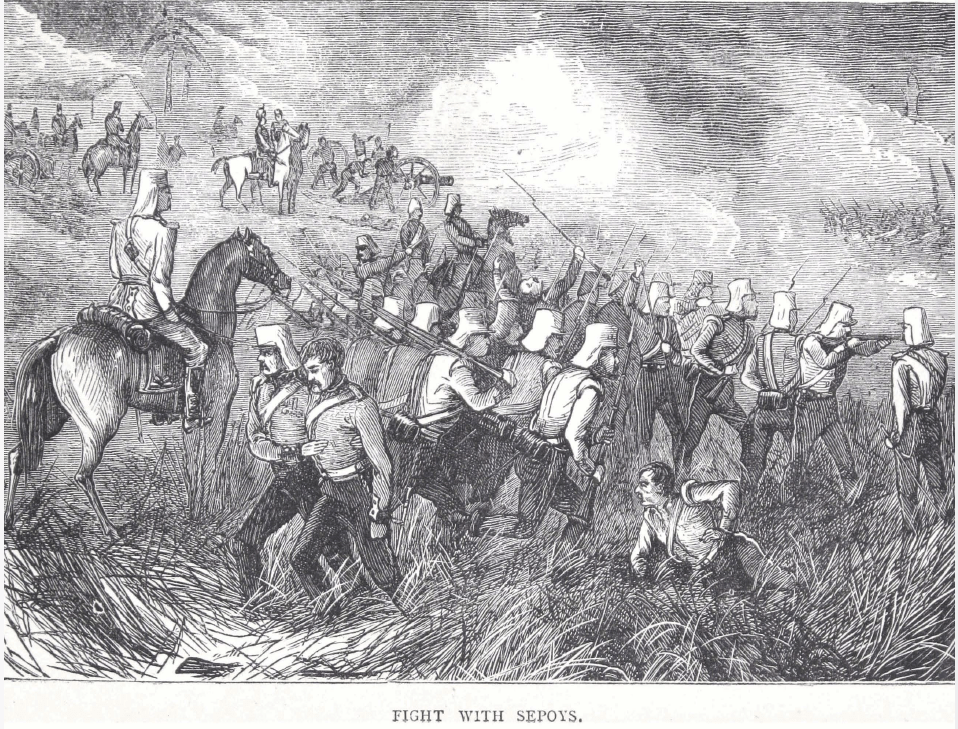
“It is very strange that after such a splendid march, in which we covered one hundred and fifty miles and met the enemy several times in less than two weeks, we were at the close repulsed. This occurred yesterday. When within ten miles of Lucknow, Franks detached a small force to attack the fort of Darowhda. The strength of the enemy was miscalculated, and we had to retire with a gallant officer killed and another badly wounded, and the enemy encouraged to further mischief. As these are days when the authorities, and people generally, are anxious and become alarmed if any slight advantage is given to the enemy, it is possible that this one misfortune will do much to dim the lustre of General Franks’ splendid work during the past few days.”
Dhowrara Fort was located two miles to the right of the road and situated in difficult, broken ground amongst the ravines of the Gumti – until now, Franks had passed many such forts, but he not paid them any mind; in his experience, the garrisons within were small and as soon as they sighted his field force, the rebels were quick to abandon them. However, Dhowrara was causing some consternation: the rebels had taken some care in their fortifications and had even placed two guns, uncomfortably positioned with Franks’ in their sights. What mischief they planned, he did not know, but apprehensive they might very well harrass his long baggage train, Franks determined to take Dhowrara.
“The main column, under Brigadier Evelegh, C.B., moved on a mile further on the road to Goorsaheegunge, where it halted; while with the two horse-artillery guns of Lieutenant-Colonel D’Aguilar’s troop, under Lieutenant Arbuthnot, a squadron of 9th Lancers, and some Seikh and Pathan Horse, the whole under Captain Coles, 9th Lancers,-I examined the fort. About 500 rebels originally occupied it, while nearly 3000 men were collected in its vicinity, most of whom fled down the ravines and escaped over the river when they saw our cavalry circling round their flanks; 200, however, fell back and prepared to defend it.”
The rebels opened fire from their two small guns as soon Franks approached. He opened up his guns at 600 yards.
Meanwhile, Franks’ cavalry threatened the rebel flanks, but he kept the 9th Lancers in reserve, well out of fire. Invain, Captain Havelock protested that Franks was deploying the wrong guns; instead of the two 24-pounder howitzers, Franks obstinantly moved the two horse artillery guns forward instead. Successively, to 400 yards, 300 hundred and finally at 200 hundred yards, the guns failed to breach the fort’s walls or silence the hail of matchlock fire from the rebels.
He then ordered up a company of marksmen from each of the British regiments under Lieutenant-Colonel Longden and finally, the Major Cotter and his two 24-pounder howitzers. Under the severe pounding from the howitzers, the outer defences of the fort collapsed, and the infantry rushed forward to capture the two guns, but the rebels were not done. Under a muderous matchlock fire, Franks extended the 10th in a meadow on the riverside of the fort and closed on the fort from that direction, while the 20th and 97th were to attack from the south-east. The rebels who had not been successful in retreating behind the gate now turned to fight; however, many of them simply ran off, up the ravines and into the waiting line of the Pathan cavalry. Back at the fort, the 20th and the 97th now rushed forward, “gallantly headed by Captain Middleton, 29th Regiment, and Ensign Elton, 37th Native Infantry, attached to 10th Foot,” and bayoneted another 120 men. Meanwhile, Brigadier Evelegh was having troubles of his own and reported to Franks a considerable body of rebels was hovering off to his right front, and he intended to send his force to meet them. Franks now galloped off to see for himself what Evelegh was facing – it turned out to be a body of rebel cavalry who, although menacing, had changed their minds about fighting after all and had fallen back towards Lucknow.
Back at the fort, instead of doing what Franks expected – scampering out the back – the remaining rebels barricaded themselves in a house behind a massive gate and continued firing on his men.
“With the assistance of Sergeant Wilkins and a couple of Horse Artillery Gunners, Jingo turned one of the enemy’s guns from the exterior entrenchment, and, kicking into the ditch the dead body of a Sepahi that lay across the bridge, ran in the gun and opened fire on the gate. But the 6-pounder shot only made little holes which did not even let daylight through, thus proving that there was some further barrier behind. He then fired at and struck what appeared to be the lock, but still, the gate remained solidly closed. A shot jamming in the bore, the gun business seemed to be hopeless, and it was decided to try a powder bag. The sergeant carried the body of the gallant young officer. Lieutenant Percy Smyth, to the rear.”
Franks turned one of the rebel guns on the gate but was unable to make even the slightest dent; he then ordered a fire lit against it, which proved equally ineffective – and the only engineer officer, Mcleod Innes, was severely wounded, while stooping over the powder bag, shot in the upper part of both legs trying to blow it open. Captain Middleton and Lieutenant Strange took over, fixed the powerd to the gate and when Middleton had lit the fuse with a port fire he had tied to his hog spear, both men rushed back to safety.
“The storming party was ready for a rush, but — the explosion only blew a few splinters from the gate, which still stood almost as before. The native powder had proved too weak. Now came an imperative order from the General to retire immediately. But there were the enemy’s guns standing in the exterior entrenchment and one close to the obdurate gate. These guns would certainly be turned on the retiring
force and there were no spikes to render them unserviceable — besides, to abandon captured guns was not to be thought of. The fire from the keep, now that the covering British Infantry were withdrawn, was redoubled. Jingo and the remaining officers dashed into the gate, flung round the gun trail, and ran it out. Directly they had passed the bridge, they were sheltered, as were the remaining three guns which were also carried off, bullocks having been procured. The derisive shouts and last shots of the plucky garrison who still held the keep, were not pleasant to the ears of the retiring men, whose consolation, however, was the capture of the guns.” (Gunner Jingo)
Franks withdrew from Dhowrara Fort and called it a day.
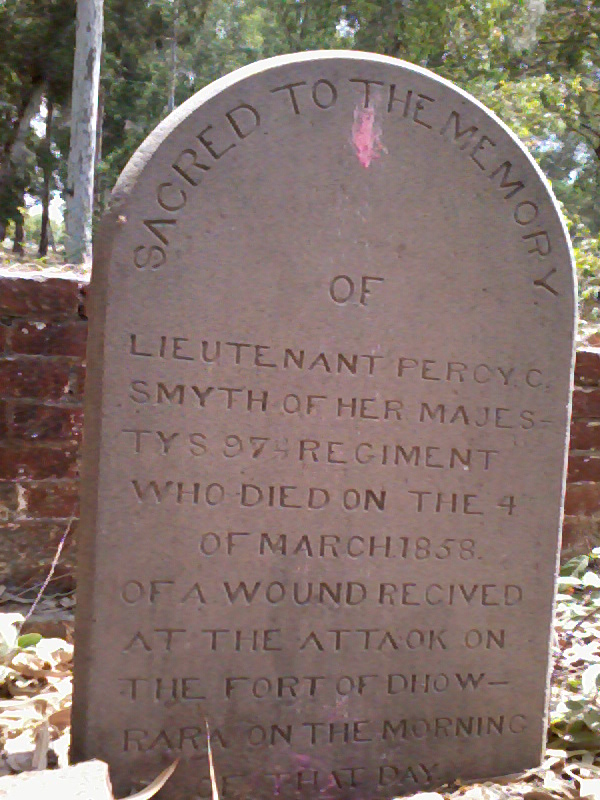
Besides Innes, Lieutenant Percy Charles Smyth of the 97th, “a most brave and promising young officer,” was mortally wounded by a musket ball that tore through his abdomen. He died shortly after, aged 21, and was buried aside the Sultanpore road. Smyth was born on 17 January 1837 in London, the son of the late Henry Mitchell Smyth of Castle Widenham, Cork.
Smyth entered the army as an ensign in HM’s 97th Foot on 9 March 1855. Promoted to lieutenant, he joined his regiment in Crimea and returned home with it in July 1856. He arrived in India with the 97th in November 1857 and joined the Jaunpore Field Force in January 1858. During the attack on Dhowrara Fort, Smyth was acting as orderly officer to the Commanding Officer of the 10th Foot. Lieutenant Smyth was awarded the Indian Mutiny Medal with one clasp for Lucknow.
The same evening, Franks arrived at Sir Colin Campbell’s camp.
This final action ended Franks’s campaign with the Jaunpore Field Force. In 13 days, he had marched 130 miles, from eastern to central Oudh, beaten the rebels in four successful actions, and captured 34 guns with the small loss of the 37 officers and men killed and wounded. The repulse at Dhowrara, a clear case of overconfidence in a skilled and experienced officer, was not taken well by Sir Colin Campbell. The C. in C., who had been watching Franks’ progress most carefully, had considered him to “command the corps d’armee” which was to act on the left bank of the Gumti; but the slap in the face Franks received at Dhowrara caused Campbell to strike out Franks’ name and replace it with Sir James Outram’s instead.
 Mutiny Reflections
I have taken part in a short story competition please put your valuable opinion through the link by Google account 🙏😊
LikeLiked by 2 people
Hello Priti
I have read your short story and left my comment! I wish you every success, the story is wonderful!
LikeLiked by 1 person
Brave soldier 💪 well shared
LikeLiked by 1 person
Thank you so much! I am glad you are enjoying reading the posts!
LikeLiked by 1 person