A Parade of Forgiveness
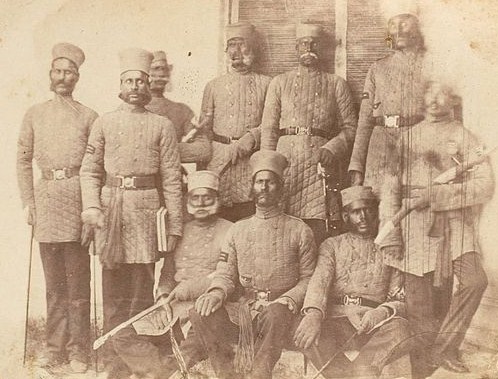
However, the following story could have been avoided, had General Barnard, then in Ambala, acted with firm resolution. Instead of disarming and disbanding both the 5th and the 60th without further ado, he chose instead to parade them. He then spoke to them with kindness and generosity – it was, he believed, all a mistake. The men had simply panicked and he was willing to forgive them and overlook their lack of judgement. Both regiments were further promised that they would march to Delhi and have the opportunity to redeem themselves. The sepoys were then made to file past their Colours in single file and kiss both, thus taking a new oath of fidelity. What he and the officers missed, however, was seen clearly by the spectators — the sepoys completed their task and then spat on the ground just out of view of the Colours.
It was in this veritable mare’s nest that Colonel Seaton would now find himself. He reached Ambala early on the 15th of May shortly before the Commander-in-Chief, General the Hon. Anson. Seaton took up his accommodation in the dak bungalow and settled down to breakfast, after which he made his arrangements to proceed to the regiment.
“…a gentleman, who was walking there, suddenly called out, ‘Look out, sir; I saw that sepoy loading his musket.’ On looking round, I saw a sepoy of some regiment outside the grounds of the bungalow with his musket at the ‘order.’ Keeping my eye on the fellow, I questioned the gentleman, who positively affirmed that he had seen the man load his musket. I got my glass, and on looking at the sepoy found that he was one of the 60th N.I., the very ‘babes’ I had come to command. Without a moment’s delay, I put on my sword, jumped into the buggy, and drove off to the quarters of the adjutant, the gallant and lamented Lieutenant Shebbeare.”
Seaton immediately told Shebbeare of his ‘errand’ and presented him with his credentials; in less than an hour, he was inspecting the muskets of the guards. Not one was found to be loaded but Seaton was very careful to explain to the men his purpose – there would be no misunderstandings and he intended to show the sepoys from the first that he was willing to listen to them. He hoped to learn, he said to them, that much he had heard of their conduct was indeed a misrepresentation.
Colonel Seaton was surprised there were still doubts amongst the officers whether the native regiments — the 5th and 60th — should be disarmed. They had both shown themselves unwilling to obey orders, but their insolence was judiciously overlooked, and they would remain under arms. Seaton found the whole undertaking a useless show — men who had already shown themselves insolent could hardly be kept together for long with niceties and kind words. He had no illusions about the state of the army; indeed, he had seen the seeds already sown years before, as had others (The Army has Ceased to Fear I & II and The Army Rebels). John Lawrence on hearing the regiments had not been disbanded, sent one of his blazing missives, that honour be damned, and demanded immediate action. The reply from the Commander-in-Chief was, in as many words, it would be wrong for an Englishman to go back on his word. They would now simply have to make the best of it all.
On the 21st of May, it was finally decided what to do with the 60th BNI. They were to be taken out of Ambala to Karnal. An officer of HM’s 75th swiftly informed Seaton he would march his men in his rear to force the 60th along if they refused to go on, and with this small comfort, Seaton and the 60th marched on the 23rd, reaching Karnal the next day.
On the March
On the 25th, Colonel Chester, with orders from Anson, ordered Seaton to take the 60th to Rohtak to intercept the Haryana Light Infantry, who, with the 4th Irregulars, had mutinied at Hansi and Hissar. The news had spread through Karnal like wildfire. The European troops declared they would not have any native regiments in their midst; the C-in-C had realised his mistake too late when he had not disarmed the 60th at Ambala and now his only option was to send them off with Seaton and the other officers of the regiment, as far away as possible. That Rohtak was only 45 miles (ca. 72 km) from Delhi did not seem to interest anyone.
As for Seaton and the other officers, they felt that Anson had effectively sentenced them to death.
“I had known Colonel Chester for years, but so thoroughly was he ashamed of the order, that when he communicated it he did not lift his eyes from the paper before him. It was a cruel, ‘half-hearted
measure,’ loudly condemned by everyone in the force in stronger language than I should like to commit to paper, for not a soul ever expected to see me or my officers again.”
However, orders were orders. Seaton put on his bravest face and spoke kindly and cheerily to the men and their officers, and on the 27th they moved off towards Rohtak. From the first, as soon as Karnal was well behind them, the men started showing the first signs of disaffection. As the road was hardly more than a track, the regiment lost its way and was forced to backtrack and recross a canal some miles back. Due to the heat, Seaton called a halt to allow his to drink on the other side of the canal, and rest in the shade, under a grove of mango trees. Without waiting for orders to fall out, the sepoys began pillaging the fruit — all endeavours by their officers to bring them to line failed. One young sepoy, bolder than the rest, barked his answer insolently at his captain who grabbed him by the collar and tried, by force, to make him fall in. Around him, the other sepoys were starting to close in, and it looked as if the captain was doomed to a nasty fate. Seaton realised only instant interference would save not just his officer but the regiment from mutiny. Stepping up slowly, he looked at the sullen sepoy and then sternly, without raising his voice, said,
“Do you know what you are about? Go and fall in instantly; you are all mad.’’ Without a word of reply, the sepoy put up his hands in a deprecatory manner and fell into the ranks at once. There was no further trouble with any of them.”
Sensing that they had not yet determined to mutiny, unable as yet to throw off the “habit of obedience” to their colonel and this strange new one, who at this point, they only knew of by his reputation, Seaton took the march onwards. At their next halt, he called the young sepoy before him.
“What had become of your senses,” I said, “this morning when you spoke disrespectfully to your captain and resisted him ?”
“ Sahib,” he answered, very respectfully, “ I committed a great fault; I have repented, and will never do so again—forgive me.”
“You ought not to have committed it. The Commander-in-chief has been very good to this regiment. Instead of punishing you all for your misconduct and mutiny at Umballa, he freely pardoned you. He took me from my own regiment, and sent me to this, that I might be kind to you, and warn you against further error. Is this the return you make?”
“Colonel Sahib, I will never again commit such a fault. I have repented—forgive me.”
“Very well; your subadar says you have repented, and your captain says you are generally a well-behaved man, so I forgive you.” Seaton was in no position to punish the man, nor could he threaten him — he hoped that by showing him respect he could stave off mutiny. He would later find out that the regiment had been carefully watching what Seaton would do — his actions gained him, at least for a moment, credit with mutinous men.
Shebbeare had for some time found himself in a difficult position – Colonel Richard Drought had been a “disagreeable officer, utterly unfit for an emergency” and above all the men did not respect him. A near hatred of the colonel prevailed among the European officers and Seaton’s arrival was for them a relief. Drought was hardly any older than Seaton himself – he was 55 to Seaton’s 51, they had arrived in India at nearly the same time, but unlike Seaton, he had grown into a well-worn East India Company officer. Drought had spent his life with 60th NI, from ensign to colonel and his trust in his men, whom he affectionately referred to as “his children” was absolute. For younger officers like Shebbeare, who did not share his infatuation, serving under him must have been a torment, to say the least. Unfortunately, the sepoys misunderstood that they had a true friend in men like Drought – men who in peacetime, in their eyes, had lost their shine. Like so many others, he was a powerless colonel singularly out of touch but retaining that terrible belief, because he trusted his men implicitly they would never betray him. The scenario played itself over and over again throughout the mutiny, a kindly but blind infatuation. His intervention at Ambala had been turned by the sepoys to their advantage; they had escaped the treatment they deserved as mutineers. Here they were, still under arms and well on their way to Delhi without firing a single shot. For Shebbeare and Walker, they could only now hope the 60th would remember enough of their old loyalty to prevent them from cutting their throats. Although Drought was the 60th at Rohtak now, Seaton’s command was absolute and the old man was left further down the chain, in charge of nothing at all.
The day they reached Rohtak, Seaton had made a long march the night before, of 18 miles, anxious to meet the Haryana Light Infantry. His objective was to parade the 60th at Rohtak before they met the Haryana mutineers, to “point to the men as cowards who had debased their name and sex by the murder of helpless women and children, and then try to bring them into collision before any communication could pass between them. It was our only hope of saving the regiment; and if, whilst I was addressing the men, or we were preparing to attack the mutineers, the 60th should show signs of turning against us, being armed and mounted, and our horses at hand, we should stand a better chance of escape than if the regiment were to break into revolt at night, or attack us unarmed and unprepared.”
The stifling heat and the hot wind blowing from the desert made the march a decidedly miserable one. No one had been able to sleep during the day on account of the scorching temperatures -Shebbeare notes it was 120° F in the shade, which barely lessened at night – everyone was tired and the men barely shuffled along. When the wind abated somewhat shortly after midnight, Seaton realised he was now falling asleep in his saddle – he dismounted and walked just to keep his eyes open, only to find himself dropping off as each successive stumble jolted him back to alertness. At two in the morning, just outside a slumbering village, Seaton called a halt. There was a large well with good water and soon all the men were crowded around it, drinking their fill.
 Mutiny Reflections