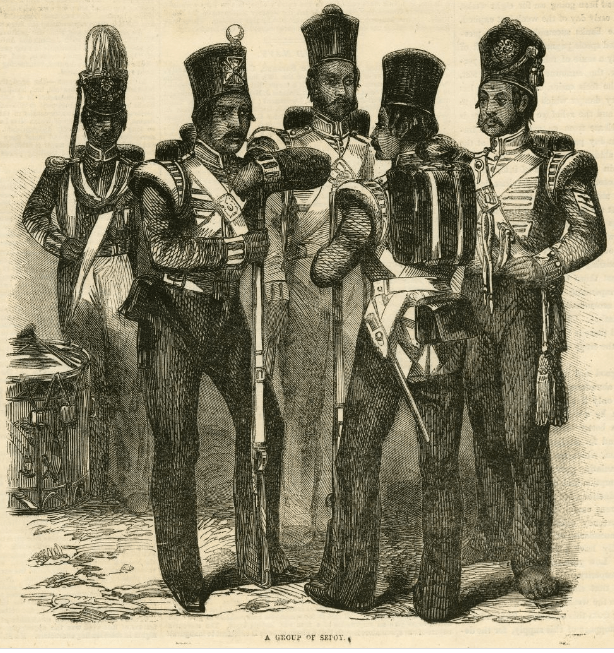
60th Regiment, Bengal Native Infantry
Raised in 1815. Late 2nd Battalion, 30th NI (Carter-ka-Pultan)
Battle Honours: Bhurtpore, Caubul, 1842
On the 13th of May, Colonel Thomas Seaton, up in Simla on furlough, received his orders to take over the command of the 60th Regiment, Bengal Native Infantry at Ambala. They, and the 5th BNI, had shown signs of panic throughout the 10th of May — the same day as Meerut — and had broken into their bell of arms. The sepoys of the 5th had gone so far as to load and point their muskets at their officers and remained under arms until evening. However, whether through prudence or fright, the officers decided the best course of action was to do nothing. They let the matter slide and forgave their men.
It must be said that the 5th BNI had not had an easy time of it. They had nearly been destroyed to a man in the Afghan fiasco of 1842, fever decimated their numbers when they were posted in Dhaka in the mid-1840s, and they never regained their cohesion after so much unsettlement. Their commander in 1857, Major Frederick Maitland, was known as a “quarrelsome man,” and “disposed to take too much on himself.”
The 5th BNI remained in a suspended state of dissatisfaction for a few more weeks. No one was willing to punish the regiment, but something had to be done. Instead of disbanding them outright, they were first dispersed into smaller groups and sent off in different directions through the countryside under the pretence of keeping the peace, with one company sent to Thanesar. Major Maitland then halted the investigation into their conduct, forgave their trespasses and chose to give them the benefit of the doubt. It was short-lived. On the 29th of May, Maitland disarmed 5 companies of the 5th BNI at Ambala with the help of the 2nd Fusiliers; two further companies, which returned from duty at Ropar, were disbanded without pay, their native officers were tried by court-martial and hanged – without, it must be mentioned, the permission of the Commander-in-Chief. Thus ended the 5th BNI and their history, which had begun in Chittagong in 1758, was erased. As for Maitland, with his regiment mutinied, he needed new employment – and he found himself on the staff at Ambala, forwarding supplies to the troops heading for Delhi. Some of his men would be seen again, still wearing their cap badges, at the assault on the city in September.
The 60th, in its turn, had behaved no better than the 5th, but on the 10th of May at the first intimation of trouble, Lieutenant Thomas Walker acted with some alacrity by dashing forward and placing himself squarely in the centre of the five bells of arms. The grenadiers of the regiment managed to break into theirs but Captain Walker rushed to that of No. 2 company, pushing his way through the Grenadiers. It was the only bell of arms that had the door inside a portico which also served as a sentry box, posted to watch over the block of five. Walker threw his back against the door and implored the men not to disgrace their company as the others had done theirs. He then heard the door of No. 1 Company burst open and the men let out a shout.
Men of the Grenadiers and other companies now came up to Walker’s little defence and began shouting for him to come out. He heard them fixing their bayonets and others were loading their muskets. One man said if Walker did not come out, he would shoot him – Walker replied if he shot him, he would blow up the ammunition. Fortunately, the man believed him. The sentry meanwhile, had been watching Walker in a dazed sort of way, but when ordered to help defend the door, he obeyed. The sepoys however managed to push the door open – the young sentry was knocked over, disarmed and sent packing by his comrades, leaving Walker alone, facing a sea of bayonets. A voice called out that if the lieutenant did not come out, he would bayonet him.
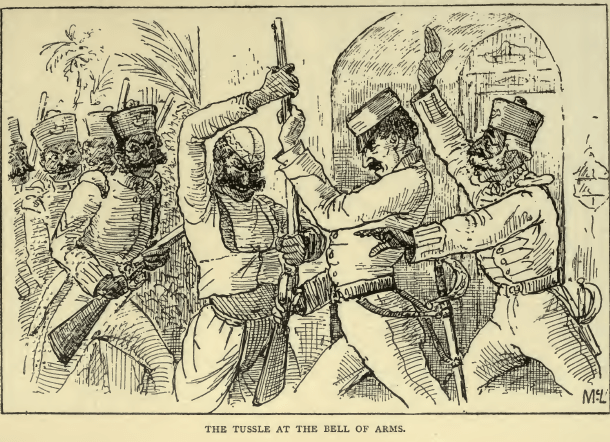
“The man with his bayonet lowered, approached nearer to me, threatening as before. I was making up my mind to spring at him and possess myself of a musket and bayonet when the old pay sergeant appeared on the scene.” He knocked the bayonet down and said, “I am a Brahmin, and you will have to kill me, then the lieutenant…” and placed himself in front of Walker. In a low voice, he told Walker he would argue on his behalf and the officer should not say a word. A sepoy stepped forward, (who Walker knew well as he had practised not only wrestling with him but single stick in the regimental sports shed) and tried to pull the pay sergeant away. He said he was Brahmin too and the sergeant should move out of the way. Walker, seeing an opportunity, leapt forward, grabbed the man’s musket and bayonet, wrestling it away from him and with the help of the pay sergeant, pushed him out as he let loose a torrent of abuse. None of the other men moved – Walker heard them muttering the word Magazine and suddenly he realised they were too scared to shoot in case they blew themselves up. By now, Colonel Drought arrived and milled about, shouting ineffectually, “What is this all about, my children?” The pay sergeant grabbed Walker and told him to go, he would remain and defend the bell of arms. Walker gave him the musket and bayonet and went to the colonel. The sepoys moved out of his way and crowded around Drought. Their lamentations were loud as they pointed to a troop of Horse Artillery, manned by Englishmen. The artillery had been turned out to fire on them, they said, they had only reacted out of fear. Walker knew the Horse Artillery had only come up after the scuffle had started but Drought would not have it any other way. He begged Walker to get on his horse, ride over to the officer commanding the troop and implore him most earnestly to not bring his guns down, the men were afraid and were terrified of being forced to mutiny against their will! Walker delivered his message and the officer withdrew his guns but only behind a barrack, just out of sight. As he returned, the sepoys yelled, “Bravo Walker Sahib, bravo!” The self-same men who moments before had been abusing him and threatening to put him to the bayonet now commenced returning their arms and accoutrements as if nothing had happened. Other officers appeared on the scene and the sudden mutiny of the 60th BNI was over.
 Mutiny Reflections