The 28th of November
Sleep as such, was not Windham’s priority. He had plans to make. Calling his most trusted officers together, Windham instantly proposed they should launch a night attack on the rebels – but no one could tell him for certain where they were, nor where they had planted their guns. After “mature consideration,” the following plan was decided upon and the officers received their orders.
“To Colonel Walpole—commanding five companies of the Rifle Brigade under Lieutenant-Colonel Woodford, two companies of the 82nd Regiment under Lieutenant-Colonel Watson, and four guns—two 9-pounders manned by Madras gunners, and two 24-pounder howitzers manned by Sikhs, under Lieutenant Green, R.A. he confided the defence of the advanced portion of the town on the left bank of the canal, that is, the portion in the left rear of the brick-kilns separated from them and from the rest of the town by the canal; to Brigadier Carthew—having under him the 34th commanded by Lieutenant Colonel Kelly, the flank companies of the 82nd, and the four Madras 6-pounders under Lieutenant Chamier—the defence of the Bithor road, in a position more advanced than, and a little to the right of, that occupied the previous day. The intrenchment was entrusted to the care of the 64th under Brigadier N. Wilson, who was also to guard against a turning movement on the right by establishing a post at the Baptist Chapel; whilst Windham himself, having under him the 88th Regiment commanded by Lieutenant-Colonel Maxwell, should defend the portion of the town nearest the Ganges, on the left bank of the canal.”
At daybreak, the action began. The pickets of the 88th were withdrawn and relieved by the 34th and the regiment was orderd to Windham’s house, where they would spend the afternoon constructing earthworks. Once done, the whole detachment, under Lieutenant-Colonel Maxwell, cover the flank of the hous and remain here until evening.
Carthew pushed across the bridge he had barricaded the evening before with the 34th and the guns, and covered his flanks with the 2 companies of the 82nd. He had just reached the road that would take him to the position he was to occupy when the Assistant Quartermaster General, Captain M’Crea brought him the order to fall back on the bridge. So, Carthew, covering his left flank with 2 companies, immediately took possession of three ruined houses in the front and on the bridge’s flanks, keeping the rest of his men on the bridge itself.
“The detached party on the right consisted of one company of the 34th commanded by Captain Stewart. The house it occupied was a lofty building with a flat roof, and from this roof Stewart noticed the advance of the enemy’s artillery to a position whence their guns could bear with decisive effect on the bridge. A zealous, intrepid officer, beloved by the regiment, Stewart posted his men in positions whence they could pick off the enemy’s gunners. They succeeded in this task beyond their hopes, in spite of the grape and round shot which came pouring upon them. This state of thing’s continued for more than two hours, from half-past 9 o’clock till noon, the enemy pouring in shot and shell, the 34th and 82nd replying with musketry, and Chamier’s two small guns doing all the mischief of which they were capable. The enemy made no way, but their artillery fire did considerable execution, and though they, too, suffered severely from the British fire, their immense superiority in numbers enabled them to fill up vacancies as they occurred.”
As such, Windham left Carthew to his own devices, since he was far more interested in watching Walpole. On the left, Walpole had taken and fought back an attack by the rebels. They came on in force but not in resolution, reserving the main brunt of it for Carthew. However, Windham’s left advanced position was so well-manned that they could defeat a successive attack even without the support that was sent up from the rear and Walpole “achieved that result without them.” Seeing that Walpole was actually holding his own, it should have been in Windham’s interest to support Carthew who was risking life and limb to protect what was left of Windham’s stores. He left the 88th, 300 men in all, in reserve. Instead, he sent McCrea, again, to tell Carthew to advance up the road, “promising him that the 64th Regiment under Brigadier N. Wilson would make a parallel advance on the right.” It was, however, deemed necessary to relieve Carthew of 40 men of the 82nd to strengthen the 64th.
The three companies, which had until now occupied the ruined houses pushed across the plain to the front in skirmishing order, all the while, a continual fire of grape flew directly at them, from the three guns posted on the far end. Within 100 yards of one of the guns, Stuart, well in front of his men, was shot in the thigh, leaving Adjutant Leeson of the 34th to take his place. To reach the guns, however, was impossible as the fire concentrated on the advance now commenced from the buildings surrounding the plain.
The men lay down in an empty watercourse to catch their breaths while Carthew, still mounted on his horse in the middle of the parade ground tried to collect enough of them together to rush the rebels. His attempt, however, led to nothing. Weakened in numbers as he was left guarding his left flank, all he could do was direct Chamier to bring his 2 guns forward.
“These, unlimbering, replied to the enemy’s fire; and, splendidly served by the Madras gunners, in twenty minutes not only silenced it but compelled the enemy to withdraw their pieces. Then
was the chance if Carthew had but had one squadron of horse at his disposal. He had not a single trooper and just at the moment he discovered that Wilson’s attack on his right had failed and that his right rear was threatened by the rebels.”
Captain McCrea, with the 40 men of the 82nd, directed Wilson, as ordered by Windham, to move the 64th parallel to the front parallel to Carthew. The problem was, that Wilson missed the road. It ran in line some little way with the river and then forked. Then instead of proceeding along the one nearer to the river, he could have come up with ease on the rebel guns, peppered the gunners and saved his men any undue harrassment. Instead, he took the other, which descended abruptly and then towards the top, became mercilessly steep.
“His skirmishers climbed up the steep part, and got possession of the guns, but these could not be retained. Major Stirling, waving his sword, jumped across one of the guns and shouted encouragement to the men embarrassed with the ascent. He was cut down by troopers coming up. The enemy rallied to the spot, six of the officers of the 64th were killed, and the endeavour to carry the height failed.”
The 2 companies were harassed by the fire of 6 guns directly to their front but they managed, when within 100 yards of these guns, not only charged them but for a few minutes to hold them. Unfortunately, the remainder of the Wilson’s force was still too far behind and the rebels, quickly recovering from the initial surprise, came on in such numbers, that hardly any of the skirmishers survived the attack. Major Stirling fell in front of the battery, fighting hand to hand until the end; Captain Morphy was shot through the heart and “seemed to bound from his saddle, falling heavily on his head.” Captain McCrea was shot dead, while Captain Saunders, seeing Stirling fall, quickly took his place and dashed forward, boldly followed by Lieutenant Parsons and O’Grady. Parson was shot through his sword arm for his pain. “O’Grady cheered the men on, waving his cap in the air, until he reached one of the guns, and he laid his hand on it as a token of its capture. In a second he and Saunders were engaged in a hand-to-hand combat with a host of the enemy.”
The men, answering the cheer, ran forward to their aid. Meanwhile, old Brigadier Wilson who had had to fight with Windham to be allowed the honour of leading his old regiment, was still pushing his wounded horse onwards towards the front, shouting, “Now boys, you have them!” The words were scarcely said when a bullet passed through his left lung and Wilson fell. Some men ran forward and carried him to the rear, still alive. Mortally wounded and close to death, Wilson continued to urge his men to “maintain the honour of the corps.”
Wilson was brought to the hospital and Reverend Mackay was there to record his end. As soon as his clothes were cut away, the surgeons who examined his wound, declared there was nothing to be done. He would, over the course of the next hour, slowly bleed to death as the pain from his wounded lung compelled him to groan and “even cry out.” The surgeons did all they could to lessen his suffering but all that was left for Wilson was to make his peace. Mackay read him a few verses from the Bible, as his Portuguese servant tried to make his master comfortable. Wilson, for his part, prayed along with Mackay, confessed his sins and as his voice gradually faded, he spoke of his wife and asked Mackay to mail the last letter he had been writing to her when Windham had interrupted him. Then, holding Mackay’s hand, Brigadier Wilson fell asleep and never woke again. In a strange twist, Mackay took up his residence that night in the tent left vacant by the death of Captain Morphy. Together with an officer and Reverend Moore, he then dined on a joint that had been prepared for Wilson’s dinner.
In his official dispatch, Windham had little to say.
“Brigadier Wilson thought proper, prompted by his zeal for service, to lead the regiment against four guns placed in front of Brigadier Carthew.” As it is, the statement is wrong – the guns upon which Wilson actually advanced were half a mile away from those facing Carthew and, when all was told, Wilson was doing exactly as he was told, advancing on the road McCrea had instructed him to take, as Windham had ordered it.
With the failure of the 64th, Carthew was forced to retreat back to the bridge as his right was now in serious danger. If Windham had sent support, things might have been different for this gallant officer. Instead now, his position, instead of being the centre of that chain of posts, with both flanks guarded and his front covered, he was isolated. Both flanking parties had been withdrawn. However, he was as determined as ever to hold his position.
The rebel attacks continued, unrelenting in their fury. Chamier’s guns and the gunners, however, continued to reply while the men of the 34th managed, twice to clear the road in front of them, and twice even reached the church to their right, both times at the point of the bayonet. However, the continuous fire of the rebels, would not let them hold their positions for long and they were forced back. The rebels then, much to Chamier’s disgust, shifted the position of their guns and he could no longer bring his to bear on them; meanwhile, the rebels had gained access to a rooftop of a house left empty after the withdrawal of the troops under McCrea and they could now pick off the Carthew’s men at will.
“A strong reinforcement might still have saved despite the position. Carthew sent for it. Pending
its arrival this gallant leader went amongst the men, cheering them, and keeping them to their work. Even when the position had become practically untenable when the enemy had all but turned his flanks, and when the party he had sent under Colonel Simpson of the 34th to keep open his communications was forced back, he still held on.”
It was 6 o’clock in the evening when a large body of rebels once again rushed Carthew’s position.
” Then came a fight between 1500 tired Englishmen and 5000 or more fresh sepoys, for these were the reserve. There are some 20,000 of them here. Please goodness, I hope never to see such a hailstorm of bullets again. I saw men fall on every side of me; splinters hit me, pieces of earth from bullets, and there we were obliged to stay. Our orders were to keep the bridge as long as possible: the keeping consisted of standing still while a hurricane of bullets passed through us.”
To make matters even worse for Carthew, the rebels brought up a fresh gun into the churchyard, positioning it so well, that Chamier had no chance of returning fire in any effective manner. The rebels then started to work around the Carthew’s rear, through his left flank. While officers and men fell around him, he once again appealed to Windham to send reinforcements.
“…but by the time they arrived night had set in, and I now considered it prudent to retire with the remainder of my force into the intrenchment, which was done with perfect regularity, the reinforcement of rifles protecting our rear. Although for some time earnestly advised to retire, I refrained from doing so until I felt convinced that from the increasing numbers of the enemy, the fatigue of the men after three days of hard fighting, and my own troops firing in the dark into each other, the position was no longer tenable, and that consequently it became my painful duty to retire.”
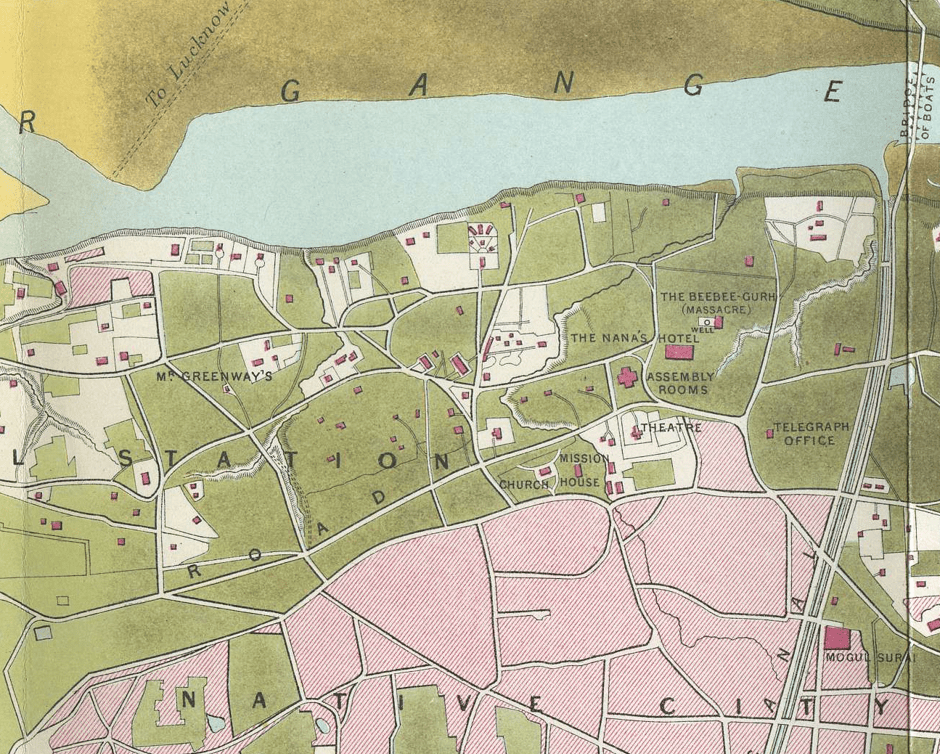
Carthew had left the riverside in rebel hands, with the bridge unprotected, and had been forced to allow the rebels to seize and burn the Assembly Rooms which had been lately converted into a storehouse for the property belonging to the regiments that had advanced towards Lucknow. He lost the theatre and with it, the supplies that had been carefully laid for the women and children of Lucknow. At the end of it all, Windham then pushed the blame for Carthew’s defeat onto the brigadier himself. In his dispatch, he wrote,
“Brigadier Carthew, of the Madras Native Infantry, had a most severe and strong contest with the enemy
from morning till night; but I regret to add that he felt himself obliged to retire at dark.”
This misleading statement impressed on Sir Colin Campbell that Carthew had abandoned his position without orders and led him erroneously to reprimand Carthew for his conduct. The official memorandum, although long, leaves one with very little doubt as to how far Windham would allow his officers to be on the receiving end of blame.
“With respect to these occurrences, his Excellency feels it necessary to make two remarks. In the first place, no subordinate officer, when possessing easy means of communication with his immediate superior, is permitted, according to the principles and usages of war, to give up a post which has been entrusted to his charge, without a previous request for orders, after representation might have been made that the post had become no longer tenable.
It might have occurred to Brigadier Carthew that when Major-General Windham proceeded to reinforce the post according to his first request, instead of ordering the garrison to retire, it was the opinion of the Major-General that to hold it was an absolute necessity.
“His Excellency refrains from remarking on the very serious consequences which ensued on the
abandonment of the post in question.
‘The night which had arrived was more favourable to the Brigadier for the purpose of strengthening his position than it was to an enemy advancing on him in the dark; at all events, there were many hours during which a decision could have been taken by the highest authority in the intrenchment, whether the post should be abandoned or not, without much other inconvenience than the mere fatigue of the garrison. The Commander-Chief must make one more remark. Brigadier Carthew in the last paragraph of his letter talks about his men firing into one another in the dark. His Excellency does not see how this could occur if the men were properly posted, and the officers in command of them duly instructed as to their respective positions.”
While Campbell was whigging the Brigadier from here to Sunday, Carthew avoided dishing out the blame. In a simple and gentlemanly fashion, he explained himself to Campbell, excusing himself for having omitted Windham’s verbal intimation to retire, should the position be untenable, in his original report. Campbell, in consideration of all the facts, finally sent a long and very handsome apology to Carthew.
The butcher’s bill for the past two days, however, was harder to explain and certainly more difficult to stomach. The 34th lost three officers killed and eight wounded but the total number Windham would lose on the 28th until nightfall amounted to 315. And this, in the face of Sir Colin Campbell who arrived in time to hear Carthew’s last demand for reinforcements.
“The sun was setting or had set when Power and I went down to see how the bridge was faring. It had never been in real danger, so inadequate had the attempts of the enemy proved. We crossed over and were standing by the palisade at the end when we saw a cloud of dust on the Lucknow road. This was soon recognised to be a small knot of horsemen, the central figure of which was peering across the water, as he turned his large-limbed horse on the quivering planks of the bridge. The figure was Lord Clyde. When we went to bed that night, we felt that all real anxiety was at an end.” (Sherer)
As we will now see, Windham’s actions would have repercussions for Sir Colin Campbell. At the end of some very harassing days, he would still have to fight Tantia Tope and the Gwalior Contingent.
Sources:
Adye, John. The Defence of Cawnpore, by the Troops under the Orders of Major General Charles A. Windham, C.B., in November, 1857. London: Longman, Brown, Green, Longmans, and Roberts, 1858.
Adye, John. Recollections of a Military Life. London: Smith, Elder, & Co., 1895.
Bulletins and Other State Intelligence for the Year 1858. Part 1. London: Harrison and Sons, 1859.
Forbes, Archibald. Colin Campbell, Lord Clyde. London: Macmillan and Co., 1895.
Forrest, G. W. A History of the Indian Mutiny: Reviewed and Illustrated from Original Documents. Vol. 2. Edinburgh: William Blackwood and Sons, 1904.
Forrest, G. W., ed. Selections from the Letters, Despatches and Other State Papers Preserved in the Military Department of the Government of India, 1857-58. Vol. 2, Lucknow, Cawnpore. Calcutta: Military Department Press, 1902.
Further Papers (No. 8) Relative to the Insurrections in the East Indies: Presented to Both Houses of Parliament by Command of Her Majesty. London: Harrison and Sons, 1858.
Mackay, James [Rev. John]. From London to Lucknow: With Memoranda of Mutinies, Marches, Flights, Fights, and Forays. 2 vols. London: James Nisbet & Co., 1860.
Malleson, G. B. History of the Indian Mutiny, 1857–1858, Commencing from the Close of the Second Volume of Sir John Kaye’s History of the Sepoy War. Vol. 2. London: Wm. H. Allen & Co., 1879.
Sherer, J. W. Daily Life During the Indian Mutiny: Personal Experiences of 1857. London: S. Sonnenschein & Co., 1910.
Verney, G. L. The Devil’s Wind: The Story of the Naval Brigade at Lucknow, from the Letters of Edmund Hope Verney and Other Papers Concerning the Enterprise of the Ship’s Company of H.M.S. Shannon in the Campaign in India, 1857-58. London: Hutchinson, 1956.
Windham, Charles Ash. The Crimean Diary and Letters of Lieut.-General Sir Charles Ash Windham, K.C.B., with Observations upon His Services during the Indian Mutiny. Edited by Hugh Pearse. London: Kegan Paul, Trench, Trübner & Co., 1897.
 Mutiny Reflections