The 26th of November – Pandu Naddi
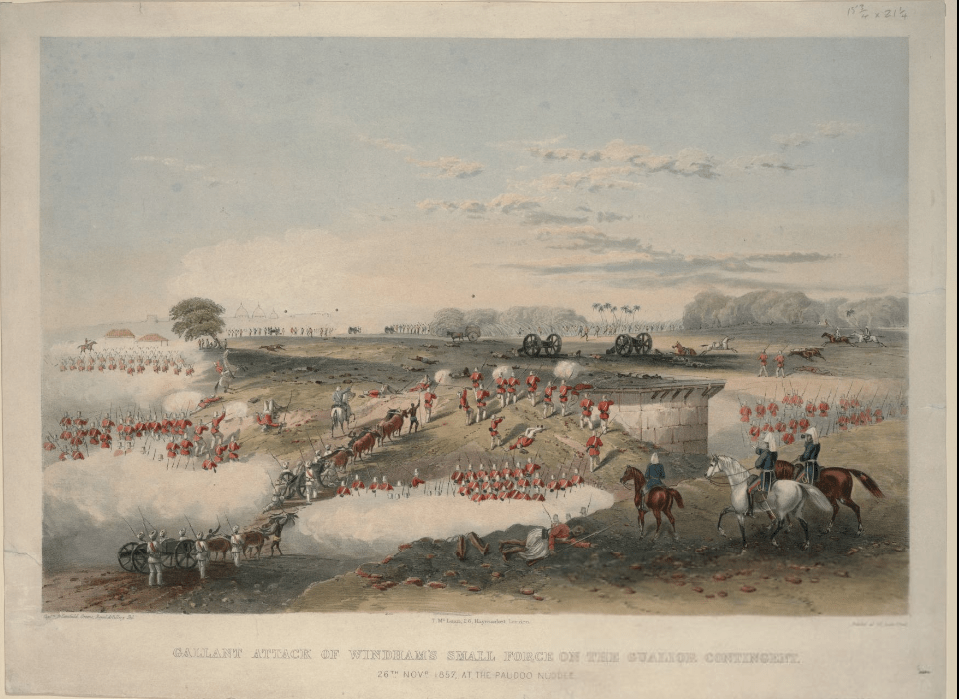
26th November 1857 at Paudoo Nuddee
From the right, Carthew directed Colonel Walpole with four companies of the Rifle Brigade to move forward in skirmishing order, followed by four companies of the 88th under Lieutenant Colonel Maxwell, with Lieutenant Chamier and his four light field guns. The extreme right was covered by 100 Sikhs and native troops. At the same time, Kelly ordered the 34th Regiment to advance on the left, withe one wing in skirmishing order and the other to support the four 9-pounders. The 82nd remained for the moment as reserve for the column.
The rebels could be seen “in masses” gathered together in front of a tope of trees but as soon as they saw the skirmishers advancing, they moved off to the right allowing their guns, hidden by the trees, to open fire. The Rifles, supported by the 88th pushed through high grass until they reached the tope just as the rebels opened fire. The balls flew over the heads of the Rifle Brigade but landed right into the 88th, who were following on, causing, in this opening salvo, significant casualties in their ranks. Captain Day of the 88th rushed forward at the head of his men across a clearing between the tope of trees and the guns but a round shot brought him tumbling from his horse. Captain Baynes of the 88th quickly brought his men to the right to support the Rifles while Captain Henning led his men against the guns.
Carthew rapidly brought his guns forward and returned fire. From the extreme left a body of rebel cavalry charged the 34th, who quickly formed square and “smote them with a crashing volley and sent them flying back.” The cavalry repulsed, and Kelly led the 34th straight at the rebel guns -two 8-inch iron howitzers and one 6-pounder – and captured them with hardly any fight. The rebels were pursued for a short distance but Windham who suddenly became aware that he had by no means tackled the main body, called off the attack and deemed it prudent to draw back to Cawnpore.
“Observing from a height on the other side of the village that the enemy’s main body was at hand, and that the one just defeated was their leading division, I at once decided on retiring to protect Cawnpore, my intrenchments, and the bridge over the Ganges. We accordingly fell back, followed, however, by the
enemy up to the bridge over the canal.” Inspired to new heights of courage by Windham’s sudden withdrawal, the rebels formed up their cavalry who swiftly came to the front and were so insolent, Windham halted and deployed his troops to deal with them. Just as quickly the cavalry moved off.
Windham marched his force to a new position across the Kalpi road, in front of numerous brick kilns. His success of the day was marred by the severity of his losses – 92 men killed and wounded.
The 27th of November – “If the Enemy has Crossed the Canal Bridge, we will Attack Him.”
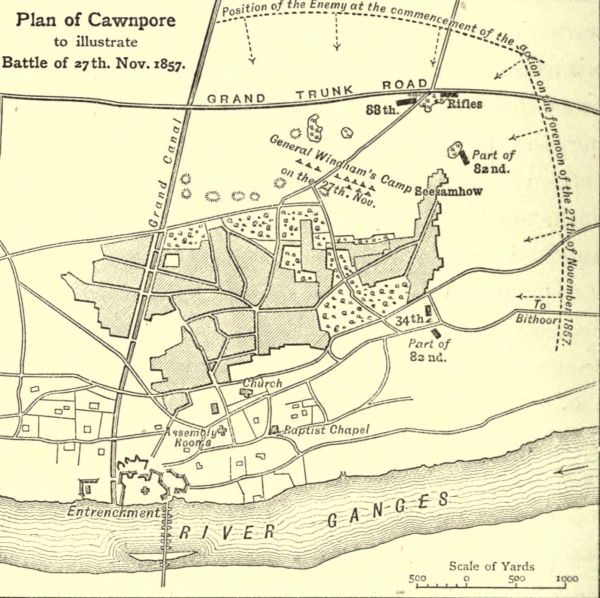
On the morning of the 27th, the men were paraded early. Windham sent his only cavalry, some 50 sowars of the local police force with their English officer to reconnoitre – they came back quickly, a little too quickly perhaps, and the officer reported they had not seen any of the enemy.
“To show that was a long-cherished idea of mine, I wrote on the 10th of November to the Chief of Staff, pointing out certain brick kilns just without the town as offering the best line of defence. In his reply to me he says, ‘Having not had a moment of time to spare when I was at Cawnpore, I am not able to give an opinion on the military position there. But it appears to me that if your retreat is secured, it is a great advantage to prevent the pillage of the city.'”
Windham, contrary to Campbell’s orders, had decided on the brick kilns a full fortnight before engaging the rebels at Pundu Naddi. While strengthening the entrenchment, he had ordered everything be cleared between the kilns and the town – in his estimation, he would be unable to hold the entrenchment unless he had a position outside it; the town, he knew, could swiftly be turned against him, but Windham, for all his careful planning, had severely underestimated Tantia Tope. Tope, far from being cowed by Windham and the affair at Pandu Nadi, he now knew for sure that Windham’s army was weak and Cawnpore was weaker still.
“Tantia Topi read the necessities of Windham’s position as he would have read an open book, and,
with the instincts of a real general, he resolved to take advantage of them.”
For his part, Windham was heartened with the news that Colin Campbell had succeeded in relieving Lucknow and was now marching back to Cawnpore. All he needed now was time – in 24 hours, Campbell would be back and he would be able to strike a decisive blow against the rebels. However, Tope was not a fool. He too was aware that Campbell was advancing; he was not going to allow himself to be attacked on two fronts; instead of allowing Windham time to catch his breath, Tope would take Cawnpore instead. He directed the force that had been in the field the previous day to stand at their arms at daybreak on the 27th of November, ready to move forward but to hold off doing so until the detachments from Sheoli and Sheorajpur, who would march now through the night, opened fire on Windham’s right flank. Using this as the signal for a general attack, the rest of the force would descend on Windham.
Windham, having engaged Tope’s interest, now had other problems. While still wanted to present a bold front and protect Cawnpore, his force was hardly sufficient for the task at hand. His right flank towards the river was open and could, with little provocation, be turned. As soon as day broke, his men were arms and Windham was hard at planning. A part of the 34th and 82nd, with four of the Madras guns were detached to the right to watch the Bithur road. Two 24-pounders manned by the men of the Shannon, under Lieutenant Hay, were removed from the entrenchment and placed directly in front of it. With no enemy in sight, Windham ordered his men to stand down and take their breakfast.
” The aspect of affairs evidently did not satisfy him, for at 11 o’clock he sent down to the camp an order for the whole force to stand to their arms. An hour later, just as the British gun in the intrenchment fired the mid-day signal, he rode into camp. He had scarcely arrived when a heavy cannonade was opened on the right flank of the British. Almost simultaneously a shell exploded over the trees in their front. It was evident that an attack in force had begun on all points.”
In Windham’s camp, the bugles sounded the alarm and the men scrambled to get under arms. Some had been washing when the first shot came and in their haste, buckled on their belts without putting on their coats first. Terrifed camels broke their lines and fled across the plain, camp followers scattered and frightened bullock drivers tried to get their increasingly unmanageble animals into their yokes. Amid the confusion the men fell in; one party of the 88th was told off in skirmishing order with the Rifles, and the other to escort the Naval Brigade, towing their guns. The sailors were having a rum time of it – the bullocks were gone and the the enemy was picking off the drivers as they rushed to bring back the beasts.
Without waiting for a further invitation, Windham ordered Brigadier Carthew, with the 34th, 2 companies of the 82nd and four 6-pounders to hold the position on the right. Carthew quickly detached the 34th to occupy some gardens off to the left while 50 men of the 82nd were placed in some ruined buildings off to the right of the road and the guns remained in the centre of it with the rest of the brigade. The rebels opened fire at long range as the men moved to their positions but as soon as they were in place, they returned the compliment with staggering fire from their Enfields and the 6-pounders – so effectively in fact, the rebels quickly stopped their attack, on this side at least. They were not in the least deterred.
In the front, to the extreme left of his position, Windham had five companies of the 2nd Battalion, Rifle Brigade, the 88th, two 9-pounder guns, and the two 24-pounders of the Shannon. With no drivers or bullocks, the skirmishers, under Lieutenant-Colonel Maxwell had to take their place and help the sailors drag the guns. The right of this position, in a wood halfway between and Brigadier Carthew, Windham had posted the main body of the 82nd. He quickly deployed his guns to the centre, supported by the Rifle Brigade and the 88th on either flank. However, before the first gun fired, Windham proceeded to the right to watch Carthew, leaving for a moment the left under Colonel Walpole. With his back thus turned, the 24-pounders were pushed to the front, directly in sight of the rebels.
“The enemy on sighting them, fired the first shot from a gun they had placed on the road. The British guns at once replied, but they had not fired two rounds when the rebels opened fire with grape and canister from batteries in front and on the right flank of Windham’s position. So superior, from their immense superiority in the number of guns, was their fire, that Windham, on his return, an hour later, from the right brigade, found that his men were getting all the worst of it. The rebel leader, with great judgment, kept back his infantry, and fought Windham with his artillery alone. The advantage he derived from his greatly superior numbers was enormous, for they enabled him to form a semicircle round the British position. Any attempt on the part of Windham to break through this semicircle at any point would have placed it in the power of the rebel leader to lap over and overwhelm his far inferior force.”
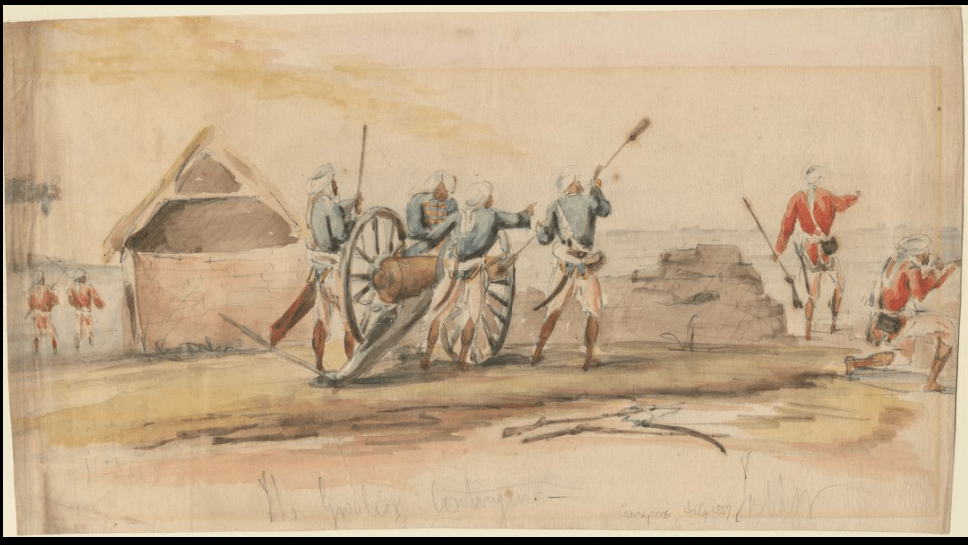
Windham attempted to break Tope’s flank by turning one of the 24-pounders against it. It was a valiant, but useless effort. Tope had no intention of sending in his infantry and the battle of the guns continued, with Windham rapidly running out of ammunition and the bullock drivers, terrified for their lives in this veritable hell of shot and shell that raged for several hours, began to desert. Orders were given to fall back on the brick kilns. At the same time, the 34th was sent for by Windham to reinforce him, and Carthew was ordered to likewise, to fall back on the brick kilns.
Meanwhile, the retreat had thrown Windham’s force into considerable confusion. The two 24-pounders had been abandoned for lack of bullock drivers and only the timely arrival of the 34th saved them as the sailors now had enough assistance to pull them in the wake of the retreating column. As such, Tope now took the advantage and signalled his men to advance. They “crowded out in numbers, firing their guns.” The British rushed to the brick kilns in complete disorder. Windham, however, had not lost hope the position could be held and turned his attention to the right brigade he had so weakened by the removal of the 34th. He left Colonel Dupuis of the Royal Artillery to command the kilns while he rode off to find Carthew.
The problem Carthew faced was intensely irritating. He was holding his position even without the 34th, and probably, had Windham left him to it, would have continued to do so, so convinced was Carthew of the “value” of his position, he initially refused to obey Windham’s order to retreat. When Windham sent it a second time, Carthew was forced to comply.
“Captain Drury, who was Brigadier Carthew’s brigade major on this occasion, thus described the situation in a letter to a friend at Madras: ” The other position ” (Windham’s) ” of the force had not fared so well, and the General sent for the 34th to strengthen the encampment. Shortly afterwards we were ordered to return to the encampment and occupy some brick kilns immediately in its rear. This order was repeated, and it was not until the second time that we commenced falling back to the place directed. This order was a grave error. General Windham says he sent a countermand afterwards. That never came.”
When Carthew arrived at the kilns, the situation had deteriorated. The carriage cattle were gone, and the tents, although they had been struck, were lying about, with the rest of the heavy baggage, scattered far and wide. Everywhere men huddled behind the kilns waiting for orders. These were not long in coming. Windham, as he was riding to find Carthew, received news through his ADC that the rebels had succeeded in turning the extreme right of his extended position and was now in the lower part of the city. To send the point home, he informed Windham he had been shot at. Windham sent the young man without further dispatch to inform Dupuis to fall back on the entrenchment. Jist as the force prepared to move off, up came Windham.
“Whilst deliberating on the critical position, two companies of the Rifle Brigade also appeared on the scene, as if they had dropped from the clouds. They had been marching all day up the trunk road, hearing firing in various directions, but unable to find anyone to give them information. Windham said a few words to them, and, placing himself at their head, away they went cheering, and soon cleared the streets of the enemy. “
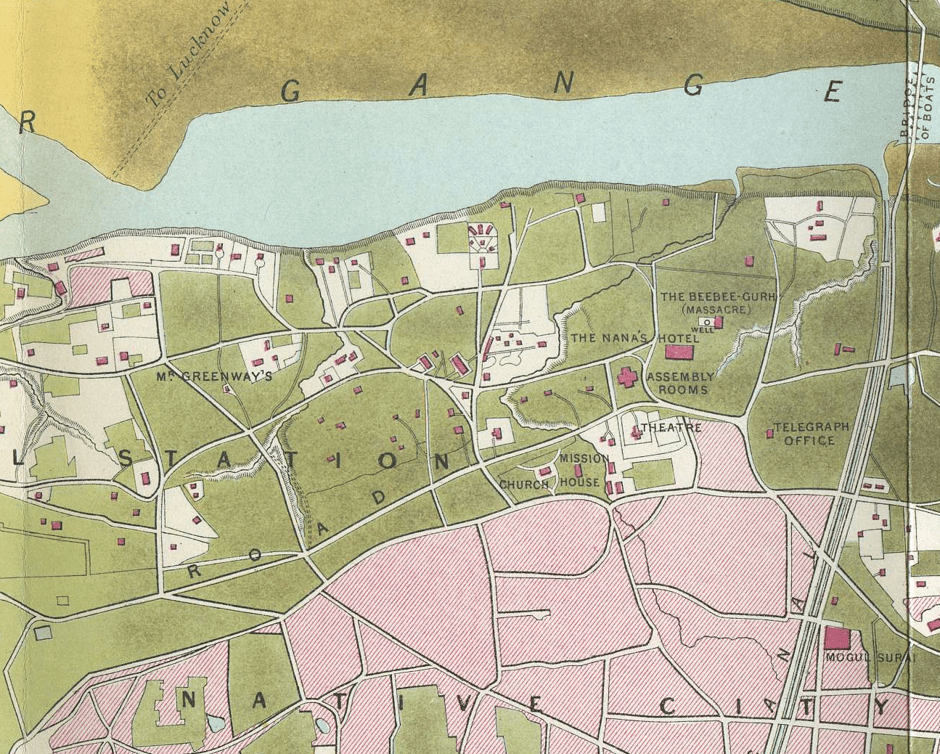
Amid the general confusion, Windham personally directed Carthew to take 2 companies of the 88th and his four six-pounders back to the very position he had just abandoned on the right and occupy the theatre building, a quarter mile from the entrenchment, where all the stores and equipment for the men had been kept. It could not be done without clearing the narrow streets first, which were by now beginning to get very crowded indeed.
“One rebel sepoy ran out of a house and fired at Lieutenant Vernor (of the 88th) who was riding in the rear. Luckily the bullet only grazed the officer’s head and then the sepoys was bayonetted. In defending himself, he cut off the left thumb of the private who bayonetted him.” At the next clearing, the 88th stumbled upon a group of rebels, who, having piled arms, and believing there were no British in their vicinity, were russling up a well-earned meal. The 88th gave them a volley to jolt them to their feet and then charged, bayonetting 50 of their number.
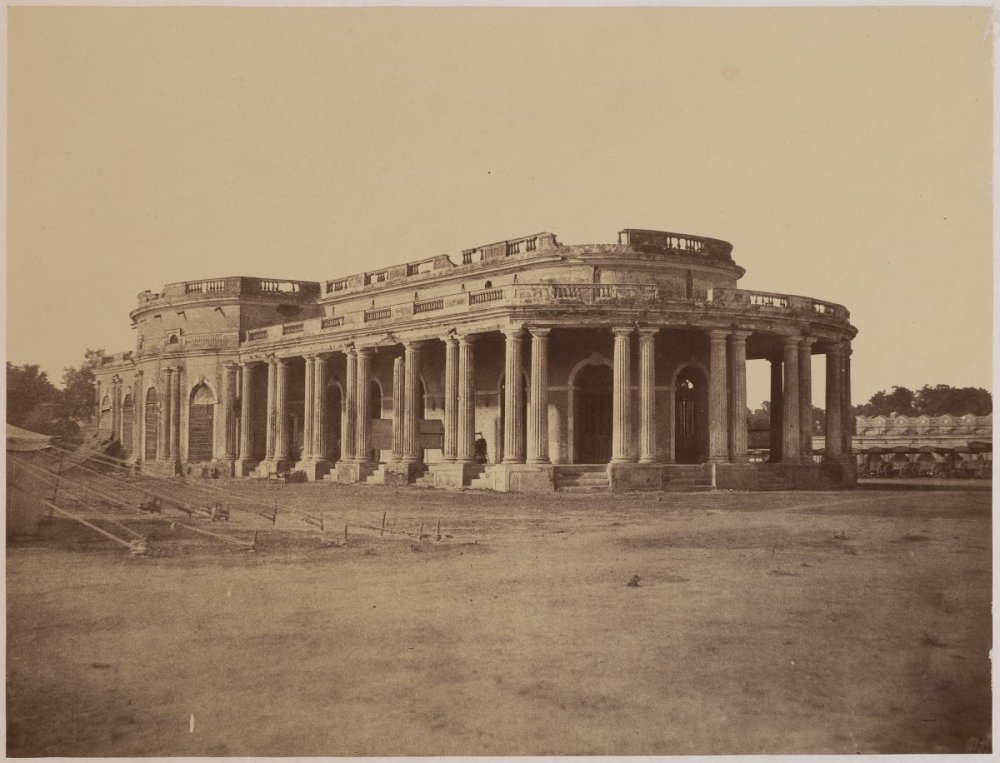
“Between the suburb right through which he had to pass and the Bithor road were the abandoned lines of a native regiment. On debouching from the suburb, he saw the enemy’s skirmishers feeling their way down the road toward the intrenchment. They were exposing their right flank to Carthew, but the moment they saw him they fell back in soldier-like style and occupied the abandoned lines. But Carthew, sending his men at them with the bayonet, drove them out in fine style, and as far as the Bithoor road. Here he came upon their guns, which at once unlimbered and opened fire. But Chamier’s four 6-pounders were at hand. They had had to make a short detour to avoid the narrow streets, but they came up with all possible haste, and, worked magnificently by the swarthy gunners of the Madras army, they silenced and drove back the guns of the enemy.
Had Carthew had four companies instead of two, he would have captured the enemy’s guns. But it was growing dark, and his few men were dispersed in skirmishing order. He could not rally in time a sufficient number for a rush. Carthew had, however, completely fulfilled his instructions. He had gained the Bithor road. Here he halted, alike to collect his men and show a front to the enemy. But the enemy had had enough of it. He then fell back, unmolested, on the theatre—the one officer in high command who had been victorious in every encounter on that eventful day.”
The next day, the theatre would become the centre of a series of outposts that formed a semi-circle, in all a quarter-mile, around the entrenchment. The far right of the semi-circle was occupied by the 64th while Carthew’s small force, after barricading a bridge in the front of the theatre, set up their post on the road near the building. The 88th was dispatched to occupy the road from the canal, while Windham and the remainder of the force withdrew into the entrenchment.
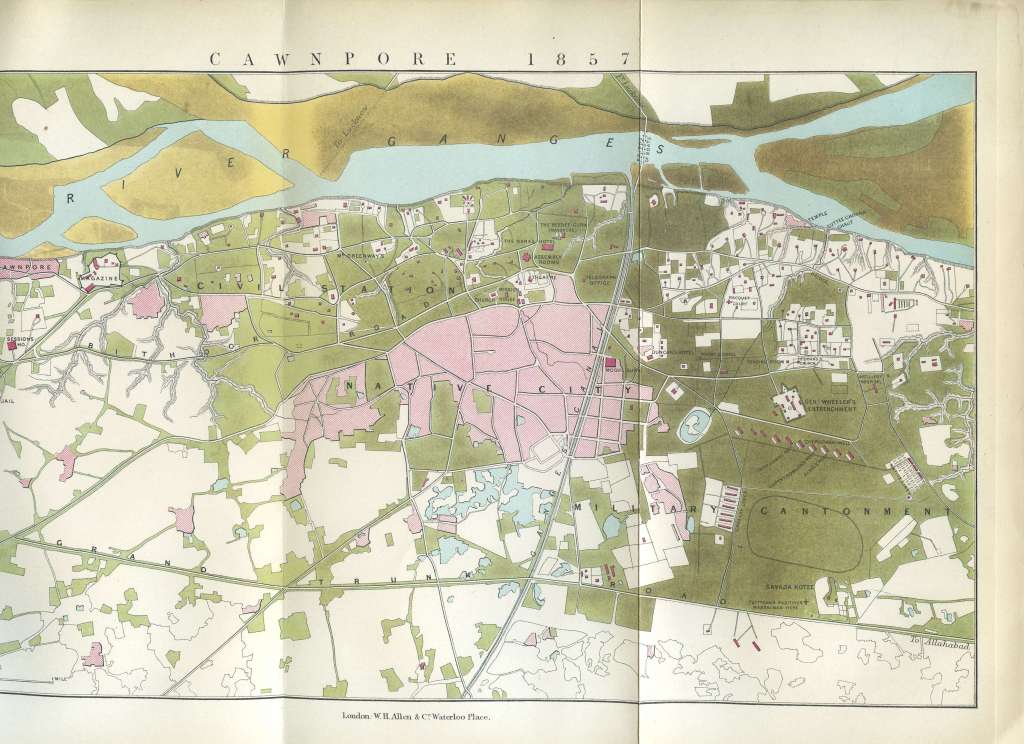
By nightfall, the battle was over and, “the laurels of the day rested certainly with the rebels.” They had pushed the British force back into the entrenchment and had they had a little more encouragement could have easily cut it off altogether. As it is, they satisfied themselves for the moment with their victory and let Windham off for the night. They were, however, hardly finished with Cawnpore, or with Windham.
During the night one of the pickets of the 88th, posted at a bridge over the Ganges canal, suddenly found themselves fired on by a few guns the rebels had managed to drag up in the dark. The men, who had been lying down on either side of the bridge were startled but unhurt. Lieutenant Vernor quickly asked permission from his colonel to seize the guns, which were less than a quarter mile away. He “…took 20 men of my own company with loaded rifles and fixed bayonets. We sneaked up behind any cover we could find and, when within 50 yards, fired a volley and then rushed the guns. With the exception of a few dead gunners, we found the rebels had disappeared. We spiked the guns and returned without having a man of the party killed or wounded.”
One of the 24-pounders of the Naval Brigade had to abandoned during the retreat – with no bullocks to haul it and no men to push it, the gun was left, overturned in the middle of a narrow road. Windham waited until after dark before ordering the Lieutenant Colonel John Adye of the Royal Artillery, with 100 men of the 64th and a few sailors, to retrieve it. It was by no means an easy task. They left the entrenchment under with a native guide, who was told quite clearly a reward was waiting for him if he led them to the gun; if not, and they ended up in a trap, there was a soldier waiting to blow his brains out. An officer of the Shannon summed up the night’s work:
“We crept along not a soul spoke a word—all was still as death; and after marching in this way into the very heart of the town, our guide brought us to the very spot into which the gun was capsized. The soldiers were posted on each side, and then we went to work. Not a man spoke above his breath, and each stone was laid down quietly. When we thought we had cleared enough, I ordered the men to put their shoulders to the wheel and gun, and when all was ready, and every man had his pound before him, I said ‘Heave I’ and up she righted. We then limbered up, called the soldiers to follow, and we marched into the intrenchments with our gun without a shot being fired. When we got in, the Colonel returned us his best thanks, and gave us all an extra ration of grog: we then returned to our guns in the battery.”
As such, Windham had left Tope’s men with fine pickings at the brick kilns – he had neglected to send his baggage back to the entrenchments and as such, it was now open for looters. In his defence, Windham simply said,
“I think it was an error. It must not, however, be supposed, that I forgot to do this; on the contrary, I had, at three o’clock that very morning, passed an order directing all the baggage and camp equipage to be taken to the island in the Ganges, just abreast of the entrenchment. I deeply regret having rescinded the order shortly after its issue.”
It was this, and other such errors, that have left Windham on two sides of a very broad coin, with his supporters defending his every action and others, less enamoured, clamouring to understand his deeds and misjudgements.
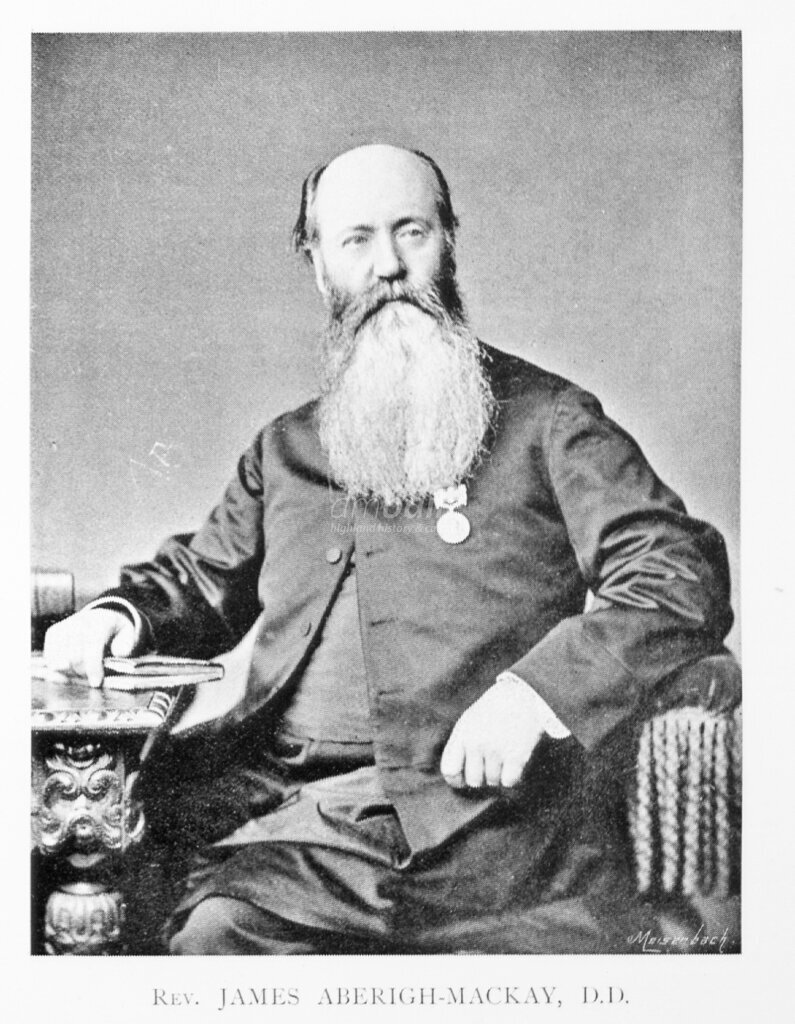
Amid the chaos of the 27th, a stranger arrived in Cawnpore in the form of Reverend James Abreigh Mackay who had arrived, as a volunteer, with the Madras men. While Windham was out fighting, Mackay reported himself to Brigadier Wilson in the entrenchment and then, before retiring to Duncan’s Hotel, he paid a visit to the Bibighar, all the while surrounded by the din of war, stating quite plainly, “…gun followed gun in quick succession until the thunder of the artillery became tremendous.” As he ate his breakfast, the house shook with every concussion but unperturbed, Mackay walked back to the entrenchment to enquire why his luggage was so slow in coming on and to find out about the fight. Feeling dusty and hot, he returned to the hotel only to find, within a few yards of the gate, people were rushing towards the hotel, carrying in their arms whatever possessions they had been able to grab from their homes. Somehow, his carriage, bearing his luggage suddenly arrived, but the driver, stricken with panic, dashed off, leaving the carriage in the middle of the road, but had enough piece of mind left to lead the horse away with him. While Mackay struggled to move the carriage, the first troops began their retreat into the entrenchment. Thinking the rebels had been routed, Mackay was surprised to discover, this was by far not the case.
“A regular panic followed. Trains of elephants, camels, horses, bullock wagons and coolies came in at the principal gate, laden with stuff. Around the principal buildings all sorts of draught-quadrupeds are collected…among the animals are piles of trunks, beds, chairs and miscellaneous furniture and baggage….” Somewhere in the chaos, he met the new chaplain, Mr. Moore who quite matter-of-factly informed Mackay he had just carried a wounded soldier on his back from the deserted field hospital to the entrenchment. Meanwhile, mounted officers galloped “across the rough ground between the inner and outer entrenchments and doolie and doolie, with its red curtains down…passes on to the hospital. The poor fellows are brought in, shot, cut, shattered, wounded in every imaginable way, and as they go by, raw stumps are now and then seen hanging over the sides of the doolies, literally like torn butcher’s meat.”
Considering he had just arrived at Cawnpore, his estimation of the affair is astonishing. Windham had “…underrated the enemy, left his flank exposed, and thus lost his camp, containing a great number of tents, the mess plate of several regiments, a quantity of saddlery and harness in an unfinished state, and private property valued at extravagant sums. Altogether it had been a most disastrous affair. But is unreasonable to expect an unbroken series of successes against a disciplined force immensely superior in numbers.”
Mackay decided that instead of sitting idly by, he would put himself to use at the hospital. It was, however, so dreadful, it left Mackay reeling. The surgeons were so overworked, that they were obliged to leave men bleeding on the floor for hours before they could attend them. As Mackay looked on, a young private had a piece of his jaw sawed out. Another, most likely a drummer boy, was lying on the floor, with a hole through his cheek and neck, the wound so swollen, his eye was shut; the boy could not speak and Mackay dispaired he would most likely die. Only one sailor, severely wounded and carried in on the shoulders of four of his comrades, was still able to “keep up his spirits amazingly and spoke to his comrades quite jocularly as he passed.”
It was hardly the introduction to Cawnpore Mackay had expected and the next day would scarcely be better.
 Mutiny Reflections