No News from Lucknow
The narrative, from here on, diverges into two camps — one that supports Windham and the other that does not. We shall attempt to find a medium between the two.
Among his instructions, Windham had been told by Campbell to make “as great a show as he can of what troops he may have at Cawnpore, leaving a sufficient guard in the entrenchment, by encamping them conspicuously, and in somewhat extended order, looking however, well to his line of retreat.”
The order was not, in Campbell’s opinion, open for interpretation and it is here, perhaps, that some of the confusion sets in. Three days after the arrival of Carthew Madras Brigade, Windham took up a position which, contrary to Campbell’s instructions, was well outside Cawnpore.
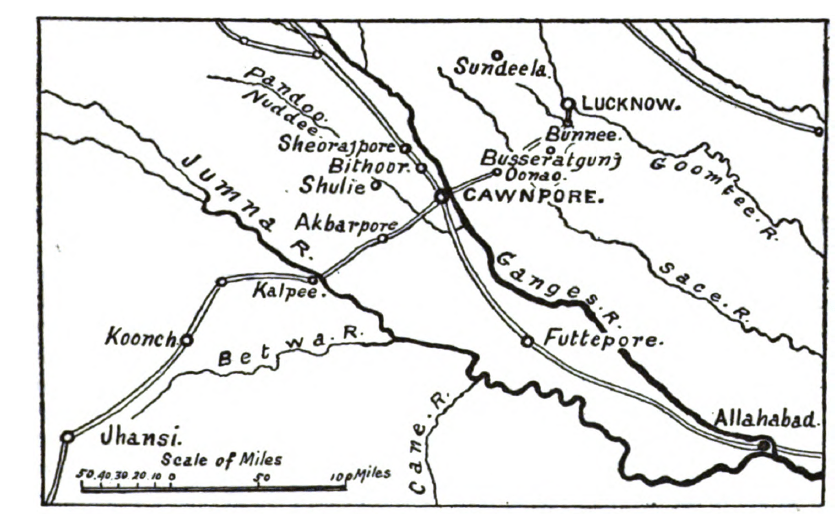
He knew that the rebels now occupied not only Sheoli but Sheorajpur, 15 miles from Cawnpore, and the main body was still 25 miles distant. Between the 2 villages flowed the Ganges Canal and Windham conceived a plan of transporting 1200 men in boats up the canal, and 2 field guns along the towing paths – he would land his men at daybreak and “would fall on the village which his latest intelligence revealed to be most open to attack.” Then he would return to Cawnpore before the main body of Tope’s troops could attack it. The scheme was based “on the honoured principle of taking advantage of the separation from each other of the enemy’s posts and of destroying them in detail.” The boats were duly collected and the tow-path declared suitable for artillery – however, as such, Windham still wanted Campbell’s approval of his plan. Up to the 19th he had received regular messages from Lucknow but now nothing was forthcoming. He would not know that his message to Campbell, regarding his intentions, never reached the Commander-in-Chief. No reply arrived and Windham, unable to move without Campbell’s approval, waited at Cawnpore.
On the 22nd of November, Windham suddenly received intelligence that the small police force station at Banni Bridge had been chased off by the rebels. As the bridge was situated on the high road to Lucknow, it was imperative to gain back the bridge. On the 23rd, at 3 in the morning, the right wing of the 27th Madras Infantry with 2 guns marched, on Windham’s orders, to take back the bridge. Meanwhile, Windham continued to watch the Gwalior Contingent with growing concern. By the 25th of November, however, it was clear he had made up his mind and expressed himself to John Sherer, magistrate of Cawnpore.
“The General had come into my tent on the 25th and had been talking about what he meant to do.
”’ I am certainly not going to let these fellows think we cannot act on the offensive,” he said, and then he added, ” these small engagements are awkward things, very little glory gained in winning them, and perhaps some valuable life is lost, and people say it was wasted.”
Something, in Windham’s estimation, needed to be done. Leaning on his studies of war, his instincts and from conversations with officers well-versed in warfare in India, he came to the conclusion the best way of defeating an “Asiatic enemy” was to march straight for them. On the 23rd a native messenger arrived from Lucknow – he carried with him a small piece of paper, rolled up in a quill and came from a commissariat officer – the force required provisions for a further 10 days and the bearer of the message was to be paid 50 rupees. When asked how things fared at Lucknow, he replied he had no opinion on military matters but things were complicated. For now, Windham believed Campbell was possibly stuck in Lucknow and he would be left on his own, for longer than expected.
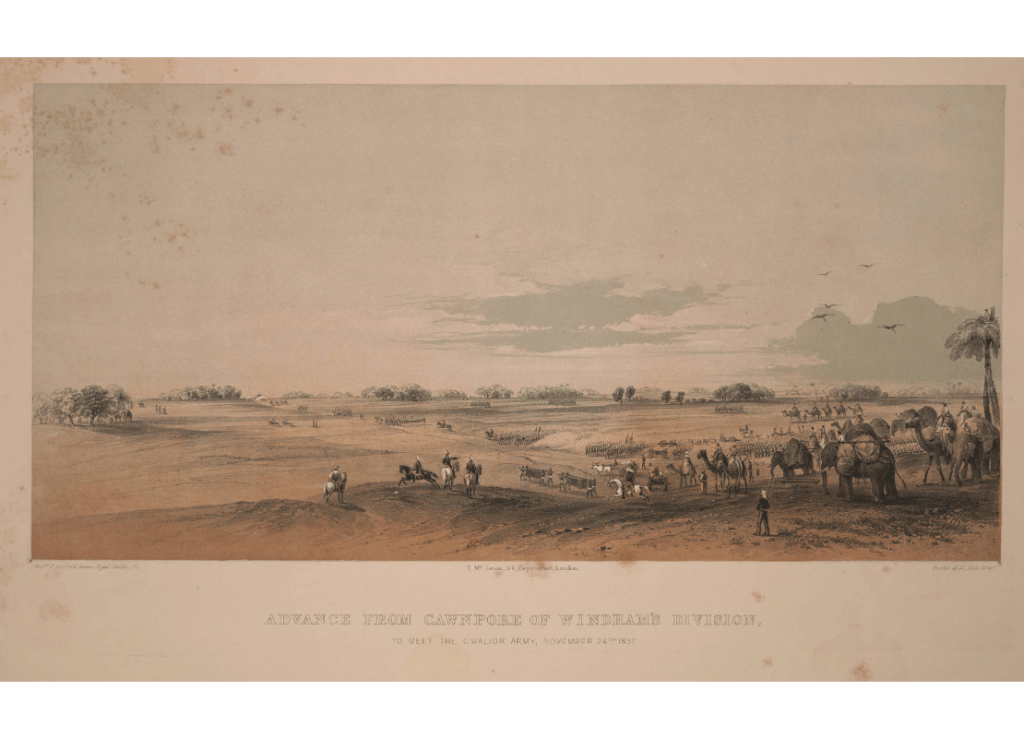
On the night of the 24th, Windham moved the majority of his force to the junction of the Kalpi and Delhi roads, leaving four companies of the 64th and a small force of artillery to guard the entrenchment. He set up camp close to a bridge where the Kalpi road crossed the canal, still expecting, at any moment to hear from Campbell, that his canal scheme had been approved. If successful, Windham hoped to weaken the rebels by attacking their unconnected bodies of troops and throwing the rest into confusion. However, he did not add Tantia Tope to his calculations.
Tope was not some country rebel led by fanatical desire leading a disorganised rabble. He was a skilled Maharatta commander who understood the British better than Windham understood the Indians. From the moment he heard that Windham had advanced his camp to the bridge, he pushed forward his leading division to a position barely 3 miles from Windham. He was answering Windham’s challenge and, in true soldierly fashion, accepted it.
“That very day the detachment at Akbarpur set out for Suchandi. Between this village and the canal, about midway, runs the Pandu rivulet. The rebels reached Suchandi on the 24th; and the banks of the Pandu on the 25th. As soon as information of this movement reached Brigadier Carthew he despatched a special messenger with it to the General. Windham at once galloped to the camp, and reached Carthew’s tent a little after midnight—during the first hour of the 26th.”
Having lost the element of surprise while waiting for Campbell’s approval, Windham now had to make his own plans.
Accordingly, he divided his forces into two brigades. Brigadier Morden Carthew would head the first, composed of the half-battalion of the 88th Connaught Rangers who were new to India and had only just arrived in Cawnpore on the 22nd of November, four companies of the 2nd battalion, Rifle Brigade and four 6-pounder guns manned by the Madras artillerymen. The second, under Colonel Kelly of the 34th, consisted of the 34th, four companies of the 82nd, and four 9-pounder guns, manned by Europeans and Sikhs. He also had 10 men of the 9th Lancers at his disposal. Then taking care to secure his baggage, protect the bridge and watch for any movement from Shorajpur, at dawn on the 26th Windham rode out to reconnoitre. The rebels were encamped just beyond the Pandu river, now nearly dry and numbered no less than 2500 infantry, 500 infantry, and six guns. Windham ordered his force to advance.
 Mutiny Reflections