“Let the soldiers go forth and smite the Feringhees without fear”
“The astrologers had calculated it, the holy Brahmins had read it; the spirits of the conjurors and the dice of the soothsayers all told the same tale. It was written that assuredly on this day the reign of the white people would be over…”
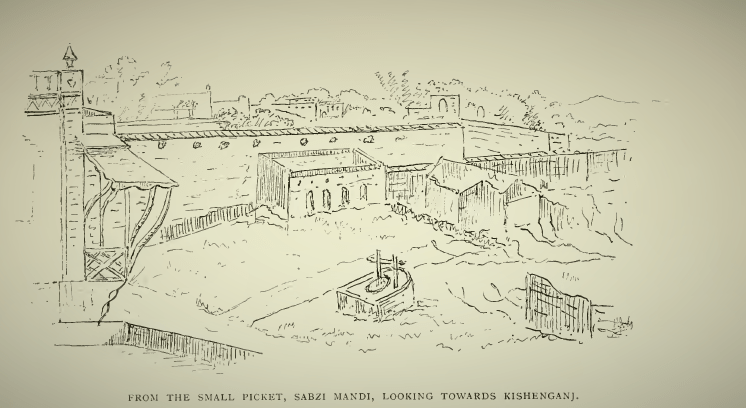
With this powerful assurance in their minds, the mutineers opened a brisk cannonade from the walls, and their whole force marched out, occupying not just Sabzi Mandi but the suburb of Kissenganj with the idea of laying waste not just to the Ridge but the batteries. Without delay, the British sent forward their infantry.
Meanwhile, a small body of cavalry and artillery was sent to the rear to cover the entrance of Major Olpherts’ long-awaited reinforcements. He was in pursuit of the mutinous Jalandhar Brigade, who were on their way to Delhi. Olpherts’ force was substantial, consisting of four guns of the 1st European troop, 1st Brigade of the Horse Artillery, part of a native troop commanded by Captain Renny, a company of the 75th Foot, some men of the 2nd Fusiliers, the 4th Sikh Infantry, and a wing of the 2nd Punjab Cavalry. It numbered, in all, no more than 850 men. While their advent would certainly be welcome, the day was turning out to be less than welcoming.
Major Reid and the Sirmoor Gurkhas were up and fighting since early in the morning. From what he could hear from their shouts, they were going to spike his guns before sunset and take Hindu Rao’s House from under his nose. They began their attack from the right rear, having availed themselves of some houses in the Sabzi Mandi the night before that the British had been unable to hold. Having the advantage of good cover, flat roofs to fire from and surrounded by jungle, it appeared that Hindu Rao’s would fall, however, Reid was not a man to be so easily thwarted. Realising the houses were full of infantry, he sent two companies of the 60th Rifles and three of his own to attack them. It was a quick fight, but within five minutes of driving them out, the Gurkhas the 60th were forced to retreat as the rebels now threw a force, ten times the size of the last one, directly at them. Reid, seeing the Gurkhas retreating, ordered all supports that were close enough to advance. Again, he managed to drive the rebels off, but he could not hold the houses without reinforcements. Reid wrote to Barnard to send men; Barnard replied he would, but it would not be until 2 in the afternoon, so not for another three hours. While Reid fought off six successive attacks on Hindu Rao’s House, the British were fighting for control over Sabzi Mandi.
The sepoys held the houses and the serais, and from the roofs poured unrelenting fire on the British. Clearing the roads was only one job – the other was forcing the houses. As soon as the infantry turned from the road, it was immediately filled again by sepoys. The battle inched its way towards the Ridge, and the shouts of the men and the “words of command could be heard by the artillery at the foot of the mound, waiting to cover the infantry should they be driven in; sometimes it seemed as if our troops were driving far before them.” Brigadier Showers had been given command of the force. Still, instead of leaving the actual running of the battle to his discretion, he was hindered relentlessly, with Barnard and some officers watching the progress of the fight from the Mound Piquet, Barnard stating he could tell the course of the battle from the smoke. His officers complained that the “order of retreat would come when they had driven the enemy back and the order to advance when they had the worst of it.”
And yet, somehow, the small force managed to drive the mutineers back to the walls of Delhi and by nightfall, Sabzi Mandi was in British hands. Their losses were one officer, Lieutenant Jackson of the Fusiliers and 38 men were killed. Colonel Welshman, 1st Fusiliers, was dangerously wounded, 2 other officers were severely wounded, with 118 men in all wounded.
Hodson’s network of spies, who worked tirelessly bringing in intelligence from the city, while at the same time sowing disinformation in it, reported with some satisfaction that the battle had left the mutineers dispirited. Their prophets had deceived them, and the great victory in the 100 years after Plassey was not to be had on this day and indeed on none other. The British, for their part, were surprised they had won the day. It should have been easy for such a superior force to hold and strengthen Sabzi Mandi and Kissenganj and then shelled the Ridge into oblivion. Yet it did not happen – the mutineers once again turned and fled back to the walls of the city, leaving the British room to place a piquet in the Sabzi Mandi, which they defended from some strong houses and from across the road from Hindu Rao’s House. They further took over a temple, the men nicknamed Sammy House. Both positions were quickly fortified, and a breastwork was built that ran along the Ridge to the main batteries, making it impossible for the enemy to advance again along the road leading to the rear of the camp without being exposed to deadly fire from the British guns.
As for Olpherts, his reinforcements did nothing to raise the camp’s spirits. It was expected that by this time, Barnard would be sitting comfortably in the city itself, not fighting for his very existence on an outcrop of rocks with hardly enough men to ward off imminent destruction. Shortly after his arrival, a man less prone to grumbling arrived with the next reinforcements to take the position of Adjutant-General, one Brigadier Chamberlain. “Everything will be right when Chamberlain comes! and all took courage when they saw his stern, pale face.” It was the 24th of June.
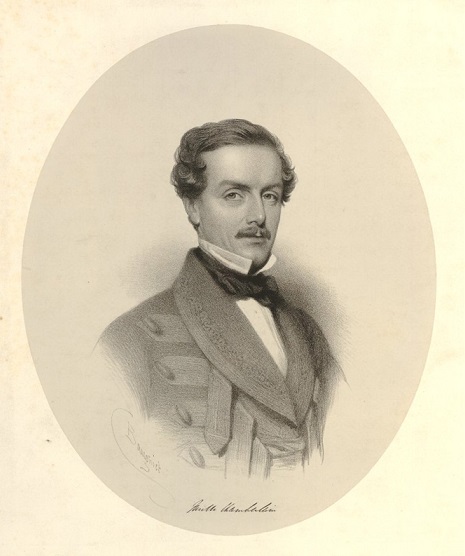
Known as a cavalry officer of some daring with a reputation that preceded him, he had gained much well-deserved praise for his handling of the Punjab Moveable Column in the first desperate weeks of the mutiny. He was indefatigably ambitious, and as promotion in the service was too slow for his liking, he found the shorter route of risking life and “playing ten to one with death” was a certain way, provided he survived to secure the position he wanted. He was a man of the same breed as Nicholson and Hodson – courage personified but without the experience in leading armies. This gave rise to a singular conundrum with generals split into two camps – daring guerrilla leaders who stopped at nothing to get the job done but with little regard for the blood they spilt or “worn out old men who had gained their rank by living long, unnerved by age and the exhausting climate of India, perfectly incapable of doing the rough work required of them, but with rank and influence sufficient to obstruct those who were able to do it.” At Delhi, there were too few of the former and too many of the latter. With the advent of Neville Chamberlain on the Ridge, it was hoped the tide would finally turn.
Following the desperate battle for the Sabzi Mandi, the attacks on the Ridge, though no less fierce, lessened in frequency. However, the death toll for the British in these skirmishes was by no means lessened, and men continued to be lost in “useless affairs.” Officers refused to remain behind the breastworks and continued to sally out to meet the enemy on their ground, and the cost was starting to tell.
27th June
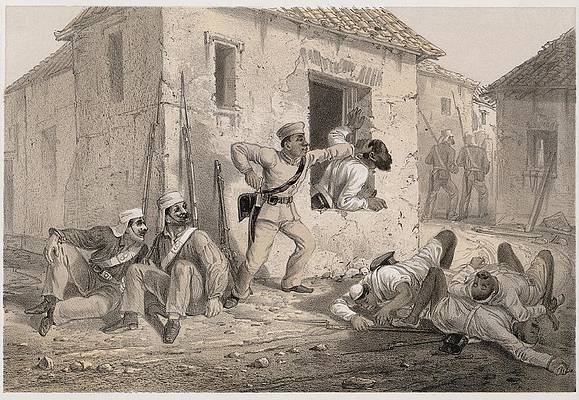
The Ridge had been relatively calm since the 23rd – although the rebels kept up a steady fire from the Mori and Burn Bastions, they appeared wary of approaching the British, but it was just a momentary pause, for on the 27th, they once again set out for Sabzi Mandi. This time, Reid was ready for them, and so were the 2nd European Bengal Fusiliers. Ordered by Reid to advance from Hindu Rao’s towards Sabzi Mandi and occupy the houses, Lieutenant J.T. Harris of the Fusiliers, however, was not particularly pleased.
“While wondering what to do in the vast assemblage of huts, I received an order from the Commanding Officer of the picket telling me to take the place with my men. In answer, I wrote back at once that if he would send me a thousand men, I should be happy to obey him, but with my force all I could hope to do was to try to defend the line of road.”
Harris took possession of a few stout buildings on his side of the road to try to keep the road between himself and the approaching mutineers who were streaming in numbers out of the Lahore Gate. As the buildings were detached but only thirty yards apart, Harris found he could talk from one to the next, thus ensuring his orders could still be heard and followed. The men barricaded the doors, and Harris posted most of the men on the roof, afforded shelter by the three-foot parapets on each. The house Harris found himself in had only one very small door facing the road. “As we had no entrenching tools whatever, I went to this doorway to examine the thickness of the wall and to see if the men could loophole it with their bayonets. While I was standing in the doorway, about twenty sepoys fired a volley at me from the other side of the road. The bullets hit both the woodwork on which I was standing and that which my head was touching. They smashed against the brick wall by the side of my ear, and one bullet took me in the thigh diagonally and came out near my hip, and another hit a man by the name of James Hartley in the iliac artery.”
Harris was unfortunately holding his naked sword in his left hand as the scabbard had been shot away – the volley “made me start so violently that I drove my sword right through my left foot and through the sole of my boot…”
Possibly, the adrenaline pumping through his veins and the mad rush of battle did not allow Harris to realise how badly hurt he really was. There was fight in him yet.
“I limped back from the doorway to find my young subaltern and my colour-sergeant Noon were both crying. Language cannot express my feelings of rage at these men for shedding tears because I had been hit. I grabbed a pugaree, put a bullet into it, and made a rough tourniquet of it, twisting it very tightly with a man’s bayonet.”
Aware that James Hartley was bleeding to death, Harris quickly put his thumb over the artery and, with the help of another man, fashioned another tourniquet for Hartley.
“During this time, I was both in frightful pain and as angry as a man can be. But in the way of misfortune tings had reached a climax, for shortly afterwards we cleared the enemy off the opposite side of the road and eventually they retired. When all was quiet again, I posted my men carefully and improved as far as possible the facilities for firing to the front.” He then saw to the other buildings, after which he allowed himself to be taken back to the camp. The losses of the day were awful – the Sirmoor Gurkhas lost two killed and fourteen wounded, the 4th Sikhs one killed and four wounded, and of the 180 men in Sabzi Mandi, fourteen were killed and wounded.
The 28th was somewhat more promising as Her Majesty’s 8th Regiment of Foot, numbering 400 men, arrived in Delhi, “about the strength to which almost every regiment in camp was reduced.” Major Olphert’s guns, Captain Renny and some foot artillery from Lahore made their appearance, bringing with them a newly raised body of Sikh artillery, comprising of old gunners who had won their scars in the far-off battles of Ferozeshur and Chillianwallah. Shortly after, with the arrival of Her Majesty’s 61st Regiment, the 1st Punjab Infantry, and a squadron of the 5th Punjab Cavalry, the force on the Ridge swelled to 6600 men.
On the 30th, yet another pitched battle took place, costing the lives of Lieutenant Yorke of the 4th Sikhs and dangerously wounding Lieutenant Blair of the 2nd Fusiliers. The cry to finally attack the city continued to grow, but General Barnard looked out on the scene and decided to wait for more reinforcements was probably the wisest course of action. By now, the red walls of the city were teeming with mutineers while the British were barely holding their own. July was now but days away, and changes were starting to happen on the Ridge – the first tumultuous month was over, but the siege was only just beginning.
Valour was certainly not lacking on the Ridge had, and the six men who were awarded the coveted VC for June were undoubtedly one above the rest.
Sources:
Barter, Richard. The Siege of Delhi: Mutiny Memories of an Old Officer. London: Folio Society, 1984.
Battye, Evelyn Désirée. The Fighting Ten. London: British Association for Cemeteries in South Asia, 1984.
Campbell, George. Memoirs of My Indian Career. Edited by Charles E. Bernard. London: Macmillan & Co., 1893.
Cave-Browne, John. The Punjab and Delhi in 1857. Vol. 1. Edinburgh: William Blackwood and Sons, 1861.
Forrest, G. W. A History of the Indian Mutiny. Vol. 1. Edinburgh: William Blackwood and Sons, 1904.
Greathed, Hervey Harris. Letters Written During the Siege of Delhi. Edited by Elisa Greathed. London: Longman, Brown, Green, Longmans, & Roberts, 1858.
Handcock, A. G., comp. The Siege of Delhi in 1857: A Short Account. Allahabad: Pioneer Press, 1897.
Hibbert, Christopher. The Great Mutiny: India 1857. London: Allen Lane, 1978.
Kaye, John, and George Bruce Malleson. Kaye’s and Malleson’s History of the Indian Mutiny of 1857–58. Edited by George Bruce Malleson. Vol. 2. London: W. H. Allen & Co., 1892.
Leasor, James. The Red Fort: An Account of the Siege of Delhi. London: Werner Laurie, 1956.
Malleson, G. B. The Indian Mutiny of 1857. London: Seeley & Co., 1891.
Roberts, Frederick Sleigh. Forty-One Years in India: From Subaltern to Commander-in-Chief. Vol. 1. London: Richard Bentley & Son, 1897.
Rotton, John Edward Wharton. The Chaplain’s Narrative of the Siege of Delhi, from the Outbreak at Meerut to the Capture of Delhi. London: Smith, Elder & Co., 1858.
Sedgwick, F. R. The Indian Mutiny 1857: A Sketch of the Principal Military Events. London: Foster Groom & Co., 1919.
Tavender, I. T., comp. The Casualty Roll for the Indian Mutiny, 1857–1859. London: J. B. Hayward & Son, 1983.
Vibart, Henry Meredith. Richard Baird Smith: The Leader of the Delhi Heroes in 1857. London: Archibald Constable & Co., 1908.
Williamson, George. Military Surgery. London: John Churchill & Sons, 1863.
Young, Keith. Delhi—1857: The Siege, Assault, and Capture as Given in the Diary and Correspondence of the Late Colonel Keith Young. Edited by Henry Wylie Norman and Mrs. Keith Young. London: W. & R. Chambers, 1902.
 Mutiny Reflections