The Next Days
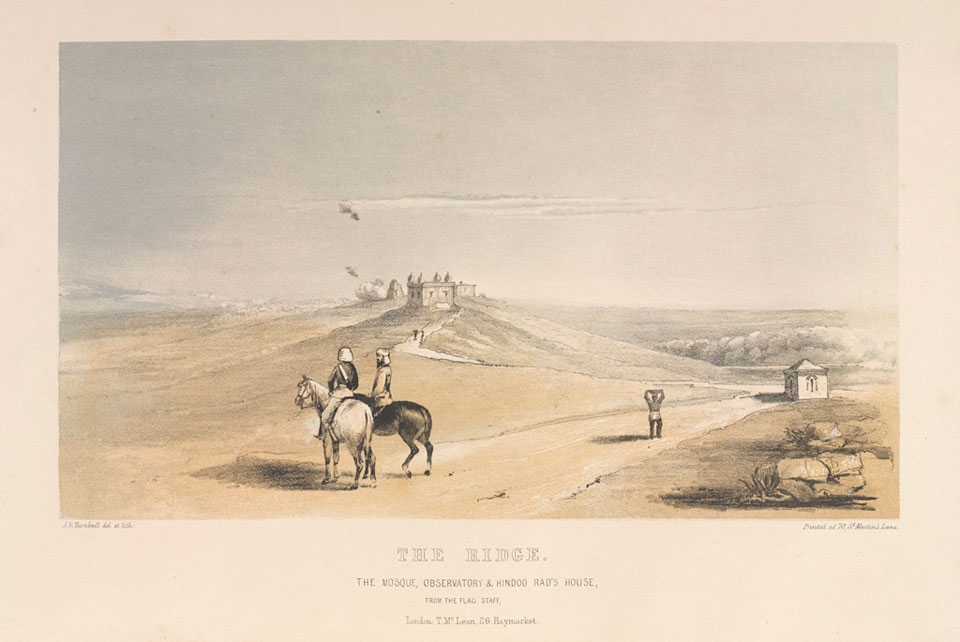
On the 10th of June, 500 mutineers sortied out of the Sabzi Mandi suburb – once again, Reid was called to advance against them, taking the 60th Rifles to his left and the Gurkhas in line to their right. The mutineers were in particular sinister humour, calling out to the Gurkhas to throw down their arms and join them. To this, the Gurkhas replied, to their surprise, with their menacing war cry, “Ayo! The Gurkhas are here!” While the mutineers held back, the Sirmoor Batallion closed the distance, doubling forward in an unbroken line. At 20 yards they suddenly stopped and to the horror of the mutineers, presented arms and fired straight into the sepoys. Without waiting for another invitation, the Gurkhas then sprang forward with bayonets and kukri flashing into the fleeing mutineers, chasing them back to the Ajmere Gate. When the artillery on the bastions took their aim at the Gurkhas the wily hillmen turned and retreated.
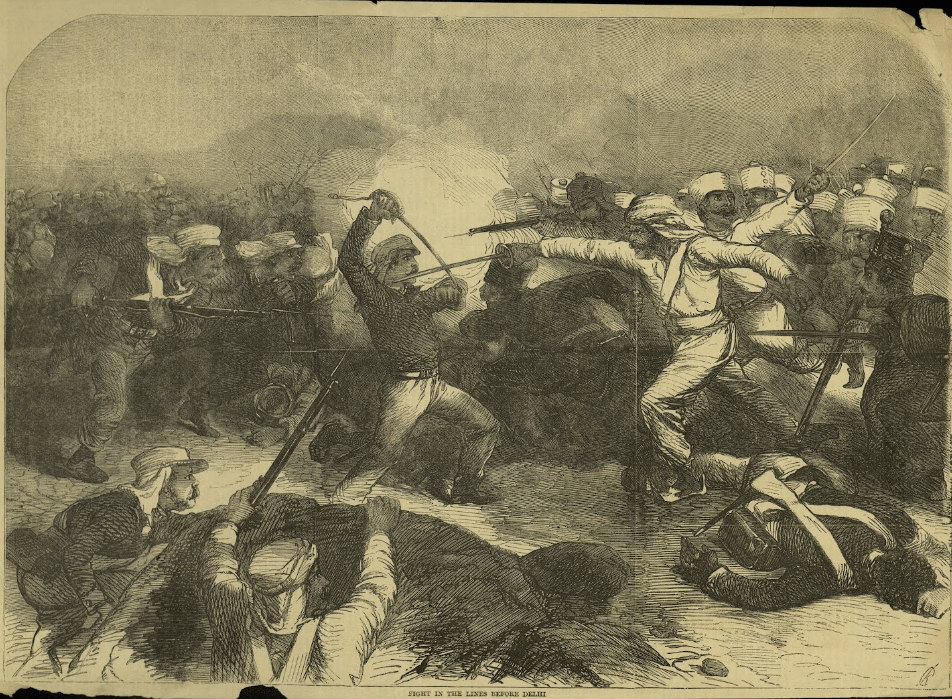
It would be a relentless fight.
On the 11th, the Gurkhas again faced off against the mutineers, and then set them to a chase on the 13th, repelling them both times. Reinforcements for the mutineers were now coming in quickly and fast, and General Barnard had no way of stopping the relentless attacks. His only strategy was to counter them as and when they came.
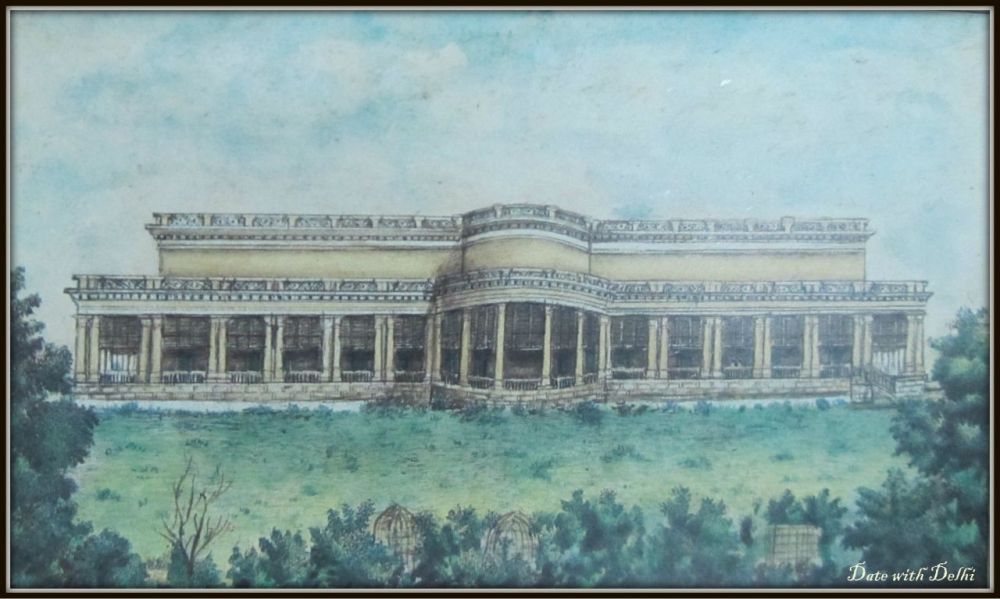
The morning of the 12th of June brought once again a surprise when a number of the mutineers were seen to be gathering the gardens and covered ground close to Metcalfe House. This once-imposing mansion had been gutted and destroyed on the 11th of May, its owner, Sir Theophilus, forced to run in extraordinary circumstances for his life, leaving his magnificent library and beautiful grounds and the mercy of plundering Gujars. The last to see the house intact had been Lieutenant Vibart – shortly after his party had left the tyekhanna of the building, it was set on fire, engulfing not just the magnificent library but a curiously large collection of busts of Napoleon. However, the racquet court was still intact, and some officers, later in the siege, would engage in spirited games, albeit with the added thrill of sniper fire.
To cover the Flagstaff Tower and thus the nearby Metcalfe House, Barnard had ordered two light guns under Lieutenant Bishop and a detachment of the 75th to take up the position. Unbeknownst to them, on the 12th, an enemy had managed to sneak along, sheltered from sight by the trees and gather, some 200 in all, in the racquet court. They then managed to gain the left brow of the Ridge in an attempt to take the guns in the flank. Bishop rapidly turned the guns, but not before Captain Knox and several men of the 75th had been killed by the rapidly advancing mutineers. The 75th quickly took shelter behind Flagstaff Tower while the mutineers continued their advance to within 20 yards of the guns, killing four artillerymen. Recovering from the shock, the 75th rallied and, coming forward, now charged the mutineers, driving them back.
To prevent another attack of this kind, a large piquet with two strong posts was established near Metcalfe House. One was on a small hillock surrounded by trees, another in the stables whose walls were heightened by sandbags. It would now be impossible for the enemy to pass in any number to the left of the British position, which was closed in by Metcalfe House.
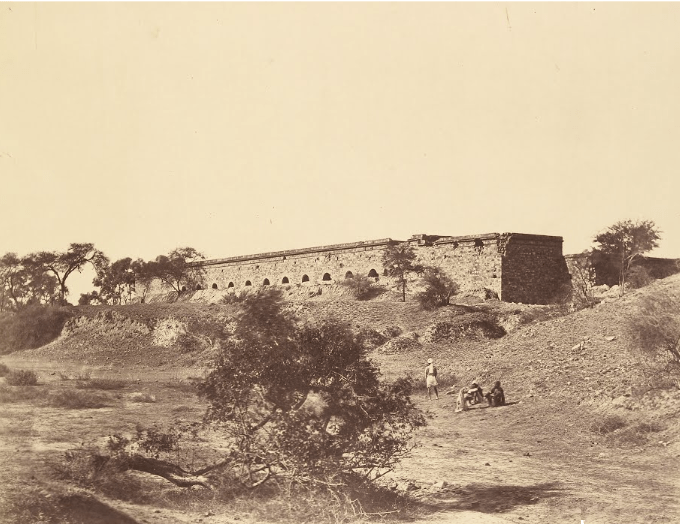
On the 13th, Reid had received a warning that a dawn attack was imminent, although the circumstances, which will be explained below, were somewhat marred in controversy. He watched with patience as 5000 mutineers made their advance in line over open ground, led by their officers who had remembered their training and yelled at their men to keep their intervals straight. Reid waited until the mass was close enough before he let loose a violent volley of grape and musketry fire. The Gurkhas stood firm as Reid then led three companies in a charge, forcing the mutineers back over the ground they had just covered, driving them back once again to the city. He would sadly report 3 killed, 11 wounded and three right arms amputated in this action alone – by the end of June, he had lost 138 of his Gurkhas, with the 60th Rifles reporting similar losses.
Nor did things improve when General Reed ( the old, infirm and bewildered general surreptitiously sent packing by John Lawrence to do his duty in Delhi upon Anson’s death) arrived on the Ridge on the 10th of June. Frail and sick, he immediately took to his bed and let Barnard continue the operations. His obvious senility had a terrible effect, however, on Barnard, who until then had had command of the Ridge, and he took the old man’s arrival as a slur on his abilities. Barnard was a Crimea veteran and a man with much military experience, but not in India. He had only just arrived and knew neither the men he commanded nor the country he was now expected to subdue. The very thought of Reed on the Ridge drove Barnard to inaction – unable to eat or sleep, he soon retired to his tent and retreated from his impossible responsibility. It did not help that the men who should have been helping him were proving to be useless.
Project of Attack on the City of Delhi
Major Laughton, as the Senior Engineer, was to have been busy working out a plan to breach the walls of Delhi – instead, he spent his time in his tent in the company of his young and demanding Persian wife, who had been allowed, by some oversight, to accompany her husband into the field of battle. To the disgust of the men, she had brought with her a veritable siege train of goods for her own comfort – some 30 camels and heavily laden carts – and her demands on Laughton were to the extent that he never left his tent. He was more than willing to pass off all his responsibilities onto junior officers and, indeed, on anyone willing to take them.
The second thorn Barnard had to contend with, besides a useless chief engineer, was the ever-vacillating Archdale Wilson of Meerut infamy. As Chief of Artillery, he openly dissuaded Barnard from even attempting any active operations, thus leaving a camp full of younger men to convince their seniors that something must be done. Wearied by the constant badgering of his juniors, Barnard finally relented and let them come up with a plan. The one with the loudest voice but deemed too incoherent and too excited was young Wilberforce Greathed of the Engineers. He was joined by William Hodson, George Chesney and Frank Mansell to work out a plan to attack Delhi. Hodson quipped, “Times must be changed when four subalterns are called upon to suggest a means of carrying out so vital an Enterprise as this – on which the safety of the Empire depends!”
The plan, called “Project of Attack on the City of Delhi, prepared for Submission to Major-General Sir H. Barnard, K.C.B., Camp Delhi Cantonment, 11th June 1857” was quickly approved by Barnard, now infinitely relieved that something had been finally committed to paper, without any idea if the plan would actually work.
The attack was set for the 13th of June, the main element being a complete surprise. In their excitement to put the plan into action, which entailed withdrawing virtually all the fighting men from the piquets and leaving the entire Ridge unguarded while the force crept up to the very walls of Delhi and blew in the gates, they had failed to inform the most senior officers. On being told to withdraw his men, Colonel Graves, as Officer of the Day, rightly baulked. The order was brought by an excited young subaltern, and Graves lost no time in asking if the man had lost his mind. The subaltern continued to demand that Graves form his men into an assault column, but as Graves had not the foggiest notion of what the subaltern was on about, he decided to ask Barnard directly what was happening. In the meantime, word had gotten about that an attack was planned, but the men milled about, as there seemed to be no one able or willing to lead them or even tell them to march. Only the Rifles advanced – within 300 yards of the walls, where they were to blow up one of the gates – to start the surprise attack against Delhi. Their efforts came to nothing as Graves spent too much time satisfying himself that Barnard had indeed ordered an attack on the city, and by the time it was finally agreed the order had been authentic, it was daylight, and the element of surprise was lost. The Rifles were recalled, and the siege continued unhindered. Colonel Graves was forced to take the blame for the whole fiasco – although he rightly pointed out that leaving the camp unguarded with but a few cavalry and hundreds of camp followers was a folly of the highest order, he was still ostracised by his fellow officers, to the point he was eventually forced to leave the Ridge. Putting in for four months of sick leave, Graves left Delhi before the end of June.
Plans for a second assault fell through with no one willing to take the responsibility of giving an actual order. Barnard deferred to Colonel Young, who then suggested Greathed and Reed should be asked for their opinions – in the end, it was decided to simply wait for reinforcements. Meanwhile, the attacks by the mutineers continued. Metcalfe House was attacked again on the 15th of June, in great force, with severe fighting between the mutineers and men of the 75th. Four horse artillery guns were brought down and brought into swift play, causing the mutineers to retreat, but not until they had put up a fierce struggle. It was around now the artillery from the walls of Delhi started their incessant firing at the Ridge, probably to distract from the fact that the mutineers were busy building a battery of their own, to the right of Hindu Rao’s House.
15th-16th June
Two days later, labourers were noticed carrying baskets of earth, so with some stealth, a force was collecting to the right across the road. The next day, 400 men of the 1st Fusiliers, the 60th Rifles, Tombs troop of horse artillery, thirty horsemen of the Guides and a few sappers and miners were told off to stop what looked like an imminent attack. To confuse the mutineers, only Major Tombs was told where they were going. Orders were given and then countermanded on short notice to further add to the enemy’s bafflement, leaving them with the idea that the British still had no idea they were there. What the rebels did not realise was that Ried was already advancing with the Gurkhas and Rifles from the Hindu Rao’s House while they were watching Tombs and his men proceeding from the left. The batteries then opened fire on Lahore Gate, whose guns would have been able to reach the advancing squadrons.
At first, the rebel cavalry prepared to charge, misjudging the numbers advancing. When they noticed the infantry advancing behind the few Guides that had been sent forward, they fled without any resistance, while their infantry, taken completely by surprise, turned and ran, some throwing down their arms as they went back to the city. Others took up a position in a mosque, the walls of which were furnished with loopholes. From here, they began firing on Tombs and his men. Tombs was their obvious target – with his loud voice, he caught their attention, and they quickly deprived him of his horse, killing it beneath him. Undaunted, Tombs ordered the riflemen to go up and fire into the loopholes while others were sent to force the doors. The Sappers poured a train of gunpowder, a bag was attached to the gates, and the explosion forced not just the doors but also killed 39 sepoys instantly. He then went on and captured a 9-pounder gun.
For his part, Major Reid was no less successful, destroying not just the foundling battery but the accompanying magazine while setting a village and a serai on fire. The losses for the British on the 18th of June amounted to three killed and 15 wounded, including Captain Brown of the Fusiliers, dangerously.
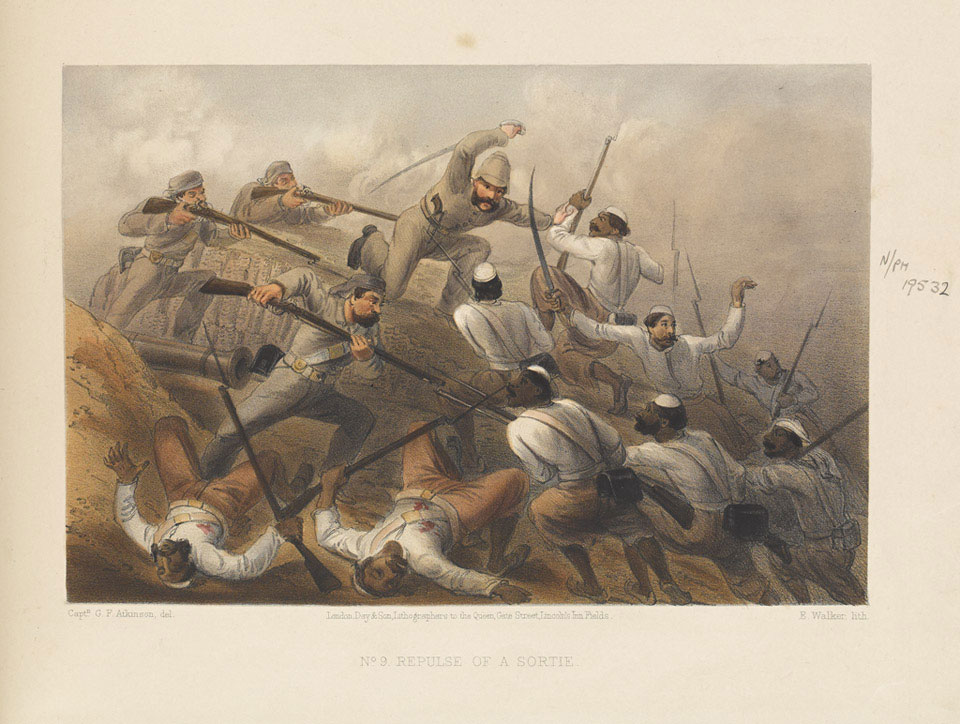
The constant reinforcements received by the mutineers were starting to show. While the Delhi Field Force continued to fight without sleep and often without even a chance to eat, constantly under fire and on alert, the mutineers were able to organise one attack after another unrelentingly every day.
The Grand Attack – 19th June
On the 19th, they attempted to force their way to the Ridge once again, this time attacking the British from two sides. Facing the British was a fresh force – the Nasirabad Brigade with two regiments of infantry, a company of cavalry with a battery of horse artillery. They had until now been forbidden to enter the city but were encamped just beyond the Lahore Gate. Through the morning of the 19th, the British watched this large force with increased trepidation, but no attack seemed imminent – until the enemy disappeared amongst the gardens to the right of the ridge and the news of their ultimate destination was brought in by some sowars belonging to the Raja of Jhind. The attack, they reported, was to take place to the rear of the position.
Tombs’ horse artillery was the first on the ground; twelve guns of the three troops fell upon the enemy, bearing for a time the full brunt of the attack with the rest of the camp scrambled into action, recalling men from piquets and forming up. The fire from the Nasirabad Brigade was steady and well-distributed and supported by infantry sheltered by the covered ground; Tombs’ guns were soon in danger of being over-run. Tombs soon found himself under a severe attack of musketry from sepoys cleverly concealed in a thicket where he could not reach them with guns. As the Guides rode up with Daly in the lead, Tombs called out, “Daly, if you do not charge, my guns are taken.” With barely a dozen men following him, Daly obliged and spurred into the thicket, earning himself a bullet in the shoulder, but his prompt action saved the guns.
Meanwhile, Captain Money’s troops took ground on the left towards Sabzi Mandi, and although taken in flank and subjected to severe firing from the enemy artillery, Money managed to push them back, gaining ground for the British, but one of his guns was disabled on the process, and his horse was killed. Another gun, belonging to the 3rd Troop under Lieutenant Bishop, was dismounted and momentarily abandoned when Bishop was wounded.
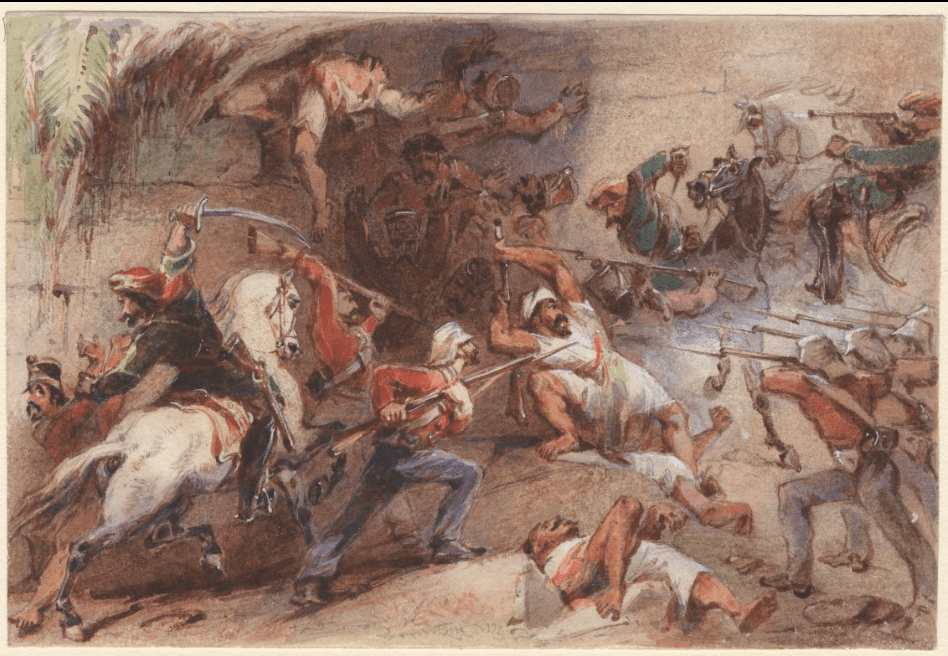
Although it was mostly an artillery affair up to this point, the Lancers now came up and charged the enemy, who turned and took them in flank in a narrow lane and inflicted losses on their numbers. Brigadier Hope Grant entered the fray, holding command of his men, but he too had his horse killed under him and thus dismounted and disoriented, would be rescued by one of his native orderlies and some Lancers. In the ensuing confusion, with dusk coming on rapidly, it became difficult to ascertain who was fighting whom.
In the perfect chaos of the day, Yule lost his life.
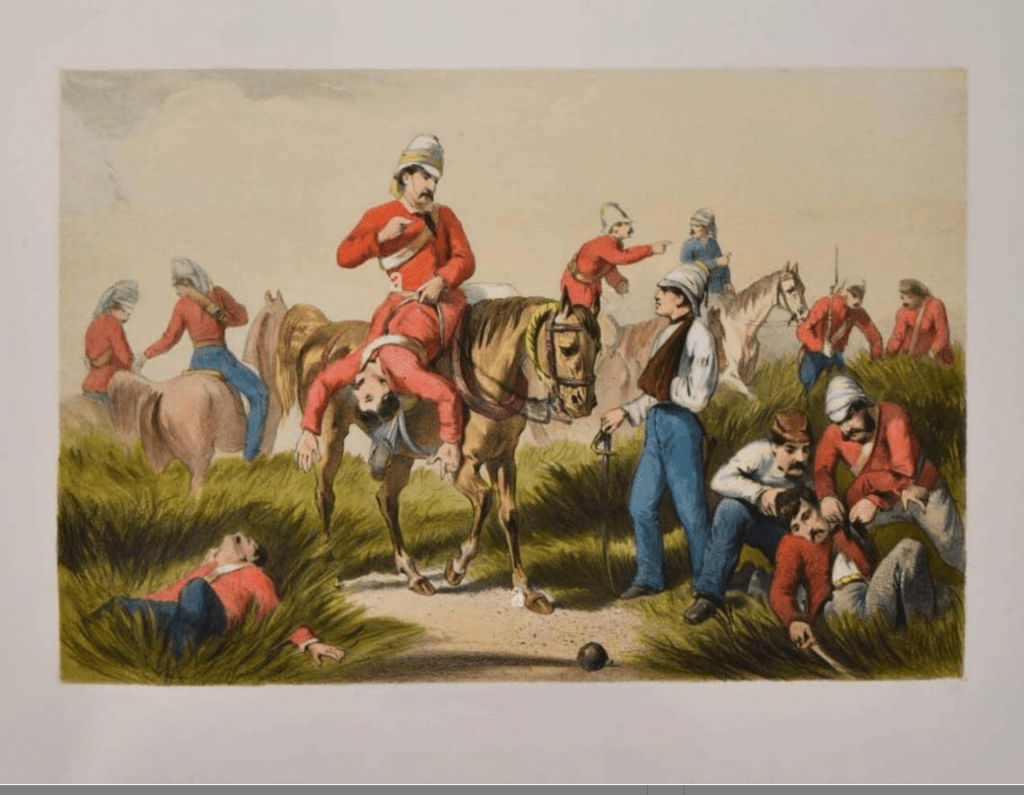
“Turner exhorted poor Yule to advance to save the guns, so we advanced and formed up across the road between the Guns and the enemy taking the fire on ourselves. Major Turner now begged Yule to charge saying (I believe) that unless the Cavalry advanced the guns would be lost….” The words however were heard by Lieutenant Alfred Stowell Jones and he stated Turner had, in fact, said: “Get along to the front, you cavalry, I can’t stand this!” This so excited Yule, he brought his men to the front and cried “Charge!” before Jones had the time to organise the squadron. This led to Lieutenant Blair rushing impetuously forward with his men without waiting for Jones who “had looked at the road and seen it was not fit to charge. He watched Yule for a moment, saw his face change so Jones tried to stop them. But they were too late so Jones went with the rest.”
Writes J. Campbell Brown who rode in the charge:
“Away we went under a most tremendous fire of musketry from the Enemy’s infantry with whom each side of the road was lined and who fired into us at a yard or two distance, we of course cleared the road and on our advance the enemy’s guns were withdrawn off the road where of course with the Cavalry we could not follow so after going 1/2 mile at a gallop and running the gauntlet not only of the enemy’s fire but that of our own artillery who mistook us in the dusk for the enemy’s Cavalry and killing a few of the enemy who did not get off the road on time we halted and formed up at the first place where there was enough open ground to deploy the Squadron on, for we had been forced to charge by the narrowness of the road, in a sort of column of threes, or rather in a mass as best we might.
“There we first knew the extent of our losses, one man after another failing to answer his name, and one man said he had seen poor Yule’s horse pass riderless and another that he had seen poor Yule himself lying face downwards, dead on the road. Some of us wanted to charge back to try and recover the wounded, whom we saw in the distance being sabered by the enemy’s Sowars, however, we were not allowed…So we moved off and after being repeatedly fired on by our Guns succeeded in getting back…” (Letter of J. Campbell Brown)
On the same day, another man was wounded – Henry Daly of the Corps of Guides. As he lay on the ground with a bad wound in his shoulder, he saw Yule, “Poor Yule! I knew him well; he came up after I was down; he trotted by me as I lay on the ground. It was quite dusk. He ought not to have been killed. The darkness did it. I fear he was left but wounded. The enemy prowled about the field during the night and found him there.”
The British force was too small and too scattered to press the enemy back at all the points, with one wing now fighting a mile away from the Ridge while another was so close their grapeshot fell on the banks of the canal. They hurried up, without any particular plan and simply plunged into the melee. The Lancers were fired upon by the British artillery, and Captain Money was twice told to turn his guns on what turned out to be British carabiniers. One of Major Scott’s wagons was blown up before anyone realised it did not belong to the enemy, while the infantry was held back to protect the Ridge. They were only sent forward as darkness was setting in, and finally, the enemy was pushed back. Only the flashes of artillery told the fight was still raging. Gradually, even those flashes ceased, and the men came back to the camp, bringing in the wounded on the gun wagons. There was no joy in the victory – the losses had been hard, and it was the first time the enemy had turned out with any real intent. Quarter Master General Colonel Becher was wounded, and the horse of Colonel Yule had returned riderless. Four guns had been disabled, and many officers and men besides were dead, while the enemy now settled themselves down to the rear of the Ridge. The dispirited Delhi Force lay itself down for a night of restless sleep.
Early the next morning, the men were assembled again, this time to drive the enemies from the rear of the camp, but it proved to be something of a strange affair.
“We came upon a sight which convinced us that their loss could not have been light. At one spot alone, forty of them were lying, their bodies torn by the ghastly wounds of cannon shot…Some were still alive; one man stated he had come along with the brigade from Nasirabad, a solitary deserter of the 1st Bombay Light Cavalry. He was spared at the request of the Rajah of Jheend. He said they were refused admittance to Delhi and ordered to go and fight, after which they would get 10 rupees a month and 200 once. Fifty-five horses were said to have been counted on the ground… The body of Colonel Yule was found, rifled and mutilated…A village about a mile further on was occupied by the enemy…At any rate, no attempt was made to cope with us; a few shells drove them out. A gun, on which some wounded men were strapped, was overtaken and brought in…”
Daly had been found by his men the day before, but no one had come back for Robert Yule. Reverend Rotten, who saw Yule’s body before he buried it, stated it was much mutilated, though this detail was left out in letters to Yule’s widow and his brothers.
In the midst of this, a few rebels came back as the force was withdrawing and “wheeled up a gun so close to our tents that the round shot passed through the Headquarter camp. Having executed this bravado, they galloped off. The alarm of the camp followers across the canal was renewed; they rushed with one accord to the nearest bridge. Soldiers mixed up with them, rushing to the front, knocking them about without any apology and troopers trying, with much swearing, to push their frightened horses against the stream. Our forces had turned out upon the plain, and clouds of dust hindered us from seeing what was going on; our artillery blazing away at an imaginary enemy; and a regiment of infantry was made to lie down by a wary old brigadier, to avoid volleys that never came.”
The losses from the previous day amounted to three officers and nineteen men killed, seven officers and seventy men wounded and sixty horses unfit for further duty. One of the officers killed and four of those wounded belonged to the 60th Rifles.
As a result of the attack on the 19th, a piquet was established to guard the rear of the Ridge, and two heavy guns were mounted to increase the defence. The next concentrated attack would come on the 23rd of June, the centenary of the Battle of Plassey.
 Mutiny Reflections