The end of June had brought more reinforcements to the small force on the Ridge. At the same time, mutinied regiments from all over Northern India continued to march into Delhi to take up the cause.
The State of Affairs in July
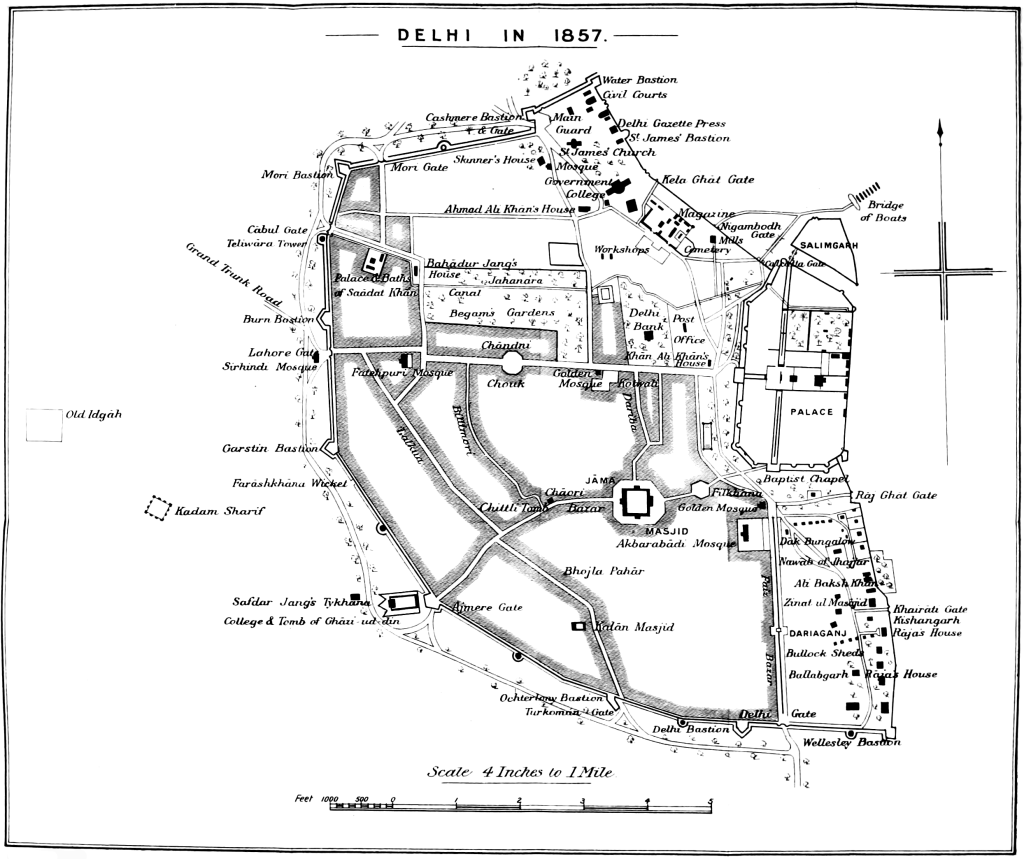
July would be the darkest month for the British on the Ridge. They still numbered no more than 5800 fighting men with nearly 1000 either sick or wounded, and while the rebels sat safely behind walls with roofs over their heads, the Ridge remained a rocky outcrop, battered now by monsoon rain. As for ammunition, the rebels had a seemingly inexhaustible stock while the British had long since resorted to collecting whatever shell the rebels fired at them, and provided it was the same size as their ordnance, sending it back to the city. Every regiment that marched into Delhi brought with them their arms and munitions; as soon as the British had faced them in one skirmish, there always seemed to be more men, more guns. Some officers believed there was no way to win against those odds, and a few believed it would be best to abandon the Ridge altogether. Having got wind of this, Sir John Lawrence wasted no time in sending missive after missive to Delhi, reminding the commander that abandoning Delhi would lead to the destruction of the British in India. General Barnard, tired and weary, now found himself in a position he had never wanted in the first place. On one hand, he had Lawrence howling from the Punjab for him to hang on no matter what the odds; on the other, he had a camp drowning in mud and sickness, and he was still facing an insurmountable enemy. To make things worse, Mr Greathed, the commissioner, was taking his orders from Agra as his position belonged rightly to the North-Western Province and refused to listen to Sir John Lawrence. Greathed was all for abandoning Delhi because it was more important to establish authority over the Doab and reopen communications between Meerut and Agra. In the midst of this, bolder and more spirited officers continued harassing Barnard to put together an all-out assault on Delhi.
A plan was put together, once again with such secrecy that even some of Barnard’s staff were “sleeping soundly in blissful ignorance”, but it was not so much a secret in Delhi. The rebels knew every movement of the plan and were on alert. A large body was moved down by circuitous route into a walled garden in the rear of the Ridge, and if the storming party the British had intended to send to blow in the Kashmiri Gate had been allowed to set off, they would not have met with the mere guard they were expecting, but a very awake army.
Someone on the Ridge had the gumption to inform Barnard of the plan – and at the last minute, the whole idea to carry the city of Delhi by coup-de-main was once again called off. The question was not so much that the plan, had it been executed, would have undoubtedly failed; it was more who had betrayed it to the rebels. There were very few native troops on the Ridge – the Sirmur Gurkhas under Reid were beyond reproach, Rothney’s Sikhs and the Guides, likewise. Yet someone was telling the enemy what the British were doing even before they had done it.
And as always, mutiny and mistrust were never far off.
It transpired in July that three of the purabiya (literally, “easterners” or men from the region of Bihar and Agra) sepoys had been attempting to sow discontent among the recently arrived Sikhs of Coke’s Regiment. They had served long and hard in the service of the company, but now, before the walls of Delhi, the sepoys lost heart.
“Addressing themselves to a Sikh officer and bewailing the inevitable downfall of the English rule, they added, “What is the use of us staying here? Let us kill as many Feringhee as we can and make our way to Delhi. See how few they are! They will be shot in the end. From the King of Delhi, our reward will be magnificent, and our name will be great.”
The Sikh officer listened and, after apparently assenting to everything they said, promptly reported them to his commanding officer. Of the three men who were arrested, one was shot by the Sikh officer himself, while the other two were court-martialled and, within half an hour of being found guilty, hanged. The remaining purabiyas of the company, some 150 in number, were dismissed from service and sent off the Ridge. Some officers now saw foes everywhere – in their own servants, in harmless villagers, in camp followers. If fighting against an enemy they could see was not enough, some officers now imagined an enemy no one could see and used the mere idea of “suspicious behaviour” as sufficient reason to shoot harmless individuals – seven villagers fell to the wrath of one particularly bloody minded man on grounds of “spying” which he did not have to prove and they had no means to defend against. The war had taken on a cruelty of its own. Prisoners, if any at all taken, were not kept for long; trials were summary, the verdict mostly inevitable. Hangings were deliberately slow and painful; the victims were strangled to death; in the field, no quarter was given. After battles, both the British forces and the mutineers scavenged each other’s dead for trinkets, munitions and money. Knowing the British would not show them any mercy, the mutineers likewise murdered the British wounded without remorse, while the British wounded, if they could, preferred to shoot themselves rather than face being hacked to death. Few officers write in their journals of the true horror of the Siege of Delhi – how men can, when given the circumstances, become monsters. There was a thin line between saviour and abuser – in July, neither side could claim to be the better of the other. Morality belonged to the past.
Like at Lucknow, it is inconceivable that the British were not run off the Ridge in one fell swoop. However, just as at Lucknow, where a force of some 10’000 mutineers faced off against barely 1000 for nearly three months, the mutineers settled themselves at Delhi to a war of fighting without conquest. They attacked, the British repelled, they attacked again, and again were repulsed. They outmanned and outgunned the force on the Ridge but were still unable to dislodge the British. They continued to hold on; however, a sense of futility had permeated the ranks. Men threw themselves recklessly into battle, some preferring the bullet to the endless cycle of hell they were tied to. Others, overwhelmed with bitterness and anger, took their fury out on the servants, the water carriers and the messengers, who had done them no wrong. Disgusted with the initial abuse the Gurkhas had received from the British soldiers, Major Reid would remain entrenched at Hindu Rao’s House, refusing to associate with the officers further up on the Ridge, as his men continued to bear the brunt of the attacks on the Ridge.
As for reinforcements, they were still only a trickle. Between the end of June and the 25th of July, the following troops arrived:
Right wing of HM’s 8th Regiment of Foot under Col. Henry Hartley
HM’s 61st Regiment of Foot, under Col. William Jones, C.B., Grenadier, Light and Nos. 2,3, and 7 Companies, plus the band – 450 men
1 squadron of the 5th Punjab Cavalry, under Lt. George Younghusband (13th BNI)
1st Punjab Infantry “Coke’s Rifles” under Major John Cokes, 800 men
1 division with two guns, 1st Troop, 1st Brigade Horse Artillery
1 division, two guns, 5th (Native) Troop, 1st Brigade, Bengal Horse Artillery
Detachment of the 4th Battalion Bengal Artillery without any guns
New raised levies of Sikh Infantry and Punjab Artillery, with no guns
1 squadron 1st Punjab Cavalry, under Captain John Watson and the newly raised Sikh Irregular Cavalry known as Hodson’s Horse, under William Hodson.
In their wake came men who were eager to secure their place in history – the young Lieutenant Frederick Roberts down from the Punjab and the eager Lieutenant Vibart who had only recently fled Delhi with nothing but the clothes on his back. Anger bristled in his 19-year-old mind – for all he knew, his parents and siblings lay dead in Cawnpore, and he joined the ranks of men seeking retribution. Nor was he alone. Wigram Cunliffe was haunted by the horrific tales of his sister’s death, which occurred barely 12 hours after he had left her with the Jennings’ in Delhi and Lieutenant Thomason faired little better – his bride-to-be had died with Cunliffe’s sister. Skulking around the Ridge, like a demented pirate, was Sir Theophilus Metcalfe, simmering with fury at the dreadful loss of Metcalfe House, whose ruins he could see from the Ridge. Other haunted men who had lost their wives and families no longer cared if they lived or died but were eager to have a last shot at the rebels. They fought with merciless fury. William Hodson continued taking immense risks with his men, sending spy after spy into Delhi, and if the rumour was true, he had walked the ruined city’s desolate streets in disguise. All along the only open road to Delhi, officers were eagerly looking for transportation to the Ridge. Bereft of their regiments, they were looking for a way to redeem their conscience for losing their commands to mutiny and were eager to dive into the thick of things. Delhi was the place to be.
However, Richard Baird Smith, the highly respected man of the engineers, arrived with a plan to put the Ridge in order, and from the wilds of the Punjab, Coke and his redoubtable Rifles swept into Delhi.
Raja Swarup Singh of Jhind
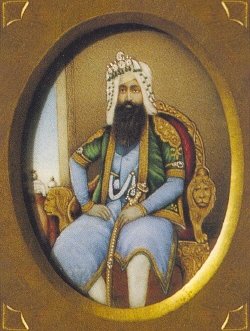
It is a misconception to think the British fought on the Ridge alone. From the very beginning of the mutiny in May, standing by their side was Raja Swarup Singh of Jhind.
It was not the first time the Jhind State had shown its support for the EICo – during the First Anglo-Sikh War (1845-46), he had provided them with men, supplies and carriage, for which he had been rewarded with territory. Although his help was not taken up for the second act of that war, the mutiny gave him every opportunity to show where his allegiance lay.
Receiving word of the outbreak in Meerut and Delhi, the Raja mustered his men and marched at the head of his troops on the 12th of May from his capital, Sangrur, to Thanesar, halting at Ghadban. He ordered his commander, Kahan Singh, to join him with every man and gun he could procure. Thus ready, he then sent his greetings to the Commissioner of Ambala and placed himself at his command. His first orders were to march to Karnal, protect and station and keep the road open. He further collected supplies for the army advancing from Ambala with the ample help of the Tehsildar of Safidon, who assisted in collecting carriages and stores to Karnal for the use of the force. Then, by forced marches, Raja Swarup Singh reached Thanesar on the 15th of May.
He left Thanesar on the 18th of May and reached Karnal the same day, a distance of some 35 miles. Here, he met with Captains Hodson, McAndrew and Lake, who gave him orders to protect the city and cantonment – no easy feat, considering there was no one in the surrounding area whom he could trust – but Karnal was saved from plunder and destruction, not by the British but the Raja of Jhind. It was with an escort of the Jhind Raja’s men that Hodson made his daredevil ride from Karnal to Meerut and back while the Raja himself undertook to secure the Jamuna crossing at Bhagpat and then marched with Captain McAndrew to Panipat, engaging with the rebels and relieving them of a copious quantity of arms and ammunition.
It was also with his help that the Delhi Field Force could move at all. All along the road from Karnal to Delhi, his men repeatedly cleared the way, fighting the rebels at Panipat, Samalkha and Rai. It was with the help of the Jhind Raja that the Karnal road remained in British hands throughout the mutiny, his men continuing to provide support to the various convoys heading towards Delhi and in reverse, escorting the sick and wounded on their way to Karnal.
Raja Swarup Singh joined the British camp on the 7th of June at Alipore. Although he did not participate in the battle of Badli-ki-Serai, his cousin, Resaldar Punjab Singh, under the command of Captain Becher and Hodson, would display outstanding bravery. Together with the British, Raja Swarup Singh pitched his tents before Delhi on the 8th of June, sending his men to settle the remaining rebels who were still in Badli-ki-Serai.
During his stay on the Ridge, the Raja of Jhind was rarely off his horse or out of his armour, consisting of a helmet and chainmail, and appeared to care little for his own comfort. Like a true warrior, he led his men from the front and fought with them, taking on the rebels, side by side with the British, wherever and whenever called to duty. He fed, paid for and clothed his force from his own coffers and provided horses for Captain Hodson’s use for that gallant troop, Hodson’s Horse.
Until the 18th of June, Raja Swarup Singh remained on the Ridge – then, hearing of disturbances in his own territory, he rushed back to Jhind to punish the rebels. Problem solved, but deeming it prudent to remain in his territory for the time being, he continued enlisting recruits for the British cause. He would send his men out to suppress the Hansi and Hissar rebellion, while 360 of them would accompany Hodson to Rohtak. He rejoined the British on the Ridge on the 9th of September, just in time for the final assault on the city.
The undaunting courage shown by Raja Swarup Singh and his men, who kept their ranks and never wavered in loyalty to their leader, is not mentioned in the returns or given their fitting place in the annals of the mutiny of 1857 – so as we read these accounts, it is worth remembering that behind every battle on the Ridge, fought the men of Jhind.
 Mutiny Reflections