The 9th of July
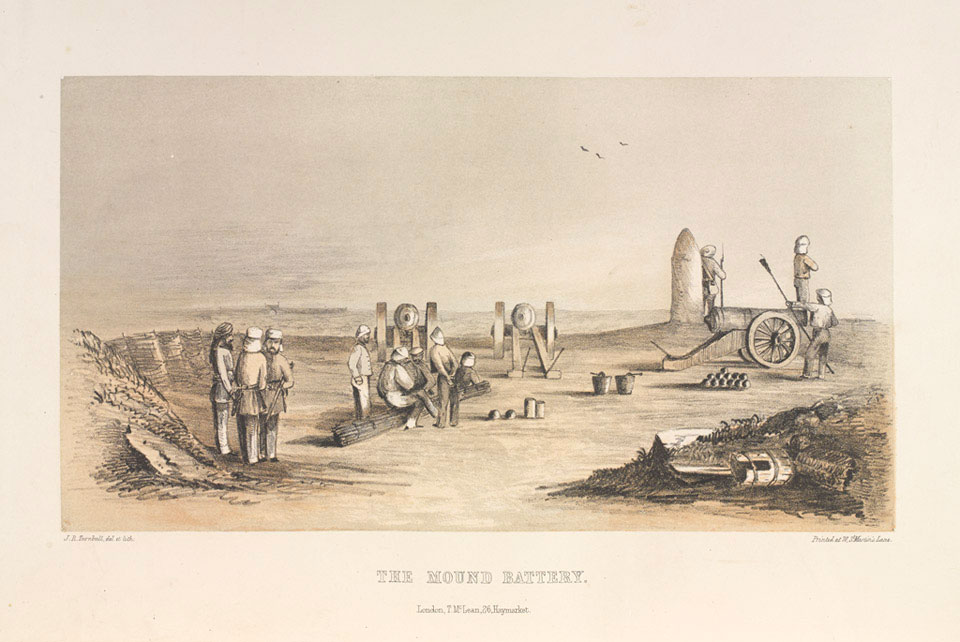
Shortly before sunrise on the 9th of July, the camp was startled to attention by a terrific cannonade to the front and right of the Ridge. The piquet below the General’s Mound was held that day by two guns of Tomb’s troop, under the command of Second Lieutenant James Hills and thirty men of the Carabineers under Lieutenant Stillman. Further along, to the right of the piquet, a party of the 9th Irregular Cavalry had been set to keep an eye on the Trunk Road. Although apprehensions about native troops were running high on the Ridge, the 9th had escaped suspicion. After all as Christie’s Horse, they had done sterling duty in Afghanistan where the Chamberlain brothers, Neville and Crawford had served them as subalterns and the regiment had an excellent reputation for bravery and loyalty. There was no reason to doubt them – if the enemy was seen advancing on the Trunk Road, the men of the 9th would send word to the mound piquet.
Stillman and Hills were at breakfast when an officer of the 9th rode up and reported a body of the enemy’s cavalry was in sight. Hills ordered the man to ride with haste to the headquarters to report and on his way, warn Tombs. He and Stillman then made ready their men neither officer realising the report they had received had been purposely delayed – so far so, there was no time to turn out the troops. Hills moved his guns to command the Trunk Road while Stillman proceeded to the top of the Mound to get a better view of the advancing enemy, thus leaving the Carabineers on their own to receive the first wave of rebel cavalry which was suddenly upon them. Young, unseasoned in battle and some of them barely trained, the Carabineers turned and broke leaving their officers behind.
Hills only managed to get one gun unlimbered before the enemy was on him and his battery. Shouting, “Action, front!” in the hope of giving his men time to load and fire a round of grape, Hills single-handedly, on his horse, charged the oncoming cavalry. Cutting down the first man and slashing at the second as hard as he could, two sowars now charged him. With their horses crashing into his at full pace, Hills and his horse were sent flying, Hills, propelled at some velocity, managed to evade the cuts the sowars made at him, with only one slitting open his jacket just below the left arm, leaving the fabric in tatters but Hills unhurt.
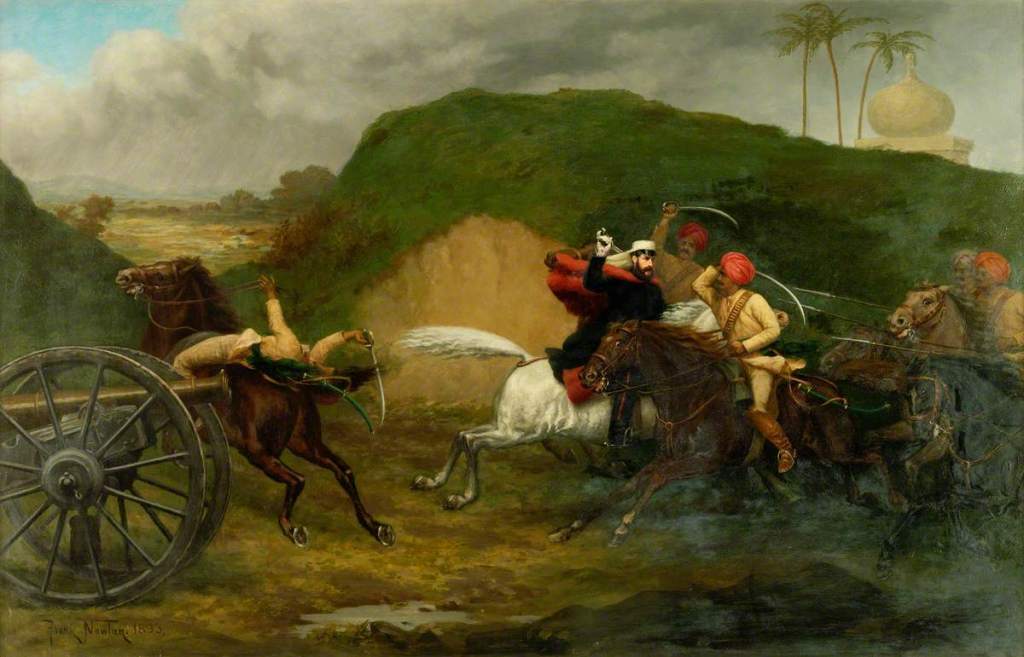
He waited, lying on the ground until the enemy had passed over him before he got up to look for his sword. He found it ten yards away, and scarcely after picking it up, the rebels returned, both on horseback. The first, Hills, shot and wounded with his pistol, dropping him from his horse, while the other charged at Hills with his lance. Hills thrust it aside, catching the man with a severe cut across the head and face. He managed to hold onto his horse and ride off.
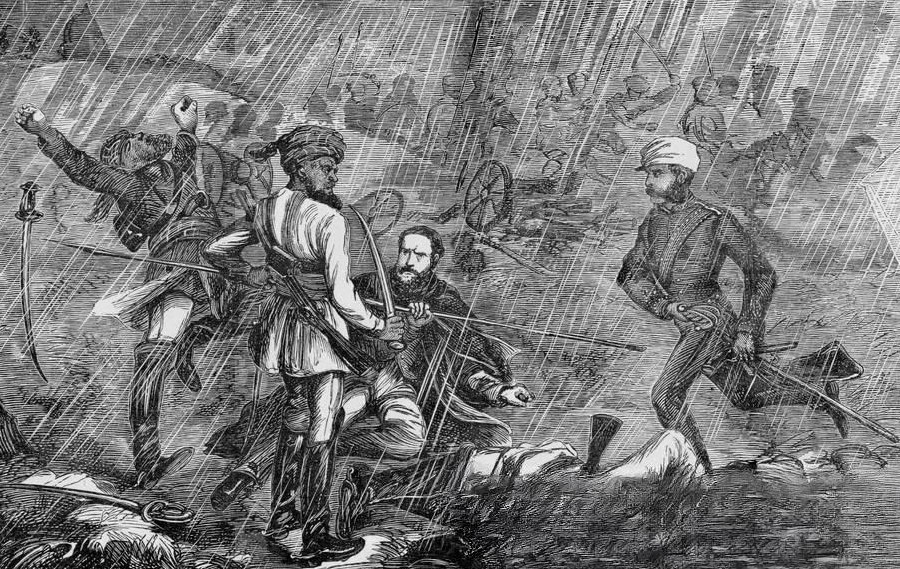
The first man, dismounted and wounded, now rushed at Hills, but Hills slashed his head clean open. Without a moment to catch his breath, a third man was now on him, Hills cutting him across the shoulder, but his blow was turned by the man’s armour. He grabbed Hill’s sword by the hilt and twisted it out of the officer’s hand, leaving them to settle the score in a fistfight. Hills punched him in the head while the man tried to cut him, but Hills was too close for the sword to be of any use. Hills tried to shoot him, but his pistol snapped twice and infuriated by the weapon’s lack of cooperation, Hills drove the handle into the man’s face. Hills, however, did not have much fight left, and as he fell to the ground, half-choked by the fastening of his rain cloak, wounded and close to exhaustion, Harry Tombs burst on the scene and shot Hills’s assailant. Helped to his feet by Tombs, Hills freed himself from the wretched cloak and ran after Tombs, back to the Mound only going back for a moment to look at the unlimbered gun they were forced to leave behind.
As he and Tombs discussed what to do with the gun, Hills noticed the very man Tombs had shot shambling off, Hills’ pistol in hand. The heat of battle on them, the two men set off after him.
“After a little slashing and guarding on both sides, I rushed at him and thrust; he cleverly jumped aside and cut me on the head, knocking me down, not, however, stunning me, for I warded his next cut down. Tombs, following him up, made him pass, and up I jumped and had him turn around, and then Tombs ran him through. He very nearly knocked over Tombs, for he cut through his cap and puggrie…“
Notwithstanding Hills’ gallant attempt to stop the sowars, the men had not had enough time to fire off a single round before the cavalry overran their battery, leaving the artillery to retreat. All the while, the 9th Irregulars sat passively on their horses as the cavalry galloped past the piquet to the tents of Renny’s Indian artillerymen, calling on them to bring away the guns and join them in Delhi. The native artillerymen not only refused but called on Major Olpherts’ European troops, with the gun unlimbered nearby, to fire at the mutineers.
Realising the Indian artillery would not join them and with the rest of the Ridge coming to life around them, the cavalry began an untidy retreat. The guns on the Mound were turned on them, while Renny, standing by his artillerymen, shot a few of the rebels with his revolver. The 1st Fusiliers were now formed up and were taking steady aim at the rebels, while Captain Fagan of the Foot artillery rushed out of his tent, grabbed his horse and, mustering the Carabineers, managed to kill several. In the midst of this, the camp followers were flying in all directions, screaming the Diliwallahs were out to kill them, while servants ran to the officer’s tents with their arms and horses while bullets hissed about ” from foes and bewildered friends.” From the right rear side of the Ridge, where until now they were unaware of what happened, the assembly sounded, and they too made ready to march on the rebels.
In the meantime, finding the Ridge really was getting too hot for them, some of the rebel sowars abandoned their horses and escaped across the canal, while the others turned back the way they came. Thirty dashed along the road by the back of the graveyard and crossed the bridge, killing a European and some camp followers on their way, and then rode off across the plain. On their flight, they passed Hodson with a body of cavalry on the Alipore Road, telling him, when he confronted them, they belonged to the 9th Irregulars. Oblivious that they were, in fact, rebels, Hodson let them pass.
The day was far from over.
Under cover of the relentless cannonade from the city batteries to the right of the Ridge, the rebels, in great force, streamed out of the city gates, making for the Kishenganj suburb; their intent, it seemed, was to turn the right flank of the British and make straight for the Ridge. The alarm sounded, and detachments of most of the regiments with Horse Artillery and a few cavalrymen under Neville Chamberlain marched to the rear of the camp, making for the Kishenganj road. Crossing the canal, they met the enemy formed mostly of infantry, with cavalry and field artillery on each flank on a patch of open ground.
The officers ordered their men to form a line and sent out skirmishers as the guns opened fire, driving the rebels back, who retreated in perfect order, turning at intervals to discharge their muskets while their field guns faced about, unlimbered and sent round shot and grape into the British ranks. Soon, however, the pursuit was broken as the ground gave way to impenetrable hedges of prickly pear and cactus, forcing the British to reroute while the rebels lined the hedges and fired at them through loopholes and openings. The pursuit continued towards Kishenganj, where the rebels had the advantage of ample cover provided by the ruined buildings, the dense vegetation and the stone walls and could lay a devastating fire on the advancing troops.
The Horse Artillery could not act, the ground was too broken bringing the guns to a standstill, while from the Ridge, the batteries sent shot and shell at will over the heads of their own men and into bodies of the mutineers who had, inadvisably grouped together. It was not long; under the sustained fire from the Ridge, the mutineers turned and fled. Reaching the suburb, the British officers again formed their men into a line with skirmishers in advance and drove the rebels before them, while the Horse Artillery, taking advantage of the open ground, plied into them with shell. Crossing a canal by a bridge, the troops now entered a wide lane, the one side of which was the bank of the canal and on the other the outer walls of a large caravanserai.
“The insurgents were posted at the far end of the lane…and received us as we advanced at the double, with a rattling fire of musketry. Some climbed to the top of the bank while others fired down at us from the walls. It was a perfect feu d’enfer, and the loss on our side was so heavy that a temporary check was the result, and it was only with great trouble that the men could be urged on.
Seeing the disposition to waiver, Colonel W. Jones, the Brigadier under Chamberlain, with great bravery, placed himself in front on foot and called on the soldiers, now a confused mass of Sikhs, Goorkhas and Europeans, to charge and dislodge the enemy from the end of the lane. He was answered with a ringing cheer, the men broke into a run, and with firing a shot, charged the sepoys, who waiting until we were within fifty yards and then turned and fled.”
By evening, the British had forced their way to within 700 yards of the city walls when the rebel infantry, seemingly having had enough of fighting for one day, retreated into Delhi and let the batteries on the walls rain down shot and shell. At this point, seeing pursuit was useless and staying was pointless, the British force returned to the Ridge. In all, they lost 223 men, killed and wounded. The very next day, on the 10th of July, Richard Baird Smith ordered the destruction of the last bridges over the canal and started the reinforcement of the Ridge.
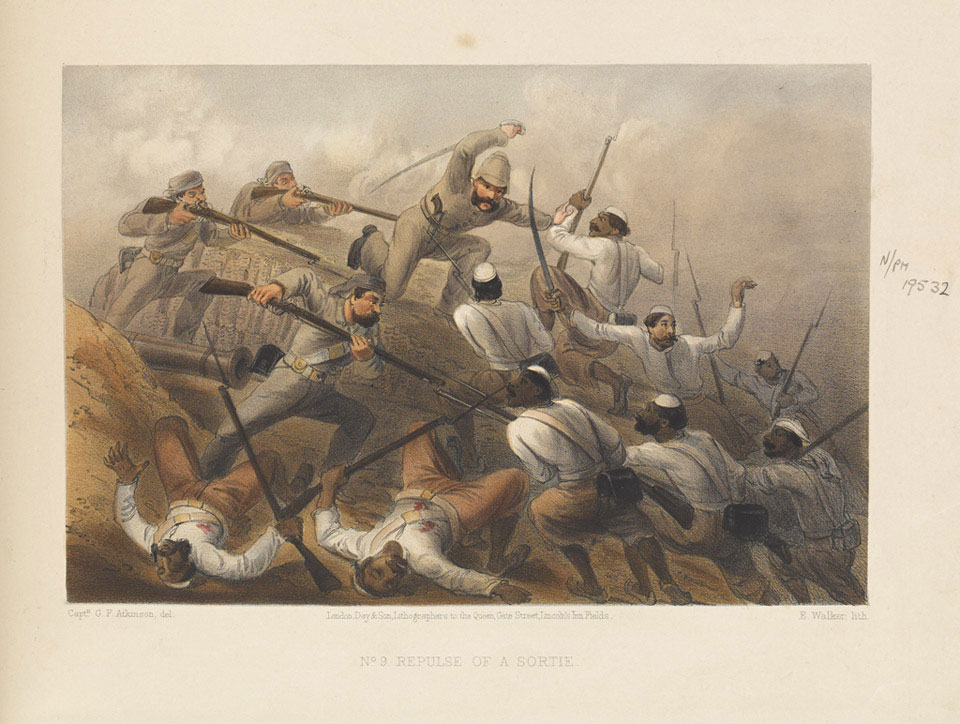
Baird Smith’s plans did not come a moment too soon. Strong parapets were built and deep ditches dug while thick “abattis trees and brushwood were carried over all the open spaces, provision was made for placing field guns in the battery behind the bank on the right of the mound. Part of the ground in front of Sammy House being wholly unflanked…it was determined a small battery for two field guns should be constructed to the right of Perkin’s mortar battery, a position commanding the ground in question..the battery was built of sandbags for sake of expedition (and) covered with a screen of gabions..” The work was not completed a moment too soon – at sunrise on the 14th of July, as the pioneers completed the final screens, the insurgents launched an attack on Sammy House.
The work, however, proved to be a success. While the troops remained quietly behind the parapets, the artillery made short work of the insurgents, opening fire from all the batteries on the right of the position. It was finally decided that although the artillery had made some mark on the insurgents, they had not succeeded in driving them off. Stronger measures would be needed to drive the insurgents back from Hindu Rao’s House and away from the Sabzi Mandi piquet.
The next day, 10th July, the rebels tried again to take Hindu Rao’s House. They began their attack at 7 in the morning, and they decided that 8000 men should be enough to get rid of Major Charles Reid and his Gurkhas.
Somehow, Reid with the help of the artillery and the 60th Rifles, managed to hold them off, but by 3 in the afternoon, he was writing up to the main camp, asking Brigadier Chamberlain if he could go on the offensive – Chamberlain agreed. For his part, Chamberlain said he would try to turn their left flank if Reid could turn their right and drive them back into the city. Reid leapt into action. He sent instructions to the officer at Sammy House to support Chamberlain’s movement, and then he set off with five companies of the Sirmoor Gurkhas, two companies of the 60th Rifles under Sir E. Campbell and 180 Guides under Lieutenant Robert Shebbeare, in all some 750 men. This counterattack certainly gave the rebels some pause for thought, for Reid now drove them before him, through the jungle and down the Grand Trunk Road, to where “they were posted in thousands.” At 400 yards from the city walls, Reid halted as his men were now getting pummelled with grape shot from the heavy guns at the Mori and Burn Bastions and from eight small guns the rebels had dragged out, two of which were positioned near the canal bridge.
“I was anxiously looking out for Chamberlain on my right. Presently, he rode up himself , and I begged of him to send me guns. He rode off, and in about five minutes up came my old friend Major Scott with four 9-pounders.”
Scott now returned fire, aiming at the light guns that had been annoying Reid and his men and after five rounds, Reid once again ordered the advance. It looked as if Reid was planning to enter the city itself, and although the idea was quite preposterous, the rebels quickly withdrew their guns and scrambled to get their infantry back behind the gates. They then manned the walls by the Ajmer Gate and commenced firing from loopholes. Surprised, Reid advanced to within 250 yards of the wall where he managed to get his men under good cover – he had succeeded in driving the rebels back into the city and with the objective met, withdrew back to the Ridge.
“The Rifles under Captain Sir E. Campbell, who appears a first-rate officer, lost five killed and ten wounded, Guides, twenty killed and wounded. A company of the 2nd Fusiliers, who came up with Scott’s guns, five killed and wounded. My own regiment, eight killed, one officer (Eckford) and twenty-six wounded. Singheer Thappah, my Sirdar Bahadur, wounded through the neck, but is doing well, I am happy to say. I got a crack over the head from something or the other, but am not hurt….Carts with killed and wounded were seen going into the city until dark. Our spies say their loss was very great.” (Reid)

The 14th of July
The day’s fighting began again as it had done twenty times before, at Hindu Rao’s House. Once again, the rebels approached with oaths, swearing they would take Reid’s head back to Delhi; they would level the House and everyone in it – but again, as in the past 20 attacks, they did not pass muster. Reid still had his head at four in the afternoon, when Brigadier Chamberlain wrote to him to drive the rebels back and, like on the 10th of July, to act in concert with him. A column of 800 Infantry, six Horse Artillery guns accompanied by the Guides Cavalry and the newly raised corps known as Hodson’s Horse, was formed up under Brigadier General Showers, with Frederick Roberts as staff officer, while Brigadier-General Chamberlain joined. Major Charles Reid formed as many men as he could spare at the foot of the Ridge. Under heavy fire, they advanced until they reached the wall of an enclosure within Sabzi Mandi, which was lined with the enemy. Seeing the men hesitate, Chamberlain rushed forward and, putting spurs to his horse, called on them to follow him and then jumped his horse over the wall. The men followed, and Chamberlain was shot in the shoulder.
Only with great difficulty, they managed to drive the insurgents back, fighting was close and the walled gardens provided the enemy with excellent cover, but undaunted, position after position fell until the British found themselves, precariously, in sight of the Lahore Gate and in their zeal, just yards away from the city walls.
Musketry from the walls and grape from the heavy guns mounted on the Mori and other bastions committed terrible havoc. Men were falling on all sides.” Getting back to the Ridge was imperative but not without being hazardous to the last degree.” As long as the British advanced, the insurgents would not come out and meet them; however, as soon as they retreated, they would come out again in numbers. As soon as the British turned, the enemy rebels again poured out of the gates and pursued the force back to the Ridge until they were forced to beat a hasty retreat by the steady fire from the piquets. Most of those killed and wounded met their fate on the retreat, which cost the British all 15 killed, 16 officers and 177 men wounded and 2 missing.
The missing men were last seen by Lieutenant Frederick Roberts.
“When the retirement commenced, I was with the two advanced guns in action on the Grand Trunk Road. The subaltern in charge was severely wounded, and almost at the same moment, one of his sergeants, a smart, handsome fellow, fell and was shot through the leg. Seeing some men carrying him into a hut at the side of the road, I shouted: ‘Don’t put him there; he will be left behind; get a doolie for him, or put him on the limber.’ But what with the incessant fire from the enemy’s guns, the bursting of shells, the crashing of shot through the branches of the trees, and all the din and hubbub of battle, I could not have been heard, for the poor fellow with another wounded man was left in the hut, and both were murdered by the mutineers.”
 Mutiny Reflections