Alipore, 4th of July
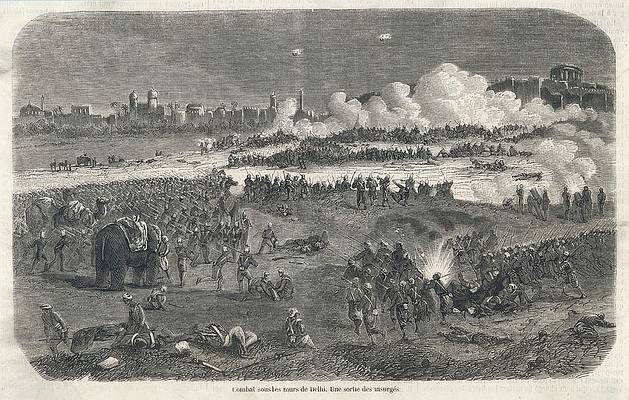
On the 3rd of July, Bakht Khan turned out some 5000 men with several guns – however, contrary to expectations, there was no grand attack. Instead, he moved his men off to the right of the Ridge. Shortly after dark, he assembled his force and marched them off in the direction of Alipore, where the British were holding a small outpost manned by Younghusband’s squadron of the 5th Punjab Cavalry.
Reaching Alipore around midnight, they opened fire on the serai with artillery – giving the sowars just enough time to mount their horses and fall back on Rhai the next post some ten miles to the rear of the Ridge and garrisoned by the friendly troops of the Jhind Raja.
The sound of the artillery barrage could clearly be heard in Delhi – with some haste, a column under Major Coke was prepared to pursue the insurgents should they decide to push up the Trunk Road or, at the very least, cut them off should they try to return to Delhi. Besides the men of the 1st Punjab Infantry, Coke took with him one wing of the 61st Foot, six Horse and six Field Artillery guns, one squadron of Carbineers, one squadron of the 9th Lancers, and the Guides Cavalry – in all 800 infantry, 300 cavalry and 12 guns. As his staff officer, Coke was given the young Lieutenant Frederick Roberts.
It was generally supposed the enemy was attempting to cut off a supply train coming from the Punjab, which was known to be under Native guard. Coke was expecting a long, hard chase – but at daybreak, the mutineers were in plain sight, crossing in front of Coke’s column. They had pillaged Alipore in the night and were returning to Delhi, laden with plunder. “The rebels were moving on fairly high ground, but between us and them was a swamp rendered almost impassable by recent heavy rain. It extended a considerable distance on either side, and as there was no other way of getting at the rapidly retreating foe, it had to be crossed. Our Artillery opened fire, and Coke advanced with the Cavalry and Infantry. The swamp proved to be very difficult; in it, men and horses floundered hopelessly, and before we were clear, the enemy had got away with their guns; they were obliged, however, to leave behind all the plunder taken from Alipur and a considerable quantity of ammunition…”
The Carabineers and Guides set off in pursuit to cut up any stragglers, but the insurgents, proceeding with as much haste as they could muster, still managed to carry off all their guns.
With the fierce sun burning overhead and the soldiers already “much distressed” for having been under arms for more than ten hours, Coke halted the infantry on the banks of the Western Jamuna Canal instead of marching straight back to Delhi, allowing the cavalry and artillery to proceed without them. They piled arms and watched as the guns and cavalry crossed the canal – a troop of elephants had been brought out to bring in the wounded, adding to the sight. All of a sudden, from the left, and with no warning, shots came flying out of the jungle, hitting some men lying on the ground. The men quickly fell in and moved in the direction from which the shots were coming.
Terrified by the sound of the firing, the elephants panicked and dashed off across the canal. With loud trumpeting, and their trunks held up well over their heads, they plunged into the water, their mahouts vainly trying to stop them. The elephants refused to pay any heed at all, their flight ending when they were safely back in their own camp.
In the meantime, the shots were “thick and fast,” while the regiment advanced in line until they came to an open space and could see the enemy, which to their horror, outnumbered them four to one. An all-out attack would have been suicidal, and prudently, Major Coke “deemed it prudent to retire.” Retreating firing, the regiment retraced its steps back to the canal and, crossing the bridge, lined the bank on each side. A young officer named Griffiths left the following account:
“The enemy followed, their men forming opposite us and keeping up a steady fire at a distance of from 100 to 150 yards. I was on the right of the line with the Grenadiers, when, half an hour later, I was directed by the Adjutant to march my men to the left of the bridge to reinforce the Light Company, who were being hard pressed by the insurgents, some of whom were wading through the canal, with the evident intention of turning our left flank. We crept along the bank and were received with joy by our comrades, one of them, I well remember, welcoming us in most forcible language and intimating that they would soon have been sent to – – – if we had not come.
The file-firing here was continuous, a perfect hail of bullets, and it was dangerous to show one’s head over the bank. Shouting and taunting us, the rebels came up close to the opposite side and were struck down in numbers by our men, who rested their muskets on the bank and took sure aim. Still, the contest was most unequal; the enemy wading in force through the water on our left and the day would have gone hard for us from their overwhelming numerical superiority…”
Suddenly, from the rear, the men heard the sound of galloping horses and the noise of wheels – Major Tombs and six-horse artillery guns “came thundering along the road…They passed with a cheer, crossed the bridge at full speed, wheeled to their left, unlimbered as quick as lightning and opened fire on the rebels.” Taken completely by surprise, the rebels fled in disorder back to Delhi, leaving their dead and wounded behind.
The engagement cost the life of one of Coke’s dearest friends from the Frontier, a man who had followed him purely from personal attachment from his wild home on the Kohat border, Chief Mir Mubarak Shah. He was a grand specimen of a frontier Khan, and on hearing that the 1st Punjab Infantry was ordered to Delhi expressed his determination to accompany it. He got together a troop of eighty of his followers, and leaving Kohat on the 1st of June, overtook Coke at Kurnal on the 27th, a distance of nearly 600 miles.” A ride which was barely outmatched by the Guides.
Shortly before sunset, the force completed the four-mile march back to the Ridge – many men died on the way from heat apoplexy and sunstroke, while the wounded and the dead were piled onto the backs of a fresh batch of elephants. Waiting to greet them was General Sir Henry Barnard with kind words of encouragement – it was almost the last thing the poor man would do; within hours, he was lying on his deathbed bed caught in the agonising throes of cholera. He would be dead before noon on 5 July. Command was now left solely to General Reed, the old, nearly senile general sent down from the Punjab who had scarcely stirred from his bed since the day he had arrived on the Ridge. No one actually listened to Reed, and for now, everyone was commanding themselves.
 Mutiny Reflections