The Piquets and Batteries on the Ridge
On 8 June, the Delhi Field Force had managed to establish itself in two positions – Hindu Rao’s House and Flagstaff Tower. These positions were quickly augmented by the formation of the Mound Piquet and subsequently another in the Observatory or Jantar Mantar. Gradually, further positions would be taken and picquets established in each – in the ruins of Metcalfe House, in an old temple called Sammy House, the Crow’s Nest and eventually Sabzi Mandi itself, with Ludlow Castle eventually added to the line.
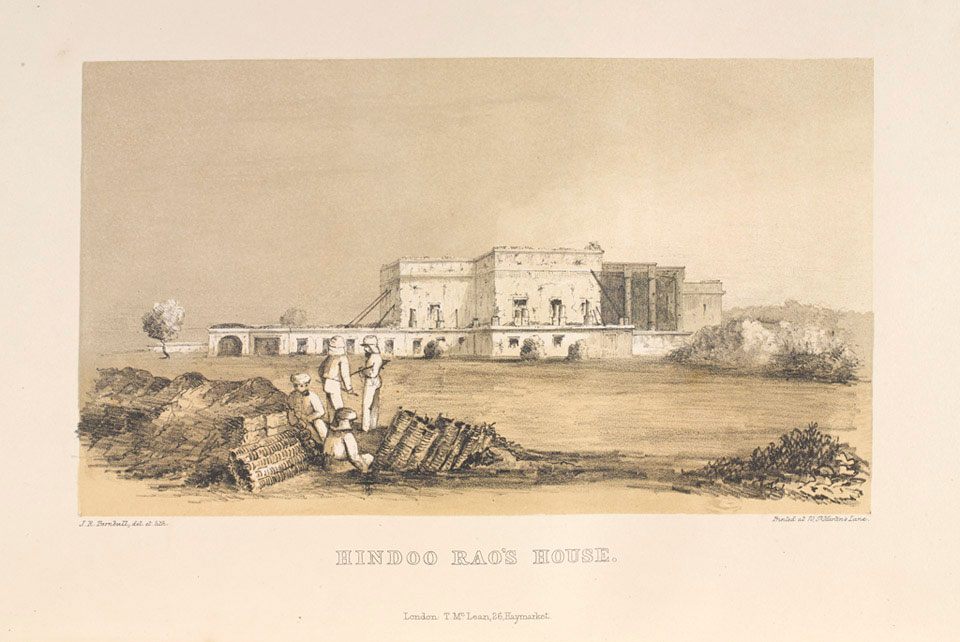
Once the home of William Fraser, agent to the Governor General in Delhi, the house and grounds had been bought by the Mahratta Chief Hindu Rao after Fraser’s assassination. After the death of the Mahratta, the house remained mostly unoccupied; however, the name of the wily old warrior stuck, and it remained known as Hindu Rao’s House.
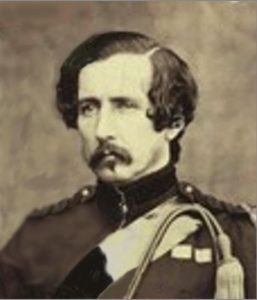
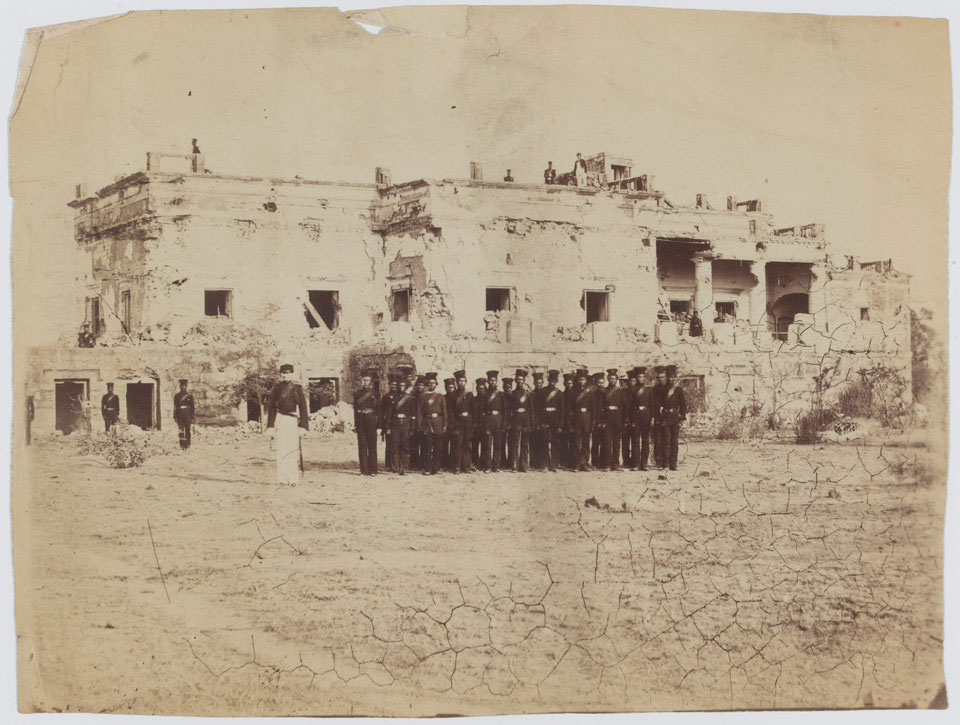
It would form the extreme right of the position and would be garrisoned throughout by the Gurkha Sirmoor Battalion under the command of Major Reid, two companies of the 60th Rifle and men of the Guides. The rest of the 60th was encamped close by to be able to send support as needed. In the rear of the house, Colonel Tombs’ troop of horse, artillery was stationed with the intention of overawing any attempt by the enemy to attack from Subzi Mandi. Batteries were constructed at various points to answer the fire of the Mori Bastion and to throw shot and shell into the suburb of Kishenganj from which the enemy envisaged attacking the camp’s flank.
As for Major Charles Reid, this exemplary officer never left his post and led his men in every attack and skirmish: he only ever entered the main camp on the Ridge when wounded during the final assault in September. The Sirmoor Battalion would suffer 327 casualties out of a total strength of 490, including eight of their nine British officers between June and September, and, like Reid, it was the Gurkha’s point of honour to never leave their post; even their sick and wounded begged their friends to conceal them to prevent being sent to the rear.
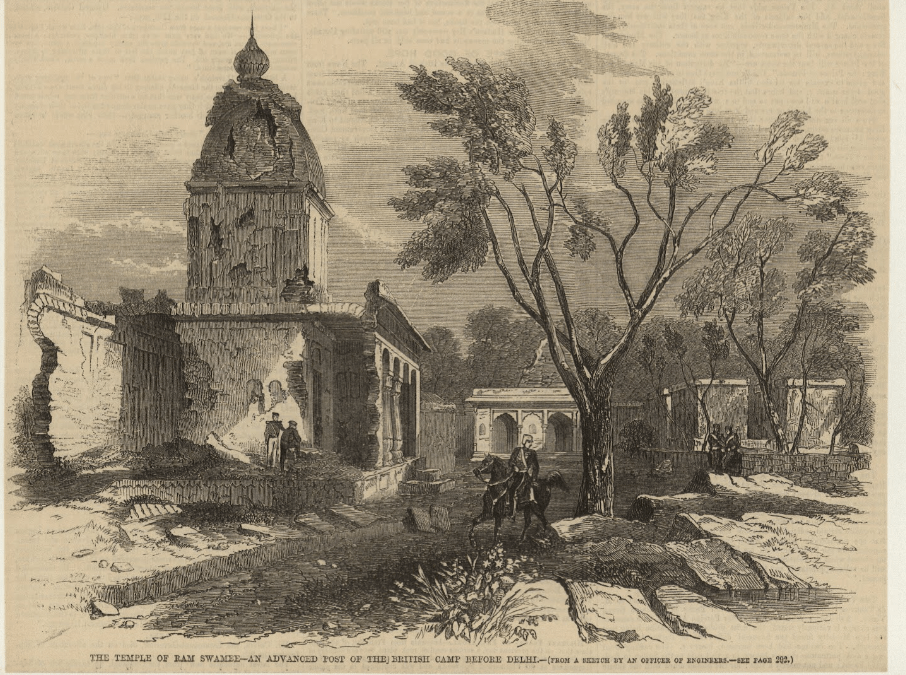
Three other forward posts, all close to Hindu Rao’s House were the Sammy House (a corruption of the word Swami),
a craggy outcropping called the Crow’s Nest which would become a favourite with riflemen,
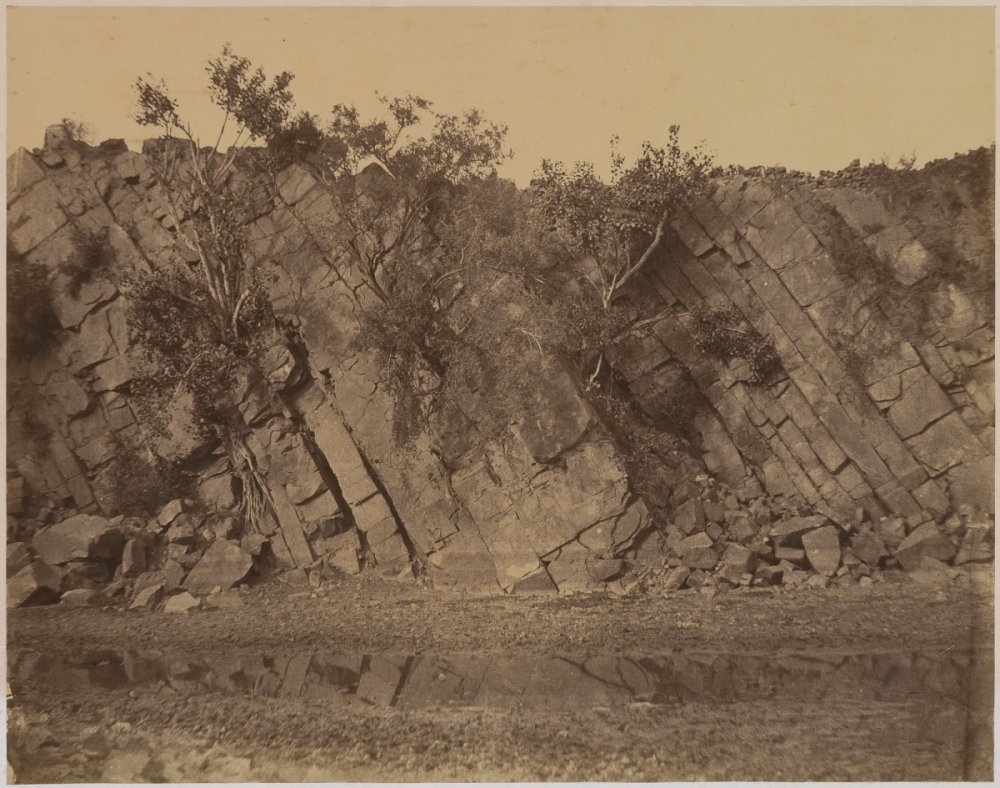
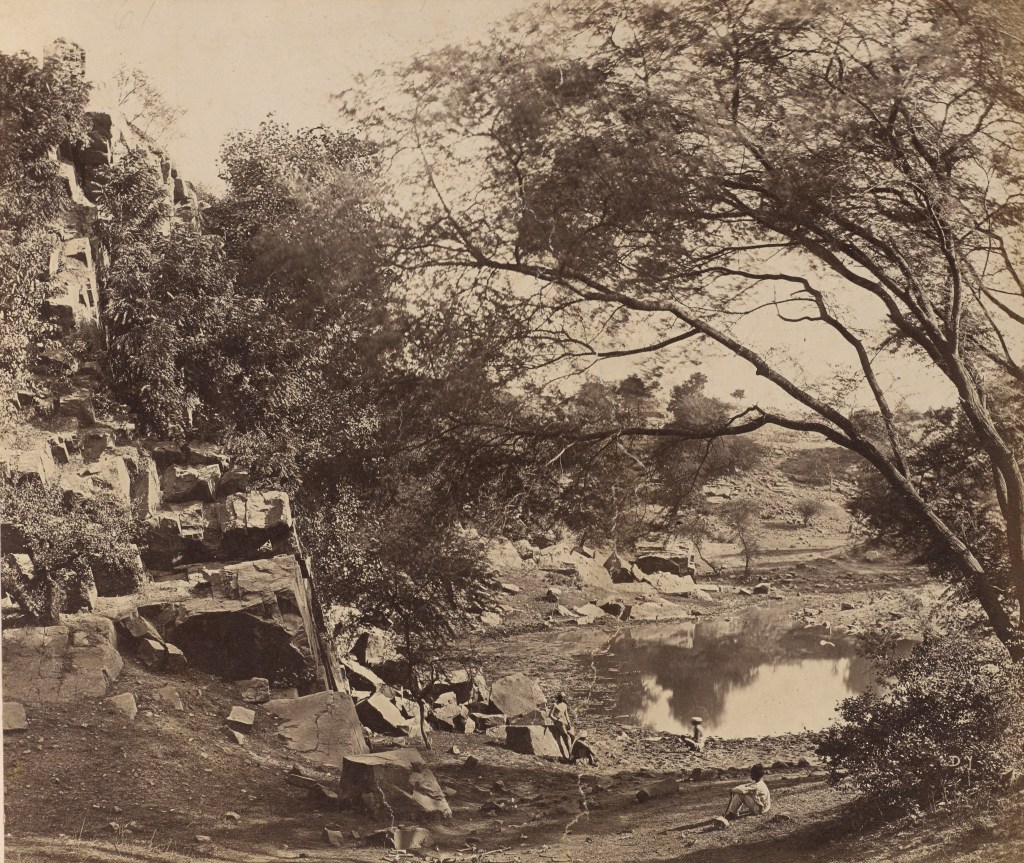
and Sabzi Mandi, the lowest point of the defences.
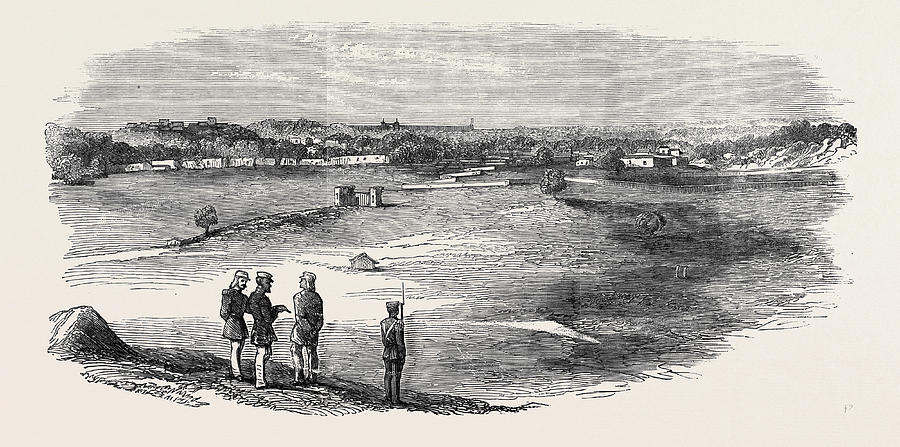
Behind Hindu Rao’s House stood the Observatory, so admired by George Beresford, it would now serve as a post for two field guns. These guns were permanently occupied in what was to be the most exposed spot on the Ridge.
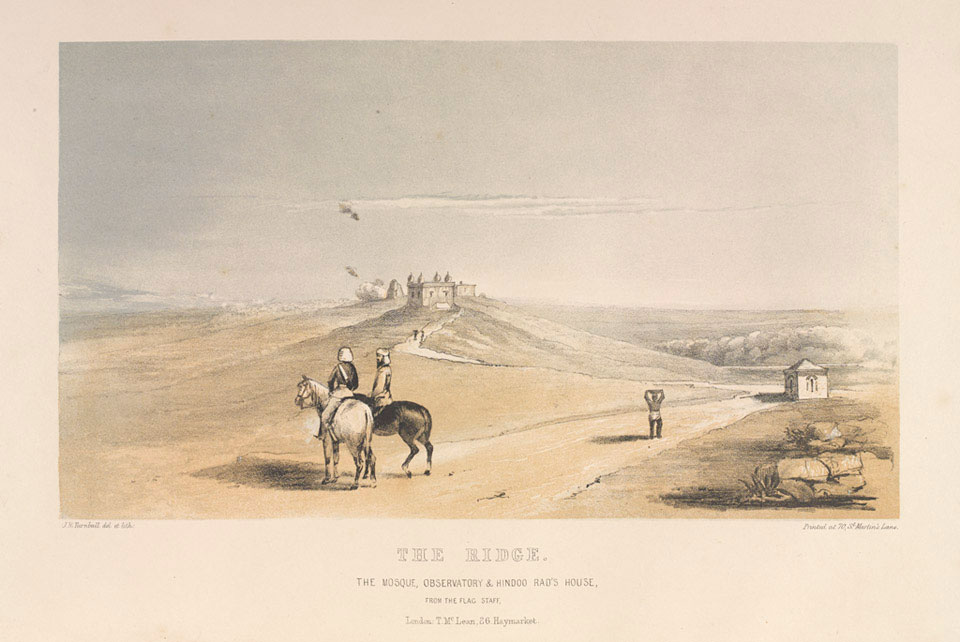
From here a red gravel road led to the Flagstaff Tower.
One of the oldest buildings on the Ridge, Flagstaff Tower, had been built by the British in 1828 to serve as a signal or lookout point. This one-roomed, castellated tower with Gothic architecture overtures had served as the rallying point for the survivors of the Delhi Massacre on the 11th of May. It was here they waited with no food or water for help from Meerut that never came. While the men gathered on the roof, the women, children and the wounded sat inside on the stairs in the stifling heat, listening to the constant sound of heavy firing from the city. When it became clear no help was coming, the fugitives crowded into whatever conveyances they could find and fled the city. When the Delhi Force took the Ridge on the 8th of June, the first sight that greeted the men was the bullock cart, covered only partially by a cloth, that had been sent up from the city on the 11th of May, still containing the bodies of the murdered officers of the 54th. Unidentifiable but for the buttons on their rotted uniforms, the grisly remains were quickly interred in a makeshift grave behind the tower.
Standing 150 feet high, the roof of the tower was accessible by a single staircase and due to its relatively sheltered position, the tower was soon a favoured place for sick and off-duty officers to gather and discuss the day’s events. As it provided a vantage point to survey the surrounding area, every new officer who arrived in Delhi was quickly compelled to climb to the top of the roof and take stock of what exactly it was he had gotten himself into. The position was held by a party of infantry and two guns.
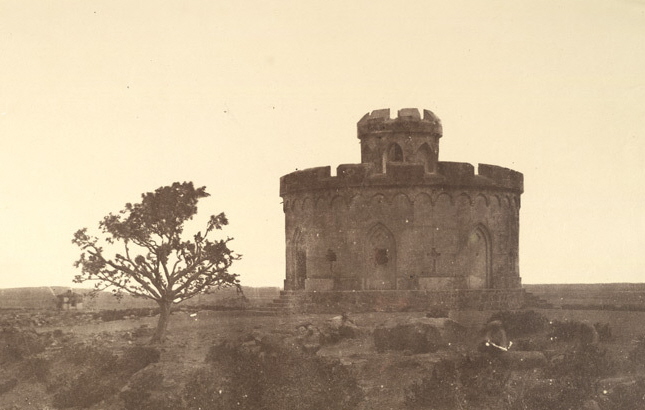
“From the top of Flagstaff Tower, the view was indeed magnificent. The city lay open to them, over the walls, topped by eight-foot parapets and flanking bastions and martello towers, and enclosing the cupolas and minarets of the Jumma Masjid Mosque and the delicate and intricate pierced screens and dome of the Red Fort…
The river bed was nearly a mile wide; in places, a confusion of channels and sandbanks, and shallow lagoons, sometimes bordered by jungle and malarial swamp, and sometimes by cultivated terraces and orange-groves. The panorama was fantastic; a delicate, ethereal city of domes and towers, framed in a deep green surrounded by swamps, gardens and trees…”
In the beauty, a quiet horror remained. Many of the shrubs and small trees had been destroyed by the fury of the mutineers; what was left would soon be eaten away by the elephants and camels of the Delhi Field Force, leaving a long, barren desert of rocks and dust. The roads in the destroyed Cantonment were strewn with the contents of the houses, the pictures and music boxes, the furniture, clothes and books of their former inhabitants, all left to rot by the elements and the burned houses roofless – the blackened remains of happier times. Officers who had escaped Delhi on the 11th of May and later joined the Field Force would make the pilgrimage to their former residences, only to be disappointed at finding nothing left of their possessions worth salvaging.
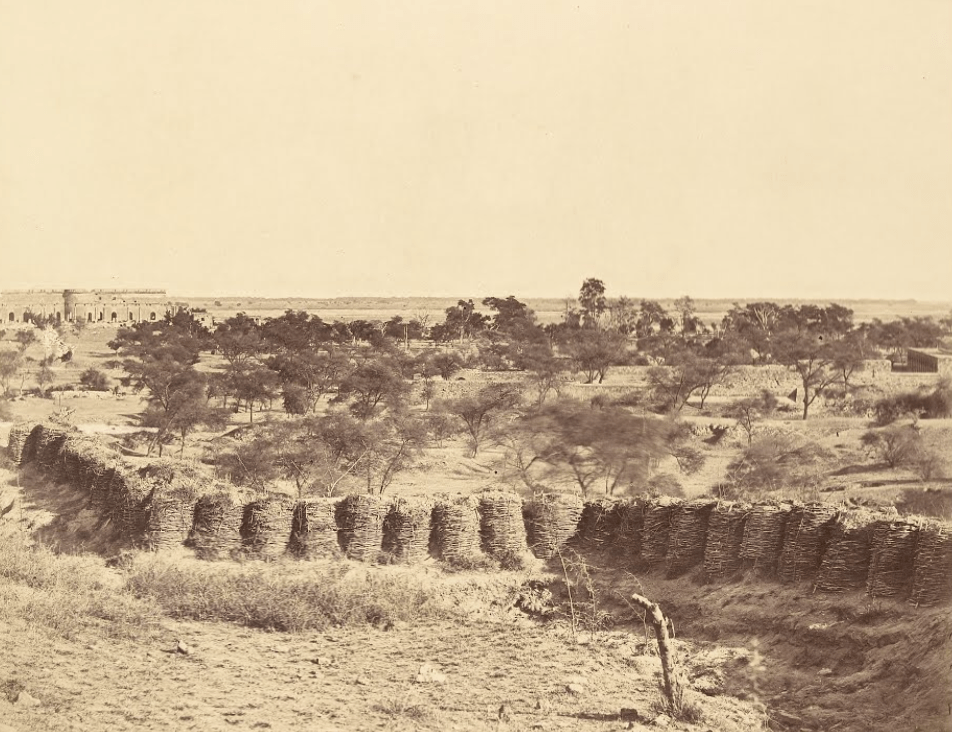
A deadly shortcut had been established between the camp and the Ridge, dreadfully exposed to the enemy’s guns. It would soon gain the sobriquet of the “Valley of the Shadow of Death” from a large number of men and animals killed there. It would become a truly horrible road, strewn with the dead bodies of camels, horses and bullocks left unburied, their rotting corpses adding to the already pestilential smells of the Ridge.
“Up and down this valley, past the bloated corpses and the vultures and the black swarms of flies, the table servants or kitmutgars would toil bravely with the meals for their officers on duty balanced on their heads. They had begun to use this short-cut before it became dangerous, and, being creatures of strict habit, they did not like to change their ways but ran on, in and out of bursting shells, cover with dust and flies, and occasionally with chips knocked out the crockery by shell splinters.”
Lord Roberts would later describe the Ridge as such:
“It was on the afternoon of the 8th June that the British force was placed in position on the Ridge. The main piquet was established at Hindu Rao’s house, a large stone building, in former days the country residence of some Mahratta Chief. About one hundred and eighty yards further to the left was the observatory, near which our heavy gun battery was erected. Beyond the observatory was an old Pathan mosque, in which was placed an Infantry piquet with two field-guns. Still further to the left came the Flagstaff Tower, held by a party of Infantry with two more field-guns. At the extreme right of the Ridge, overlooking the trunk road, there was a strong piquet with a heavy battery.
This was the weak point of our defence. To the right, and somewhat to the rear, was the suburb of Sabzi Mandi (vegetable market), a succession of houses and walled gardens, from which the rebels constantly threatened our flank. To protect this part of the position as much as possible, a battery of three 18-pounders and an Infantry piquet was placed on what was known as the General’s Mound, with a Cavalry piquet and two Horse Artillery guns immediately below. In front of the Ridge the ground was covered with old buildings, enclosures, and clumps of trees, which afforded only too perfect shelter to the enemy when making their sorties.”
 Mutiny Reflections