The 9th of June
“The rule of war is that the besiegers should outnumber the besieged by at least three to one; and here the British Force was in front of a city well fortified and having along its walls over three hundred pieces of ordnance, garrisoned by trained soldiers of all arms at least thirty to one of the besiegers and supplemented by an irregular Force double the strength of the regular Sepoys, all well armed and in possession of the finest arsenal and magazine in India.”
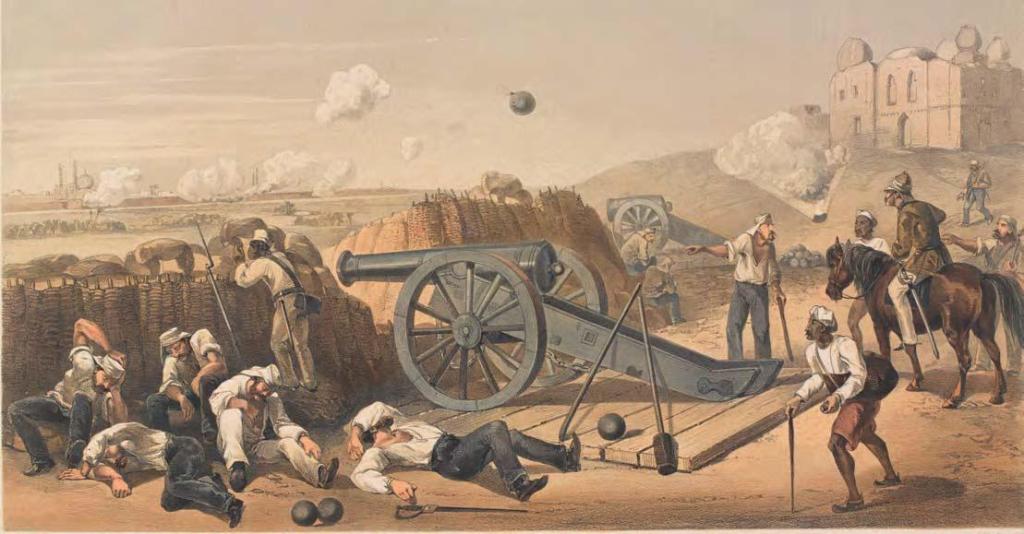
In the early morning of the 9th of June, the alarm sounded at the house, signalling the first attack in earnest of the siege. The Sirmoor Gurkhas and the 60th Rifles took up their positions to face what looked like an “unimaginative and uncoordinated attack…determined but unscientifically delivered.” Major Charles Reid took the lead in front of his men, and he led the Gurkhas in a swift charge which had the enemy retreating in some haste back to the city – but it took 16 hours of hard fighting to achieve this final goal. At 5 pm, close to dusk, Reid and his men returned to the cheering of every European regiment present. He had not been completely alone in his venture. Joining the Gurkhas had been the Corps of Guides and their stalwart leader, Captain Henry Daly.
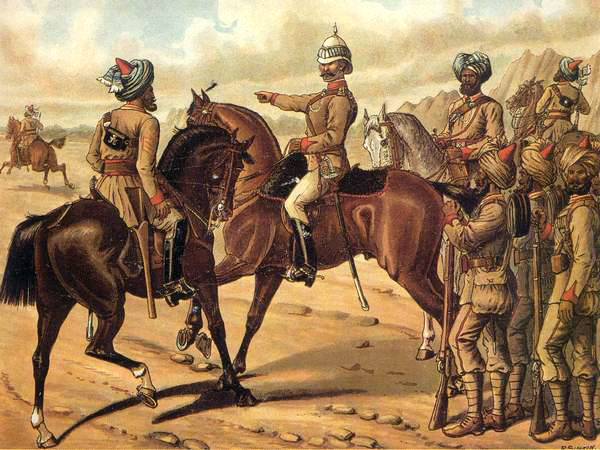
The first reinforcements to arrive on the Ridge on the 9th of June were none other than the Corps of Guides. This elite fighting unit had been raised in 1846 as the brainchild of Sir Henry Lawrence to serve as the foremost force to serve on the North West Frontier. Consisting of infantry and cavalry, their first commander was Lieutenant Henry Lumsden and as second-in-command, William Hodson. By the outbreak of the Second Sikh War, the unit had grown in size to six companies of infantry and three troops of cavalry. Following the war, they would be garrisoned in the new fort of Hoti Mardan, designed by William Hodson, who had been promoted to their commander in 1852. Here they remained until 1857, when ordered to proceed with all haste to Delhi. The Guides marched nearly 600 miles during the hottest season of the year, crossing over five immense rivers and fighting their way through 4 small battles. The Muslims of the unit, who were then observing Ramadan and thus forbidden from eating or drinking during the hours of daylight, accomplished this tremendous feat in just over three weeks.
They were welcomed on the Ridge by William Hodson himself, and they had not forgotten their one-time commandant. Hodson wrote. “The Guides came in today- the welcome they gave me…cheering and shouting and crowding around me like frantic creatures. They seized my bridle, dress, hands and feet and literally threw themselves down before the horse with tears streaming down their faces. Many officers who were present hardly knew what to make of it and thought the creatures were mobbing me, and so they were – but for joy, not for mischief…” This display of affection did much to dispel the reports that Hodson had been forced to leave the Guides due to his unpopularity with the men and must have left some of the rumour mongers at something of a shamefaced disadvantage.
There would, however, be no rest for the Guides. Their commander, Henry Daly, had been met by a Staff Officer who had ridden out to meet them and asked Daly how soon they would be ready to go into action.
Daly looked at him for a moment. “In half an hour,” he said briefly and marched his men on.
Within three hours of arriving on the Ridge, the call came to “Call out the Guides!” and with no delay, Daly formed up his men. He sent off the Guides Cavalry under Lieutenant Kennedy to blockade the road leading from the city to Subzi Mandi while he took the infantry with Lieutenants Battye and Hawes to reinforce Hindu Rao’s House.
The sudden ferocity of the Guides’ attack took the mutineers by surprise, and they fell back in confusion while 25-year-old Lieutenant Quintin Battye pushed on ahead, the Guides coming up behind him. Finding himself suddenly alone and surrounded by the enemy, Battye, on horseback, parried “a slashing backhand cut from a rebel with a heavy sword. It dented Quintin’s and surely would have cut his head off had he not brilliantly guarded the blow and then felled the mutineers with one swift stroke.” Above the cacophony of the battle, the voice of Henry Daly boomed out, ” Gallant Battye! Well done, brave Battye! Noble Battye, ever in front!” The cavalry had troubles of their own, busy routing the rebellious 3rd Cavalry at the Subzi Mandi crossroads. Lieutenant Kennedy was hit in the sword arm by a pistol charge, forcing him to retire from the battle, but his men persevered and routed the mutineers. They now found themselves free to assist the infantry and quickly dove into the fray afresh. Sowar Mahmud Khan rushed to help the two lieutenants – Battye was still defending himself and Hawes, with blood spurting from a wound on his face. Daly was sprawled on the ground next to his dead horse, having been hit by a blast from a shell. He struggled to his feet only to be hit by a spent bullet in the leg, which again laid him flat. The only officer who remained unwounded and still on his horse was Quintin Battye.
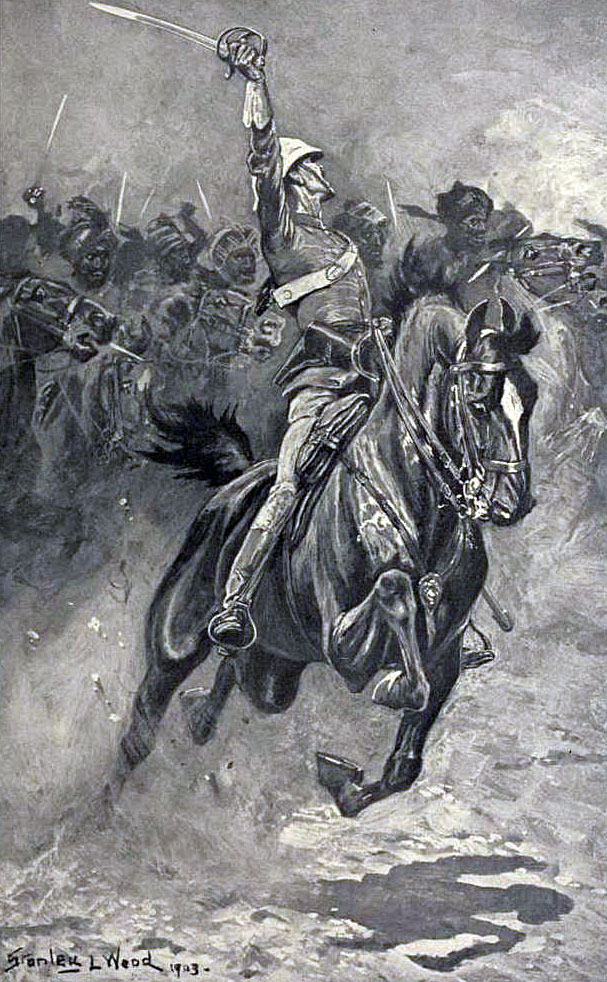
“He called to the senior Rissaldar on the spot and to Mahmud Khan to follow him, leapt from his horse and chased down a steep bushy scrub of strewn boulders to where a body of rebels was fiercely engaged with the Infantry. An echoing cry from behind told Quintin others were following to the rescue.”
Quintin did not see the man, laying concealed to one side, who suddenly jumped up and, wielding a heavy musket, charged the lieutenant. Quintin grabbed hold of the weapon and deflected it, but as they grappled, “in the instance of dropping the musket fleeing, the mutineer’s finger pressed the trigger.” The shot, fired at point-blank range, entered the young man’s groin and burst through his back. Barely a moment later, Mahmud Khan sprang on the mutineer and stabbed him through the heart. He was, however, too late to save Battye.
Quintin Battye would live on, beyond help, slowly dying in Henry Daly’s tent, refusing anything to deaden the pain, telling the surgeon, “While I am alive, Dr Stewart, I want to be alive with all my faculties.” Outside the tent, the Guides gathered with tears streaming down their faces, lamenting, “Why not us? We can be replaced, but how can such a man as Battye Sahib ever be replaced? He fought his guns like a burrah lerai wallah; he dies like a burrah lerai walla… he is a great fighter, look how he fights death!” His friends came to see him and sat by his bed, each trying in their own way to raise the young man’s spirits, and one by one, his men came into the tent, each giving into the sorrow of seeing him one last time.
Quintin received the Last Rites from Reverend Rotton (who had come up with the force from Meerut) and now waited quietly in the dawning light of the 11th of June for the moment of death. Rotton called Daly and Hodson, his best friend for all times, to the tent – Hodson arrived first.
Bending closer to catch the whispered words, William heard Quintin say on a last breath, ‘Ah well, old fellow, Dulce et decorum est pro patria mori. That’s how it is…’
Although much was made of these words, uttered as they were by a young man dying in indescribable agony, they were meant less in patriotism than in irony.
A talented amateur artist with a penchant for quoting in Latin, Battye had drawn on the walls of the Hoti Mardan a spirited caricature of a charge of the Guides on the wall of the billiard room, giving it the self-same Latin title. Lumsden had admonished him, saying the title was “too tall”, but the drawing won great favour with his friends who had recognised themselves in the drawing. This would become a “friendly joke at Battye’s expense, for whenever he received a dull or unpleasant assignment, he was sure to be reminded it was “sweet and fitting.” Yet it was the unintentional patriotism and not the irony of his last words that made them legendary. Quintin Battye was the first of the ten remarkable Battye brothers to do service in India, six of whom would serve through the mutiny.
We now return to events on the Ridge.
 Mutiny Reflections