Lucknow Kavanagh
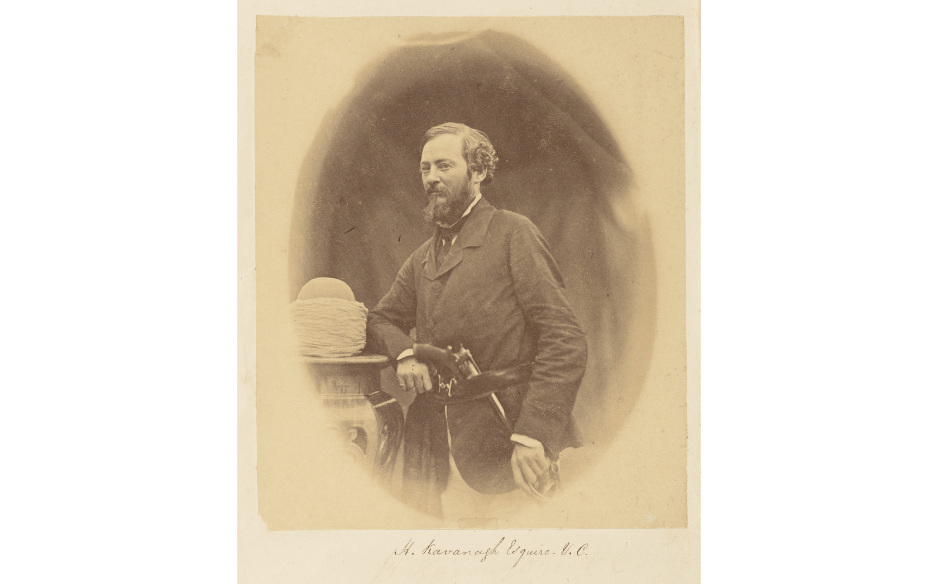
As eager as a terrier, Thomas Henry Kavanagh was appointed Assistant Field Engineer by Colonel Napier and he certainly could not have appointed a more enthusiastic civilian for the job.
“What a nervous moment was the first crawl on all-fours through a long, narrow, cold, damp mine, appalled by the darkness and a fancy that an enemy may have got in wishing to blow out my shrinking brains or that it might fall in and bury me alive…at last, I discovered that a resolute man was more dangerous below than above ground, and I soon had an opportunity of testing my spirit in the bowels of the earth.” (Kavanagh)
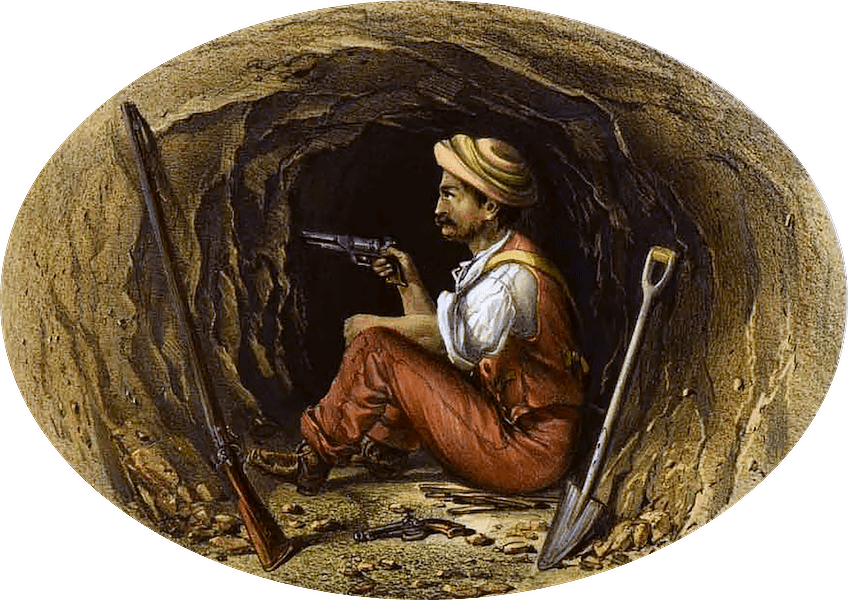
Once he had shaken off his initial fear, Kavanagh appeared the relish the idea of sitting in the mines, sometimes for as long as 9 hours at a time. On one occasion he watched as rebel miners approached – they first made a small hole, through which the man first stuck in the handle of his tool to try and ascertain where it led to – they were, at this point unaware, that Crommelin and Napier had constructed listening galleries. As the miner withdrew the handle, Kavanagh pushed down the thin partition with his hands and put a pistol to his breast.
“It misfired again and again as I went after him, and he scrambled out screeching with fear….” At a loss for what to do, the sepoys now began squabbling amongst each other as to who should venture down into the hole, while Kavanagh waited.
“…a Sepoy jumped down, cautiously keeping his body back from the mouth of the gallery. He put his musket towards me showing no more than his head; I felt certain he would look before he fired and reserved my shot…As he stooped, his left arm and shoulder was exposed – my bullet passed through it and he lost no time in getting out to his comrades.”
The miner had unfortunately left his tools in the mine and under threat of being shot by his comrades, miserably descended back down, remonstrating, “most sorrowfully, and my heart sickened as he prayed, before descending, that they would see to the support of his family. He leaped down, crying, “Mercy! Mercy!” Kavanagh did not shoot and privately grieved, “…that our imminent danger made it compulsory to intimidate the enemy’s miners, so as to render it difficult to obtain the services of such men…”
To keep this wily Irishman up to his tricks, he was assigned to the mosque post at the quarters of the Ferozepore Sikhs who took much pleasure in watching the man they had dubbed, “Burra Surungwalla” (Great Miner) – if nothing else Kavanagh gave them a few hours of entertainment. They watched as he descended into one of the galleries and waited anxiously for the result. They would not be disappointed.
After a two-hour wait, the rebel miner pushed his way through and an unusually heavy stroke left him face-to-face with Kavanagh.
“His eyes glared with fear as he spread out his arms screaming, and fell back mortally wounded into the shaft, where he lay moaning pitifully. The gallery was unusually large but not more than six or eight feet from the pit, we being separated from the enemy, at the Sikh quarters, only by a few yards…” Kavanagh widened the opening and crawled forward to retrieve the abandoned tools when there came a noise from above. The voices loudly called to each other to go down and fetch the wounded man and of course, the tools. One man ventured down but Kavanagh shot him through the abdomen before he could discharge his musket. On his part, Kavanagh had forgotten to load his revolver and now only had one shot left.
“The commotion above grew louder and louder, and the fellows blustered and swore as if the whole body of them were coming down to me. I was close enough to see their feet by placing my face to the floor of the mine, and I now taunted them with cowardice in the profane language that is so often, and so well spoken by Englishmen to their followers, and so raised their ire that one swaggered and swore, in a superior style, that he’d go and kill me. 1 laughed and tried to provoke them to come in, till they thought of firing into the mine, and drove me back to my own gallery, nearly suffocated with smoke and blinded by earth the bullets threw up ; which gave them an opportunity of hooking up the two wounded men who were groaning their lives out.
I returned to the same spot after a few minutes, protected by a couple of Siekhs, (who watched from our gallery), and then we commenced a very pleasant and harmless abuse of each other. I was upbraided for associating with cursed Feringies^ who ate cow’s meat, and did other abominations; which convulsed the Siekhs with laughter, for they perceived that I was mistaken for one of them, to whom such things are horrible. I told them at once that it was a European officer who spoke, Then, to my surprise, the noise ceased. They civilly listened as I reproached them with ingratitude-condemned their infamous conduct to helpless women and children…and presented to them a picture of the ruin in which themselves and their families were sure to be soon involved…
There was perfect silence for awhile, when a voice, as if affected by the truth, remarked, “ It is true!” Then there was quietness again as if all were thinking. But, if they thought at all, their reveries were immediately disturbed by a command, in an authoritative voice, to fire, which they did so carelessly that there was no need this time to shift backwards. I mocked them and challenged the officer to come down and fetch the tools, to which he replied that he had plenty, and would give me some if I came for them. The Sepoys were once more desired to fire at me, and refused, urging that they wished to hear the Sahib speak!” I caused them to laugh at the officer, by asking him to wait till I fetched some women’s apparel, and kept them in humour with a fanciful account of our inexhaustible supplies — the speedy approach of the army which I have once before described as overrunning India — and endeavoured in vain to draw information from them.
They began filling up the mine with earth, but stopped whenever I spoke, sometimes calling to me to go on. I felt a foolish pride to possess the implements which lay nearly in the shaft, or pit, and told the Sepoys, at the opening of our conversation, that I would have them, and was answered by defiance, for they were right under their guns. When I thought my talk had diverted their attention, I brought away the tools by a sudden spring, which so alarmed them, that only two men stayed to fire, and they were in such trepidation that both missed me at a distance of five or six feet. “Well done!” exclaimed the Siekhs and Sepoys in concert, and I recreated to my own gallery to watch the closing of the pit, which was now set about in earnest.
Sardonically humourous, Outram, who witnessed another exchange between Kavanagh and the miners, remarked that by the articles of war, he could have hung Kavanagh on the spot for fraternising with the enemy. Kavanagh concurred – his uncle had once said that such a wild lad as he was certainly marked for just such a fate! As luck would have it, Lucknow Kavanagh would live to tell his tales.
Sources:
Danvers, Robert William. Letters Written from India and China During the Years 1854–1858. London: Imperial Press, 1898.
Fayrer, Joseph. Recollections of My Life. Edinburgh: William Blackwood and Sons, 1900.
Gubbins, Martin Richard. An Account of the Mutinies in Oudh, and of the Siege of the Lucknow Residency. London: Richard Bentley, 1858.
Hervey, Charles. Lieutenant General Crommelin, C.B., Royal (Bengal) Engineers: A Memoir and a Retrospect. Exeter: Printed by W. Pollard, 1887.
Inglis, Julia Selina. The Siege of Lucknow: A Diary. London: James R. Osgood, McIlvaine & Co., 1892.
Innes, J. J. McLeod. Lucknow and Oude in the Mutiny: A Narrative and a Study. London: Innes & Co., 1895.
Kavanagh, T. Henry. How I Won the Victoria Cross. London: Ward and Lock, 1860.
Maude, Francis Cornwallis. Memories of the Mutiny. Vol. 2. London: Remington & Co., 1894.
 Mutiny Reflections