Apprised by messages from the Alambagh that relief was most certainly on the way, from the end of October two batteries were constructed in the advanced garden while mines were driven out into the Hiran Khana and the Steam Engine house. Everything was to be ready by the 12th of November. From the Alambagh a signal was sent on the 10th of November, much to the relief of Kavanagh’s wife Agnes, who now knew her reckless husband was still alive.
On the nights of the 12th and 13th trenches were widened to allow for the passage of guns and screens were constructed to protect against musketry fire – which was expected to pour out from the breaches in their own walls. A final battery was completed the night of the 13th of November and armed with heavy guns the following morning for the storming of the following buildings as yet outside the boundaries of the extended position – the Hiran Khana, the Engine House and the King’s Stables. On the same night
29 charges of powder (each weighing a hefty 25 pounds) were laid in previously dug chambers under the East face of the advanced garden wall directly to the new battery.
The attack had been planned for the 14th and it was most elaborate venture to coincide with Campbell’s anticipated advance. The first column of 260 men was to storm the Hiran Khana in three divisions, the right to storm by the breach caused by a mine which would explode immediately before the rush of the column – as the men would be exposed to the firing from the city they would have to take the Hiran Khana with all haste, the centre division would storm the gate, which if barricaded, would be blown up – this task was given to Lieutenant Hall who would then open communication with the other parties who should by then be in the building. The left division would enter through a breach made by the artillery and “proceed immediately to the house at the opposite side of the enclosure…by breaking a wall if necessary, obtain command of the passage which runs along the top of the street…” If possible, they were to break through to the lower storey and barricade the shops beneath.
The next point of attack would be the King’s Stables – 150 men would proceed through a breach knocked through by the artillery, and following the explosion of the mine signalling the attack on the Hirn Khana, the men of this column were to force an entrance through this position and then with tools, break open an entrance to the Steam Engine House. This would leave the remaining 100 men with a working party of 30 men with tools and a party of 6 miners, supported by an additional 70 men to take the Steam Engine House. Thus secure, they could then wait for Sir Colin Campbell.
This at least, was the plan.
The 14th of November
On the 14th of November, the advance of the Campbell’s force could be seen from the top of the Residency, the smoke of the guns and the still distant musket fire – by evening they could see a British flag waving from the roof of the Martiniere and later, at dusk, blue beacons lit up the Martiniere and the Dilkusha, signalling both buildings were now Campbell’s possession. However, the anticipated advance to the Residency was now postponed.
As a result, the carefully prepared attack from the Residency was postponed for the morning of the 16th. In the meantime, the charges of powder, in common canvas sacks, lay exposed to the elements in damp soil for two days. On the 15th, three mines were prepared, loaded and tamped, to form breaches in the Hiran Khana. People rushed in anticipation onto the Residency rooftop, expecting to see Campbell’s advance- instead, they watched as the rebels rebuilt the Bridge of Boats. They saw irregular troops both cavalry and infantry crossing the river to the Residency side who advanced towards the Martiniere, where they soon became lost in dense woods. Following them came another party, but with guns, that advanced to the Kaiserbagh. “Presently our guns were seen to open on the right face of the Martiniere, and soon we saw the enemy’s horse, foot, and guns return much faster than they had gone. In the evening the Commander-in-Chief erected a telegraph on top of the Martiniere, and the communication ” advance tomorrow ” was made out just before dark.“
The Residency garrison now held its breath.
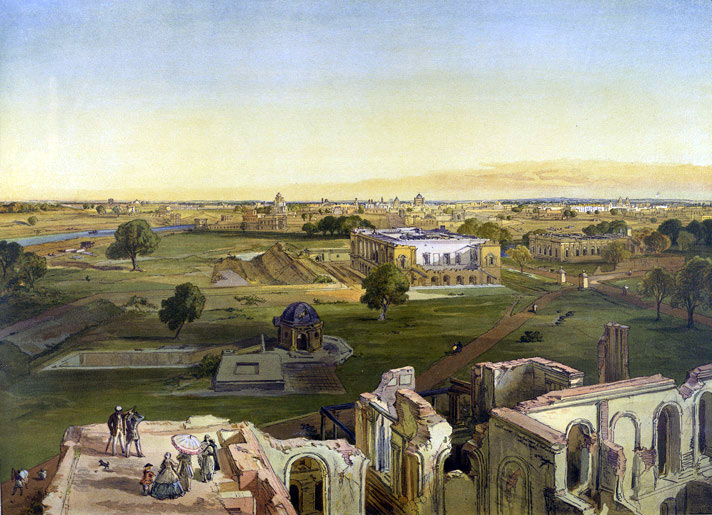
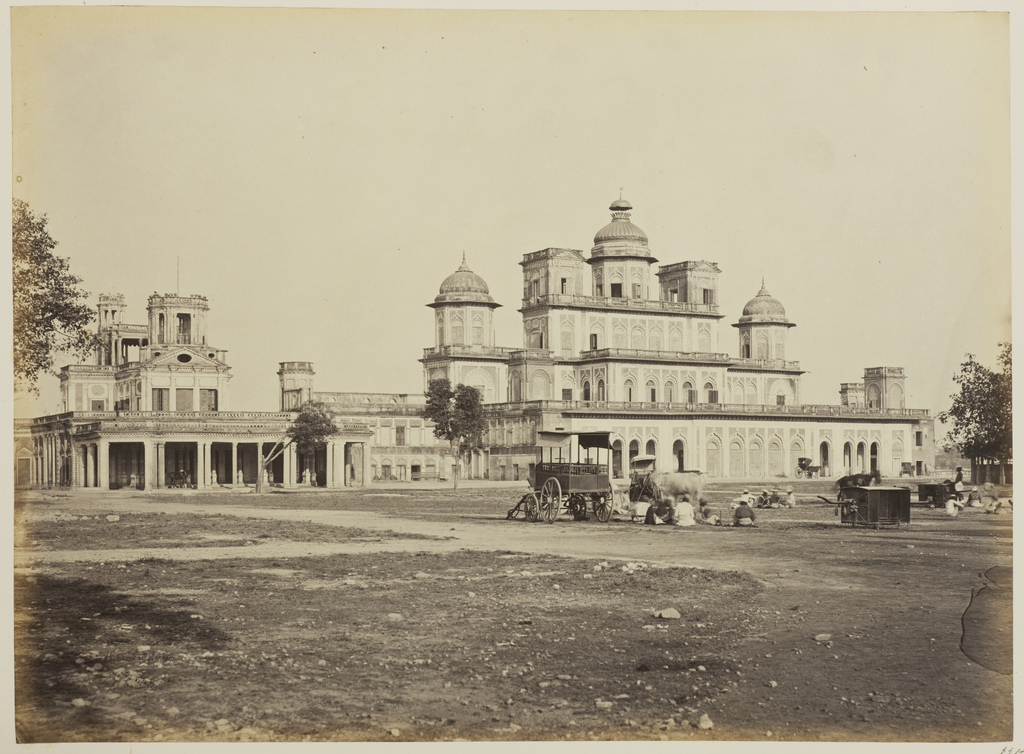
From the roof of his house, Dr. Fayrer could distinctly see the cavalry, infantry and artillery and watched as the mines exploded at the Chattar Manzil while rockets flew from Peel’s Naval Brigade, setting some buildings into flames. The damp powder which had lain dormant since the 14th was only able, when fired, to split the walls but the artillery took care of the rest.
Mr. Gubbins joined Sir Henry Havelock on the roof of the Chattar Manzil to watch the proceedings. Unfortunately for them, the rebels were not going to let this be in the least pleasurable and took to lobbing roundshot from their battery in the Badshabagh on the other side of the river towards the roof; twice they managed to send the men scurrying down the stairs. However, by 10 in the morning, Gubbins distinctly heard firing of the artillery to the left – the river side of the Martiniere, signalling that the advance was underway.
“The advance presently reached nearly to the Sekundur Bagh, where a very heavy rattle of musketry began, and was kept up for some time. We could, by aid of our glasses, distinguish our guns opening on the place, and see many of the shot strike. Presently, the tide of war appeared to reach the building itself, and we could plainly see the gleaming bayonets of our men pouring into it.”
After a while, the men reemerged from the Sekundarbagh and could be seen hotly engaging their opponents around the Shah Najaf and the Kudum Rasool.
“Our vision is sadly impeded by buildings and the thick wood with which the environs are covered. Here and there, we obtain a glimpse. One opening in the trees we steadily watch, and see heavy guns moving towards the Shah Nujeef and horse artillery pass, and repass. And now we clearly distinguish the costume of a Highland regiment. Oh ! that must be the 93rd. But do you see yon low range of mud building, with tiled roof? mark the number of sepoys hiding behind it, and peering out towards the Shah Nujeef, and occasionally one fires; but see! the further end of the range has been fired, and the enemy is flying from his covert as fast as his heels will take him. Mark again that party of irregular foot soldiers carrying matchlocks, who are advancing from the direction of the Kaiser Bagh. They enter the shrubbery of the 32nd mess-house and make their way through the trees and bushes towards the scene of action. Another group of matchlock men have collected at a gap in the mud enclosing wall of the mess-house facing the Shah Nujeef. But they do not fire: one man only looks through the opening, the rest are safely sheltered behind the wall. Now watch again the opening in the trees to see what is doing at the Shah Nujeef. The firing continues, and all that we can distinguish are a few sepoys carrying muskets, running for their lives. This much, however, is no bad symptom; the place must have been carried.“
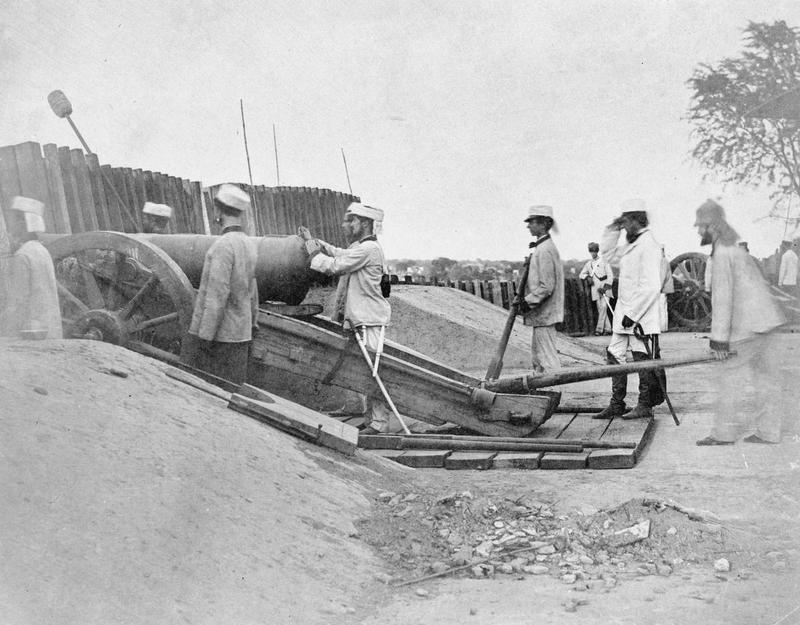
Outram now gave orders to unmask the battery and begin the attack on the Engine House and the surrounding buildings. Maude opens up with mortars that throw a flight of shells into the buildings; all meeting their mark. However, the mines do not spring as expected due to the damp powder; the breaches are weak -yet as soon as the dust clears, a heavy fire of musketry and shot is rapidly deployed in the direction of the Kaiserbagh; and as the room from which we are gazing is directly in the line of fire, it soon dislodges me. General Outram remains, and narrowly escapes being struck by a 6-lb. shot.”
The heavy guns with a deafening roar begin pounding the Hiran Khana; unfortunately, the long piece of wall that was not breached sufficiently by the damp powder continues to impede the artillery, who now turn their guns on it and level it in no time. The two mines driven under the Hiran Khana explode, throwing a shower of bricks and timber up into the air; the assault can begin. It is half past three and the men of the 5th, 64th and 90th wait for the sound of the bugle. As it sounds, cheers break out from the palaces. The storming party are swiftly at the breach, scrambling over the broken ground, their officers leading a few paces ahead, and cheering, they pass over the breach and disappear.
Meanwhile, unbroken musket fire continues pouring from the Kaiserbagh as puffs of smoke reveal the rebel sharpshooters, positioned on the domes of the Sadat Ali tomb – not for long. Captain Maude greets them with shell after shell, and the sharpshooters soon flee. The Engine House is taken, and the rebels fly from the far side of it, disappearing into the shrubbery surrounding Martin’s House. Off to the right, men traverse the King’s Stables in the midst of which Outram and Havelock are on the spot issuing orders. Word comes that the Hiran Khana is taken, but the Kaiserbagh guns are now firing into the sergeant’s bungalow, the most advanced post of the new lines – no one seems inclined to keep it. The men continue to fire at it until it bursts into flames, at which they retreat back to the Engine House. As for the advance of Sir Colin Campbell, as night falls, all that remains for him to do is clear the 32nd Mess House and the Moti Mahal. That, however, would have to wait until the next day.
“During the tremendous bombardment and heavy fighting which led to the junction of the two Forces (Outram’s and Campbell’s) and which is known as the “Relief of Lucknow,” most of the superior officers in our little army enjoyed excellent opportunities of witnessing some of the minutest details of the operations, from the commanding positions afforded by the turrets and cupolas of the extensive range of Palaces held by us: to which hourly additions were made, by mines and sorties on our part; besides the bombardment, assault, and capture of the portion allotted to Clyde’s gallant troops. The two Generals, Outram and Havelock, with their respective Staffs, were, so to speak, in layers, one above the other, in a tower of the Chutter Munzil. To them appealed the ever intrepid but often histrionic “Hell-fire Jack,” in terms of robust eloquence, that they would allow our troops to advance, as the “black blanks ” had bolted. Afterwards this gallant and irrepressible gunner evinced his disdain of the enemy’s fire, by taking a quiet drive, on one of his gun-limbers, past the great wall of the Kaiser Bagh, in the midst of a sharp fire of musketry, to which he responded only by the most expressive gesture of contempt, embellished with a few choice remarks in the purest Persian.” (Maude)
As for Maude, he and his men worked their guns for thirty-six hours straight. After it was all over, he sneaked off to find some tobacco.
Sources:
Danvers, Robert William. Letters Written from India and China During the Years 1854–1858. London: Imperial Press, 1898.
Fayrer, Joseph. Recollections of My Life. Edinburgh: William Blackwood and Sons, 1900.
Gubbins, Martin Richard. An Account of the Mutinies in Oudh, and of the Siege of the Lucknow Residency. London: Richard Bentley, 1858.
Hervey, Charles. Lieutenant General Crommelin, C.B., Royal (Bengal) Engineers: A Memoir and a Retrospect. Exeter: Printed by W. Pollard, 1887.
Inglis, Julia Selina. The Siege of Lucknow: A Diary. London: James R. Osgood, McIlvaine & Co., 1892.
Innes, J. J. McLeod. Lucknow and Oude in the Mutiny: A Narrative and a Study. London: Innes & Co., 1895.
Kavanagh, T. Henry. How I Won the Victoria Cross. London: Ward and Lock, 1860.
Maude, Francis Cornwallis. Memories of the Mutiny. Vol. 2. London: Remington & Co., 1894.
 Mutiny Reflections