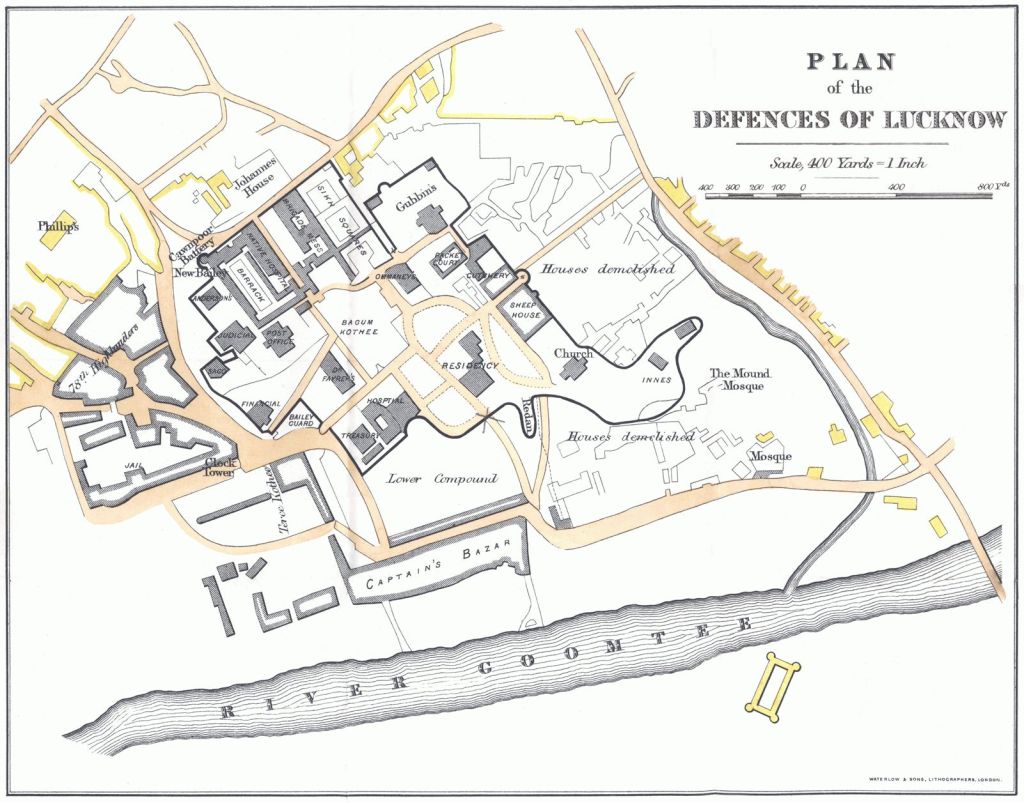
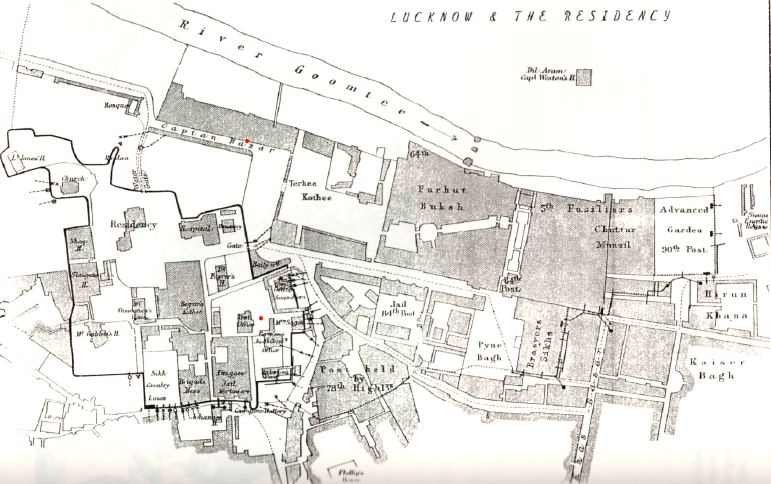
Throughout October, in addition to extending the mining operations to secure the Residency, numerous sorties further extended the position. By the end of the month, the grounds had been expanded in every direction, and new posts were added to the picture with a new line of defence extended from a barricade built across the Cawnpore road close to Anderson’s Post. It was named Lockhart’s Post and occupied by the 78th Highlanders; the line then proceeded towards the goal, which was now the home of the 84th.
Lockhart’s Post was positioned on the road that Havelock and Outram had taken in September with the 78th and the Ferozepore Sikhs when they charged up to the Residency. The road was still lined with the corpses of the dead, their bodies lying where they fell, barely covered with a little earth. The stench that hung over the post was, as Gubbins recorded, still very bad. On the 19th of October, the body of Captain Bazely of the Artillery, whose fate was uncertain, was identified. He was recognised by the ring he wore.
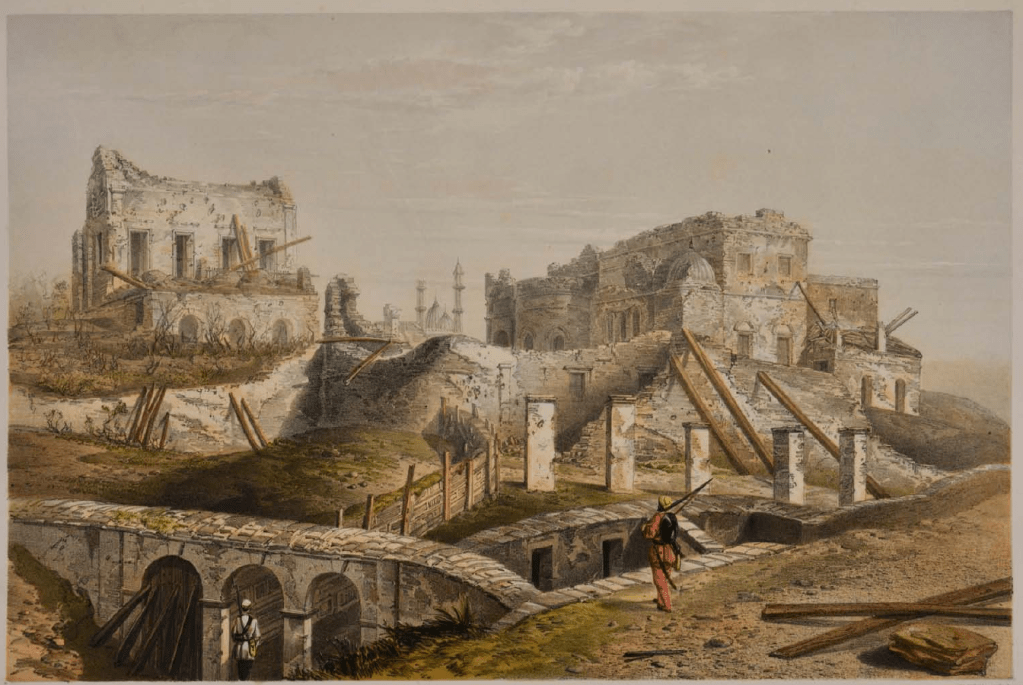
From here a succession of posts were constructed, ending on the east side with the advanced garden post just beyond the Chattar Manzil Palace, which was held by the 90th Regiment of Foot. From the loopholes of a building on the southside, one could look straight into the infamous Doolie Square which still contained the corpses of the men abandoned on the 26th of September.
From here, the defences continued up to the north-western angle to the ruins of Innes’ Post. Further on to the west and south sides the old defensive lines were still held but fortified – at Innes’, a commanding mound was taken and reinforced, while trenches were dug that now connected Innes’ Post outwards to a small mosque in the direction of the Iron Bridge. As for Gubbins’ Post that had been left nearly unprotected for the duration of the siege, the lane on the south side of the compound wall was seized and the enclosure beyond it, named the “Goindah Lines” was swiftly occupied. Within it, a battery armed with a 9-pounder gun, which gave Gubbins a little piece of mind. On the north side, as far as the river, and to the east the defences included not just the Teri Kothi but the Farhat Baksh and Chattar Manzil palaces. This placed the insurgents 1000 yards back from their original positions so now the hospital, Dr. Fayrer’s, Sago’s and Germon’s Post were now safer than they had been since June. The road to the Bailey Guard had been cleared, pushing the insurgents further back and they could no longer advance up to the gates.
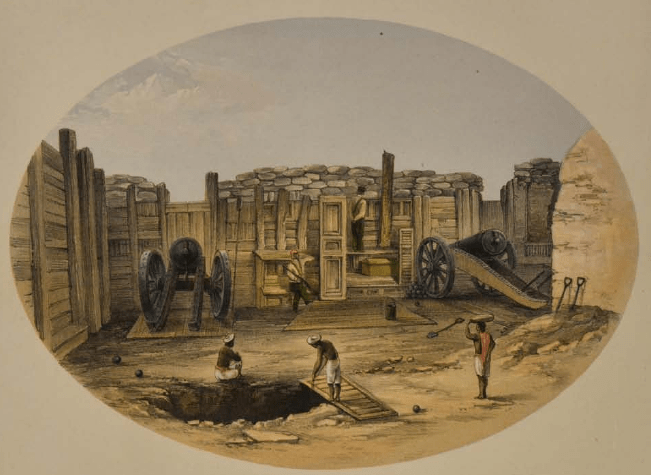
The Cawnpore Battery (now called The New Cawnpore Battery) was reconstructed by Captain Thomas of the Madras Artillery. He turned it into a marvel of a battery, a veritable phoenix from the ruins, and completed it with two 18-pounders. The Sheep House battery that had never been finished was now armed and occupied.
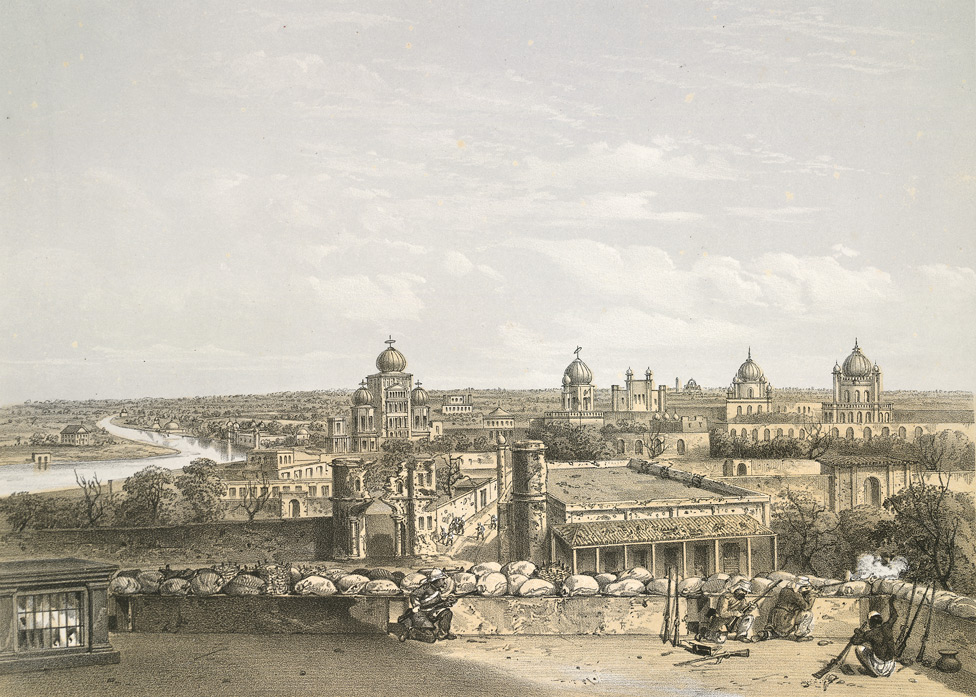
These new positions did not of course prevent the insurgents from still peppering the Residency with musket fire or desist from cannonading it albeit from a distance but much of their wrath was now directed at Lockhart’s Post and the palaces.
On the 13th of October, Julia Inglis noted,
“A good deal of firing this morning; the rest of the day very quiet. The weather was now delightful; mornings and evenings quite cold. I used at this time to let the children take a little walk in the mornings as far as Ommanneys’ house, there being little or no firing in that direction and they enjoyed it so much…”
However, it was by no means safe. A room which Mrs. Dashwood had been sitting in moments before was destroyed by a 24-pounder smashing through the wall; a hospital apprentice was shot in the hospital as he walked across the room; Mrs. Harris was shot, though without any consequences, when a bullet hit the leg of her chair and smacked into her side – the force, she noted had already been expended. A Sikh escorting Mrs. Germon to her husband’s post for her daily chat with Charlie was shot in the arm for his pains, while as Mrs. Case took little Jonnie Inglis for a walk, a man who passed them was shot in the back. Unfortunately, Charlie Dashwood, who like much of the garrison had become inured to the war around them, took a little time to sketch in the churchyard, only to have both his legs blown off by roundshot. However, people continued to come out of their houses, cautiously walking over to other posts to visit their friends -for the ladies, after months of being cooped up indoors, it was a relief to finally have at least a little respite. Mrs. Batrum decided to stay indoors – one evening, while taking a short constitutional, a bearer who was carrying her son was shot in the side and the bullet glanced across the infant’s leg. It was enough to convince her that outside was hardly as safe as others were making it out to be. For his part, Dr. Fayrer noted the health of the garrison appeared to be improving – the heat and the damp were dispersing with the change in the weather, while the new sanitary measures had begun bearing some fruit – the air had less of a pestilential fog. While the Residency was by no means safe, much of the work of war was now in the outposts.
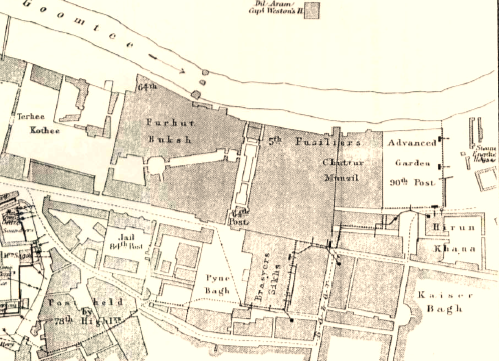
As soon as the boundary was established, the rebels resorted to subterranean warfare and on the 3rd of October they blew up a mine directed at the wall of the advanced garden but it proved to be too short. Not discouraged in the slightest, on the 5th, they tried again.
On the 5th of October, the rebels sprung a mine at one of the picquets and then charged the breach in the wall but they were soon driven off. A few shots “seemed to have the desired effect” and when a few of them had thus fallen, the rest prudently decided to retreat. The next day, another mine was sprung, this time near the new mosque picquet close to Innes’ Post.
“The enemy swarmed everywhere, and you heard them yelling out defiance and abuse. I was the only officer at the time at the headquarters (Scott had gone away for a few minutes), and accompanied a guard of twenty men ordered out to assist in repelling the attack. I had a house to keep, or rather a ground story of a house, on a level with the garden where these fellows were swarming and yelling horribly. I stationed men at the iron-barred windows, concealing them as much as possible, and kept others right and left of some small doors through which I expected the enemy would try to effect an entrance. We shot several men as they came rushing into the garden with drawn swords, muskets, and matchlocks, hallooing out, ” Maro, maro ! chelo, chelo ! ” (” Kill, kill ! come along ! “) They gave me very much the idea of men intoxicated with bhang, for they seemed to come on without any definite design, and rushed madly about, apparently unconscious where they were going to. They came within a few yards of us, and so excited were my men that they missed many even at that distance. Some Seikhs who were in the house with me were much cooler and more collected and did not throw away their fire nearly so much. After some time the enemy managed to get into the rooms above us, and before our men in another part of the garden, and in an exposed position, were aware of it, opened a fire upon them, wounding many men. Scott, who had joined another party of his men, was wounded and had gone to the hospital. Now, therefore, I withdrew my men, having first seen that my part of the garden was cleared, and assisted in driving them from the upper rooms. They fought from room to room, and from one corridor to another, and we made our way over the corpses of the killed. It was wretched fighting. In one small room we shot and bayonetted no less than eight.
This kind of fighting went on till dark, and we found our further picket near the mosque, from which they had been driven in the morning, leaving the enemy, I am sorry to say, in possession. From this place they kept up a fire upon our picket, and any man exposing himself at the windows, even though behind the wooden Venetians, was nearly sure to be shot. Two men in the 90th, who would foolishly expose themselves, were shot close by me —one died instantly.” (Danvers)
They had also managed to make a second breach by burning down one of the gates of the garden. These breaches and fire they levelled on the position from the Hiran Khana, led the engineers to construct a series of trenches in the garden for both shelter and communication. This would leave the insurgents thinking up new ways to harass the garrison.
On the 6th of October, they blew up the picquet at the junction of the China Bazaar and the Khas Bazaar and managed to gain some ground in the building but they were swiftly driven out again. Meanwhile they were still holding the mosque but the engineers had a plan.
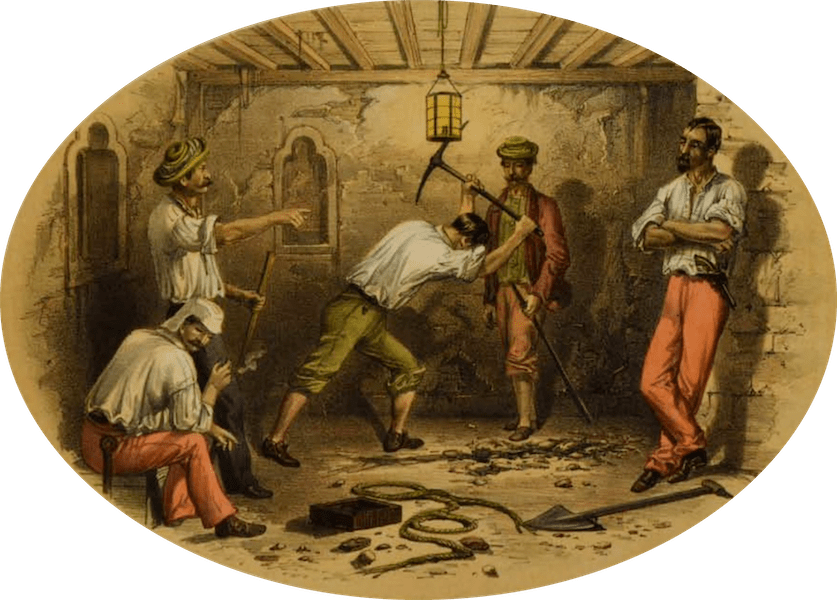
To stay one step ahead of the insurgents, Crommelin and Napier commenced constructing a series of countermine shafts and galleries. to put an end to the rebels’ escapades and cut off all communication between them and the Residency. Accordingly, “to effect which a charge of 200lb of powder was laid at much risk under the superintendence of Colonel Napier, Chief of Staff, in a vaulted chamber below some apartments adjoining our position and occupied by the Enemy…” the explosion worked its devastation.
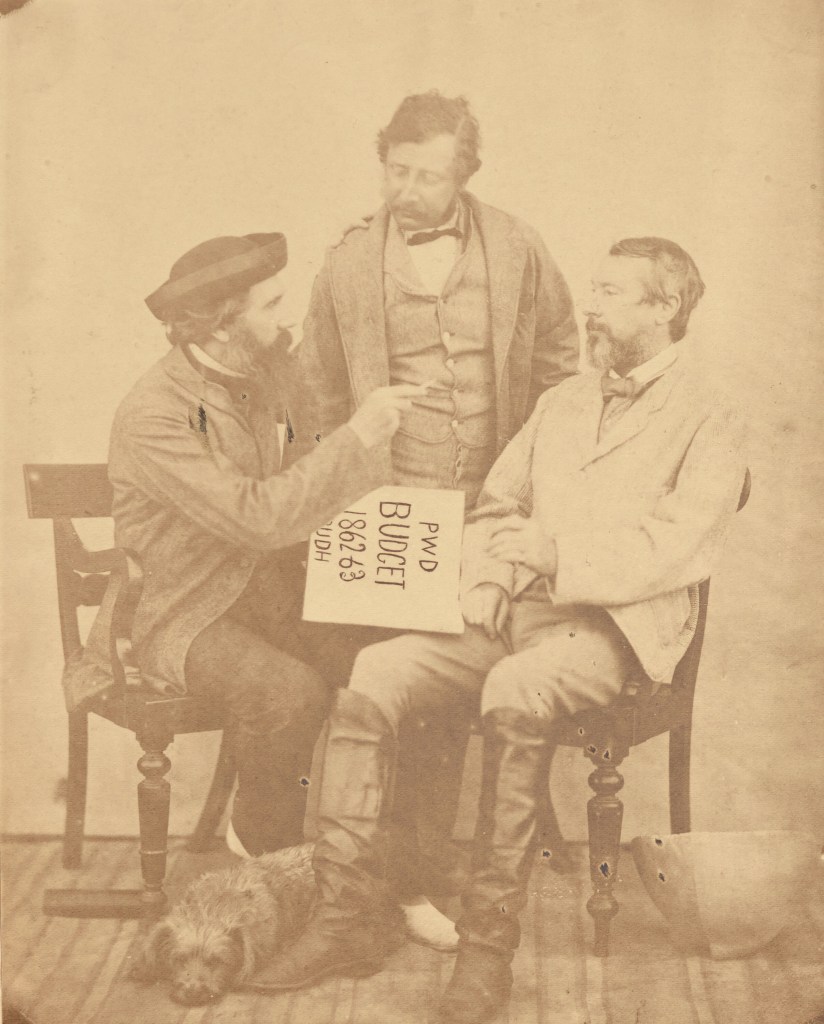
A clear view was opened up down the China Bazaar Street; the piquet could now be protected by a strong sandbag parapet, some 8 feet at the base and four at the crest, the construction of which took only one night. While the rebels’ 9-pounder continued to pound this picquet at intervals, it remained steady. A battery for two 9-pounders was also erected with equal alacrity, and constructed in a lane which now had a clear vantage of what was beyond – anyone reckless to wander down that particular lane would be greeted by a barrage of fire. Not content with a little building, Napier and Crommelin set themselves the task of constructing a barricade, 72 feet long and constructed for a gun, also served as a covered walkway to the road that ran by the Clock Tower to the Bailey Guard gateway. A similar barricade, albeit without an embrasure for a gun, was set up close to the riverside, and heavily obstructed the insurgents from passing between the palaces and the river, with a corresponding barricade built upstream. To further protect the position, all doors and windows still exposed were blocked up with shot-proof barricades of boxes and sandbags. Crommlin observed with some satisfaction that “a 24-pounder shot fired at 400 yards off, twice struck the weakest part of one of these barricades at a height of ten feet – the sandbags were on both occasions thrown inwards, but the shot fell harmless on the ground close by,” further remarking that at eight feet, these barricades proved to be “quite shot proof.” Nor did Crommlin leave the regained mosque picquet unguarded.
On the terrace, he constructed three lines of barricades made of doors, sandbags, and tent poles, with the single view that if the insurgents managed to destroy any portion of it before the countermines could be completed, the area was not left unprotected.
“The Enemy very shortly after our occupation of the Palace, shewed a disposition to annoy us as much as possible by Mines; on the 5th of October they effected a breach…on the 11th they breached the boundary wall on the east face of the Sikh position; on the 17th they destroyed the upper storied House in front of the mosque – scarcity of gunpowder prevented retaliation by offensive mines.”
Rather than allow the rebels to continue their game alone, the engineers were now determined to encircle “the whole of that portion of our position open to attack by mines of defensive or listening galleries…” From these it could be discerned in which direction the the rebels were running their mines. These could then be either broken into or destroyed with small charges of powder before they could reach the boundary. On the 18th of October, Crommelin assembled his volunteer miners consisting of 51 European soldiers, 48 Sikhs, 54 dhoolie bearers and gun bullock drivers. A total of 19 shafts and galleys were thus prepared:
– a total of nine in the Sikh Squares position – an aggregate of 73 1/2 feet of shaft with 540 1/2 feet of gallery)
– four for the protection of the mosque, the advanced piquet and the surrounding buildings – 32 1/2 feet of shaft and 585 1/2 feet of gallery
– two for the protection of the buildings along the lane to the south (16 feet of shaft and 514 of gallery)
– two for the barricade and the south wall with branches constructed for offensive mines -16 feet of shaft and 765 feet of gallery
– -two for the east face with 16 feet of shaft and 387 feet of gallery.
This would total to 152 feet of shaft, each averaging 8 feet in depth, and 2’791 1/2 feet of gallery with the general section of the galleries only three feet high and 2 wide and arched at the top – they were mostly run without casing with only some exceptions made for “rough open casing.” Remarkably 2 of the galleries were run to the respectable lengths of 298 feet and 192 feet without resorting to air tubes; while in one light worked well, in the other the men had to work in the dark and were drawn up after an hour of labour to take them out of the foul air below. Thus “purified” down they went again.
These countermeasures certainly had the desired effect.
On 5 separate occasions, the rebels were heard to be mining towards the European position who then waited patiently until they had broken into the gallery. The waiting men then opened fire on the startled miners and proceeded to capture the rebel galleries and destroy them. In two other instances, on hearing the rebel miners approaching, Crommelin ordered out branches to be run from the galleries for the simple purpose of depositing a charge to blow up those of the rebels – in both cases, the rebels fled and abandoned their galleries. This new offensive form of warfare below ground as it was, appeared to alarm the rebels to no end and Crommelin observed they seemed to fear approaching the position now and “twice exploded charges at ridiculously long distances from the works they intended to destroy – indeed neared to their own Buildings than ours.” These listening galleries did more to secure the position than muskets – the rebels were unable to breach the line and as a result, the precariously exposed fronts were at least safe from mines.
 Mutiny Reflections