Onto Agra
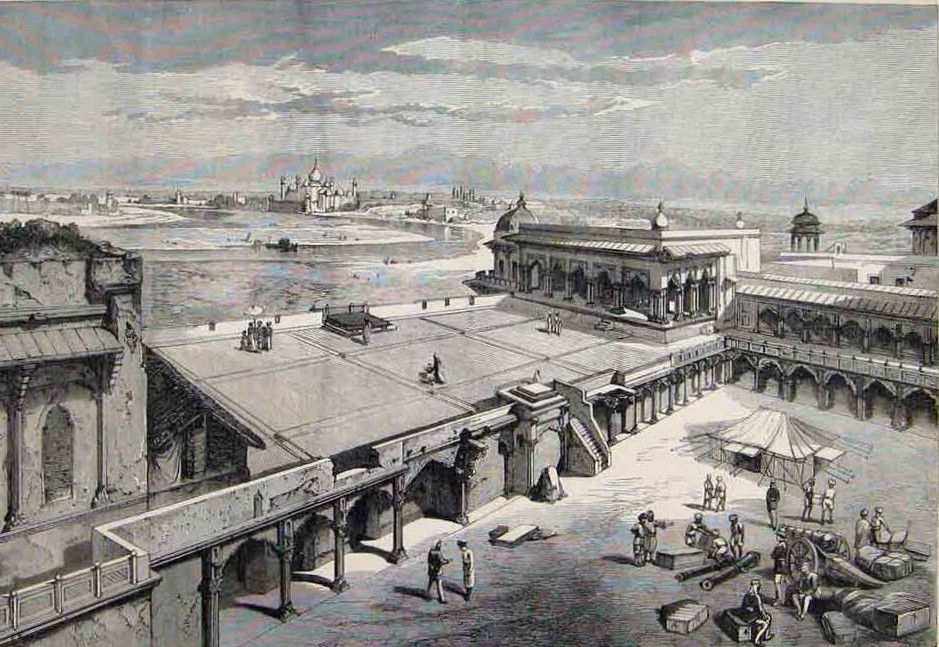
Repeated calls for aid reached Greathed or as Bourchier put it, “At this distance even from Agra, loud croakings were heard: epistles imploring aid, in every language both dead and living, and in cypher, forwarded by Government special messengers, and received by Colonel Greathed, came pouring into camp. Many, like the dreams of Pharaoh, were beyond the interpretation, of the soothsayers, and no Joseph was at hand. All, however, that could be made out of the business was, that the people at Agra were in a cruel stew about some enemy supposed to be hovering round the neighbourhood with a siege train.“
After razing Akbarabad to the ground, the column halted at Brijghur. No sooner had they arrived that the croakings that Bouchier refers to began in earnest. What finally turned Greathed’s head from the road to Cawnpore was the news Agra was facing an imminent attack from not just the Delhi mutineers he was pursuing but the combined forces of Gwalior and Mhow. There was also a chance if Greathed moved with alacrity, he could intercept the Rohilkhand mutineers, said to be marching on Lucknow. “Instructions issued in ignorance,” is a phrase that could be used to sum up the entire government at Agra. A few letters from Muir show how desperately they were guessing.
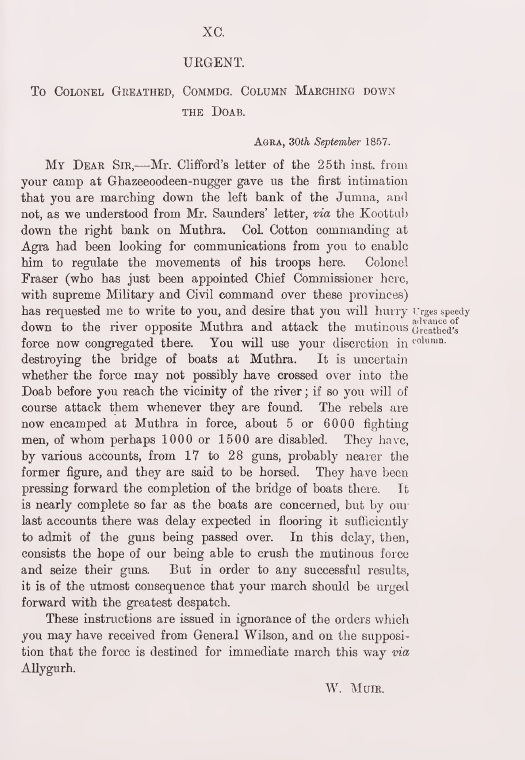
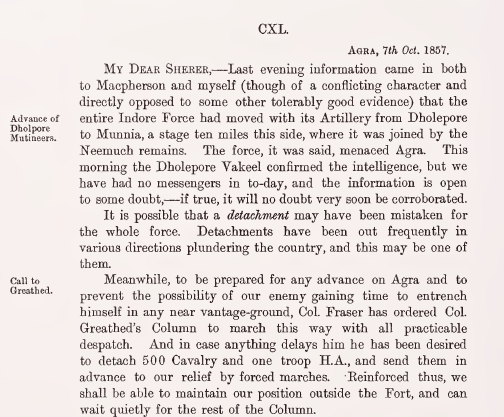
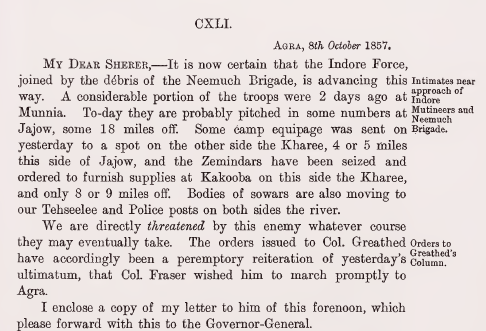
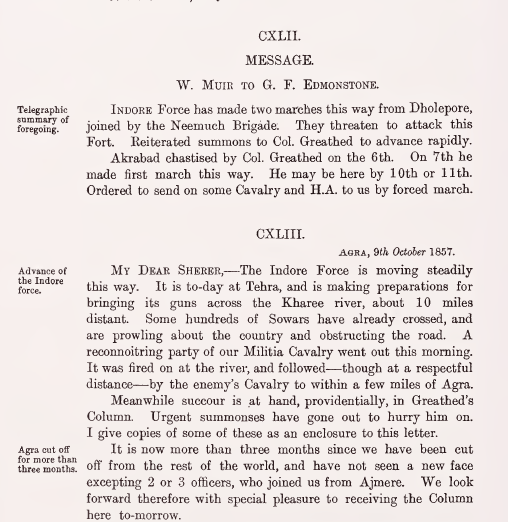
Muir managed to force Greathed’s hand – he would leave off his march to Cawnpore where Havelock and Outram were desperately waiting for reinforcements. Greathed had no way to assess if what Muir said was true or was just another bleat from Agra, but the tenacious official had written to everyone in government he could think of, from Calcutta to Delhi, the consensus was Greathed should march with all haste to Agra.
“The Cavalry and Horse Artillery, it was insisted, must go on at once; and as Colonel Greathed felt that he had come within the clutches of the hydra-headed powers of the North-Western Government, they were despatched on the 8th, at midnight, with instructions to push on rapidly to Agra, a distance of forty-eight miles. The infantry and the field battery followed four hours afterwards, arriving early in the morning at Hattrass, a well-built town, in an apparently flourishing condition, through which Bukht Khan’s force had marched a few days previously levying a heavy fine for its ransom.
“As we got nearer to Agra, the plot was getting hotter and hotter. Despatches, more and more urgent, were received by Colonel Greathed. His credit would be at stake if Agra was attacked, and he so near: they were threatened, and in momentary dread of an attack; in fact, we must push on to the utmost, for if we delayed, we should only find their ghosts to reproach us for their murder.” (Bourchier)
While Bourchier can be given some leeway for his exaggeration regarding ghosts, the march was very real. Greathed would have to traverse a distance of 44 miles in 28 hours to the succour of a well-provisioned European garrison, barricaded behind thick walls, with powerful guns who had continuously downplayed their own position to gain the assistance of an army that was sorely needed elsewhere. Accordingly, the cavalry and artillery set off on the 8th of October from Gunge, marched through the night, to arrive at Sydabad the next morning at 8am, a distance of 26 miles. The infantry followed in carts and on elephants.
At 2 pm an express was received from Agra that the enemy was barely 3 miles from walls – instead of resting, the force marched again, another 9 miles to Kundowlie. Roberts, as DAQMG, expecting any moment to be ordered on to Agra, delayed pitching the camp. Ouvry had gone ahead to Agra by mail cart to ascertain the situation for himself.
Going alone to the fort, he then drove along the roads around it, talking to natives and officers alike as he met them; he saw plenty of people but not one of them was the feared enemy. As such, Ouvry spoke to the chief commissioner and told him his force would stay put for the night and arrive in Agra the next morning. Somewhat irritated, he returned to his men and ordered their tents pitched. In the meantime, Greathed and the rest of the column arrived. The Sikhs had marched well but the Europeans were in a sorry state, having been unable to face a forced march, they had been dragged along on gun limbers, on top of elephants and in carts of every description, they were exhausted.
At sunrise the next morning, Greathed’s column crossed the Jumna at the bridge of boats, “to relieve the garrison of a fort possessing an inexhaustible supply of ordnance and ammunition, amply supplied with provisions, and capable, from its strength, of defying the whole army of Pandies for an indefinite time.” It was the 10th of October.
Sources:
Anson, Brev. Major O.H. St.G. – With H.M. 9th Lancers During the Indian Mutiny (London: W.H. Allen & Co., Ltd, 1896)
Behan, T. L., ed. Bulletins and Other State Intelligence for the Year 1858. Part 1. London: Harrison & Sons, 1860.
Blomfield, David, ed. Lahore to Lucknow: The Indian Mutiny Journal of Arthur Moffatt Lang. London: Leo Cooper, 1992.
Bourchier, George. Eight Months’ Campaign Against the Bengal Sepoy Army, During the Mutiny of 1857. London: Smith, Elder & Co., 1858.
Coopland, Ruth M. A Lady’s Escape from Gwalior and Life in the Fort of Agra during the Mutinies of 1857. London: Richard Bentley, 1859.
Dodd, George. The History of the Indian Revolt and of the Expeditions to Persia, China, and Japan, 1856-7-8. London: W. & R. Chambers, 1859
Dunlop, Robert Henry Wallace. The Khakee Ressalah: Service and Adventures with the Meerut Volunteer Horse during the Mutinies of 1857-58. Milton Keynes: Leonaur, 2005.
Further Papers (No.5, No.6, No.7) Relative to the Mutinies in the East Indies. London: Harrison & Sons, 1858
Gough, General Sir Hugh Old Memories. London: William Blackwood & Sons, 1897
Jocelyn, Julian Robert John. The History of the Royal and Indian Artillery in the Mutiny of 1857. London: John Murray, 1915.
Knollys, Henry, ed. Incidents in the Sepoy War, Compiled from the Private Journals of General Sir Hope Grant. Edinburgh: William Blackwood & Sons, 1873
Lee-Warner, William. Memoirs of Field Marshal Sir Henry Wylie Norman. London: Smith, Elder & Co., 1908.
Malleson, Col. G. B. The Indian Mutiny of 1857. London: Seeley & Co. Ltd, 1891
Muir, William. Agra in the Mutiny and the Life of W. & E.H. Muir in the Fort, 1857: A Sketch for the Children. Privately printed, 1896. Muir, Sir William. Records of the Intelligence Department of the Government of the North-Western Provinces of India During the Mutiny of 1857. Edited by William Coldstream. Vol. 1. Edinburgh: T. & T. Clark, 1902.
Ouvry, Henry Aimé. Cavalry Experiences: Letters and Journals of a British Cavalry Officer. Milton Keynes: Leonaur, 2012.
Roberts, Frederick Sleigh, Field Marshal Lord. Forty-One Years in India: From Subaltern to Commander-in-Chief. Vol. 1. London: Richard Bentley & Son, 1897
Thornhill, Mark. The Personal Adventures and Experiences of a Magistrate during the Rise, Progress, and Suppression of the Indian Mutiny. London: John Murray, 1884
Wright, William, ed. Through the Indian Mutiny: The Memoirs of James Fairweather, 4th Punjab Native Infantry, 1857-58. Stroud: Spellmount, 2011.
 Mutiny Reflections