The March Continues
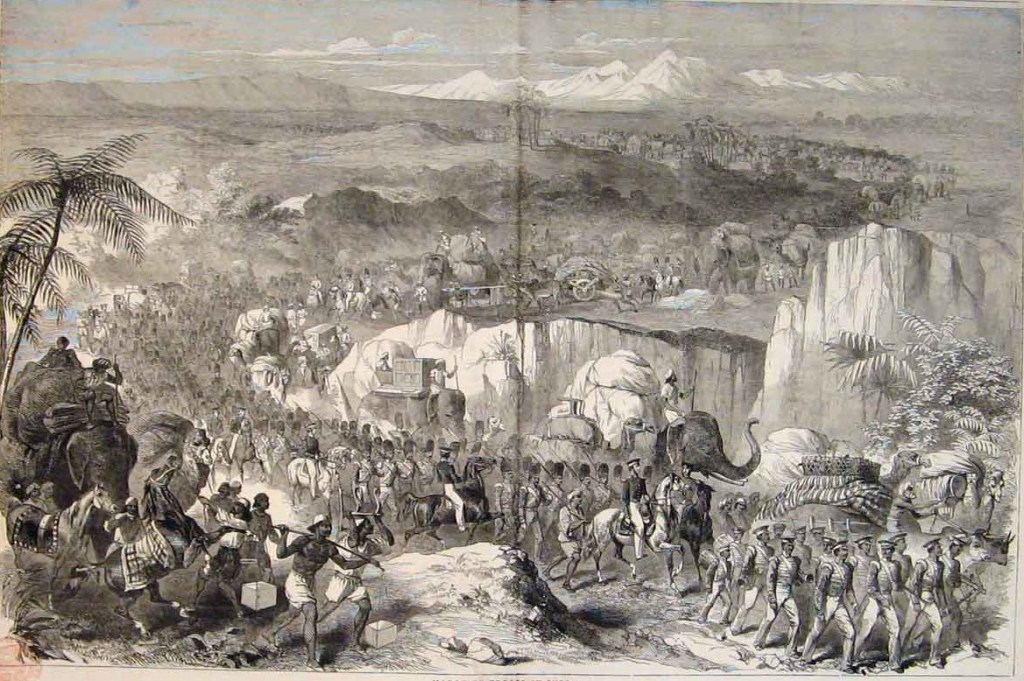
After four days of plundering and marauding, the column marched at 2 in the morning on the 4th of October. Orders had been given to lighten the baggage, which had reached immense proportions, much to the sarcastic delight of Anson who wrote, “I shall be quite glad when I am reduced to soap and a towel à la Napier. I shall then begin to think myself a veritable soldier…” The main concern was the temptation such a train presented to the ever-wily Gujars; the force, strengthened as it had been by two eighteen-pounders, the Kumaon Battalion and 100 more Europeans, the column needed speed and could not spare time waiting for a lumbering baggage train. The families of the camp followers were likewise sent off with the sick to Meerut, much to the satisfaction of Anson, if only for practical reasons – he no longer had to worry about paying for another hackery.
It must be noted here that Anson was not a hard-hearted man. He is one of the few officers who expressed any remorse at the next stages of Greathed’s march – the endless line of burning villages he left in his wake, the murders of innocent men, the wanton destruction of homes and lands; he hated the orders given to the Irregular Cavalry, stating bluntly, “This indiscriminate sort of massacre does no good – simply goads the villagers to commit atrocities on our defenceless people…” Vengence was a dangerous bedfellow.
Matters were not helped when the force entered the town of Khurja when, on the outskirts, the troops discovered a headless skeleton with its bones hacked and broken, propped up on the roadside. The medical officers declared it to be that of a woman, probably a European; the news spread through the column like wildfire. Fairweather had to stop a “wild Irishman, Hugh Haly” from torturing a poor fakir into telling him who the woman had been; others took their vengeance out on the townspeople, who vainly protested their innocence. Brand Sapte and George Campbell argued for the town – they had after all continued paying their revenue; what other proof of loyalty could Greathed possibly want? Even Anson agreed – what was the point, “…though there were probably a hundred or so bad characters in it, why rob and kill and spoil thousands for the budmashes?”
Colonel Greathed was aware that some rebels – “a miscellaneous armed mob” had decamped from Delhi and had fled in this direction – towards evening, several armed men barricaded themselves in a house and refused to give up their arms. Wisely, Greathed decided it was not worth a man’s life to send anyone into the town at night for a sortie that would ultimately only delay his march onto his next destination – Aligarh – by yet another day. The town’s collector interceded, the men were allowed to keep their arms and the column marched off; as for the collector, as soon as it was practicable, he bolted back to Bulandshahr, leaving Kurjah to decide their own fate.
Greathed, meanwhile marched on but not before Ouvry, hearing there was a great deal of English plunder in the town, entered the streets with a large force to look for it. All he found, for his pains, were a few “rotten old carbines” and one decent English double-barrelled rifle, which was promptly taken by the prize agent of the 75th.
No one ever found out who the skeleton had been – as Bouchier pointed out, it was unlikely to have been an Indian – they would never have treated their dead that way. Perhaps it was one of the many missing civilians who had haplessly been caught up, at the wrong place, at the wrong time.
It was Roberts who became aware that maybe there was still a lady to save.
“Just before we left Bulandshahr, a spy reported to me that an English lady was a prisoner in a village some twenty miles off, and that she was anxious to be rescued. As on cross-examination, however, the story did not appear to me to be very reliable, I told the man he must bring me some proof of the presence of the lady in the village. Accordingly, on the arrival of the column at Khurja, he appeared with a piece of paper on which was written ‘ Miss Martindale.’ This necessitated the matter being inquired into, and I obtained Brigadier’s permission to make a detour to the village in question. I started off, accompanied by Watson and Probyn, with their two squadrons of Cavalry. We timed our march so as to reach our destination just before dawn; the Cavalry surrounded the village, and with a small escort we three proceeded up the little street to the house where the guide told us the lady was confined. Not only was the house empty, but, with the exception of a few sick and bedridden old people, there was not a soul in the village. There had evidently been a hasty retreat, which puzzled me greatly, as I had taken every precaution to ensure secrecy, for I feared that if our intention to rescue the lady became known she would be carried off. As day broke we searched the surrounding crops and found the villagers and some soldiers hidden amongst them. Tliey one and all denied that there was the slightest truth in the story, and as it appeared a waste of time to further prosecute the fruitless search, we were on the point of starting to rejoin our camp, when there was a cry from our troopers of “‘Memsahib hai!’ (Here is the lady), and presently an excessively dusky girl about sixteen years of age appeared, clad in Native dress.”
She wasn’t the lady Roberts had been expecting, but a poor clerk’s daughter who had been rescued from Sitapur by a sowar. He had carried her off to his village and had been keeping her safe ever since – when Robert’s asked if she wanted to join them, she refused. The sowar had married her and she had no family or friends left to return to. While there might have been a time she would have gladly gone with them, she had made peace with her predicament – the shame of returning was more than she was ready to bear. Roberts gathered the men together and they returned to camp to bear the chaff of their colleagues. How many daughters of Anglo-Indian clerks and writers were scattered throughout India during the mutiny is anyone’s guess; she was certainly not the only one who chose to remain with her one-time captor rather than face the stigma of a rigid Victorian society. What Robert neglects to mention in his otherwise wholesome account is the fact that some of the men of the village were recognised as having belonged to Fisher’s Horse – the 15th Bengal Irregular Cavalry – that had mutinied in Sultanpore, killing their officers. Roberts ordered 12 of them shot on the spot. (Ouvry, Cavalry Experiences)
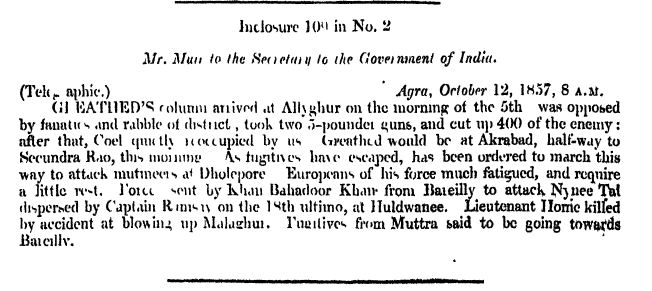
Greathed’s column pushed on to Somna where they halted for the night. News reached him that insurgents composed mostly of Ghazis, ex-convicts and a few rebels had made themselves ready to oppose his march to Aligarh. it was expected they would be reinforced by a large number of the Delhi mutineers. However, it turned out quite differently.
In the morning it became clear that instead of a large, well-turned-out force of unknown numbers, the way to Aligarh was blocked by “Some horribly impertinent fanatics of Mussulmen, attempting to hold this place against us with telegraph iron stumps for guns and wire of ammunition. They had the impudence too, to spike these curious guns…” wrote Anson, “They ran away, and we pursued them about five miles along the trunk road, killing in all about a hundred of them between us all, but frightening the poor wretched inhabitants and villagers out of their wits.”
Roberts gives the whole affair a slightly different spin:
“Our advance was stopped by a motley crowd drawn up before the walls, shouting, blowing horns, beating drums, and abusing the Feringhis in the choicest Hindustani; but, so far as we could see, there were no sepoys amongst them. The Horse Artillery coming up, these valiant defenders quickly fled inside the city and closed the gates, leaving two guns in our possession. Thinking we should be sure to attack and take the place, they rushed through it to the other side and made for the open country. But we had had enough of street fighting at Delhi. Our Cavalry and Artillery were divided into two parties, which moved round the walls, one to the right and the other to the left, and united in pursuit of the fugitives at the further side. Wc followed them for several miles. Some had concealed themselves in the high crops and were discovered by the Cavalry on their return march to camp. Ouvry formed a long line, and one by one the rebels, starting up as the troopers rode through the fields, several killed, while our loss was trifling.”
It was no surprise then, the inhabitants of Aligarh were eager to offer the army whatever supplies they could provide. Aligarh had already played a part in 1857 – https://mutinyreflections.wordpress.com/category/etah-aligarh-bulandshahr-and-secunderabad/
but the inhabitants did not deserve to be set upon by Greathed.
Akbarabad
In the village of Akbarabad, two rebels – twin brothers, who had become so notorious the government placed a price on their heads, were routed and killed: all they had to defend themselves against Greathed’s men were three small guns. In their possession, they had some European ladies’ dresses, books, photographs and trifles of every description – it wasn’t the loot the column was looking for but it served as fuel for their vengeance.
For Greathed’s Column, it was time again for a little more vengeance and Anson had had about as much as he could stomach.
“You must expect to see me return without a heart or feelings of any soft humanising tendency if I am destined to witness, day after day, such harrowing scenes of revolting brutality as have been perpetrated during the last two days, and are at the present moment enacting in this place, which has a very bad name, and which is being treated with corresponding severity. Fathers are shot with all their womankind clinging to them, and begging for their lives, but content the next moment to lie down in their blood, howling with despair. Yesterday in the Kates there was a sowar with three women on the top of him, trying to conceal him. One woman got shot in the arm by accident; the sowar got up and ran away, twelve pistols being fired at him without effect (this was the time when my horse was wounded; he was finally, but with much difficulty, lanced. Unarmed cowherds were mercilessly pistolled, together with about twenty armed men. What the poor women and children in this place are to do without their men, who are being killed in every house, I cannot say…George Campbell killed three men this morning, and that awful little snob B. boasts of having killed six, but I do not believe him. Just before leaving our picnic breakfast this morning, I saw him nearly put out the eye of his hardworking syce for some trifling offence by a severe blow with his fist. The only real wonder to me in this land is that all do not at once rise upon us and exterminate the hated Feringhees who so grievously oppress them…Others keep their servants in order by perpetual kicking and thrashing…That awful snob H., who is one of the lowest of the bad sort of selfish Irishmen, treats his servants like beasts—even worse. A bullet has just come whistling over the tent from the town, where the work of destruction is going on so ruthlessly…you must expect to see me a fiend if I witness many more of these horrors of war.”
For the few officers who still had some sense left in their hearts, it was a sore trial. A man of the 8th regiment was caught senselessly killing an Indian for no reason at all by beating his head in with a stick, saying he “filled him with disgust…” The Sikhs found the act so horrifying they complained in force to their commander, who was powerless to stop the outrage, as the man was not under his command. All he could do was call the murderer an arrant coward.
 Mutiny Reflections