The Battle for Agra
To their surprise, instead of a beleaguered mass of terrified inhabitants, the Delhi Column was greeted with loud cheers and several derisive remarks, particularly from the ladies they had marched so hard to save.
“Was there ever such a dirty-looking lot seen?” said one. Another believed they were Afghans. Their own men were so neatly dressed, the 3rd Bengal Europeans in their clean uniforms stood on the bastions and cheered Greathed’s dusty and begrimed force as they marched under the walls of the fort.
The arrival of the troops from Delhi was something of a treat for the bored, fidgety people of Agra. Mark Thornhill was one of the many who had stepped outside his quarters to watch the troops march past, but he was a little nonplussed, all the same. “…the spectacle was imposing from the impression it gave of strength and power, but it had nothing of the show and glitter of a review…in short, it was the reality of war-not its dress rehearsal.”
The Sikhs, infantry and cavalry, terrified the ladies with their wild appearance. The Lancer’s uniforms were plain blue, but their plain ash lances bore no trace of decoration. Everyone else was dressed in the most drab khaki. Behind and between them came strings of camels, and for at least two miles behind the troops, struggled the baggage carts and the camp followers. Agra had been expecting shining saviours – what they received instead was a battle-worn army that had just spent 28 miserable hours on the road. However, in their pretty dresses and handkerchiefs waving, the ladies of Agra must have been a sight for the men from Delhi – they were, after all, alive.
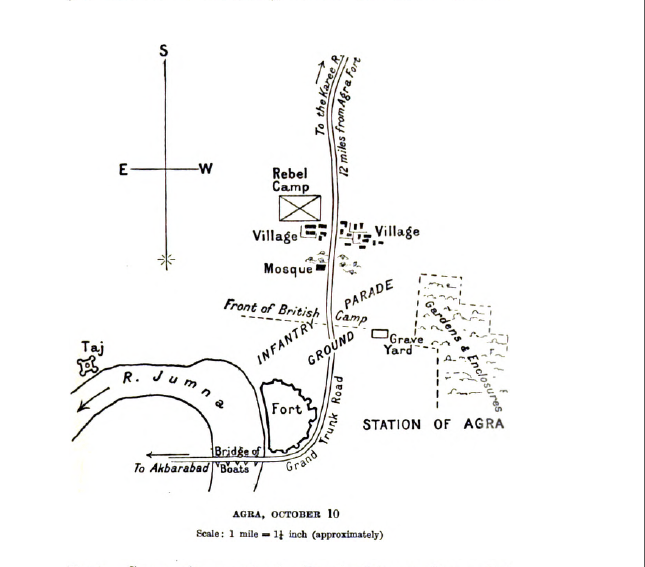
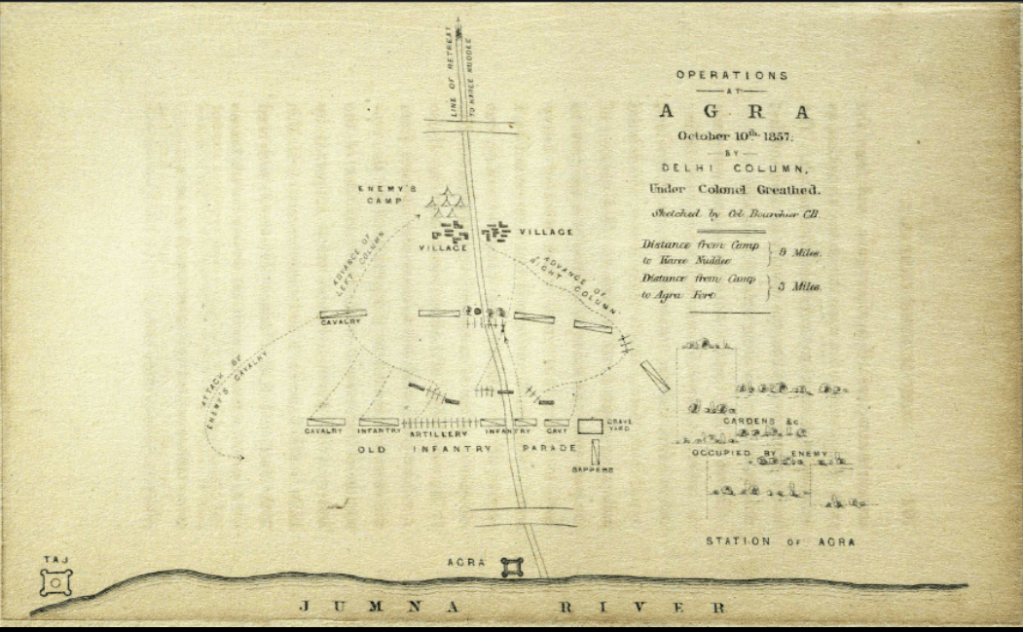
For their part, some of the officers found the spectacle at Agra ludicrous. Bourchier was amused by the sight of ladies driving about in carriages, and he watched as the Agra militia careened about in full equestrian grandeur; Norman was struck by how 6000 people could live in what he saw was a veritable beehive while Anson found time to grumble that their good furniture and well-ventilated rooms too comfortable; he soon found himself in the bosom of the Muir family, joining them for a late breakfast. The rest of the force was left outside under the hot sun, waiting while Greathed argued with the Agra authorities as to where he should put his men. Muir was in favour of encamping them in a series of shady, overgrown gardens –“where the guns would not have had a range of 50 yards and where the cavalry could not possibly act…” (Bouchier) as opposed to Greathed’s plan of securing the wide open parade ground which afforded him unobstructed sight for four hundred yards in every direction. At the end of the vista stood some high crops. The order was given to pitch tents, Roberts accordingly marked out the camp and received leave to go with the other officers to breakfast in the fort.
After 2 hours, Greathed, fortunately, moved his men onto the plain, but he also believed the intelligence department at Agra who now told him the threatening enemy had moved beyond the Kali Naddi, ten miles away from the cantonments. The men on the field proceeded to picket their horses, remove their accoutrements and settle down to a well-earned breakfast while their officers dined in the fort. . Lulled into a sense of security, Greathed neglected to post any pickets and no patrols were sent out to reconnoitre the high crops that surrounded the camp. The authorities at Agra, not having had to worry about such things behind their walls, took few precautions regarding who was admitted within the vicinity of their citadel.
For one, Lieutenant Roberts did not believe what the authorities in Agra were saying.
“Our doubts, however, were met with the smile of superior knowledge. We were informed that the rebels had found it impossible to get their guns across to the Agra side of the stream, and that, feeling themselves powerless without them to resist our column, they had taken themselves off with the least possible delay. We were asked with some indignation,
‘Had not the whole country round been scoured by thoroughly trustworthy men without a trace of the enemy being discovered?’ And we were assured that we might take our much-needed rest in perfect confidence that we were not likely to be disturbed. We were further told by those who were responsible for the local Intelligence Department, and who were repeatedly questioned, that they had no doubt whatever their information was correct and that there was no need to follow up the enemy until our troops were rested and refreshed.”
What Roberts only understood in hindsight was that the administration in Agra had completely collapsed, and no one in charge was willing to take responsibility. Except for a few civilians, like Mark Thornhill, who were routinely ignored and belittled, no one at Agra understood the nature of the revolt in progress. Unfortunately, it was Greathed, after fighting the rebels for so many months in Delhi, who should have known better than to leave his camp unguarded and pass off his duties for the sake of a better breakfast.
Suddenly, a troop of men appeared in the camp, for all intents looking like conjurors or jugglers – one Sergeant Crews of the 9th Lancers found them so suspicious that he ordered them to leave. Instead, they threw off their costumes, drew out their tulwars and proceeded to hack Crews to death. At the same time, two guns cleverly concealed in the high crops opened fire, as a party of six mutineers dressed in the colours of the 2nd Punjab Cavalry rode up to the Quarter Guard of the 9th Lancers and cut down the sentry. Sergeant Henry Hartigan (VC) rushed to Crews’ rescue and seized the tulwar of one of the men and, with the other hand, punched him in the mouth. He then defended himself against the other three with the captured tulwar, killing one and wounding the other two. Although severely injured in the head, he fought off the attackers before he fell.
However, it was the sound of round shot and not the scuffling of Crews and Hartigan that awoke the camp. It was pouring into their lines, passing through their tents – the enemy was not across the river; they were in the cantonment itself, hidden by the long crops at the end of the parade ground. The men used to sudden attacks in Delhi were quick to their feet. Bouchier bounded out of his bed and rushed out of his tent as one of his servants was shot through by the next shower of round shot. Just out of view was a battery of twelve guns belonging to the rebels, from the right and the front, terrifying the camp followers and the Agra sight-seers.
The artillery rushed to their guns, and directly returned fire, and while the cavalry mounted their horses, the infantry fell in line, waiting for orders. So many officers had left the camp for the day to visit their friends in the fort, and there was, for a brief moment, no one in charge.
Everyone was settling down to their well-earned repast in the fort when the sound of a heavy cannonade ripped through their jocular conversations and spilt more than one cup of tea. William Muir and many others ran up to the ramparts, their eyes towards Greathed’s camp. To his surprise, he saw the whole column was engaged by the enemy but he could not understand how it had happened. His intelligence had assured him the rebels had left.
“It had come suddenly upon our camp, concealed by the fields. And the first notice they had was a round shot bowling in upon the tents. How they brought these guns over in this quiet way no one can yet tell...”
The first thing the sentries at the gates did was slam them shut, leaving a bewildered and terrified population trapped outside the fort and surprised officers stuck inside. It was the Agra panic again.
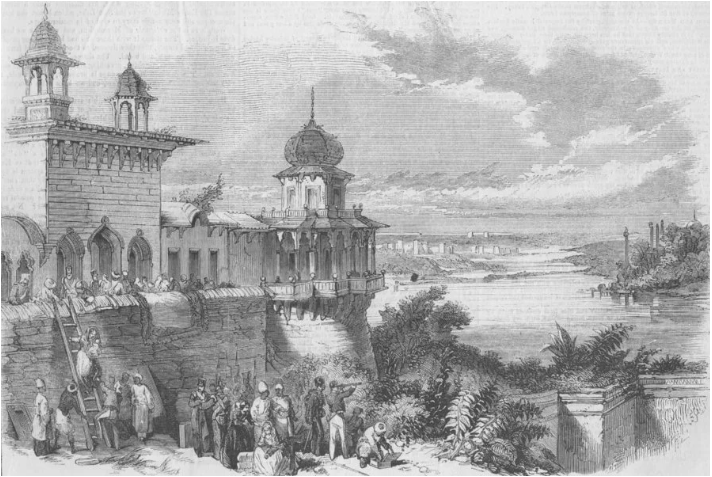
Two-thirds of the fort inhabitants had treated it like a day out, a break from their tedious existence and had stepped out to see the troops marching in; they then remained outside to watch the camp being pitched. When the first shots were fired, they scampered as fast as they could, back to the Fort. Unfortunately, they became entangled with the baggage train, which was late in coming up and “Instantly, elephants, camels, led horses, doolie-bearers carrying the sick and wounded, bullocks yoked to heavily-laden carts, all becoming panic-stricken, turned round and joined in the stampede. Elephants, as terrified as their mahouts shuffled along, screaming and trumpeting; drivers twisted the tails of their long-suffering bullocks with more than usual energy and heartlessness, in the vain hope of goading them into a gallop; and camels had their nostrils rent asunder by the men in charge of them, in their unsuccessful endeavours to urge their phlegmatic animals into something faster than their ordinary stately pace.”
Trying to get out of the Fort was Greathed and his officers. Ouvry and Cotton had sent their horses away for the day, expecting they would be enjoying a long sojourn in the fort. When the firing started, they leapt to their feet and shouted for their horses. They were gone. Seeing an idle buggy, they jumped into it and rode furiously towards the gate. Anson, in the meantime, had appropriated another buggy and after a hasty goodbye the Muirs, hightailed it towards the camp. Roberts and the others jumped on their horses and galloped out of the fort. No one got very far.“Wc had got but halfway to camp when we were met and almost borne down by an enormous crowd, consisting of men, women, and children of every shade of colour, animals and baggage all mixed up in inextricable confusion. On they rushed, struggling and yelling as if pursued by demons…Into this surging multitude, we rushed, but for a time our progress was completely checked. Eventually, however, by dint of blows, threats, and shouts, we managed to force our way through the motley crowd and reach the scene of action.”
Mark Thornhill ran back to his quarters to grab his sword and revolver, but by the time he arrived at the gateway, he found it had been shut once again. Disappointed, he returned to the ramparts and watched the battle for Agra unfolding.It was a battle, but not like anything Frederick Roberts had ever seen.
“Independent fights were going on all over the parade ground. Here, a couple of Cavalry soldiers were charging each other. There, the game of bayonet versus sword was being carried on in real earnest. Further on, a party of the enemy’s Cavalry were attacking one of Blunt’s guns (which they succeeded in carrying off a short distance). Just in front, the 75th Foot (many of the men in their shirt-sleeves) were forming square to receive a body of the rebel horse. A little to the left of the 75th, Remmington’s troop of Horse Artillery and Bourchier’s battery had opened fire from the park without waiting to put on their accoutrements, while the horses were being hastily harnessed by the Native drivers and saices. Still further to the left, the 9th Lancers and Gough’s squadron of Hodson’s Horse were rapidly saddling and falling in. On the right the 8th Foot and the 2nd and 4th Punjab Infantry were busy getting under arms, while beyond, the three squadrons of Punjab Cavalry, under Probyn and Younghusband, were hurrying to get on the enemy’s flank.”
Watson rushed off to take command of the Punjab Cavalry while Roberts and Norman rode off in different directions, searching for Greathed. Unable to find him, Roberts attached himself to Major Frank Turner, commanding the artillery. “The Commander was not to be found; no one knew who was the senior officer present; consequently each regiment and battery had to act according to its own discretion. The troops got ready with incredible rapidity and set to work to drive the enemy off the ground. The Artillery replied to the insurgents’ guns; the Infantry did what they could, but were hampered by the fear of doing more injury to their friends than their foes, and thus the brunt of the work fell upon the Cavalry…”
Greathed finally arrived and immediately gave orders for a general advance but just as the men prepared to move off, on the scene arrived that erstwhile Agra official, Lieutanent-Colonel Cotton. Being senior in rank to Greathed, he assumed command amid the battle and caused a notable delay while he pondered the information Greathed gave him, considered the situation as he saw it and discussed the plan of action before leaving everything in the hands of Greathed anyway. Captain Remmington’s troop, supported by the Punjab Cavalry and some of the infantry were ordered to advance on the right, while the heavy guns of No. 17 battery were left to cover the advance of the centre, supported by the guard left to protect the camp, while the rest of the battery Captain Blunt’s troop, the 9th Lancers, detachments of the 75th Foot and 2nd Punjab Infantry advanced from the left. The Agra Battery and the 3rd Europeans then joined on the right and the column was formed into two divisions. The infantry was set to work clearing the gardens that Muir had first suggested as a camping ground while the rebel cavalry was routed by the Punjab Cavalry.
Watson, Probyn and Younghusband with their three squadrons, cleared our right flank, capturing two guns and some standards.“Probyn greatly distinguished himself on this occasion. In one of the charges, he got separated from his men and was, for a time, surrounded by the enemy, two of whom he slew. In another charge, he captured a standard….”
Charging the rebel infantry ahead of his squadron, Probyn dashed into a party of half a dozen sepoys and cut two down before his sowars caught up. He then encountered a steady and determined mutineer who managed to wound him in the chest with his bayonet – unshaken, Probyn turned around and slew him. He next singled out a rebel standard-bearer surrounded by a guard as he charged his selected target, but he was attacked by a rebel sowar, who, gaining a momentary advantage, raised his sword to cut him down. Probyn’s orderly, ‘a grey-haired old Sikh’, saw the danger and flew forward, raising an arm to protect Probyn. The blow fell, all but severing the orderly’s limb – he died two days later.
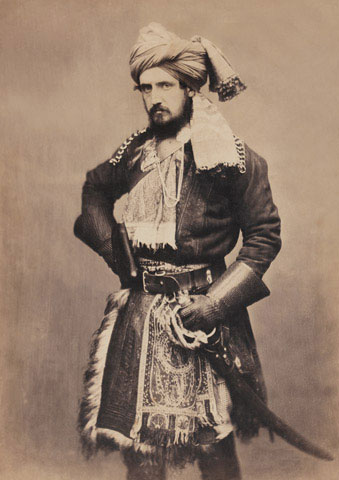
In the midst of it all, Younghusband, who had just captured two guns, suddenly vanished – he had ridden his horse straight into a blind well and rapidly two more horses and their riders fell in, all but burying Younghusband under their dead weight. Alfred Moffatt Lang quickly brought up sappers and ropes to get them out. (Younghusband survived the fall). Leaving some men of the 8th and a few of Younghusband’s troopers to get on with the work, Lang galloped off on the Gwalior road only to find the 3rd Europeans, so primly dressed in their bright scarlet uniforms, huddled together. The infantry said the enclosures ahead were full of the enemy which was why they had halted. Confused, Lang, with four Punjabis and a volunteer horseman, rode on ahead only to find the enclosures were not only empty, but in the distance they could see the enemy moving away, as fast as their bullock carts could carry them.
On the left, a large body of rebel cavalry, who had until now only been seen loitering on the edge of the battle, dashed through the camp. Captain Blunt with his guns and a squadron of Lancers fell back to reinforce the camp guard, meeting the cavalry as they came in – in the exceptional charge of the Lancers, Captain French was killed and Lieutenant Jones gravely wounded.
Hugh Gough, commanding Hodson’s Horse, was particularly pleased with his men leading them in a charge from the left – with his raw recruits and the disbanded soldiers of the once great Khalsa Army, Gough routed the rebels, charged and chased, of which he wrote, admiringly,
“They had no knowledge of drill or of our words of command; in fact, all I attempted to teach them were, ” Threes right” or “Threes left” (never Threes about!), and “Form Line,” “Charge.” However, with all their want of knowledge and training, they had plenty of pluck, and their success lay in that, combined with readiness and goodwill for any amount of work.” (Gough)
On the left, a large body of rebel cavalry, who had until now only been seen loitering on the edge of the battle, dashed through the camp. Captain Blunt with his guns and a squadron of Lancers fell back to reinforce the camp guard, meeting the cavalry as they came in – in the exceptional charge of the Lancers, Captain French was killed and Lieutenant Jones gravely wounded.
Hugh Gough, commanding Hodson’s Horse, was particularly pleased with his men leading them in a charge from the left – with his raw recruits and the disbanded soldiers of the once great Khalsa Army, Gough routed the rebels, charged and chased, of which he wrote, admiringly,
“They had no knowledge of drill or of our words of command; in fact, all I attempted to teach them were, ” Threes right” or “Threes left” (never Threes about!), and “Form Line,” “Charge.” However, with all their want of knowledge and training, they had plenty of pluck, and their success lay in that, combined with readiness and goodwill for any amount of work.” (Gough)
The rebels had no stomach for a fight on this occasion. Fairly soon the road towards the river was choked with camels, carts and men – hundreds of sepoys from the 23rd, 22nd and 47th, 1st Cavalry, red-coated Irregulars and others only armed with matchlocks and tulwars, fleeing in such a blind panic that a few officers, Lang among them, and some of the Agra volunteers could “ride through them like sheep. It was absurd…we rode through them, slashing and thrusting, and leaving them behind…” (Lang) In his rear, he could hear the shouts of some Agra officials, “whom I knew not and whose orders I didn’t much respect,” imploring Lang and the others to “hold hard.” The order was ridiculous – they did not seem to understand just how small Greathed’s force was; had a force of fresh cavalry ridden up at that moment, it would have resulted in a massacre. There was only one option – rout the rebels and give chase without giving them a chance to regroup.
There was little left to do.
The rebels scrambled as best they could across the river, leaving behind whatever guns and baggage they could not carry and dispersed into the countryside. The column pulled up as they reached the river, still in pursuit and then waited while the Horse Artillery gave the rebels their last send-off. They opened up with the ball and continued firing as long as there was any enemy in sight. Once the spectacle was over, everyone returned quietly to camp. The contrast between the European troops was remarkable. The 3rd Europeans, who had barely marched a fifth of the way, grumbled and requested to be carried back to Agra on gun carriages; the infantry of Greathed’s column had had little to do during the battle they concentrated on emptying the carts left behind by the mutineers – the 75th, had behaved as their commander expected, so unsteady and faltering he was “beyond words disgusted with them.” The battle had been fought by the cavalry and the artillery, once again.
Everyone wanted to be a hero, while the real heroes of the day looked on.
“First, came a fat old gentleman, on as fat an old horse, who requested Major Ouvry to give him a certificate to the effect he had been under fire, he being the commandant of some volunteers of whose whereabouts he was in total ignorance; next came a truly perspiring hero, jogging along with his bridle and drawn sword in one hand, while in the other was a fan of enormous size, which he managed with dexterous address; while further on might be seen a corpulent clerk, brandishing his stick over a fallen Pandy, ever and anon starting at his own temerity.”
An Agra volunteer thinking no one would notice, tore the medals off the chest of a dead sowar of the 1st Bengal Cavalry, and claimed the kill as his own – Anson, however, had seen it was a trumpeter of the 9th who had been the real winner. To Anson’s amusement, however, he also watched as one of the Agra volunteers was chased about by loose horse – horses, he said, were wont to have their bit of fun too on days like this.
The last laugh of the day was left to Mark Thornhill.
Having been much disappointed by what he saw of the battle from the ramparts (little puffs of blue smoke, followed by a booming sound, then the rattle of musketry, plenty of shouting and then the retreat of the enemy). Thornhill left the ramparts as the sound of firing lessened – the only thrill he had had was the sight of a large cloud of black smoke – Remmington had blown up two tumbrils of the enemy’s munitions, a grand spectacle. As he stood about discussing the outcome of the battle and watching as the first wounded were silently carried past in their blood-soaked doolies, he was approached by Muir’s spy, the ever-present blind man, led by his attendant. Thornhill burst out laughing. Trying to convince this stalwart bearer of information that his news was not only wrong but late, was impossible – he would not have it that the battle that had just been fought was against the very rebels he now so proudly had discovered as loitering around the fort. He passed along, the bearer of important information, to find Muir. It was no wonder, thought Thornhill, when the Intelligence department relied on such information this bad, that they really had no intelligence at all.
 Mutiny Reflections