After the Battle
Recriminations were not far behind.
The day after the battle, a Sunday, the Agra officials, Greathed and his staff spent their day discussing the battle, acrimoniously at first but by Monday, it was an all-out row, in true Agra style.
Colonel Cotton blustered about, demanding the magistrate be suspended, but when it was pointed out that while the magistrate had given him no warning, he had received plenty from other quarters but had ignored it. Colonel Greathed jumped in, expressing his intention to send a formal complaint to Calcutta, regarding the false information he had received which had nearly cost him his entire column. He was quietly reminded he could also explain to Agra why he neglected to post picquets or take any precautions to protect his camp. Chagrined, the company stared at each other, every man convinced the other was at fault.
Had the battle been lost, there might have been hell to pay – but they had, after all, won. It was decided to drop the whole affair and let it disappear. It was with some satisfaction, the rebels’ intelligence had been as bad as their own:
after spending at least 3 days hiding in the tall crops and gardens within two miles of the fort, they had let themselves believe that the few tents pitched on the parade ground were all the resistance they could expect, assuming them to be just a few men from the Agra militia and the detachment that had been recalled from across the river. When they realised their mistake, they fled – an army that could have changed the course of the mutiny was routed, nothing more than a panic-stricken rabble.
“They knew that we were on our way from Aligarh, and had arranged (as we afterwards heard) with the people of the city to destroy the bridge of boats in time to prevent our crossing. But our movements were sufficiently rapid to prevent their carrying their intention into effect, and although the insurgents were informed that we had actually crossed the river they refused to believe the report, and, it was said, hanged the man who brought it. ..Their astonishment first became known when they were repulsed by the 75th Foot, and were heard to say to one another, “Arrah bhai ye Diliwhale haini’ (I say, brother! these are the fellows from Delhi!).
For Greathed, the victory was bittersweet. He had failed to give satisfaction to either the Agra authorities or to the men on his own staff – under their combined influence, Muir wrote to Delhi to request Hope Grant be sent in his place, at least, that was the official version. Muir had started pushing for Greathed’s removal as soon as the man arrived in Agra. In a letter on the 10th of October, as the battle raged, Muir wrote –
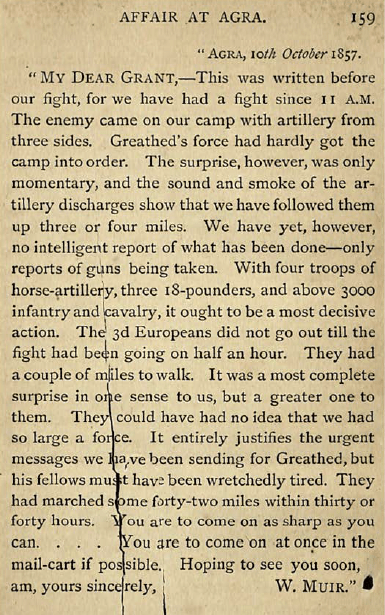
How Muir expected Grant to get to Agra to take instant command of the column quite puzzled Grant. He showed the letter to Neville Chamberlain and then took it to General Penny. Equally surprised by Muir’s request, Penny agreed it was probably for the best, and issued Grant a written order to proceed to Agra to take charge of the moveable column. Grant set off at once, putting in first for 2 days at Meerut; ascertaining the road to Agra was indeed open, Grant and his brigade major, Hamilton embarked on the 130-mile journey to Agra, arriving 16 hours later. The column had already marched on their way to Cawnpore but Grant, after visiting the men in the hospital and getting his intelligence from Muir, proceeded after them. Finding them encamped at Firozabad on the road to Cawnpore, Grant immediately sought out Greathed’s tent and gave him Penny’s order. Greathed first turned pale, but in good soldierly fashion, immediately relinquished his command. Greathed continued as brigadier of the infantry.
Leaving Agra
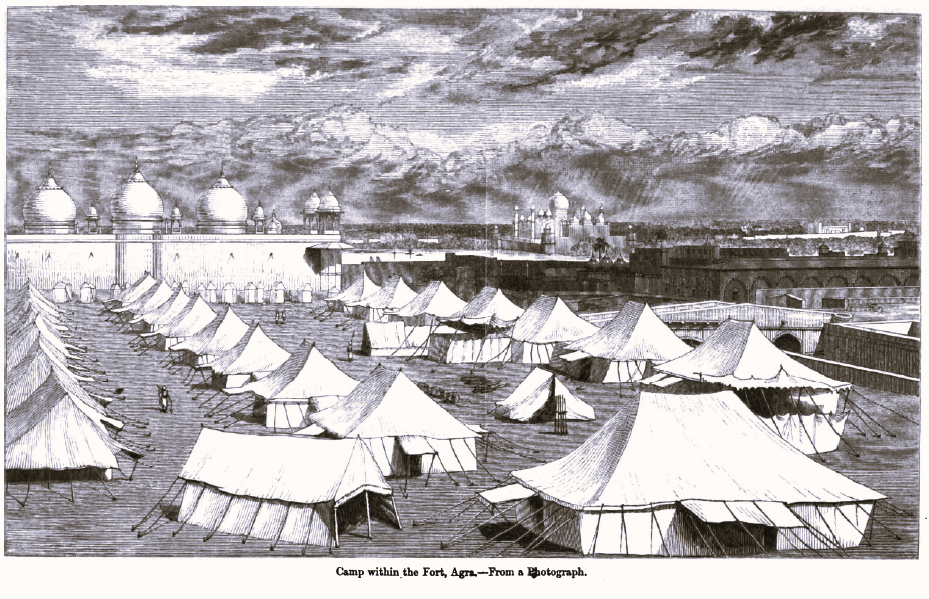
It was clear the force would not stay in Agra – they were being called urgently for other work in Cawnpore and Lucknow but at least for a few days, they could rest. Anson spent time with friends, dining and giving himself over to leisure, exploring the fort, and admiring the view. He took a little time to commiserate over the loss of a quantity of rum the kegs having been thrown off by the frightened camels. The Agra Volunteers challenged the Lancers to a game of cricket.The 12 officers and men who had been killed in the Battle of Agra were duly buried and the 54 wounded were made comfortable by the tireless energies of the fine ladies, nursing them with as much comfort as they could offer. Who looked after the wounded camp followers is anyone’s guess. Breakfasts and capital picnics and the adoration of the ladies did much to soothe the bruises of some of the officers from Delhi. However, Anson could not help feeling the men, as a whole, had been treated badly and could not help feeling offended at the “…the cold and shabby treatment they received from the Agra people in the fort, who made not a single effort to please them, or show their sense of the great service we had rendered them, dispersing in a few hours a force which they themselves would never have got rid of.”
Bourchier spent time listening to the ladies, many of whom told him they had spent months listening to the menfolk of the fort, their stalwart protectors, who proclaimed hourly in wonder, would be anyone alive in the morning? Given the choice, the ladies would have gladly joined the march to Cawnpore with all its perils, just to get away from them. A man, just as fed up with Agra as the ladies, grabbed Bouchier by the hand and begged him to talk to him about the Punjab, anything to help his heart feel at ease. Everyone wanted to leave, but there was still nowhere for them to go.
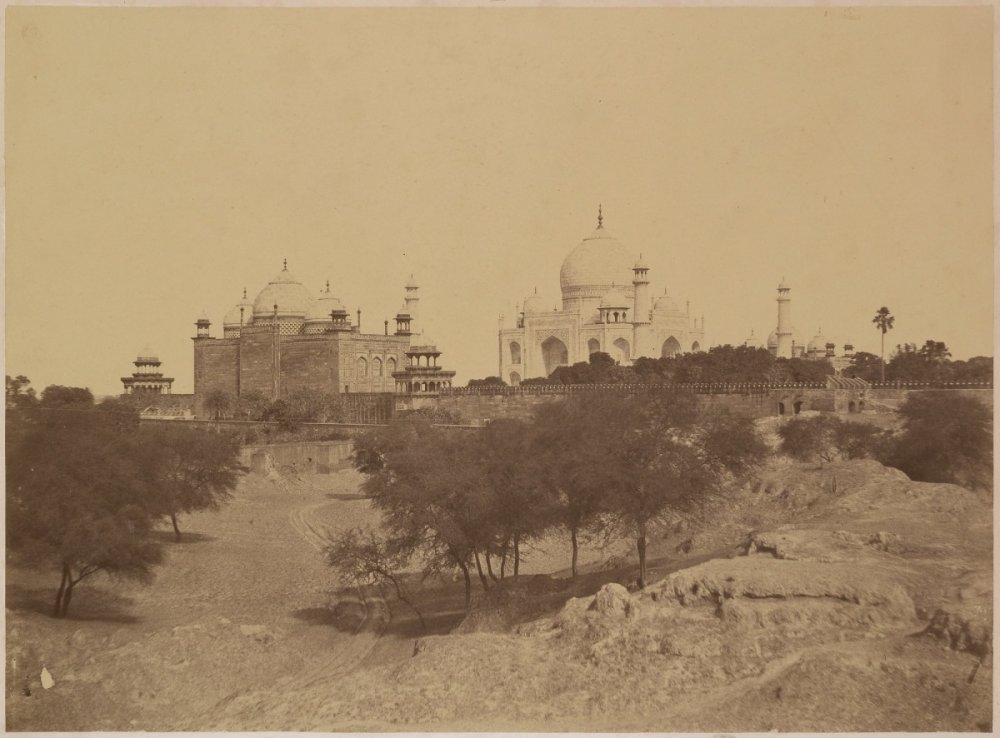
In the evening, those who could, went to the Taj Mahal. While the band of the 2nd Punjab Infantry played, there on the white marble floors of the most beautiful building Roberts had ever seen he could not help remarking, “Go to India. The Taj alone is well worth the journey.“
Early on the morning of the 14th of October, the column marched, or rather “crept stealthily out of Agra, doubtful, indeed, how far we should get away, ere, local timidity being excited, we should be recalled from the more urgent duty…” (Bourchier).
There would be no more ladies in their fluttering new muslins for many months to come. As a small comfort to the authorities, Greathed left behind 200 Sikhs who Ruth Coopland – in the true style of a lady, could not help comparing the wild, fighting men of the Punjab to gipsies. Agra, would for now be left, once again to their own devices until the 27th of December when Sir Colin Campbell took Fatehgarh, which finally opened the Grand Trunk Road to Cawnpore and Calcutta on the right bank of the Ganges. Until then, Ruth Coopland and the others would sit in the fort and wait.
Sources:
Anson, Brev. Major O.H. St.G. – With H.M. 9th Lancers During the Indian Mutiny (London: W.H. Allen & Co., Ltd, 1896)
Behan, T. L., ed. Bulletins and Other State Intelligence for the Year 1858. Part 1. London: Harrison & Sons, 1860.
Blomfield, David, ed. Lahore to Lucknow: The Indian Mutiny Journal of Arthur Moffatt Lang. London: Leo Cooper, 1992.
Bourchier, George. Eight Months’ Campaign Against the Bengal Sepoy Army, During the Mutiny of 1857. London: Smith, Elder & Co., 1858.
Coopland, Ruth M. A Lady’s Escape from Gwalior and Life in the Fort of Agra during the Mutinies of 1857. London: Richard Bentley, 1859.
Dodd, George. The History of the Indian Revolt and of the Expeditions to Persia, China, and Japan, 1856-7-8. London: W. & R. Chambers, 1859
Dunlop, Robert Henry Wallace. The Khakee Ressalah: Service and Adventures with the Meerut Volunteer Horse during the Mutinies of 1857-58. Milton Keynes: Leonaur, 2005.
Further Papers (No.5, No.6, No.7) Relative to the Mutinies in the East Indies. London: Harrison & Sons, 1858
Gough, General Sir Hugh Old Memories. London: William Blackwood & Sons, 1897
Jocelyn, Julian Robert John. The History of the Royal and Indian Artillery in the Mutiny of 1857. London: John Murray, 1915.
Knollys, Henry, ed. Incidents in the Sepoy War, Compiled from the Private Journals of General Sir Hope Grant. Edinburgh: William Blackwood & Sons, 1873
Lee-Warner, William. Memoirs of Field Marshal Sir Henry Wylie Norman. London: Smith, Elder & Co., 1908.
Malleson, Col. G. B. The Indian Mutiny of 1857. London: Seeley & Co. Ltd, 1891
Muir, William. Agra in the Mutiny and the Life of W. & E.H. Muir in the Fort, 1857: A Sketch for the Children. Privately printed, 1896. Muir, Sir William. Records of the Intelligence Department of the Government of the North-Western Provinces of India During the Mutiny of 1857. Edited by William Coldstream. Vol. 1. Edinburgh: T. & T. Clark, 1902.
Ouvry, Henry Aimé. Cavalry Experiences: Letters and Journals of a British Cavalry Officer. Milton Keynes: Leonaur, 2012.
Roberts, Frederick Sleigh, Field Marshal Lord. Forty-One Years in India: From Subaltern to Commander-in-Chief. Vol. 1. London: Richard Bentley & Son, 1897
Thornhill, Mark. The Personal Adventures and Experiences of a Magistrate during the Rise, Progress, and Suppression of the Indian Mutiny. London: John Murray, 1884
Wright, William, ed. Through the Indian Mutiny: The Memoirs of James Fairweather, 4th Punjab Native Infantry, 1857-58. Stroud: Spellmount, 2011.
 Mutiny Reflections