The Taking of Malagarh Fort
The men found, a little to their surprise, that Walidad’s men had been expert plunderers and had stocked their fort well. Lang and his garrison, consisting of a detachment of Hodson’s Horse and the 10th and 11th companies of the Punjab sappers, with a further 50 true sappers quickly took up their residence in the stronghold in a room over the river gateway. They then proceeded to take their fill of Walidad’s stores – “geese, ducks and pigeons…we are also well provided for with tables and chairs, and plates and dishes, beautiful beer, unlimited in quantity, cones on cones of lump sugar, and numberless great bottles of rose water with which we bathe! ”
Home, Lang and the others went over the fort. They examined his guns which were of a strange make, constructed out of the screw-pile ends of the telegraph posts with the wire, cut into pieces and shoved into bags, serving as grapeshot. Walidad Khan had left in something of a hurry and Lang found, to his delight, a large “but impure cornelian, the size of a plum, and a pretty little painted box.” His servants were somewhat more practical and provided him with 5 dozen bottles of beer, more cone sugar and a very good cane bed.
Anson recounts,
“I was sitting next to young Watson at dinner last night, and he amused me much with an account of the vain efforts he made to secure something worth having. His attention was fixed on a beautiful gold and blue vase, of the value of four or five guineas, and he was handing it over to his orderly to take care of for him when Mr. Sapte claimed it as his own. He next picked up a very pretty gold-mounted riding whip, and meeting Mr. Sapte, was addressed with, ” Oh ! where did you find this? It is my wife’s.” So he made it over to him. Soon after Greathed comes in, and seeing the whip in Sapte’s hand, immediately claims it as his sister-in-law’s (Mrs. H. H. Greathed). Sapte, however, retained possession, Greathed connecting himself with observing that it was the very counterpart of Mrs. Greathed’s, and Watson waiving his right to it in spite of the rival claimants.”
The Sikhs of the party were not above their own hand at helping themselves. One officer, while examining a large bottle of rose water, was surprised by one of these stalwart gents who abruptly knocked the neck off the bottle, and after bathing his hands and face in the water, remarked, “That’s very good, sir!” before proceeding on his way, leaving the startled officer holding the rest of the bottle.
Some remarkable treasures were found, including a diamond brooch with Brand Sapte claimed to belong to his wife – he might have been right, seeing as he had lost his property upon leaving his district; otherwise, the more valuable plunder was auctioned off in the Irregulars camp, with a silk scarf fetching 180 rupees. The Sikhs made a profit selling off the loaf sugar they found, while the villagers, who were allowed into the fort to likewise take their share of the loot, were stopped at the gate by the sentries and quickly lightened their loads. Young Watson, who had been unlucky with the vase, found a box of excellent medical instruments and a ruby brooch. However, much of what they found was worthless to the British – blankets, brass pots and pans and a room of women’s dresses.
Meanwhile, the force languished at the fort and in the camp, waiting for ammunition to come from Delhi and doolies for the wounded from Meerut. They lived, said Lang, like conquerors and marauders, a very different life to that they were accustomed to in Delhi. However, Greathed had not taken the fort to simply empty it of its contents – he intended to blow it up. The task was left to the Engineers.
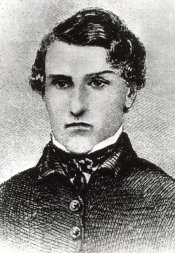
The engineers found amusement in their work. Bit by bit, they blew up Malagarh. They started with bits of the glacis and the bastion at the gateway, and invited Gough and the other officers to watch; they also placed them in a position where they would not only get a good view of the explosion but also get dosed with earth and dust for the laughter of the engineers. On the 2nd of October the gateway, the bastion and the escarp were blown in. Suddenly, the unimaginable happened.
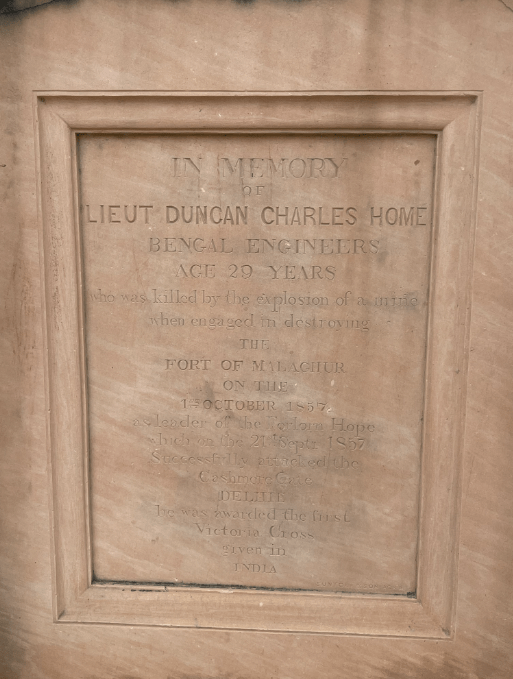
“The last mine to be blown in was the counterscarp, by which we should make a broad smooth road into the place. Stevenson and I rushed up on the ruins of the bastion and saw Home run laughing up to the mine; he his hand out and to our horror instantaneously the mine sprung; down we rushed, out every man to work to scrape and dig. Sergeant Robson, a few feet from poor Home, had been knocked down and bruised but was not really injured, but of poor Home, for a minute or two we saw no traces. I looked around a little distance and about twenty yards off in the hollow of a well I recognised his body, all mangled and covered with dust: poor fellow, his legs were broken in two places, his arms broken and one nearly torn off; his death must have been instantaneous. It was like a horrid dream…I could not realise that merry Home, so full of life and happiness just before was now dead. He so enjoyed these explosions, laughing always as he watched us clear off…”
It was supposed that when the mine was laid and the slow-match lighted, Home thought the match had gone one and went forward to re-light it with devastating consequences. The man who had survived the blowing up of the Kashmir Gate and had been awarded the VC for his valore was dead 2 weeks later in a dusty, abandoned fort.
Lang was left with the solemn task of writing to Home’s brother and settling his friend’s affairs.
As for the fort, it was now indefensible – the parapet all around was gone and a road had replaced the ditch. Colonel Greathed inspected the work and declared enough had been done. After breakfast on the 3rd of October, everyone and everything of any value was turned out of the fort while the remaining buildings were fired and the powder houses were blown up. It was time to move on.
 Mutiny Reflections