The Battle of Bulandshahr
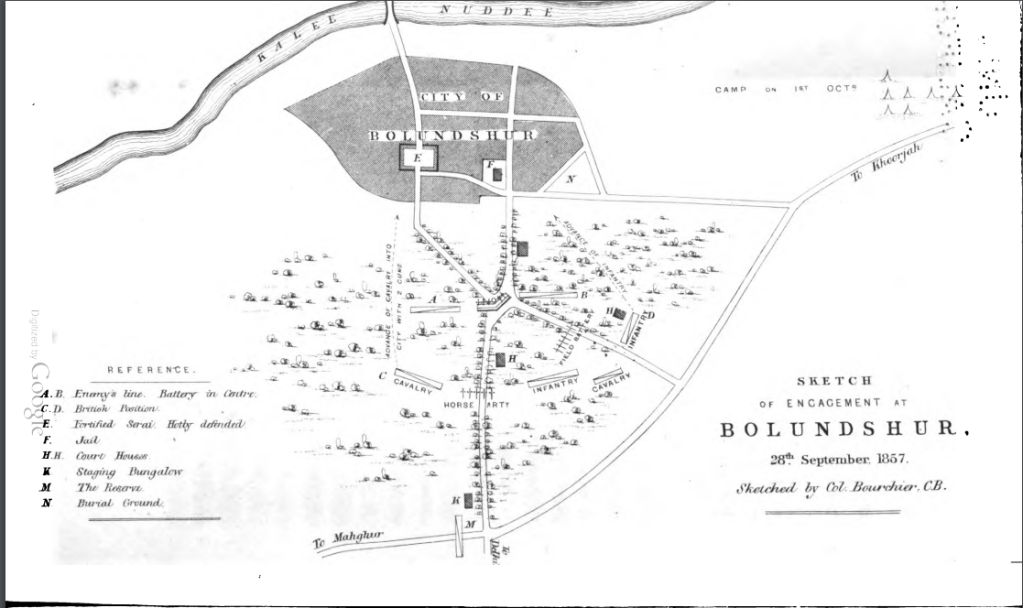
The Battle of Bulandshahr does not feature as a remarkable victory in the annals of the rebellion, nor does it attract the attention it deserves. Fought between Walidad Khan and Greathed’s Column it would serve as their first test in what would be months of fighting ahead.
The station was located some 42 miles from Meerut and five from the Malaghar Fort – the intention of Greathed’s Column, in this first service, was to depose Walidad Khan, the notorious rebel leader and chief plunderer who had wreaked unrepentant havoc throughout the district for months, destroying the telegraph, disrupting communication and generally looting his way through the villages and secure Bulandshahr. At daylight, the advanced guard arrived at a crossroads, 1 1/2 miles from Bulandshahr. One of the roads led directly to the fort, the other straight into the town and the civil station. On the 28th of September, Greathed’s column arrived in Bulandshahr.
Henry Aimé Ouvry had his own take on the day. Upon approaching Bulandshahr, Ouvry consulted with Lyall, who had his spies out and they assured him there was no enemy near. It was 2 o’clock in the morning – and Ouvry’s advance guard soon reached the vicinity of the town. It was little surprise they found it occupied by a brigade of mutineers and 6 guns. Ouvry ordered up 2 six-pounders to face the enemy’s breastwork and battery which crossed the road.
Marching ahead of the column, Frederick Roberts recalled,
“We halted, and, having put out our piquets, lay down and waited for the dawn. From information obtained by the civil officers with the column, we suspected that large numbers of mutineers were collected in the neighbourhood. We were not left long in doubt as to the correctness of our surmisings, for we were soon rudely awakened by the rattle of shots exchanged between om: vedettes and those of the enemy. Information was sent back at once to the advance guard and to our Commander, while we set to work to ascertain the enemy’s exact position; this proved to be at Bulandshahr, and we were within a couple of miles of the main body.“
A picquet of the rebel cavalry that had been placed at the crossroads fell back on the approach of Greathed’s column – it was quickly ascertained the rebels had indeed control of Bulandshahr and intended to make their stand – their guns were positioned at the entrance, with the infantry occupying the houses and gardens, protected by walls. Their cavalry was “hovering about, ready for any mischief that might turn up.” (Bouchier)
Ouvry quickly perceived the mutineers had in their arsenal, a few 9-pounders. He quickly advanced a battery to take their guns in the flank on either side, “which opened a splendid fire.” Colonel Greathed now rode up and took command.
Roberts now found himself in the thick of things.
“As we advanced the rebel Cavalry fell back, and when we got under fire of their guns, our Horse Artillery came into action; our Infantry coming up, found the enemy occupying an extremely strong position, in the gaol and a walled serai at the entrance to the town, their left being covered by the enclosed gardens and ruined houses of the deserted civil station, within which they were collected, in considerable force. From these points, they were driven by the 75th Foot, who, in a most dashing manner, captured two 9 -pounder guns, while a third was taken by the Cavalry. The rebels then began to retreat and were followed up by a small body of Cavalry, under Drysdale, of the 9th Lancers, with whom were Sarel, of the same regiment, Augustus Anson of the 84th Foot, and myself. We soon became entangled in narrow streets, but at last found ourselves in a gateway leading out of the town, which was crowded with bullock carts, flying townspeople, and a number of the enemy, some on horseback, some on foot. There we had hard fighting; Sarel was wounded in the act of running a sepoy through the body, the forefinger of his right hand being taken off by a bullet, which then passed through his left arm; Anson was surrounded by mutineers, and performed prodigies of valour…”
Roberts was riding a Waziri horse, which had belonged to John Nicholson and Roberts had had a friend buy up at auction. Though a great favourite of Nicholson’s the horse proved to be “naturally impetuous” and took offence at the noise, by prancing about, rearing and plunging. His antics caught the attention of Hugh Gough, who couldn’t help noticing the slight, striking officer on the reticent horse. It was certainly an interesting way to start a life-long friendship. It was however the horse that saved Robert’s life. Amid the fracas, a sepoy took aim at Roberts – Roberts tried to push forward. The sepoy fired; the terrified horse reared and received the bullet in the head that was meant for Roberts. The horse survived and would eventually behave better.
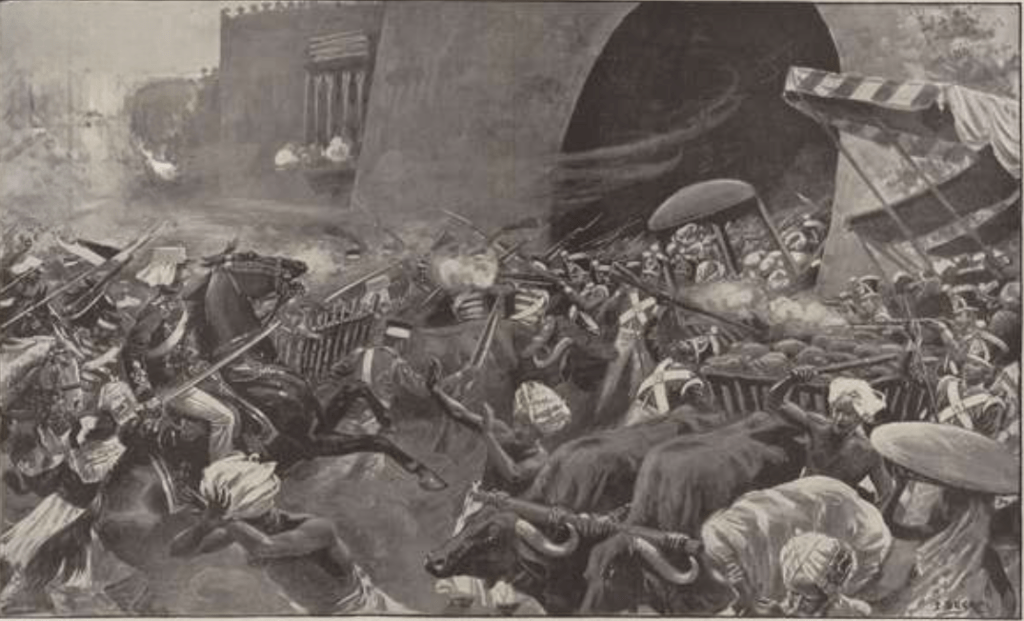
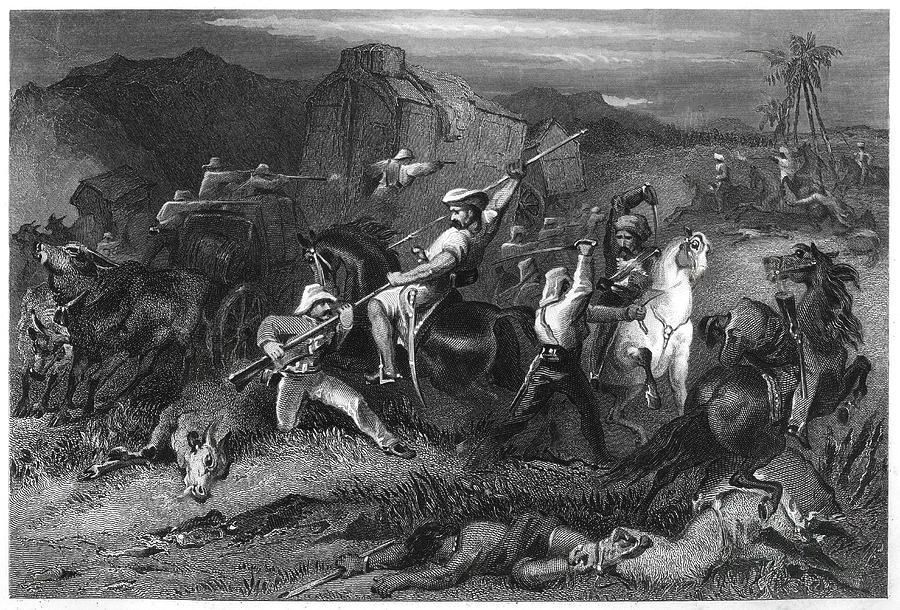
The advanced guard was strengthened by two of Captain Remmington’s Horse Artillery Guns and was soon engaging the rebels while Greathed collected the column. A reserve formed under the command of Major Turner a junction of the crossroads, to protect the baggage was attacked, as anticipated, in the flank by cavalry and guns. They were quickly driven off but with some loss – some sick soldiers following the column in doolies were murdered in their beds. Fairweather’s bearer managed to keep the surgeon’s baggage safe by jabbing at the sowar’s horses with a spear.
Remmington had not been idle – his two guns quickly opened up on the mutineers, and with reinforcements from the rest of his troop, Bourchier’s battery took up its position to the right, supported by the Punjab Cavalry and a portion of the 75th. In desperation, the rebels plied their guns into Greathed’s column and kept up a steady fire of musketry from behind the garden walls. However, Greathed formed up the infantry on the right and centre and ordered the advance on the gardens. It was not dissimilar to the fighting the British had already experienced in Delhi, particularly at Sabzi Mandi, with a strong force hidden behind walls, peppering them with shot at will, while the British remained exposed every step of the way.
The artillery kept up a severe barrage of crossfire on the rebel battery and, as soon as the firing slackened, the advance was ordered. A few well-aimed salvos of grape cleared their front and the artillery was ordered to move forward to secure the position. Roberts “brought the order at a gallop. The guns charged and took the battery…Lieutenant Roberts was first at the guns. A second burst, after clearing our front with grape, brought us to our goal; the enemy flying before us like sheep.”
However, it was not over yet.
The second column on the left consisting of a greater portion of the cavalry with two of Captain Blunt’s guns under Lieutenant Cracklow had managed to advance into the town but found themselves pinned down by severe firing in the streets. Four men out of one gun crew were wounded, rendering it nearly impossible to work the gun with any success. The cavalry was called to charge and routed the rebels.
Ouvry now went for the pursuit – forming the 9th Lancers into threes, he ordered them to charge down the main road, Ouvry at their head. Although they passed through a shower of musketry from both sides of the road, they managed to get to the other side of the city without any losses. At the far end, the rebels determined to make a stand but unable to hold off the cavalry charge, they fled.
For Arthur Moffat Lang, the entire affair spoke of excitement.
“Well, we went along the fine smooth pukka road…this shady road led to the civil station of Bulandshahr…a hasty parapet had been thrown up, behind which two or three guns were placed, and other guns stood about. ‘Now,’ said the guide, 500 yards ahead are the enemy.’ Round swung Murray’s two guns and the jolly order, ‘ Load with ball,’ was given! Joyful sound! Again the blood danced in one’s veins like mercury and I could have laughed with pleasure.”
The Lancers filled out to the right and Remmington called, ‘Let’s have first shot,’ but no sooner was the word out of his mouth when ‘bang’ went Pandy’s gun, and ‘whishhh’ came the 9-pounder ball ricocheting like a cricket ball on a smooth hard road; delightful…Our guns answered immediately, and the smoke curled up blue and purple against the rising sun. Hammer and tongs they went… Up galloped the three other guns of Remmington’s troop and wheeling to the right formed line and let fly at the smoke of the enemy’s guns. The 1st Punjab Cavalry galloped away to the right, the Lancers to the left, and Bouchier’s five 9-pounders and one 24-pounder howitzer with eight horses to each, flew across the ploughed fields. as if they were Light Horse Artillery…Two guns of Blunt’s troop took position on an open road through the fields on our left…we had 13 guns pegging away at Pandy’s five or six..‘
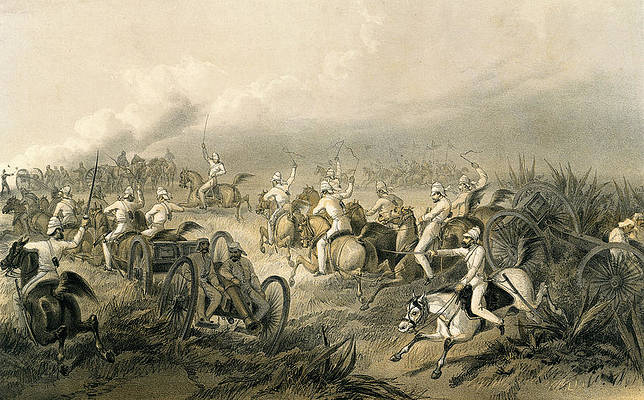
The artillery cannonade lasted some 2 hours, with the British pounding away at an enemy they could not see and the rebels firing straight at them from behind their enclosures. Lang watched as Captain Best of the 1st Punjab Cavalry returned with an ugly wound across his neck – he had run a sowar through with his sword but the man had writhed up the blade and slashed Best’s neck “nearly through.”
Although the day was ultimately won by the artillery and cavalry, the infantry deserved their fair dues.
The 8th, 75th and Green’s Corp had marched up the right, keeping themselves as low as possible to avoid the enemy fire. 50 of Green’s men “who had been with the guns had seized one of the station houses on the right, and after some time our Infantry, with a great deal of cheering and no results, and a great deal of Delhi musketry took a couple of guns, one a good English 9-pounder and one native, long 3- pounder.” As dashing as it all sounded, Lang observed Cracklow working his gun “most pluckily” but with 2 horses killed, one man killed and five wounded he now only had 2 to work the gun. Greens men were thrown forward to support him “doing lots of wild musketry” while the 9th Lancers on the right charged through the street from right to left “doing little execution but fired upon from side streets and having lots of men and horses knocked over…” The 8th too had charged to the right and had nearly taken 2 guns which had been pointed out to Hugh Gough by them but “having his eyeglass broken by a ball, could not see and galloped the wrong way!”
All that was left was to rout the insurgents from the town and clear the streets. Although the affair ended in the near complete rout of the rebels from Bulandshahr, Ouvry added there had been mistakes made. The infantry hadn’t advanced on the flank of the guns and he felt the cavalry had “no business to charge into the town…” but it was either that or allow the rebels to entrench themselves within it which, as Ouvry saw it, was not an option.
Writing after the battle, Anson recalled,
“We found the enemy very strongly posted here under that rogue Nana, and we had to drive them out, which we did after three hours (from six to nine) fighting. We charged through the town; indeed, the brunt of the action fell on the Artillery and the Cavalry, the Infantry being scarcely engaged. I am sorry to say that three of our officers have been wounded. Sarel, right hand shattered and left arm wounded; Blair, very severe sabre-cut on the left shoulder, severing the joint, and down the back; Thonger shot in the left arm; two or three men killed, and four or five wounded. I am not sure of these numbers; two, I know, have been killed. While we were fighting, some sowars attacked our baggage but were handsomely beaten back by our baggage guards and Probyn’s Irregulars. Poor Drysdale’s horse was shot, and, falling on him, has hurt his chest and collarbone very much, so the command devolves temporarily upon me. Two guns have been taken, some say five, and we propose renewing the fight tomorrow at Malaghur. The officers of Irregulars, Probyn, Younghusband, and Best, have distinguished themselves greatly. Best is wounded. The Cavalry and Horse Artillery found themselves in the main street of Bolondshuhur enfiladed by the enemy’s musketry fire. We are to be joined by the Meerut force today or tomorrow and halt here tomorrow. I am writing under the buggy with considerable difficulty.”
The wounds suffered by the men were frightful.
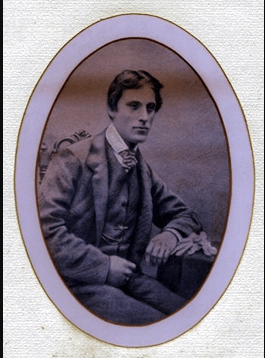
Lieutenant Blair’s arm, nearly severed at the joint, was taken out of its socket, and after a bit had been cut off, was placed back in – fortunately for him, the operation was performed under chloroform – the arm would remain stiff and unusable at the shoulder joint but he would still be able to move his elbow. Blair’s injury had a small caveat – for his action on the 28th of September he received a VC, as did the man who saved him, Private Patrick Donohue of the 9th Lancers. In all 7 Victoria Crosses would be won that day. Sarel lost his forefinger on his right hand, it had been hacked off below the knuckle. Drysdale smashed his collarbone but refused to go on the sick list. The action had cost them six men dead, 6 officers and 35 men wounded. According to Lang, it was 47 killed and wounded (of which only 6 men were killed in action), three officers dangerously wounded and two slightly. One of the dead was considered by Anson as the best dragoon in his troop, one William Clayton, who was killed by a shot through the throat.
With the fighting over, the column passed through Bulandshahr and pitched their camp a mile beyond on the banks of the Kala Naddi. In the afternoon a party was sent out to reconnoitre Walidad’s fort, Malagarh – it was found deserted but far from empty.
 Mutiny Reflections