The 20th of June
Now, how he did it would later be considered a stain against his character, however, we must remember that Tayler did not have the means to face an army, regardless if they were sepoys from Dinapore or hundreds of armed townspeople. Cunning was his only weapon, and he should not be judged too harshly for it.
Tayler summoned to his house a circular letter to all respectible citizens of Patna, including three of the Wahabi Moulvies – Shah Mahomed Hossein, Moulvie Ahmedullah and Moulvie Waizul Huq. The letter perported to consult with them on the current state of affairs, and not a single man refused the invitation. In the company was also the Collector, Major Nation, Commandant of the Behar Guards, Captain Rattray, Mr Lindsay the Assistant, Mr Lockwood a civilian, and Hedayat Ali Subadar of the Sikhs. The next morning, the assembly took place around Tayler’s dining table. The only people who were aware of what Tayler intended were Rattray and Nation – and he had only told them moments before the meeting began. To keep them in the clear, he took the responsibility of the action on himself.
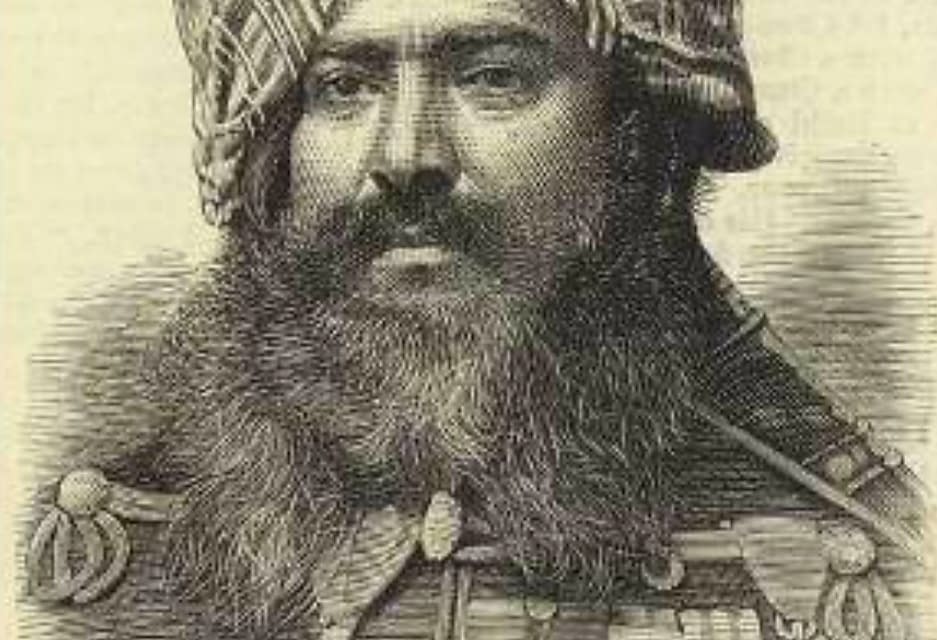
The meeting went ahead, and although the company soon suspected something was up, especially when Rattray and the Subedar entered the room with their swords “clanking on the floor” and took up positions uncomfortably close to the three Wahabis. Yet they continued to speak, with some nonchalance even giving Tayler some very sensible proposals on how to best defend Patna. When the meeting was over, Tayler called the dismissal. he politely requested the Moulives to remain. When everyone else was gone and had safely driven away, Tayler returned to the room and explained why he had asked them to stay behind.
“…saying that the present was as time of turbulence, dissafection and intrigue, that I had received several letters and petitions, accusing the Wahabees of complicity in evil designs, and though no proof of guilty connivance, I still thought it my duty to take precautions against the possibility of surprise and had therefore resolved, as a precautionary measure, to keep them, as leading men of the sect, in safe keeping, until matters had settled down, and all cause for precaution should have ceased.”
Instead of protesting Tayler’s actions, Ahmedullah appeared to have understood what the Commissioner intended, “Great is your Excellency’s kindness..what you order is the best…so shall our enemies be unable to bring false charges against us.” Tayler further informed Ahmedullah he had refrained from arresting his father, the venerable Moulvie Ilahi Buksh who was very old and completely blind – although the man wielded considerable influence even in his aged state, Tayler felt it was better to leave him in the city to act as a check – basically, as long as they both behaved, they stayed alive. Removing so revered a man would have caused a tremendous uproar, but as long as he remained in Patna, he could also remind the followers to tow the line for his son’s sake.
The three men were taken to the circuit house and placed under the watchful eye of Rattray’s Sikhs.
Tayler then removed the head of the local city police from his position – Moulvie Mehdi- not because he had been given any reason to fear the man but because he had very good reason to believe he was in contact with certain rebellious elements of the Lucknow court. He also removed Latif Ali Khan, the city’s most prominent banker (and a Shiah no less who had lately taken on a very affected friendliness with the Wahabis). Both men were confined by Tayler.
The next day, Tayler issued a proclamation calling on all the citizens to give up their arms within the next 24 hours “on pain of being proceeded against,” and he declared a curfew in Patna, prohibiting anyone from leaving their homes after 9pm.
Instead of the all-out uprising so feared by the Magistrate and others, several thousand arms were brought in and delivered up even though Tayler suspected this was but a fraction of what they had and rightly surmised that many more had been thrown down wells or buried. A sudden peace descended upon Patna, and until July, Tayler had one less worry on his mind. The fearful Europeans hiding in the Opium Godown elected to go home.
Things might have gone well for Tayler had this not been 1857 – no-one could predict what would happen next. The fall of Mr Tayler however, was already in motion.
Sources:
Chhina, Rana T. S. “Hon. Lieutenant-Colonel Hedayat Ali – Some Further Details.” Journal of the Society for Army Historical Research 80, no. 323 (Autumn 2002): 221–28. https://www.jstor.org/stable/44230828.
Great Britain Parliament. Appendix (A) to Further Papers (No. 5) Relative to the Mutinies in the East Indies. London: Harrison and Sons, 1857.
Malleson, G. B. The Indian Mutiny of 1857. London: Seeley and Co., 1891.
Stephens, Julia. “The Phantom Wahabi: Liberalism and the Muslim Fanatic in Mid-Victorian India.” Modern Asian Studies 47, no. 1 (January 2013): 22–52. https://www.jstor.org/stable/23359778.
Tayler, William. 38 Years in India. 2 vols. London: W. H. Allen & Co., 1881–1882.
Tayler, William. Brief Narrative of Events Connected with the Removal of W. Tayler from the Commissionership of Patna. Calcutta: Privately printed, 1858.
Tayler, William. The Patna Crisis; or, Three Months at Patna During the Insurrection of 1857. London: James Nisbet and Co., 1858.
 Mutiny Reflections