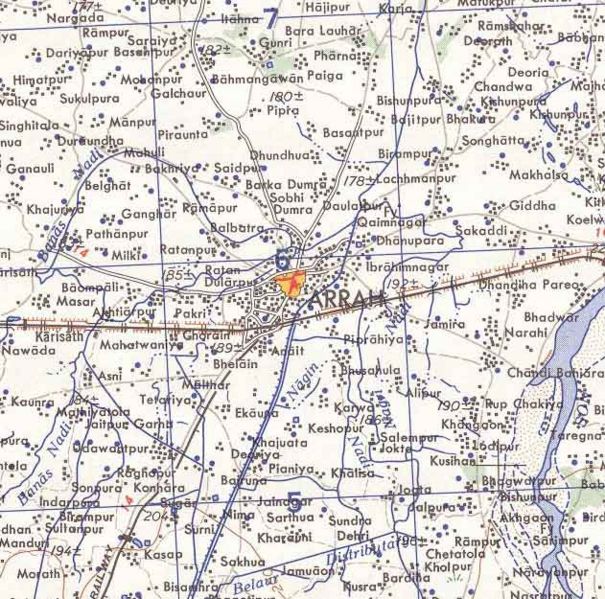
The objective of the mutineers from Dinapore was not Patna; it was not even Delhi. They were going to Arrah.
Arrah, a small civil station situated in the Shahabad district of Bihar near the junctions of the Ganges and Son Rivers, ten miles from the former and 8 from the latter, intersecting the Dinapore and Patna roads. That said, Arrah was a mere 25 miles from Dinapore – is it not curious then, when their fortunes were at their lowest, that Lloyd was unable to put together even a fraction of a force? In fact, Lloyd despaired only for himself – he expected the mutineers would ransack Arrah, kill the civilians and then return to hassle him. As such, the little station was left to its own devices.
No news of the mutiny reached Arrah. A message was received on the morning of the 25th that trouble was anticipated, but after that, nothing more was heard. By evening, the road to Arrrah was already in possession of the mutineers, and they ensured no messages reached the station.
On Sunday, the 26th of July, a sowar- who the Magistrate Mr Wake had stationed at Koelwar Ghat on the Son River – reported numbers of sepoys had been seen crossing the river, and more were coming. Wake quickly caught hold of Mr Palin, the Railway Engineer stationed at Koelwar and asked him about the boats. Palin replied he had drawn them over the other side the night before but had failed to destroy them.
The police force at Arrah did not have a stomach for a fight and, at the first sign of trouble, bolted to a man. Wake had no way to know how many rebels were coming to Arrah, and worse still, he barely had any means to defend himself. It was too late, anyway, to leave Arrah – there was nowhere left to go.
On Monday morning, the mutineers marched into Arrah. Their ranks had been swelled by sepoys who happened to be on leave and by armed men from other districts. They were not following the banner of Bahadur Shah – their leader was closer to home, and his name was Kunwar Singh. He brought with him his retainers, and the force numbered over 3000 men.
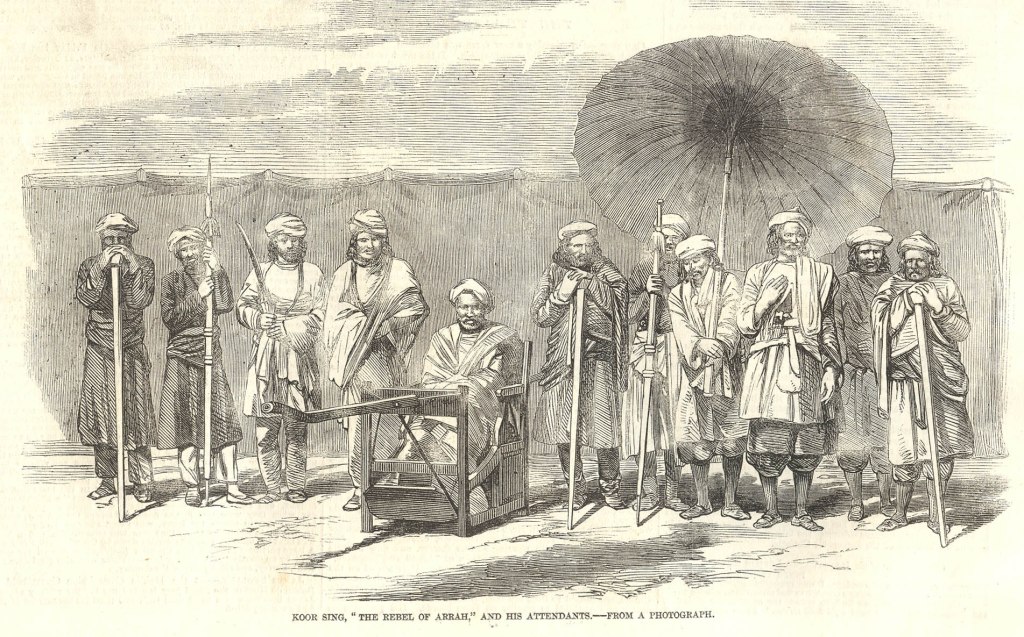
Kunwar Singh was not supposed to be a rebel. He should have been at home in Jagdishpur enjoying his retirement; after all, he was 80 years old and had already lived a lifetime longer than most. The EICo, however, had put an end to his idea of a quiet life.
Up to a point, Kunwar Singh had done everything the EICo had told him to do. As his estates were in some disarray, he had obtained an advance of money to the sum of 20 lakhs to pay off his debts. There was to have been a “gradual process of liquidation from the proceeds of his estates through the Collector at Shahabad”; however, the loan had never been thoroughly negotiated. Kunwar managed to obtain some of the money from other parties, and the rest was given as an advance. All of a sudden, for no reason at all, the Sudder Board of Revenue sent a message to William Tayler that unless Kunwar Singh managed to pay back the entire loan within a month, they “would recommend the Government withdraw all interference with his affairs and to abandon management of this estates.”
Although Kunwar Singh owned a vast estate, that one statement had turned him, in one stroke, into a pauper. He was “in reality, a ruined man” and could hardly gather together enough money to pay off the interest on his debts. He appealed to Tayler, who in turn sent letter after letter to Calcutta, fighting Kunwar Singh’s case. As late as June, Tayler was still arguing in Kunwar Singh’s favour. Tayler repeatedly invited Kunwar Singh to a council in Patna, but after what had happened to the Moulvies, he pleaded age and infirmity, knowing full well that if Tayler chose, he could imprison him too. As long as his case remained undecided in Calcutta, there was still hope. Yet bureaucrats are not well known for admitting they are wrong, and in Kunwar Singhs’ case, they refused to change their minds. The case was decided against him, and the old man realised the only way he would be able to retain his estates and keep his honour was to fight. He consented to lead the rebellion in Bihar. When the Dinapore regiments revolted, the whole Shahabad District rose, and Kunwar Singh took his place at the head of the insurgents. While Lloyd fretted in Dinapore, Kunwar Singh was marching to Arrah at the head of an army.
The men in Arrah had been aware something could happen and, acting on the intimation of Tayler, who warned them of the state of Patna, had sent their families to Dinapore in June. They then set about preparing themselves for the worst. Their only problem was none of them were military men. They were civilians and engineers.
 Mutiny Reflections