Patna and the Other Stations
Upon arriving, Tayler found letters waiting for him from Mr Wake, “the active and high-spirited” Magistrate of Arrah, informing Tayler that many of the Railway men and other Europeans had upped and bolted for no reason at all except blind panic, abandoning Shahabad, making their way without any excuses to Dinapore.
“Absurd stories were circulated about some of the gentlemen having reached Dinapore in women’s clothes, some said that on an ekka being stopped and challenged with the questions “Quon hie” (who’s there?) a voice replied – “Hum Aurut hie” (we are women) – when the sentry, not having heard so gruff a voice before issuing from a fair female’s lips, lifted up the curtain, and found a bury red-faced Englishman.”
Whether this story was true or not mattered – unfortunately, it showed the people of Patna the British were not just scared, they were cowards. It was not exactly the image Tayler wanted to represent.
Tayler quickly sent a notice to the runaways insisting they return to the district – like General Lloyd, Tayler was worried that since the exodus was thoroughly unjustifiable, it could cause unwarranted alarm. He needed everyone, no matter what the situation, the keep their wits about them. Parading around the countryside in ladies’ clothes was not helping.
In the meantime, the letters sent to the Najib’s were the source of a thorough investigation, and it unfolded that instead of being the hoax some Europeans thought they were, they turned out to be true. The writer and his accomplices were identified – six Sepoys were found that they not only taken part in the conspiracy but had instigated the sending of the letter which was given to Major North. That same night, when it reached Patna, 3 men of the 8th Regiment suddenly deserted when they heard that instead of it being delivered to the Najibs, it was securely with the major.
It was now critical to set the Najibs to right. Tayler determined to reward the three who had brought the letter to Major North, and he would do so in public. On the evening of the 12th of June, three bags, each containing 200 rupees, were made ready, and shortly before sunset, orders were issued for the whole corps to assemble on the parade ground. Tayler rode out to address the men.
“The three bodies of men were drawn up in a square – the Nujeebs in front, the Seikhs on the left, and the Police on the right, spectators on horseback and in carriages formed the fourth line. As I entered the square, Major Nation and Captain Rattray rode forward to tell me that a Nujeeb had been discovered, endeavouring to tamper with the Seikhs and shake their allegiance.”
It was unfortunate to hear such news, but Tayler asked the officers to keep their peace until the ceremony was over. He went ahead with his plan and addressed the men in Urdu. As plainly as he could, Tayler explained the evils of mutiny, the dishonour of disloyalty, and that the government had no intention to convert anyone – in fact, that was the lie they should close their ears against. Thus said, he then called forward the three men, gravely narrated the good service they had done and handed over the bags of rupees.
As soon as the parade was over and the men dismissed, “the culprit who had shirked the muster was seized in the lines and marched off between two stalwart Seikhs to my house, where preliminary enquiries were conducted by the Magistrate, and he was carried off to jail.” The very next morning, Tayler telegraphed the government at Calcutta, requesting what sentence he might pass on the offender, who had, by his admission, gone the Sikh lines and told them the regiments at Dinapore had been forced to use the offensive cartridges – and where, pray tell, did the Sikhs stand? It wasn’t perhaps the most seditious statement since the story he told was not a complete lie. The men at Dinapore were slated to receive the cartridges, but no one had held one, much less been compelled to use one.
As such, after consulting with General Lloyd once again in Dinapore, Tayler wanted the general to try the man by court-martial and in all eventuality, hang him as an example – Lloyd concurred the court martial was warranted, but he refused to have anything to do with the execution. As such, Tayler would hang him. He did not do so without the sanction of the Government:
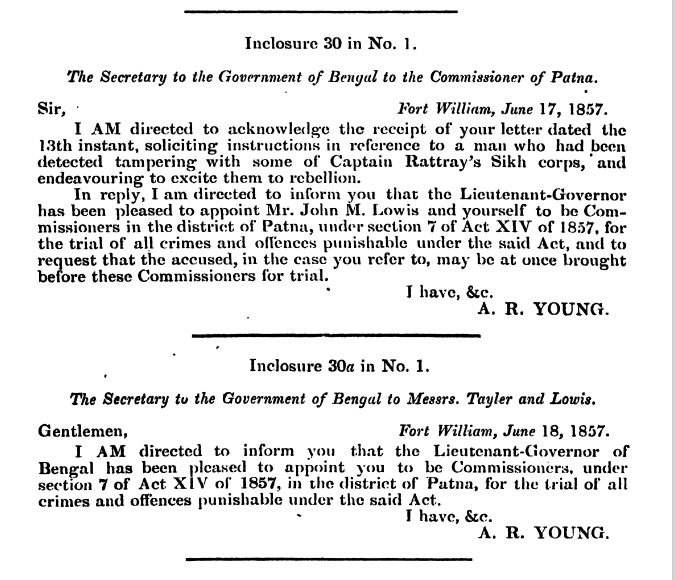
Like many of his counterparts, Tayler had been given hanging rights – although Canning would recind this in the coming months, for the time being, Tayler was not acting contrary to orders.
In Dinapore, the general excitement was dying down, with officers declaring openly their regiments were staunch and the 40th BNI would never revolt if rightly managed. Fate would prove differently but for now, disarming the regiments at Dinapore was a suggestion no one except Tayler and Rattray dared make. As such, it was ignored.
Tayler was decidedly nervous about the various treasuries in the Patna division – large sums of money, particularly at Chuprah and Arrah – that were, in this perilous time, only sparingly guarded. As such, he ordered the treasure, the sum of 30 lakhs in these two stations alone to be removed to Patna. His intention was to store it at the Opium Godown, but Mr Garrett positively refused to admit it, stating emphatically should Patna be attacked his walls would be the first to go as such a treasure would serve as a temptation impossible to withstand. Tayler agreed and stored it instead in the Collector’s Cutcherry – however, the story quickly spread to ears in Calcutta that it was Tayler who had refused to put it in the Godown – an absurd story with grave consequences.
From the start, an increasing amount of notes and letters arrived in Patna, each speaking of increased distrust and disaffection in all the outlying districts. Some of the Chuprah officials, claiming they were going to be attacked, quickly mounted their horses and fled to Dinapore – Tayler ordered them back. The Deputy Magistrate at Barh was holding his own, but he reported a plot had been discovered to burn down his house and murder him. Letters from Arrah, Gaya and Tirhoot all spoke of impending attacks – at Arrah, their worry was not so much from the townspeople but a powerful landlord named Kunwar Singh who was mustering his own army, and Arrah was on his sights. From Gaya came reports that the disaffection in that town was being caused by troublemakers from Patna, and at Mozufferpore, the Najibs were openly talking of mutiny, prompting the planters to send a petition to General Lloyd for a European guard. The planters could have saved themselves the trouble of asking – Lloyd would not part with a single man.
Rattray and Tayler continued to travel to Dinapore, hoping each time that General Lloyd would finally disarm the native regiments. However, Lloyd had no such intentions. He was in constant communication with the Government at Calcutta, and besides, seeing it was his station and in effect his men, Tayler and Rattray were reminded it was a “purely military” question and not one they were authorised to ask. With this flea in their ears, Tayler and Rattray decided to concentrate on the town of Patna itself.
 Mutiny Reflections