There Has Been No Storm in Patna
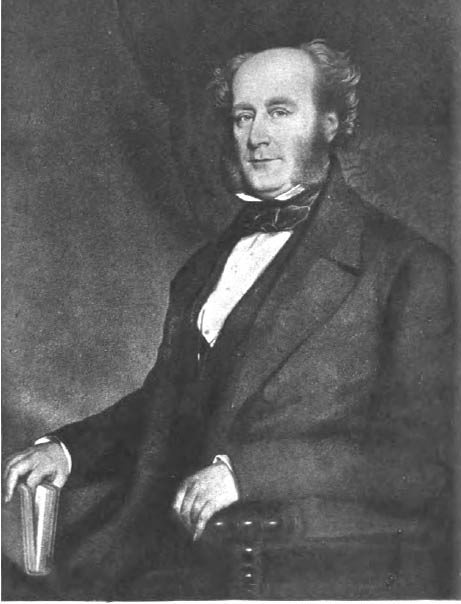
The weight on Tayler’s shoulders was immense. He had no army at his call; General Lloyd in Dinapore would neither disarm the regiments at the station nor send any of the European troops to help Tayler. Tayler’s idea to call on the aid of friendly landowners to send him armed men was quashed by Calcutta in fact, the increasingly irritating Lieutenant-Governor, Mr. Halliday, did not see any danger in Patna at all stating most emphatically, “…in reality, there has been no storm at all in Patna.” He informed Tayler he could accept matchlock men if they were offered by the landowners, but he was under no circumstances to ask for them. The absurdity of this order beggars belief. Halliday still believed, after so many months had passed, that Tayler had coerced the local zamindars to agree with his proposed national education plan, and somehow, this gave Halliday the right to deny Tayler his best means of protecting Patna.
“But Mr. Halliday objected to my asking the Zemindars for any assistance, stating that, with reference to a late correspondence (regarding the Institution), such “asking” might be misunderstood—be added, that I might receive aid and thank the Zemindars for it if given, but that I must not ask! The meaning of this evidently was that, having declared in the Proclamation regarding the Industrial Institution, which I have referred to above, that no assistance on the part of Native Landholders, unless spontaneous and disinterested, was acceptable, Mr. Halliday did not like to involve himself in the inconsistency of asking for such assistance immediately afterwards.
Now this distinction appeared to me so palpably a distinction without a difference—it would have been so complete a piece of hypocrisy in me to tell a Zemindar, that I could not ask him for aid, but I would thank him if he gave it—that I could not lend myself to what appeared a mere subterfuge and a sham, and the plan was abandoned.”
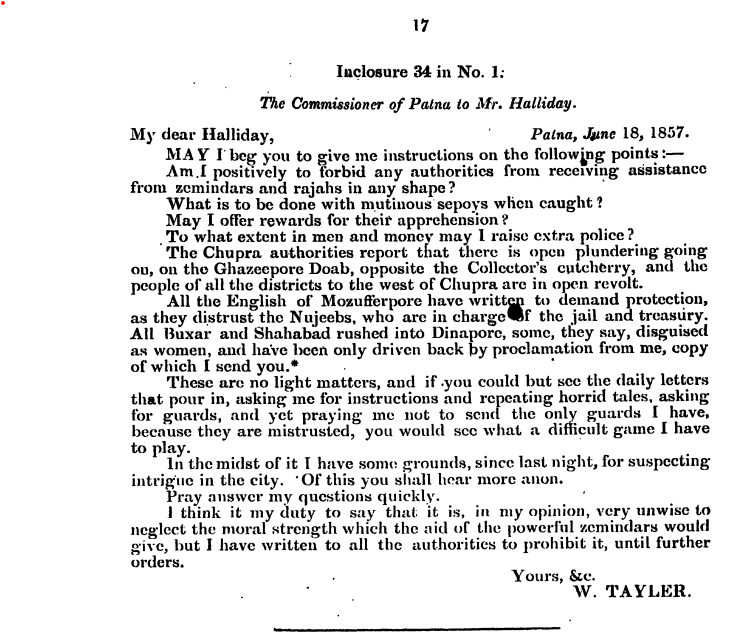
Mr Halliday did sanction Tayler raising an extra police force, comprising mostly of low caste men who would not be bound by loyalty to either Muslims, Brahmins or Rajputs. Each magistrate in the outlying stations was to similarly raise 50 men and arm them accordingly with a shield, a sword and a light spear. These impromptu policemen were not meant for actual fighting but merely to show presence – in other words, keep the peace as far as possible and give the magistrates in Barh and Shergotty a little help. Yet, asking the zamindars was out of the question. He then promptly informed Tayler he was no longer to write to him in a demi-official manner: all correspondence was to go through official channels.
The Lieutenant-Governor put Tayler’s worries and warnings down to an over-active imagination. The very fact that his own brother-in-law, Mr Farquharson, was still hiding in the Opium Godown did not appear to give Mr. Halliday any food for thought. He was determined to make Tayler’s life as difficult as possible from 400 miles away.
But there was a quiet storm in Patna, and Tayler was ready to meet it head-on.
Where Tayler and many residents of Patna saw the problem was not in a possible mutiny of the Najibs or a general uprising of the people. Tayler was repeatedly advised that he needed to address the elephant in the room – the Wahabis of Patna. We will not discuss for long what we understand today who the Wahabis are. We shall take the viewpoint of Mr. Tayler instead in order to prevent misunderstandings with our present century.
“The Wahabees area set of Mohamedans, taking their name from Abdel Wahab, who was born in 1691, and became celebrated in after years, as an earnest and energetic reformer.
The tenets originally professed by the Wahabees, have been described as “Mohameda Puritanism” joined to a Bedouin Phylarchy, in which the great chief is both the political and religious leader of the nation.
The unity of God is the fundamental principle of their faith. They regard the Prophet as a man, though gifted with a divine mission, reject the fables and false glosses of the Koran, but recognise and adopt the traditions of the Soonees.
They hold that all men are equal in the sight of God and therefore condemn the custom of invoking departed saints or paying honor to their remains.
To swear by Mohamed is considered a crime.
They affect great purity of morals, abstain, or at least profess to abstain, from spirituous liquors, and all sensual indulgences.
With the Soonees, the Wahabees are on terms of tolerable agreement, thought differing in certain points, but from the Sheahs, they differ radically, and their hatred, like all religious hatred, is bitter and intolerant.
But the most stiking characteristic of the Wahabee sect, and that which principally concerns this narrative, is the entire subservience which they yield to the “Peer”, or spiritual guide, a subservience, which, if rumour lies not, compensates, at least among the Patna puritans, for many prohibited indulgences and bestting sins.”
Tayler did not have a problem with Wahabis in general; however, where he perceived the threat was from the fact that Patna was home to many thousands of the sect’s followers. Their peer, Mahomad Hussein, was a powerful man in his own right, able to give orders no follower would be able by faith to refuse. He had at his beck and call “tailors, butchers an low-born followers of every description, who would sacrifice everything..” It was also no secret he held practically no real loyalty to the EICo, and Tayler did not put it past him to try his luck in an uprising. Without informing the fussy Mr Halliday, Tayler put his own plan in action.
He would arrest the Wahhabi leaders.
 Mutiny Reflections