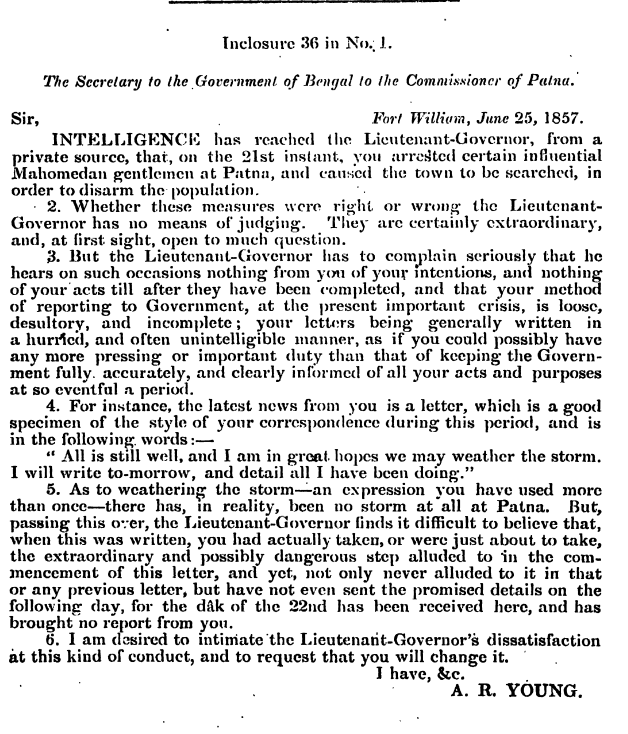
There was more than one private source in Patna – the first was Mr Garrett, the Opium Agent and the erstwhile Mr Halliday’s brother-in-law; the other was a gentleman of the English persuasion who held Mr Tayler a personal grudge.
This nameless personage was a man of considerable age, a veritable relict of the old days of the EICo who had made his fortunes on the backs of the burgeoning Indian Empire and had decided to spend his remaining years in decadent luxury in Patna. He had, in the slang of the day, “gone native” and entertained a substantial harem in his opulent house. He was no stranger to petty scandal and well known throughout the district for his rather eccentric lifestyle. It was perfectly fine for the men of the station to visit the old reprobate, especially when their wives were well out of the station (and Tayler was one of them), but Tayler refused to allow his wife and daughters to be seen in the man’s garden, much less in his house, something the old civil servant took objection to. It would only later come to Tayler’s notice that the principal lady in the harem happened to have been, at some point in her life, a pupil of Moulvie Ahmedullah. Under her protestations over his arrest, the gentleman wrote his own nasty missive regarding Tayler to Mr. Halliday.
Halliday had no way to know whether Tayler’s actions were justified or not: he was safely in Calcutta, living his cottonwool life in Prinsep House, but whispering in his ear was Mr. Samuells, the suddar judge. Why this man hated Tayler with such a vengeance is difficult to understand – except, of course, we have to consider that Halliday had promised him Tayler’s job. So, he set about writing letters of his own.
“While the latter (i.e. all the residents of the Province) were applauding Mr. Tayler to the echo, a retired civilian, who had known Patna for some forty years, and had property in the station, as he stated, of the value of two lacs of rupees at stake, laid before the Government of India a memorandum of the causes of the dangers which, at the time, menaced this city, in which he traced these dangers principally to Mr. Tayler’s ill-judged measures.” It was just the start of Mr. Samuels’ campaign. With this opening salvo, he had taken direct aim at Tayler. The individual mentioned in the letter was not an honourable man – Mr. Samuells forgot to mention that this retired civilian was living a life which would have made the austere Calcutta society scream in horror.
Tayler had, in fact, not stopped a mutiny in Patna; he had simply quenched the fire of mischief from spreading. Unfortunately, it made Calcutta look foolish. They had until now been slavishly hanging on to Mr. Beadon’s, “everything is quiet within six hundred miles of the capital…” His “passing and groundless panic” is echoed in Halliday’s letter to Tayler. Patna being but 400 miles from Calcutta, Halliday could not admit Beadon might be wrong. While he was pestering Tayler with an endless stream of letters, he quite forgot that should Patna rise, there would be nothing left to protect Calcutta.
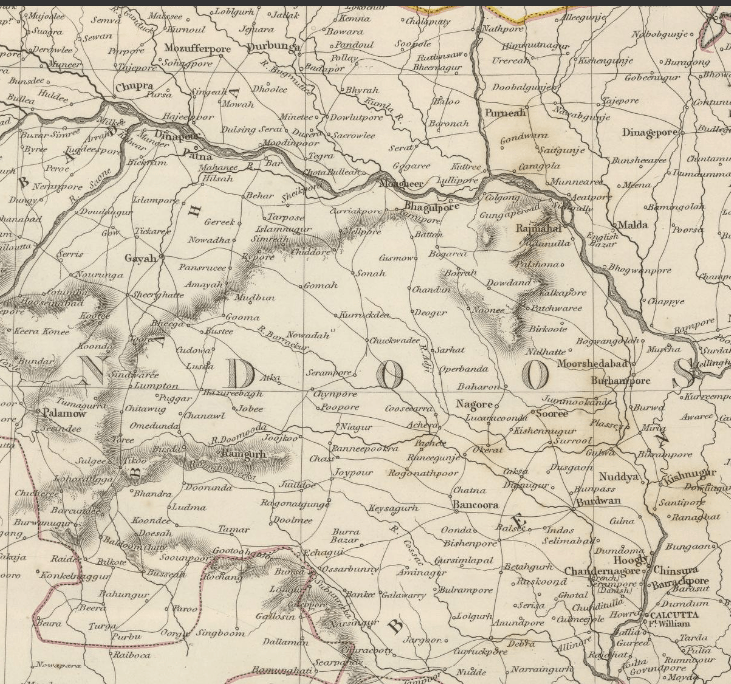
Tayler’s actions had sent a veritable quake of action through the Patna division. Where previously civilians had been hesitant to act, they suddenly started taking matters into their own hands. Particularly watchful was Major Holmes at Segowlie, who placed Tirhut, Chuprah and Chumparun under martial law; he further dissuaded the indigo planters from leaving their factories. They had been sent a circular by the rather jumpy judge at Tirhut; he needed them to protect his station! Holmes quickly countermanded the judge’s orders, and the planters stayed where they were. They were, in their own way, a line of defence sorely needed.
Mr Richardson, on the other hand, as magistrate at Tirhut, too, took his work seriously – he intercepted letters from a police jemadar, one Waris Ali, which were written by one Ali Karim, a man of some notoriety, who was living 9 miles from Patna. Richardson arrested the jemadar and immediately wrote to Tayler, sending the confiscated letters.
Tayler, after reading the letters – which spoke of conspiracy and sedition – decided Ali Karim, if allowed to roam free, would cause nothing but mischief in Patna. It was the 23rd of June, and if Tayler was to hold Patna, Ali Karim had to be caught.
He quickly sent for Mr Lowis, the Patna Magistrate and Moula Baksh, the native deputy magistrate – a man in who Tayler had implicit faith. He did not have quite so much in Lowis, but at least he still had Rattray. It was arranged for Lowis, with 10 cavalrymen and 50 Sikhs, to set off in pursuit of Ali Karim – the plan was to simply surround his house and arrest him. Lowis set off in a buggy followed by the troopers – but when they arrived at the house, Ali Karim was gone.
Lowis could see still him far ahead, astride his elephant and accompanied by his armed attendants. Someone in Patna had got there first, and Karim had taken the warning seriously. Whispering in Lowis’ ear was his nazir (court official) – the only man not under Tayler’s supervision and who had probably sent a warning to Karim – who advised the magistrate to follow Karim on his own, leaving the troopers behind. Karim quickly turned off the road and left Lowis in the dust, unable to follow him with his buggy. Instead of dispatching the troopers, now Lowis tried to follow Karim himself on foot. He was lied to and misled by villagers, had a horse stolen he had requisitioned and finally ended up walking back to Patna. The nazir promised to continue the chase but after several days, returned to Patna, claiming Karim had disappeared.
This was not the last we would hear of Ali Karim or the nazir.
Lowis refused to give up trying to catch Karim – shortly after returning to Patna, he was informed the fugitive was hiding in the city. As such, he informed the nazir and requested the man to accompany him for the arrest. The nazir, instead of waiting for Lowis, simply took his buggy and made off to the cutcherry, leaving Lowis again on foot and unable to arrest Karim. Lowis furiously complained to Tayler, and Tayler, in what he saw becoming a regular occurrence, arrested the nazir. The Commissioner decided that if Ali Karim could not be found out, he would at least be made terribly uncomfortable. His property was seized, and a reward of 2000 rupees was put on his head.
Now, why were the British so interested in Waris Ali, a police jemadar posted in Muzaffarpur? This warrants a short explanation.
In 1855, the British made another one of their interesting amendments to India and decided to withdraw the brass lotahs from jails in Arrah and Muzaffarpur after a British magistrate had been attacked and smacked on the head by a prisoner, the weapon being a lotah. It must have been quite a hit since the man died. What the British stupidly forgot was the brass lotah was held in much esteem by Hindus and as such, the prisoners rioted as did the people of the cities, leading to what can be termed the lotah uprising. Tayler had his hands full with this particular incident. Being in Arrah at the time, he managed to quell the riot in the local jail, recapture the prisoners who had been set free and then went to find out, in his own fashion who was behind it all. Unable to prove he was behind it, the name Waris Ali, a man claiming to be a relative of Bahadur Shah of Delhi, appeared to have been behind the uprising. It is not surprising, then, that Waris Ali was being watched in 1857.
Waris Ali would not cause any more riots – Major Holmes had him sent to Dinapore, and on the 6th of July, he was sentenced to death for sedition.
 Mutiny Reflections