Kunwar Singh Returns

Following Kunwar Singh’s defeat by Major Vincent Eyre at Jagdispur in 1857, the province of Bihar had fallen into a state of relative calm. This, however, was deceptive. By September, he had begun amassing his forces again on the banks of the Son River, and this time, he had help. His three brothers, Ammar Singh, Nisban Singh and Juban Singh, had flocked to his standard; in the meantime, the mutinous 5th Irregular Cavalry was plying a dangerous trade of plunder throughout the western districts of Bihar; after destroying the public buildings at Noida, they turned their attention to the town of Gaya. The only force to oppose them was Rattray and his Sikhs. Under the urgings of a very misdirected civilian named Alonzo Money, Rattray finally agreed to go out and meet the 5th Irregulars. As defeats go, this one could have been worse. The Irregulars were almost all mounted, and they managed to go around Rattray’s position — twenty of Rattray’s Sikhs were killed in the onslaught. As it turned out, the 5th Irregulars, by keeping Rattray thus occupied, fell in some numbers on Gaya some hours before he could manage his retreat. They opened the jail, setting loose 400 prisoners and attacked a fortified house where the remaining British civilians had determined to hold out. In this attempt, the Irregulars failed — Skipwith Tayler, the son of the disgraced former commissioner of Patna, William Tayler, stood his ground with such determination that the Irregulars left off trying to take the house.

The Battle of Chatra gave Rattray some satisfaction where revenge was concerned. However, the two companies of the mutinous 32nd BNI ( who had mutinied on 9 October at Deogarh) were still running loose in the district. Rattray would finally force them to an open fight a month later on 6 November at Dhanchua. The battle was severe and raged on through most of the night, but finally the rebels withdrew and fled. However, it was not the end of skirmishes in Bihar. Until the formation of Rowcroft’s field force in November, the British force in western Bihar consisted of Colonel Fischer’s Madras troops, a portion of the Naval Brigade under Captain Sotheby and Rattray’s Sikhs. Assisting them was Lieutenant Stanton of the Engineers: ” the energy, the zeal, and the activity of this officer compensated to a very great extent for the paucity of fighting men.”

Meanwhile, Brigadier Carthew, following the Battle of Cawnpore on December 6 1857, had been detached with the Madras Brigade to command Fatehpur. While it was less to Carthew’s liking to be sent off, the posting was nevertheless an important one and, as it turned out, an exciting one. Fatehpur was exposed to rebel attacks, not only from Kalpi and Jhansi but also from Bundelkhand. Positioned as it was on the southwestern frontier of Oudh, with only a narrow strip of the Ganges intervening, it was prone to flying attacks from rebels from that quarter. It was now Carthew’s duty to thrust back these attacks while ensuring the Grand Trunk Road between Cawnpore and Allahabad remained in British hands. He did have help, however, from the troops and the convoys that were constantly passing up the road, and Carthew was able to call on these to assist him in clearing the districts bordering the road. At the south-eastern end of the line was the station Allahabad, and this was under the command of Brigadier Campbell.
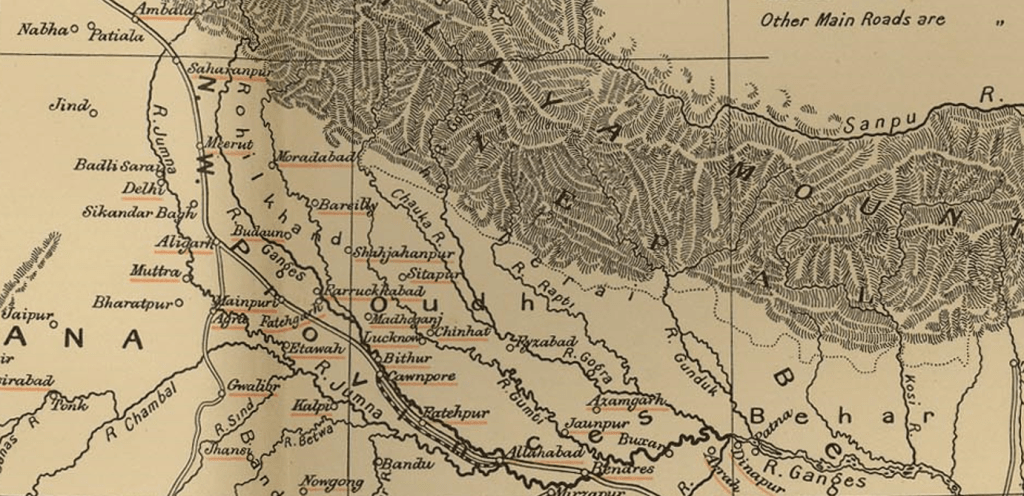

Before Carthew arrived at Fatehpur on 19 December, Colonel Barker (Royal Artillery) had been busy. Nearly a week earlier, on 11 December, with a small party under his command, Barker made a raid on a few disaffected villages in the district — although this was seen as a success, the expelled villagers certainly did not agree to watching their homes burned to the ground for the sake of punishing a few malcontents. It forced the villagers to flee across the Jamuna to find safety in the ranks of a considerable rebel force that was gathering on the right bank. From Kalpi all the way down to Banda, they were amassing; rebels from Gwalior, Jhansi and Bundelkhand, who counted in their numbers the men of the Raja of Chikani and relatives (a brother and nephew) of the Nana Sahib. The rebel leaders at Julapur on the Betwa River took this to heart and now began calling on landowners west of the Jamuna to furnish them not just with money but additional recruits, claiming they would be serving the Nana Sahib himself. Whether the Nana was there or not was never confirmed, but his name certainly still carried some weight with it.

For Sir Colin Campbell, whose hands were still tied at Cawnpore, it was impossible to divide his force to send anyone across the Jamuna. However, he “deemed it especially advisable that the districts to the east of that river should be kept clear of the mutineers,” and Carthew was the man to do it. On 10 January 1858, Brigadier Carthew, with a small force consisting of two horse artillery guns, four companies of the Rifle Brigade, and 200 men of the 17th Madras Native Infantry, set off from Fatehpur along the Cawnpore Road. When they reached Jahanabad, Carthew turned west toward Kalpi to meet up with HM’s 34th, sent up from Cawnpore for this purpose. He then moved towards Bhognipur, clearing pockets of rebels as he pushed on to Sikandra, returning to Fatehpur via Cawnpore. Meanwhile, Brigadier Campbell, on 5 January, set off from Allahabad with a brigade composed of the 79th Highlanders, a regiment of the Rifle Brigade, a new levy named the Benares Horse, and some foot and horse artillery, to clear the districts close to Allahabad, on the left bank of the Ganges. However, the successes of the small forces were but momentary and could not stop the never-ending flood of rebels who reappeared as soon as Campbell and Carthew turned their backs. As long as Sir Colin Campbell did not take Lucknow, the “the delta west of Kanhpur, that is the narrow strip lying between the two great arteries the Ganges and the Jamna, should be constantly threatened, and almost as constantly invaded. It was necessary, therefore, to patrol the entire district.” So it was time to raise yet another Moveable Column, this time under the command of Colonel Christie, to take up the work. In March 1858, Christie and his column moved down to the village of Dhana, close to the left bank of the Jamuna. The column was meant for speed, consisting of 70 men of the 8th Irregular Cavalry, 244 HM’s 80th Foot, 257 men of the 17th Madras Native Infantry, with one 12-pounder howitzer and one 6-pounder; however, while they did have some success, taking Siroli in the Hamirpur District from the rebels, but hampered by a lack of boats, Christie could not follow up his victory by following the rebels across the river. So once again, the British were engaged in stamping out fires as they occurred, they prevented rebel incursions into the districts, and stopped raids on villages, but like Carthew and Campbell, Christie could not be everywhere at once, and the raids continued.
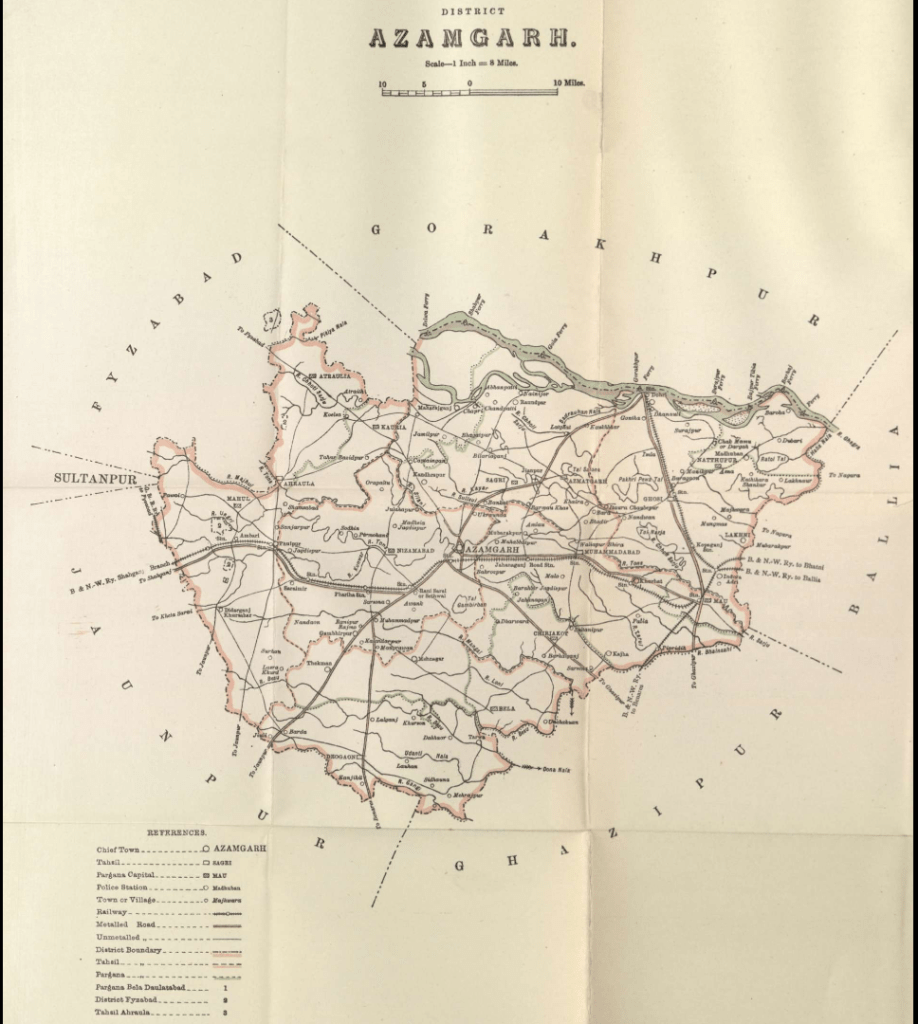
The Sarun Field Force had given the rebels a hasty awakening at Amora, but Rowcroft was unable to follow up his victory, and the rebels were still able, from the stronghold at Belwa, to detach a considerable force to the south-east, gathering up, during their march, the troops that had been dispersed by Brigadier Franks and the Jaunpore Field Force. Thus reinforced, they effected a juncture with Kunwar Singh at Atraolia on the 17th of March. Their destination was Azamgarh.
Atraolia

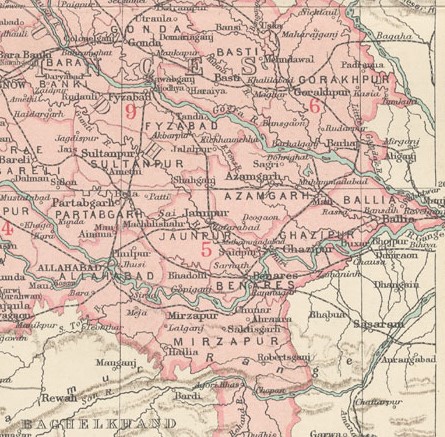
The 3000 Gurkhas of Jung Bahadur of Nepal entered India north of Gorakhpur at the end of July 1857. Their arrival signalled the disarming of the sepoys at that station on August 1st; however, Edward Frederick Venables, an English indigo-planter, had already been making himself known. While the mutiny at Azamgarh had prompted him to leave, upon hearing that several clerks and planters had been unable to make good their escape, it was Venables, along with Mr P. Dunn, who determined to rescue them. They set out on 16 June, barely ten days after the mutiny, with only a few mounted constables lent to them by A. Ross, magistrate of Ghazipur. Venables created a small levy of his own, consisting of a few tenants from his Duri Ghat estate and a few volunteers; his sudden appearance in Azamgarh had the effect that the 13th Irregulars decided to abandon the city, leaving it open for Venables to reoccupy. On 10 July, Venables took the offensive against the sepoys who were still lurking about the city, and with 75 mounted constables, an old gun and his own levy, attacked the police station and freed his friends. Unfortunately, Venables, perhaps bolstered a little too much by his own moderate success, decided to take the fight to a few recalcitrant Rajputs in the district; his levy deserted him, and he was forced to return to Azamgarh. On 20 July, he decided to try it again, this time leading the cavalry himself, followed by whoever was still mad enough to stay with him. Venables managed to set the remaining Azamgarh rebels on a headlong flight away from the station. Calmer heads did prevail, and Commissioner Tucker ordered Venables to quit his one-man war, abandon Azamgarh, which he had no hope of holding. and return to Ghazipur. As soon as the Gurkhas were within shouting distance, however, Venables quickly attached himself to these new allies and returned to Azamgarh. On 19 September, at Manduri, when the Nepalese launched a surprise attack on the rebels, Venables led the cavalry, seized a gun and killed three men with his own hand. It was no surprise, then, when Brigadier Franks marched with the Jaunpore Field Force, Venables volunteered his services.

Of course, it would not do to leave Azamgarh District unguarded, but the force left in place was hardly a formidable one. Called the Azamgarh Field Force, it consisted of 260 men of HM’s 37th Regiment, 60 sowars of the 4th Madras Cavalry and a very negligible artillery of two light field guns; the whole was under the command of Lieutenant-Colonel Egerton Milman of the 37th. On the day Kunwar Singh formed a junction with his rebel allies at Atraolia – the 17th of March – Milman and his force happened to be encamped in the district at Koelsa, not far from Azamgarh. Milman was none the wiser that Kunwar Singh was Atraolia, only 25 miles from Azamgarh, but a communication received from Mr R. Davies, magistrate at Azamgarh, reached him on 21 March. It was vague, stating only that a considerable body of rebels was in the neighbourhood of Atraolia but of enough interest for Milman to set off, at 3 in the morning, with 96 men of HM’s 37th, one 24-pounder howitzer, one 9-pounder of the Bengal Artillery, 25 European gunners and 140 sowars of the Madras Cavalry. By daybreak, Milman had found the rebels, and they had no idea he was coming. They were settled in several groves of mango trees, and being quite unaware of Milman’s approach, they did not notice when he advanced his skirmishers out in front; he then sent on his guns, supported by the 37th, with the Madras Cavalry under Colonel Cumberlege on the flanks. Startled by the sudden onslaught, which began with Lieutenant Welsh opening fire with the guns directly into the trees, the rebels, who were mostly sepoys from the Dinapore regiments, decided this was not a fight they wanted and fled, with Millman’s cavalry keeping up the chase until the ground became too “marshy and unsound” that they were forced to give up. Thinking this was the end of the day’s work, Milman gathered his force together and marched to Lorkha, a village which Milman, for some unfathomable reason known only to him, ordered destroyed. Leaving the burning village behind him, he returned to Atraolia.

As his men settled down in the very mango groves but recently vacated by the rebels to betake themselves to their belated breakfast, a scout confounded Milman’s repose with the news that the rebels were advancing, and this time, it was not a few men languishing under trees, but at least 5000 of them. Milman, realising he needed to see things for himself, proceeded with some skirmishers to “ascertain their strength and position” and found them quite quickly, posted behind a mud wall in the midst of another grove of trees and a field of tall sugar cane. He quickly sent back orders for his troops to advance, but it was too late. The number of rebels continued to multiply so quickly, and “they covered such a large space of ground that both my flanks were threatened,” that there really was very little he could do. The first thing the rebels did was try to turn his left flank, and Milman, realising he was in serious trouble, still tried to check their progress by ordering the advance, but he was outnumbered, as much as eight to one. Then, retreating slowly, Millman ordered his force to withdraw, first to the village of Atraolia and then right through it, hoping he could reach Koelsa. All the way, the rebels harassed Milman’s force, never charging but keeping up a steady advance and an even steadier onslaught of musket fire. Had Kunwar Singh ordered an all-out attack, it would have certainly been the end of every last man. Instead, he tried only once more to outflank Milman, but the 4th Madras Cavalry charged, and the rebels drew back.

As soon as Milman arrived in Koelsa, he found a very different place from the one he had left behind him the day before. “The rumour of their mishap had preceded them. A panic had seized the camp-followers, most of whom had fled, taking their bullocks with them.” Besides this, the villagers surrounding Koelsa would have been impossible to contain, and many had turned out now, armed. Despatching a squadron of cavalry and an infantry piquet to keep an eye on the rebels, Milman set about organising his retreat. However, the hackery-drivers had disappeared, as had the cooks and the camp-followers. Leaving behind a quantity of tents and a considerable amount of baggage, much to Kunwar Singh’s delight, Millman gathered up his pride and made for Azamgarh.

“This was a vexatious and serious discomfiture. It told unfavourably in two directions; for while it paralysed the exertions of the few British officers and troops in that region, it afforded to the rebels an excuse for vaunting abroad their prowess and success. The natives, inexplicable in character to Europeans, were often incredulous to rumours of defeat among their own countrymen; but rumours on the other side spread among them with astounding rapidity, encouraging them to schemes of resistance which they might possibly otherwise have avoided.”

As soon as he arrived in Azamgarh, Milman set about entrenching himself in the only defensible building in the town — the jail — which was surrounded by a deep ditch. He set every man to work strengthening the defences and sincerely hoped that Kunwar Singh would not attack before help arrived. Instead, the insurgents continued to arrive until they had fairly surrounded him and taken over Azamgarh. Milman did send off messages to Benares, Allahabad and Lucknow, calling for assistance; the first to respond was Benares, from whence 46 men of the Madras Rifles were dispatched on 24 March, but they were set into bullock carts, and progress was slow. The following day, 150 men of HM’s 37th set off from Ghazipur, who could not proceed any faster than the Rifles. Two days later, 130 of the same regiment and the headquarters division of the 4th Madras Cavalry managed to reach Azamgarh, with two guns in tow, and into the entrenchment, with Colonel William Longworth Dames leading the rush. He swiftly took over command from Milman and attempted a sortie with 200 Europeans, two guns and 60 sowars of the Madras Cavalry with a vague idea of breaking the siege. At first, it appeared he had made an impression, but Kunwar Singh redoubled his efforts and chased Dames back into the entrenchment. The folly cost Dames one officer (Captain Bedford, HM’s 37th) and 11 men killed and wounded.

“The express despatched to Allahabad reached that place on the 27th. Lord Canning was at Allahabad. The news caused him anxiety. Knowing what sort of a man Kunwar Singh was, that he possessed audacity and courage, and that he knew the value of time in military operations, he realised at once the danger of the situation. He saw how possible it was for the Jagdispur chieftain, reinforced as he daily was by troops who had escaped from Lakhnao, to overwhelm Milman at Azamgarh, and then rapidly traversing the eighty-one miles which separated that place from Banaras, then almost ungarrisoned, to seize that important city, and thus sever the communications between Calcutta on the one side and the Governor-General of India at Allahabad and the Commander in-Chief of the army at Lakhnao on the other.”

And still Kunwar Singh did not attack. He merely invested the jail and attempted to starve the British out, while pouring an unremitting fire on their heads. While he could have been on his way to Benares, leaving a decent force to continue the blockade, he remained instead in Azamgarh, quite unaware that the British still had a trick up their sleeves, and he was named Lord Mark Kerr.

The old jail at Azamgarh

Sources:
Ball, Charles – The History of the Indian Mutiny, Vol II (The London Printing & Publishing Company, Ltd.)
Behan, T.L. – Bulletins & Other State Intelligence for the Year 1858, Part III (London: Harrison & Sons, 1860)
Dodd, George – The History of the Indian Revolt and the Expedition of Persia, China & Japan (London: W.&R. Chambers, 1859)
Malleson, Col. G.B. – History of the Indian Mutiny 1857-1858, Vol II (London: William H. Allen & Co., 1879)