The 6th of December
Order of the Day:
Brigadier Greathed’s Brigade.— H. M.’s 8th Foot, 64th Foot,
2nd Punjab Infantry.
Artillery Brigade.—2 Troops Horse Artillery, 3 light field
batteries, guns of Naval Brigade, heavy field battery, Royal
Artillery.
Cavalry Brigade.—H. M.’s 9th Lancers, detachments 1st, 2nd,
and 5th Punjab Cavalry and Hodson’s Horse.
4th Infantry Brigade.— H. M.’s 53rd Regiment, H. M.’s 42nd
and 93rd Highlanders, 4th Punjab Rifles.
5th Infantry Brigade.—H. M.’s 23rd Fusiliers, H. M.’s 32nd
Regiment, H. M.’s 82nd Regiment.
6th Infantry Brigade.—2nd and 3rd battalions, Rifle Brigade,
detachment H. M.’s 38th Foot.
Engineer Brigade. — Royal Engineers and Detachments Bengal
and Punjab Engineers, Sappers and Miners attached to the
various brigades of infantry.
At 5 in the morning, Reverend Mackay was awoken by the bagpipes ringing out “Hey Johnny Cope, are ye wakin’ yet?” as the trumpets sounded the reveille. In the cold dark of a December morning, men stirred in their tents, hasty snatches of conversation broke the stillness. Every camp rumbled awake.
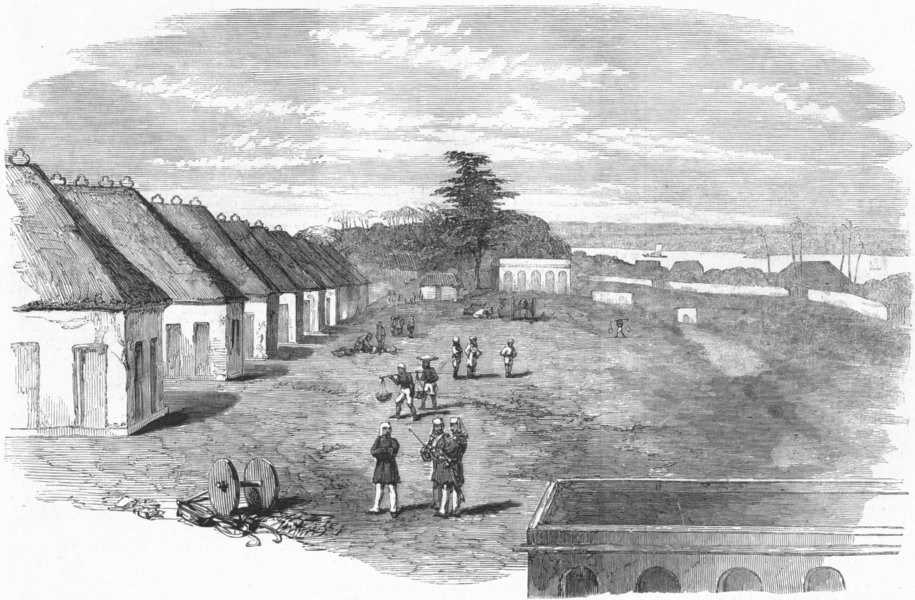
By seven all the tents had been struck, packed and sent, with all other baggage, to the rear, to be parked near the Windham’s entrenchment. The doctors had sent the wounded to the field hospital the night before, well out of harm’s way.
For Peel’s naval cadets, Lascelle and Watson, it was the start of an adventurous day. In a letter written home which starts “Dear Mama,” young Watson would write on the 11th of December,
“Early that morning we woke up we had just woken up in our tent when an order came to strike tents immediately. Up we all got, put out things in the hackery and everything ready. The men fell in and everything done. The Captain called Lascelles and me up privately and said we were going to make a grand attack, and we were not to run and blow and get head over heels and get out of breath.”
In the opinion of the rebels, Peel’s men, who they called “Peel’s Jack’s were looked on the sailors with “…great alarm and held that they were cannibals who ate as much as of their victims as they felt disposed at a first sitting and salted down what was left. Others said they went on all-fours, were four feet high and measured five feet from snout to tail. They were supposed to be terrible in battle, they carried 9-pounders about quite easily and the sepoys were advised to steer clear of such monsters. Of the Highlanders, the natives thought they were the ghosts of murdered women; but the sailors astonished them the most – four feet high, four feet broad, long hair and dragging big guns!”
While the men breakfasted, Sir Colin explained his plan of operations to the commanding officers and the staff, carefully, to ensure no one misunderstood his instructions, but it was clear what Sir Colin intended to do.
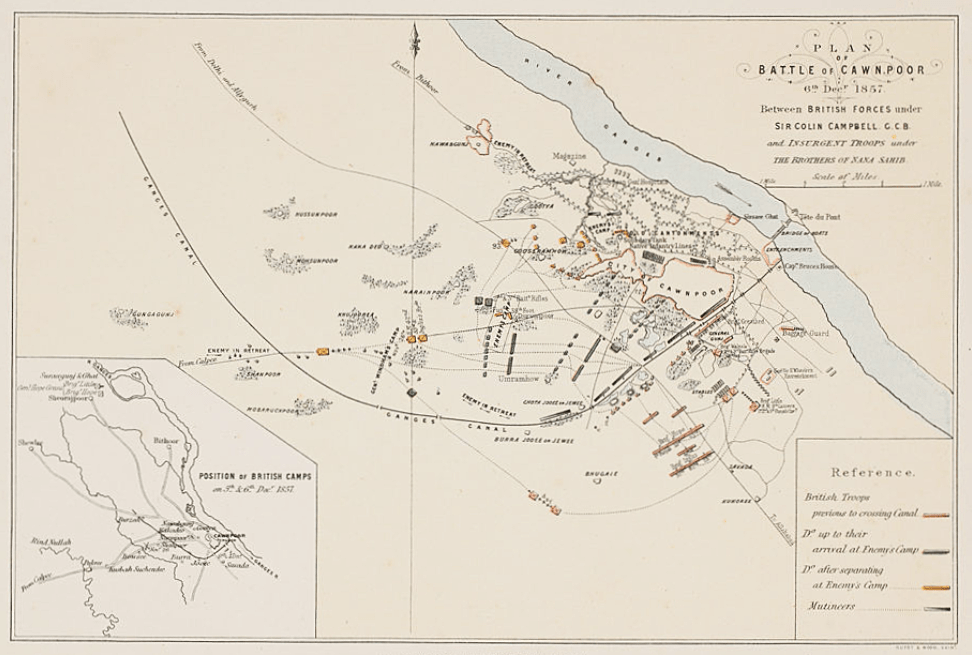
With the rebels’ left, occupying the old cantonment and his centre in the city itself along with the houses adjoining the canal an attack on these fronts was impractical. However, his right stretched well past the angle formed by the Grand Trunk Road and the canal, and then ran for another 2 miles (3.22 km) to the camp of the Gwalior Contingent which covered their line of retreat, on the Kalpi Road. From the British perspective, the right could be approached by two canal bridges; the walls of the town would provide cover to the attacking columns on the British right – however, the same walls would prove a decided obstacle for any reinforcements the rebels would choose to send from left to right. Sir Colin would make a feint on the rebel’s left and centre; then, with them thus occupied, direct the real attack on their right, the weakest part of their line. Should all go well, they would then able to effectively draw a wedge between the rebels, leaving them unable to reinforce the right.
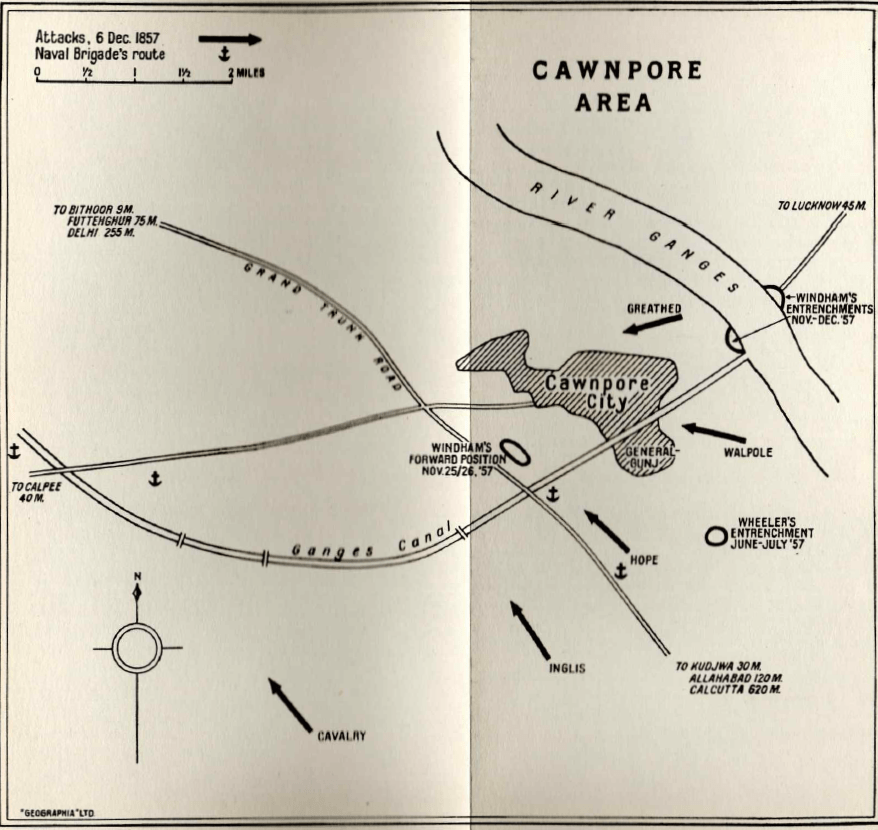
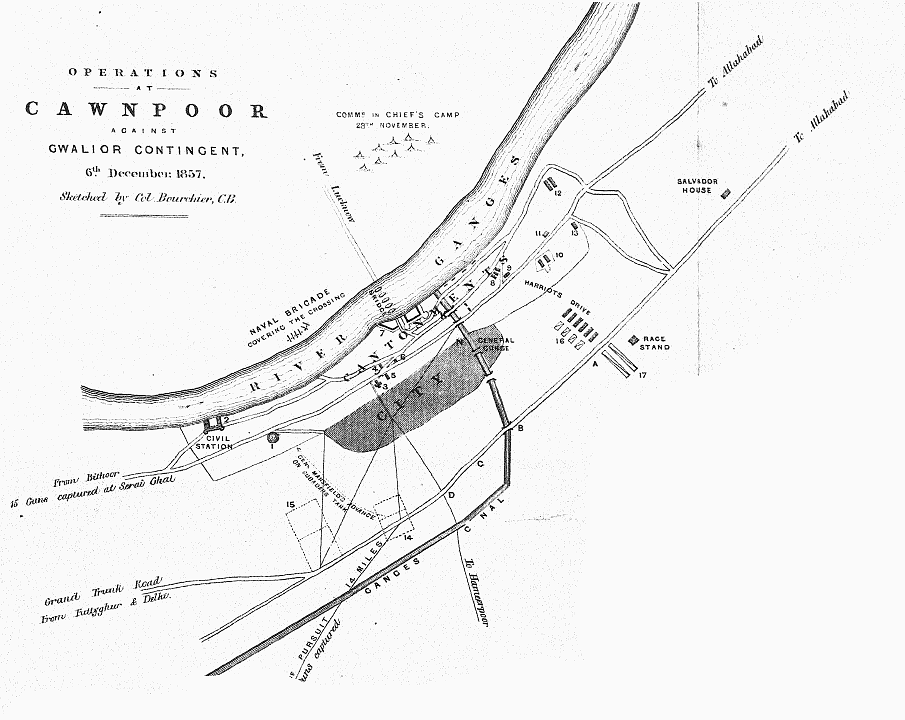
With this goal in sight, Windham was ordered to open up with every gun in the entrenchment at 9 in the morning while Greathed, supported by Walpole would make as though to attack the rebels’ left and centre. Exactly at the time appointed, the guns opened. Mate Garvey of Peel’s Brigade commanding a small party with two guns under Windham’s was more than thrilled.
“We took our time from the right, and such a crash of artillery you never heard; houses fell, trees disappeared, and the rang again the with whistling of shot, fizzing of shells… It was noble fun. In a little more than an hour, I fired seventy-five rounds from each of the guns in my battery.”
At the same time, Peel moved off with three 24-pounders, one 8-inch howitzer and two rockets.
Meanwhile, Adrian Hope drew up, in fighting formation, behind the Cavalry stables on the British side of the Trunk Road, and Inglis’s brigade, behind the racecourse, on the other side. At 11 o’clock, the order for the advance rang out. The cavalry and artillery moved to the left, ordered to cross the canal bridge, some 2 miles (3.22 km) off, ready to greet the Gwalior Contingent should they make for the Kalpi road. Walpole’s Brigade covered by Smith’s field battery crossed the canal bridge to the left of Generalganj, cleared the canal embankment and, by staying close to the city walls, prevented the rebels from sending reinforcements to the right. At the same time, Peel’s and Longden’s heavy guns, with Bourchier and Middleton’s field batteries, opened up on the brick kilns held in force by the rebels.
“We then opened fire,” so wrote Watson to his mother, “and they soon answered us. Captain Peel went galloping about all over the place, so I could but run after him like a groom! He told me to stick by the gun our First Lieutenant was commanding and to stay with him for the present. We blazed away for some time as hard as we could, they gave us shot for shot and burst their shells beautifully.”
Under cover of their fire, Hope and Inglis’s brigades, taking to the left, wheeled into three parallel lines. The formation in line complete, Hope, followed by Inglis and preceded by the Sikhs and the 53rd, moving out in skirmishing order, advanced against the brick kilns.
“It was a sight to be remembered, that advance, as we watched it from our position on horseback, grouped around the Commander-in-Chief. Before us stretched a fine grassy plain; to the right the dark green of the Rifle Brigade battalions revealed where Walpole’s brigade was crossing the canal. Near to us, the 53rd Foot and the 42nd and 93rd Highlanders in their bonnets and kilts, marched as on parade, although the enemy’s guns played upon them and every now and then a round shot plunged into their ranks or ricocheted over their heads: on the went without apparently being in the least disconcerted, and without the slightest confusion”
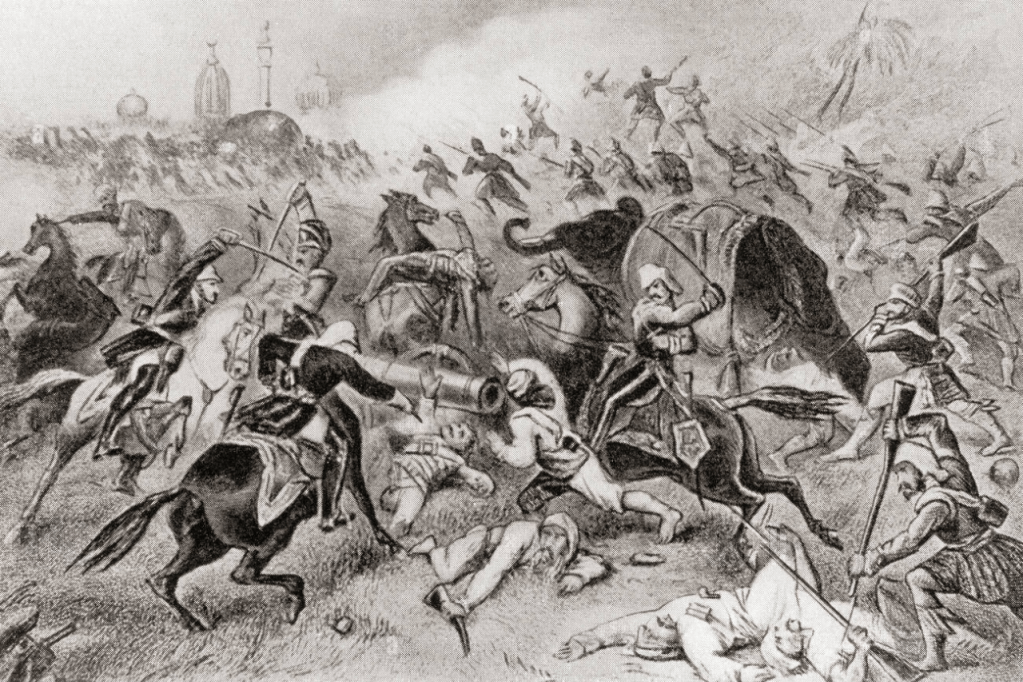
As they neared the brick kilns, the 4th Punjabis, supported by the 53rd, charged the rebels in grand style and drove them back across the canal. The British artillery all came into action at once, with Peel’s guns directed against the brick kilns. The rebels opened up a withering fire against the troops advancing over the bridge. Each rush at the bridge was beaten back a storm of shot, shell, and bullets; in the clouds of dust and smoke, the 93rd were attempted was to advance in double column of sections from the centre to cross the bridge. Now there was a slight check. In the smoke and the dust, the commanders could not clearly see why there was no progress. The rebels in the meantime had managed to bring up reinforcements, decided to make a stand. They had brought their guns to bear on the bridge within grape shot range. As each column tried to advance, they were repulsed.
“Now, although this shower of grapeshot did very little damage, being badly aimed over our heads, yet the very swish of grape can easily have an unsteadying effect on any troops who may come under it, especially when they happen to be in a column as we were, and executing such a difficult manoeuvre.”
The men of the 53rd and the 4th Punjabis who had been lying down near the bridge and extended short of the canal bank, suddenly heard, from their rear, the rumble of wheels — it was Captain Peel, followed by his 24-pounders, hand-drawn and double crewed by 40 seamen, the limber following. For a moment, he was in line with the head of the column. “Action Front!” shouted Peel and the long lines of sailors swung round…firing, sponging, loading, firing…” Two rockets fell “slap” into the middle of the rebels and a joyous young Watson related, how they now advanced their guns, “and they actually ran! Didn’t we just yell and shout!”
With a loud cheer, the men now dashed across the bridge while Peel continued to pound the rebels. A Light Field Battery of the Royal Artillery passed through the infantry at a gallop, unlimbered and opened fire as Peel now moved his guns forward, dragged by the sailors as fast they could manage.
The men, on the advance into the kilns, were now the conquering force. The rebels, who put up a stout resistance for a moment, suddenly turned and fled. They abandoned the kilns and left one 9-pounder behind. As the whole of Hope’s brigade, followed by Inglis’s were now on the other side of the canal, they quickly reformed and moved rapidly up the Kalpi Road. Roberts, the C-in-C, Hope Grant and their respective staffs, accompanied the troops for nearly a mile and a half when the rebel camp came into sight. Their other line of retreat, the Fatehgarh Road was covered by two-gun battery under Midshipman Lord Walter Kerr.
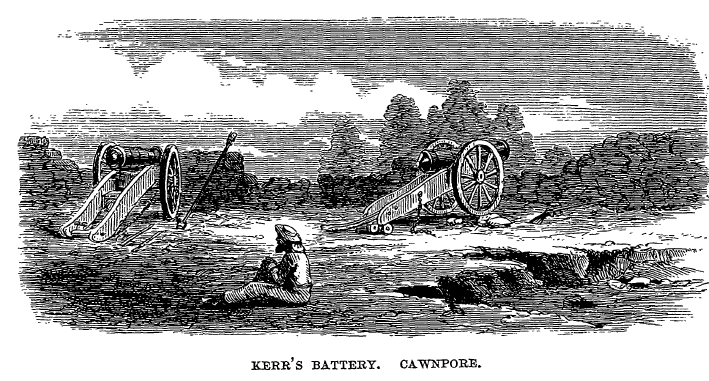
They were, as one would say, unexpected visitors. Caught wholly off guard, the rebel wounded were lying about “in all directions” and the cooking fires with chapatis still in the pan, showed with just what haste the sepoys were in. The contingent, at least on this occasion, was nowhere to be seen. They took their camp and found three 8-inch and two 5-inch mortars, and a good number of fine bullocks, some destined now for Ordnance, others for the cooking pot. The camp was found to be full of property plundered from the cantonments and the city. Soldiers’ kits, bedding, clothing and sundry items of every description were all stuffed into tents.
Sir Colin Campbell determined to pursue the portion of rebels now in full flight but the cavalry and horse artillery that had been sent to turn the right flank of their retreat were delaying the advance, owing to the broken ground. While the force waited, Campbell arranged to send Mansfield with a small force (two Rifle Brigade battalions, the 93rd, Longdon’s Heavy and Middleton’s Field battery) around to the north of Cawnpore to threaten the road along which the remaining rebels would retreat and “compel them to evacuate the city.” The 23rd Royal Welsh Fusilers with a detachment of the 38th would remain behind at the deserted camp and Inglis’s brigade was to move along the Kalpi road to support the Cavalry and Horse Artillery. It was now nearly 2 in the afternoon and the mounted troops had still not come up. The rebels were going further up the road, still wholly unpunished with their guns in tow. Suddenly Campbell announced he would follow them himself with Bourchier’s Battery and his own escort.
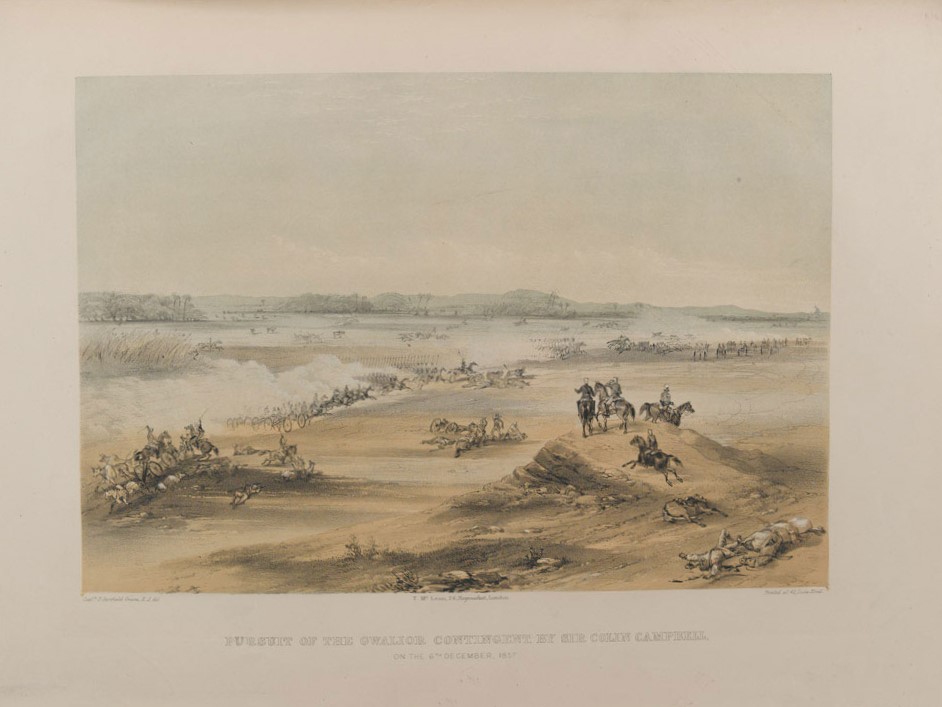
“What a chase we had! We went at a gallop, only pulling up occasionally for the battery to come into action,’ to clear our front and flanks. We came up with a good number of stragglers and captured several guns and carts laden with ammunition. But we were by this time overtaking large bodies of rebels and they were becoming too numerous for a single battery and a few staff officers to cope with.” (Roberts) By now they had outrun the C-in-C and Hope Grant decided to call a halt, hoping the missing cavalry and artillery would turn up.
“At last they came up, and we were enabled to pursue the enemy in great form. Soon we came across a deserted 24-pounder, and then gun after gun drawn by magnificent bullocks. Several men were sitting on the limber-boxes of another 24-pounder; and when Colonel Little, commanding the 9th Lancers, rode up with one of his regiment, a sepoy fired his musket at the lancer and killed him. The wretched fellows were soon cut down; and some of the Irregulars who had come up discovered two bags of gold in the boxes. As may be imagined, the gold was not left long in so unsafe a place. For fifteen miles we pursued the enemy, up to the Kalla-Nuddee, capturing a great many guns, which we brought back with us when we returned to camp at nightfall. Sir Colin, who had followed up with the cavalry and artillery, did not slacken in the pursuit. He had informed me that two 24-pounders had been captured, but one of these was missing, which appeared to me strange, as so heavy a piece of ordnance would be a cumbrous weight to move away.” (Grant)
The chase up to the Kala Nadi was an exhilarating one. Gough and his men were surprised when Sir Colin Campbell, who appeared to be enjoying himself, called out to Gough, “By Jove! You fellows can go! ” and added that it was the best run he had ever had. Seeing Campbell’s face beaming with delight, Gough felt he would have gone anywhere for the “plucky old man.” As for the rebel sepoys, they scattered through the countryside, throwing away their arms in their flight and rapidly discarded their uniforms. Nineteen guns were captured on the route.
At Kalla Naddi, Grant asked Roberts to ride with haste back to Cawnpore before it was too dark and select the ground for the night’s camp. As it was too dangerous to proceed alone, Augustus Anson volunteered to join Roberts. Halfway back, they stumbled across the body of Lieutenant Salmond, ADC to Grant. In his account, Grant states Salmond had been “loitering behind” but Roberts, with a little more feeling, believes the young man had become separated from the rest during the pursuit. His throat was cut, and he had a terrible slash across the chin. It was presumed he had unwittingly come across some of the rebels who had had the mind to hide until the force passed by. They had made short work of the young man, and Grant supposed they had dragged away the missing gun.
Roberts soon came upon Inglis’s brigade and, according to instructions, turned them back. At the Gwalior Contingent camp, there had been a scuffle as Roberts found out – some of the rebels had tried to take it back, but the troops had stood their ground and chased them off. It was dusk before Roberts and Anson reached the junction of the Kalpi and Grand Trunk roads. Agreeing it would be a suitable place for the night’s bivouac, with the city a mile in the front and Mansfield column less than two miles to the left at the Subadar’s Tank. Roberts marked the ground and showed each corps as they came up where they were to rest for the night. Young Watson, Lascelles and the First Lieutenant slept under one of the captured guns “as comfortably as possible.” Peel, for his part, was “so delighted.” There was precious little food and no cover but it heartened the men when they saw Sir Colin Campbell, like the soldier he was, lay on the ground with them, rolled up in his coat.
The Subadar’s Tank
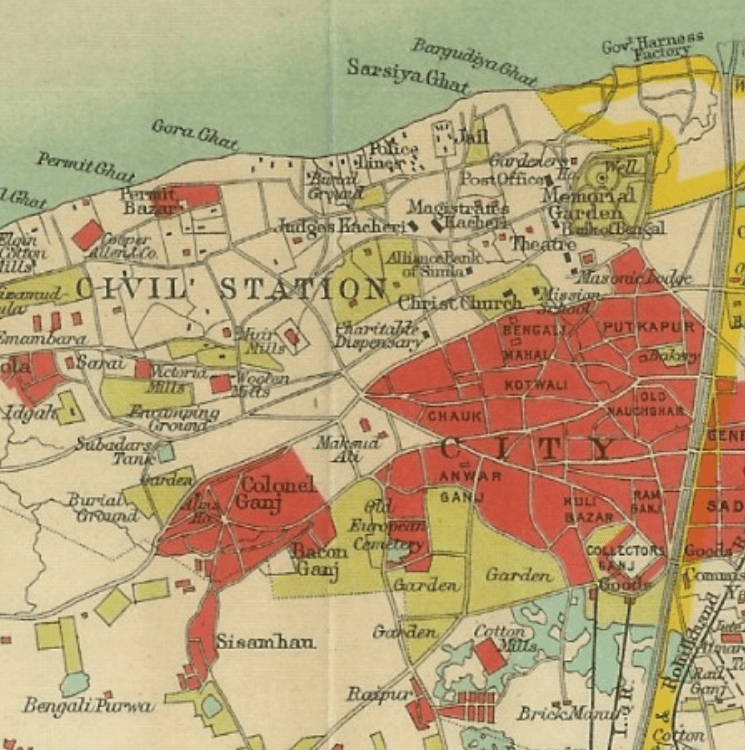
Back at Cawnpore, Windham’s bombardment of the rebels’ left had drawn their attention to him, so much so that they failed to take on Greathed and his feigned attack; Walpole had prevented the centre from moving reinforcements to the right. Hope, Inglis, Peel, Bourchier and officers, with the brigades and batteries, had done the rest. The Gwalior Contingent was completely defeated, their camp captured, and the rebel army was, in the words of Malleson, headless. The centre and left were now effectively cut off and their only line of retreat was up the Bithur road.
Just left of the said road, in the rear of the rebel left was a water reservoir, known locally as the Subadar’s Tank. It was here that Sir Colin Campbell was sure the remainder of the rebels would be forced to surrender, and he hoped to give the honour to General Mansfield, his chief of staff. “Considering the regard, almost amounting to affection, he felt for the officer whom he did select for this duty, it is, probable that he was anxious to give him an opportunity of distinguishing himself as a commander.” It was a curious choice, but Mansfield, in Campbell’s estimation, was the man for the task.
At 2 in the afternoon, Mansfield advanced, the Rifles in skirmishing order to the front, Longdon’s heavy guns next, with the main body following, and the 93rd held in reserve. He drove the rebels before him. Longdon’s heavy battery was sent forward to the junction of the Grand Trunk Road and the cantonments, while the Rifles, still in skirmishing order, extended 300 yards on either side of the road, slightly ahead of the guns. The rebels, it was seen, were giving way and position after position fell from their hands – Longden and Middleton kept up a rapid fire, while the Rifles began their advance on the cantonment with Lt.Col Horsford in the lead. They were now within 1000 yards of the Subadar’s Tank. Middleton’s battery galloped through it before the infantry came up and took a position on the plain, opening fire on not only the rebel guns but their infantry, who were now in full retreat up the Bithur Road. The Rifles rushed up to Middleton’s support while Brigadier Hope came up in the reserve with the 93rd to take up the picquets that had been thrown out on the line of the rebels’ retreat.
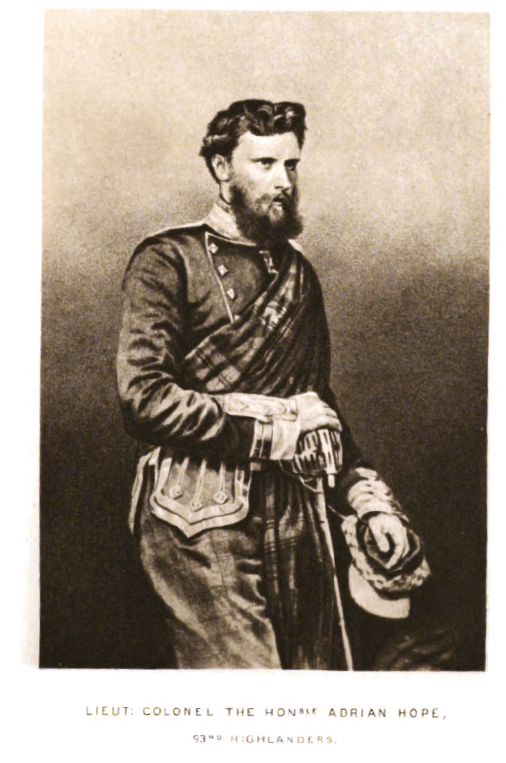
Quite suddenly, just outside the tank, Mansfield halted not only the skirmishers but the 93rd, to the bewilderment of everyone from the drummer boys to the Brigadiers. “ He directed the men to stand at ease. The Rifle Brigade, as skirmishers, lay down. In the meantime, the rebels continued to bring up more and more guns to bear on their line, and they doused the Rifles with grapeshot, reserving the round shot and shrapnel for everyone else. The artillery continued to answer. Lieutenant Stirling of the 93rd was shot through the leg, shattering his thigh and a young lance corporal, just behind him, lost his arm. Mansfield received a wound from a shrapnel bullet which burst right over the heads of the centre of his line, killing one man and wounding another four. Hope closed up on Mansfield and suggested the 93rd lie down. Ungracious to the last, Mansfield allowed Hope to give the order, which the irritated officer delivered in a short, sharp tone to the men he usually treated with far more respect. “Lie down, 93rd!” he barked.
“As the enemy had now got our range beautifully, and our inaction was as is invariably the case with all Orientals giving them fresh courage, as was apparent from the fact that they were actually beginning to bring up infantry and cavalry amongst the groves of trees and enclosures along our front in support of their guns, even our obstinate and incapable commander began to see that the position we occupied, as a target for the enemy’s artillery practice, would very soon be no longer tenable; for we still continued to lose men, and it seemed not impossible that they would even venture to attack us. Hope made no effort to conceal his annoyance, but, evidently owing to his previous offers of advice having been surlily received, he did not attempt to speak to Mansfield again.”
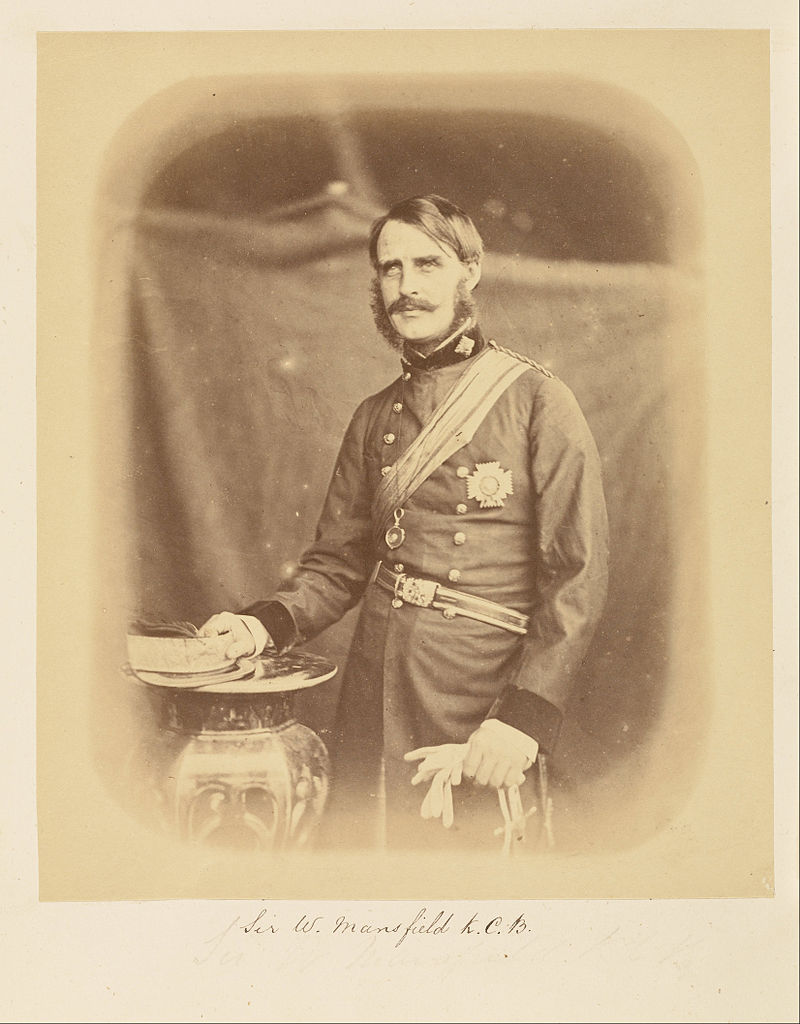
For his part, Mansfield refused to believe he had placed his men in a position where they were incapable of acting – had the rebels had any audacity left in them, they could have cut Mansfield off. It was only his luck that they had only one idea, and that was to escape. While covering their retreat, they continued firing on Mansfield’s position. For the next three hours, Mansfield sat coolly by while his men seethed with rage, watching as the cavalry, infantry and artillery of the rebels filed past. It was no wonder that very uncomplimentary remarks muttered by the men of the 93rd that the “respective destinations” of the round shot that had so knocked Stirling and the lance corporal about, could have been better used against Mansfield. Had Sir Colin Campbell believed for a moment that Mansfield would, at a critical moment, turn the entire move to the Subadar’s Tank into one of useless passivity, he might have reconsidered the appointment and given it to a far more energetic officer than his chief of staff. At five o’clock, when the rebels were almost out of sight, Mansfield ordered the 93rd to rise, and the bugles sounded the advance. They now rushed up the Bithur Road, the Rifles and artillery clearing the front as soon as the rebels realised that Mansfield had decided to pursue them after all. They could have saved their worries. The men had barely got themselves among the shattered houses of the cantonments when they were again ordered to halt, “…however, free from any annoyance from either the enemy’s artillery or even infantry fire, as, doubtless, their leaders had not realized that it could possibly be the deliberate intention of a British General to allow the whole rebel forces now hemmed in within the city to escape at their leisure, horse, foot, and artillery.” He could have at least taken their guns, but even that was one step too far for General Mansfield. In his despatch, he simply stated, “Their guns might have been taken, but I refrained from giving the necessary order, being aware that it was contrary to your Excellency’s wish to involve the troops among the enclosures and houses of the cantonments.”
If anyone expected Mansfield to receive censure for his actions or lack of, they were to be disappointed. Mansfield had followed Sir Colin’s orders to the letter; with dusk approaching and unable to communicate with Campbell for further orders, he simply stopped doing anything at all. On the 8th of December, Hope Grant would be given the task of finishing what Mansfield had been unable to start. He had briefly menaced the rebels but had, by way of following his own command, done little more than inconvenience a force already on the retreat.
That night the five companies of the 93rd bivouacked under the trees near the Subadar’s Tank, the Light Company and No.2 Company of the 93rd occupied a house on the north side of the Bithur Road as an outlying picket to block anyone still interested in leaving the city. Captain Burroughs and the No. 6 company of the 93rd took over several ruined outhouses belonging to one of the destroyed bungalows in the civil station, closer to the river. Throughout the night the men could only listen as the “fugitive multitude” fled from Cawnpore by the only two open roads left for them between Mansfield’s column and the river. His instructions for the night were clear – the men were by no means to engage anyone leaving Cawnpore. Captain Henry R.L. Newdigate’s company of the Rifles, together with Major Ross were placed on picquet in a bazaar, not far from the Bithur Road. During the night they were suddenly startled by a loud noise, coming from a nearby enclosure. No one could have been more surprised than the rebels, who, having lost their way in the dark, stumbled straight into the Rifle’s picquet. The sentry challenged before he could rightly see who was in front of him and the rebels fled pell-mell down the road, leaving behind their string of camels – laden with 20’000 rounds of ammunition – in front of the Rifles. “The next night the cartridges having been broken up on the ground, a grand illumination was produced by setting fire to the heap.”
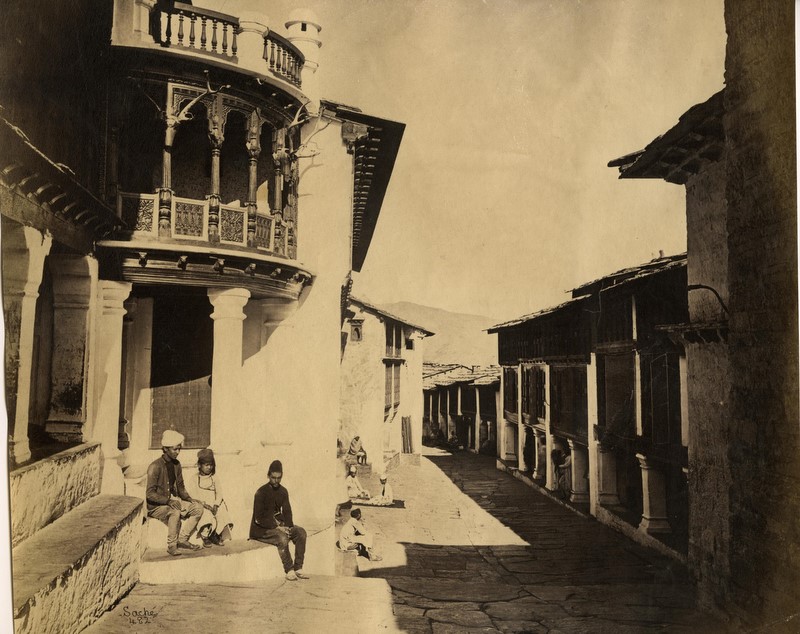
Everyone, except the Rifles, kept their spirits up by raiding the stores of brandy, and champagne the rebels had left behind and Adrian Hope contrived to make a tolerable evening for the officers as they occupied the only house left standing in Cawnpore. Once a bungalow, most likely of an officer, the rebels had, for some curious reason, left the contents mostly untouched, including some admirable French china. While the mess cooks tried to gather together ingredients for a tolerable meal which would include beef and freshly caught pigeons, Hope and the officers took a much-needed bath finishing it off with the invigorating bottles of rose water the rebels had so thoughtfully left behind. They then sat down to their odd mess, decked out with the beautiful china. The men for their part, took their dip in the tank, a few privates foraged through the gardens and came up with something everyone took to be asparagus, slaughtered a meandering bullock and tossed everything into the stew pot, and then admired the alcohol to a more than tolerable degree. When it came time to finally sleep, unlike their comrades, shivering out on the plain under their coats, they had found the old rebel hospital still had its stores intact, enough quilts were left behind to furnish each man with not only a cover one to spread one on the cold ground.
As for the Rifles, they were not so fortunate, and passed a very cold night in their clothes, not even having the great-coats with them. For the 3rd Battalion, hunger caused them to kill and slaughter a very lean cow. They roasted bits of it’s tough carcass over a fire on the points of their swords and ate the morsels, still half-raw. The 2nd Battalion was somewhat luckier for “…they got hold of a good many sheep, and in fact regaled themselves so well on them, that they named the house where they passed the night Mutton Bungalow.”
No one could say for sure where Mansfield was, but their disgust for the man prevented them from caring. The opinion that night was unanimous – Mansfield should have been a lawyer or a politician, some unkindly suggested he could be a “permanent official in the Treasury” but never a soldier.
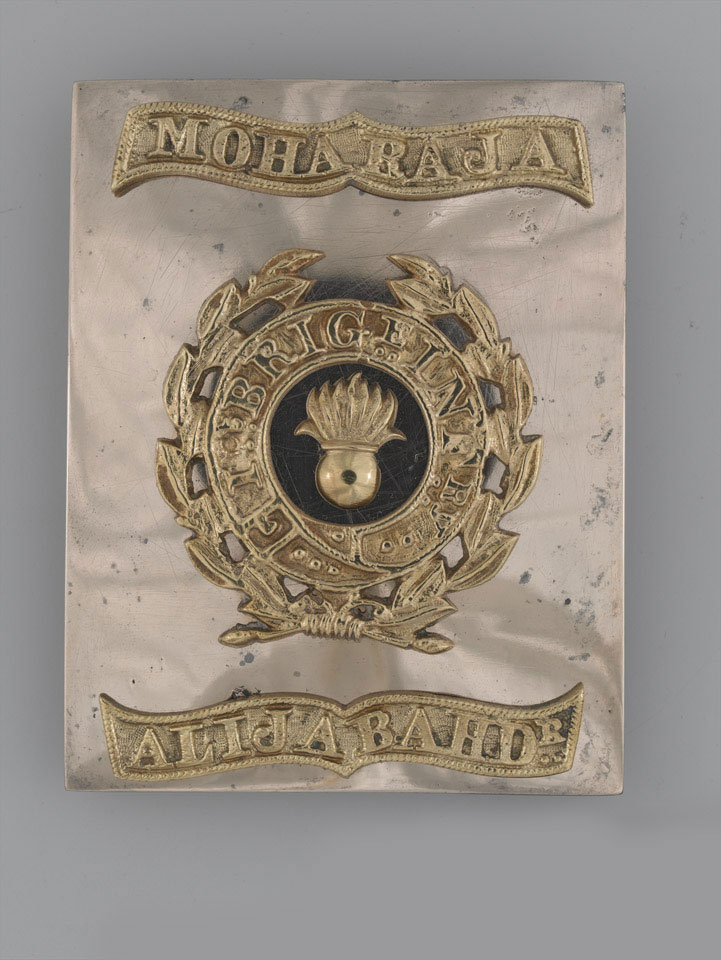
NAM. 1984-03-80-1
https://collection.nam.ac.uk/detail.php?acc=1984-03-80-1
And what of the Gwalior Contingent? Gough had expected to at least meet their cavalry in the field, but they were gone. They had broken and fled, issuing with haste along the Kalpi Road. They would in part succeed in withdrawing to Kalpi, carrying most of its artillery with them. The contingent, however, as a whole, never regained their strength. Another battle was waiting for them, at Kalpi in 1858 but by then they were no longer operating as the proud Contingent that had worried not just Scindia, but every station between Gwalior and Cawnpore for half a year. They had become part of the rebel machinery, sucked into the disorganised mass of troops, directionless and for the most part, defective of effective leadership. They would never rise above again.
Sources:
Bourchier, George. Eight Months’ Campaign Against the Bengal Sepoy Army during the Mutiny of 1857. London: Smith, Elder, and Co., 1858.
Cope, William H. The History of the Rifle Brigade (The Prince Consort’s Own) Formerly the 95th. London: John Chatto & Windus, 1877.
Ewart, John Alexander. The Story of a Soldier’s Life; or, Peace, War, and Mutiny. Vol. 2. London: Sampson Low, Marston, Searle, & Rivington, 1881.
Forbes, Archibald. Colin Campbell, Lord Clyde. London: Macmillan and Co., 1895.
Forrest, G. W. A History of the Indian Mutiny: Reviewed and Illustrated from Original Documents. Vol. 2. Edinburgh: William Blackwood and Sons, 1904.
Gordon-Alexander, William. Recollections of a Highland Subaltern: During the Campaigns of the 93rd Highlanders in India, under Colin Campbell, Lord Clyde, in 1857, 1858 and 1859. London: Edward Arnold, 1898.
Gough, Hugh. Old Memories. Edinburgh: William Blackwood and Sons, 1897.
Grant, Hope. Incidents in the Sepoy War, 1857-58: Compiled from the Private Journals of General Sir Hope Grant. Edited by Henry Knollys. Edinburgh: William Blackwood and Sons, 1873.
Khan, I. A. “The Gwalior Contingent in 1857-58: A Study of the Organisation and Ideology of the Sepoy Rebels.” Social Scientist 26, no. 1/4 (January/April 1998): 53–75. https://doi.org/10.2307/3517581.
Mackay, James [Rev. John]. From London to Lucknow: With Memoranda of Mutinies, Marches, Flights, Fights, and Forays. 2 vols. London: James Nisbet & Co., 1860.
Malleson, G. B. History of the Indian Mutiny, 1857–1858, Commencing from the Close of the Second Volume of Sir John Kaye’s History of the Sepoy War. Vol. 2. London: Wm. H. Allen & Co., 1879.
Munro, William. Reminiscences of Military Service with the 93rd Sutherland Highlanders. London: Hurst and Blackett, 1883.
Roberts, Frederick Sleigh. Forty-One Years in India: From Subaltern to Commander-in-Chief. Vol. 1. London: Richard Bentley & Son, 1897.
Verney, G. L. The Devil’s Wind: The Story of the Naval Brigade at Lucknow, from the Letters of Edmund Hope Verney and Other Papers Concerning the Enterprise of the Ship’s Company of H.M.S. Shannon in the Campaign in India, 1857-58. London: Hutchinson, 1956.
 Mutiny Reflections