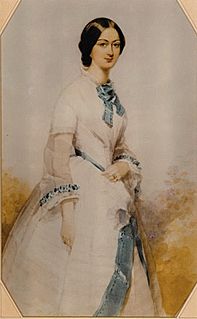
“Sir Colin Campbell came and talked to me for some time; he was very kind in his manner, and talked about us as dear creatures, meaning the ladies; at the same time, I knew he was wishing us very far away, and no wonder!” (Julia Inglis)
The ladies of Lucknow had borne their lives with remarkable fortitude. They had lost their homes, and many were grieving their dead — the children laid to rest in early graves and husbands killed in battle or dead from disease; they had suffered for months in cramped quarters, with shot and shell flying over their heads, expecting every moment to be their last. Some of the ladies kept laudanum and prussic acid at hand, so they might end their lives and that of their children should the rebels break the battered walls. Reverend Polehampton, a devout man of the cloth, wrote when asked by Major Banks what,
“…he would advise him to do, in case it being certain that his wife would fall into the hands of the rebels, and that they would treat her as they had done to the women of Delhi and Meerut. It was a difficult question: but I told him that if I was certain that my wife would be so treated, I should shoot her rather than let her fall into their hands. Colonel Inglis afterwards as me whether I thought his wife would be justified in killing her own children, rather than let them be murdered by natives. I said, no; for children could but be killed…God forgive me, if I gave wrong advice! but I was excited…”
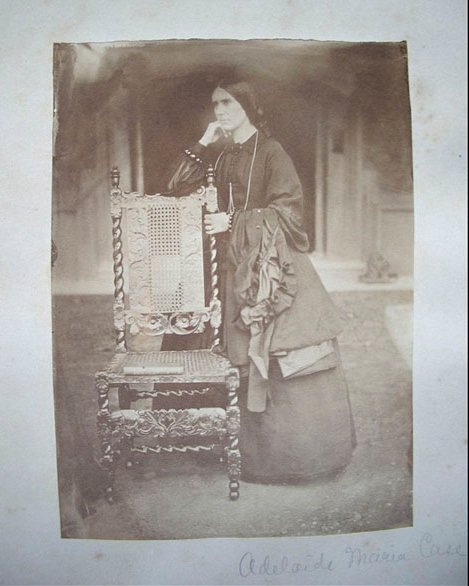
For himself, the reverend had long since determined he would shoot his wife. Men spoke of blowing them all up rather than letting them fall into the hands of the rebels, others kept bullets in reserve for those final shots but Mrs Case found the entire proceeding absurd — “…it appears to me that all we have to do is, to endeavour, as far as we can, to be prepared for death, and leave the rest in the hands of Him who knows what is best for us.”
Endure they certainly would.
Their rations had been reduced to starvation fare and by the 25th of August, the entire garrison was placed on half-meat rations. Men were given 12 oz of meat instead of 1 pound (0.45 kg). Women and children over the age of 12 received 6 oz, children under 12 were not reduced and continued to receive 4 oz but children under 6 now were given only 2oz, half of their previous rations. These pitiful amounts were reduced again in October, as Maria Germon noted, — “14 ounces (0.53 kg) of wheat a day for a man and no grain for dal for anyone and a smaller portion of rice. We have only 14 ounces (0.53 kg) of rice a day for our whole party so that we can only have it at dinner now.” It is little wonder then, that their journals, after the relief by Sir Colin Campbell, are replete with descriptions of food — and one little girl even excitedly announced to her mother at the Dilkusha, she had seen white bread and butter, with her own eyes. Yet their hunger days were hardly over. The hurried journey to Cawnpore saw them, once again, going without, Kate Bartum, for one, barely ate until the march was over; others subsisted on bread, although Mrs Inglis was able to offer her friends some tinned soup. During one of the halts, a young boy fell to thievery,
“…a little boy about five years old, son of an officer of the garrison, on loot intent, spotted a fowl that I had procured with great difficulty; he thereupon seized and bolted with it. At this moment I caught sight of him legging it off for all he knew, with the neck of the bird clutched in his tiny hand, the legs dragging along the ground. I gave chase and recovered it. Poor little Tommy wanted it for his mother.” (Ruggles)
Now here they were in Cawnpore. The ladies of Lucknow, the wives of officers, humble soldiers and civilians, all crowded together on a patch of land, living in hastily assembled tents and others in the battered barracks, all waiting to find out what the future had in store for them. Around them their children played, “…and they, true to their character, were wholly absorbed in their dolls or some sort of knotted handkerchief which passed as such, or perhaps an empty sardine tin drawn by a string, and enjoyed the cheerful weather, without thought of Tantia Topee, or any other bogie.” Or, as Reverend Mackay observed, “The little ones were romping and laughing…as merrily as if they were in merry England.”
Not so much their mothers. Their camping ground was,
“….certainly a strange one, tents, carts, carriages, dhoolies all pushed together as closely as possible… Some of the women and children had gone into the barracks…Desultory firing continued, and once or twice a shell fell near enough to make us feel rather uncomfortable.” After their first night at Cawnpore, the order came to change grounds: they would be moved to the artillery barracks, closer to the river and further from the rebels. They had discovered the ladies’ whereabouts and, as the day proceeded, took to firing shrapnel at the very grounds they had slept on the night before. By early afternoon, the ladies were in their new quarters.
Mrs Inglis pitched her “large tent,” on the roomy and comfortable grounds, as she did not like the look of the barracks where many of the women and children were now quartered; Mrs Edgell, Mrs Anderson and Mrs Harris availed themselves of not only a tent but a small corner room, while Mrs Bartum and Mrs. Orr, having no tent at all, made themselves comfortable in the guard room. Some were fortunate to have friends and husbands at Cawnpore who quickly made private arrangements for their stay that was supposed would be a long one. Mrs R., who had arrived from Lucknow with her husband, was staying in the late Captain Morphy’s tent where on the 30th of November, all attempts were made to have a civilised breakfast, however, as Reverend Mackay writes, it was indeed a strange proceeding.
“Moore begged from Captain Austin, in the next tent, a plate of hump for the lady, and presented her with a clean pocket handkerchief, at the sight of which she exclaimed, ‘What a treat!’ An egg was also procured for her, the first she had seen since July. Mrs R then mixed for us a little chocolate, provided by one of the party, and put it into a kettle, which required first to be cleaned. We had also several slices of cold, old-looking ration beef, as tough as leather, mustard in a wine glass, some meat sauce, a bottle of guava jelly, and a lot of musty broken bread and biscuits…Whiz-z-z! a shell right over us – the second within a minute. Under the rickety little camp table at my elbow are an officer’s basket, with a frying pan, two shoe brushes, a dish cover and a black kettle. Behind the lady’s chair, at the side of the tent, are beer boxes, horse blankets, an ewer and a basin of gutta-percha, empty biscuit tins, some plates, a teapot, and a Bible in two volumes quarto, with several trunks and bundles. Behind me, two gig wheels are leaning against the embankment, and on our left stands one of those unpleasant-looking blood-coloured dhoolies, which I hope will not be needed. The chief danger seems to be from spent round-shot or ricochets…We know nothing of what Sir Colin’s force may be doing outside.”
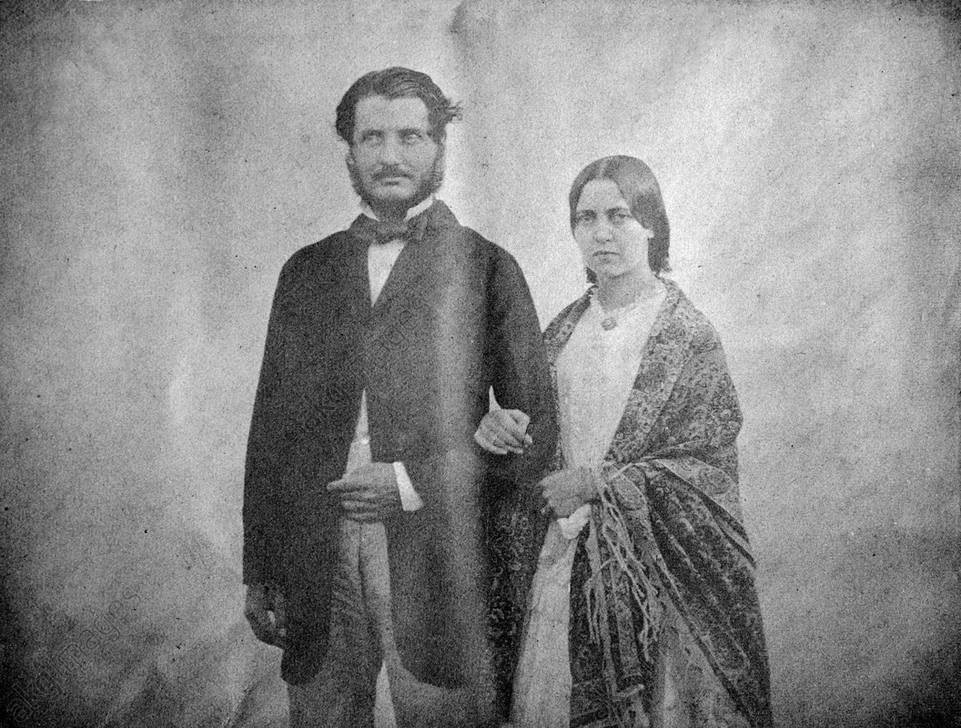
However, to their surprise, Sir Colin Campbell was moving heaven and earth to get rid of the ladies. On the morning of the 2nd of December, an order came they were to march that night, something which once again threw Maria Germon into a panic of packing and arranging her boxes until she went to bed, fully dressed, with a fearful headache. Her husband had turned down an appointment on account of his health, but his sick certificate had not yet been approved; Mrs Inglis was suddenly faced with the dread of leaving hers behind. They had all been ordered to draw 8 days’ rations for the road, but as night drew in, the order to leave was countermanded. It was one more night in Cawnpore.
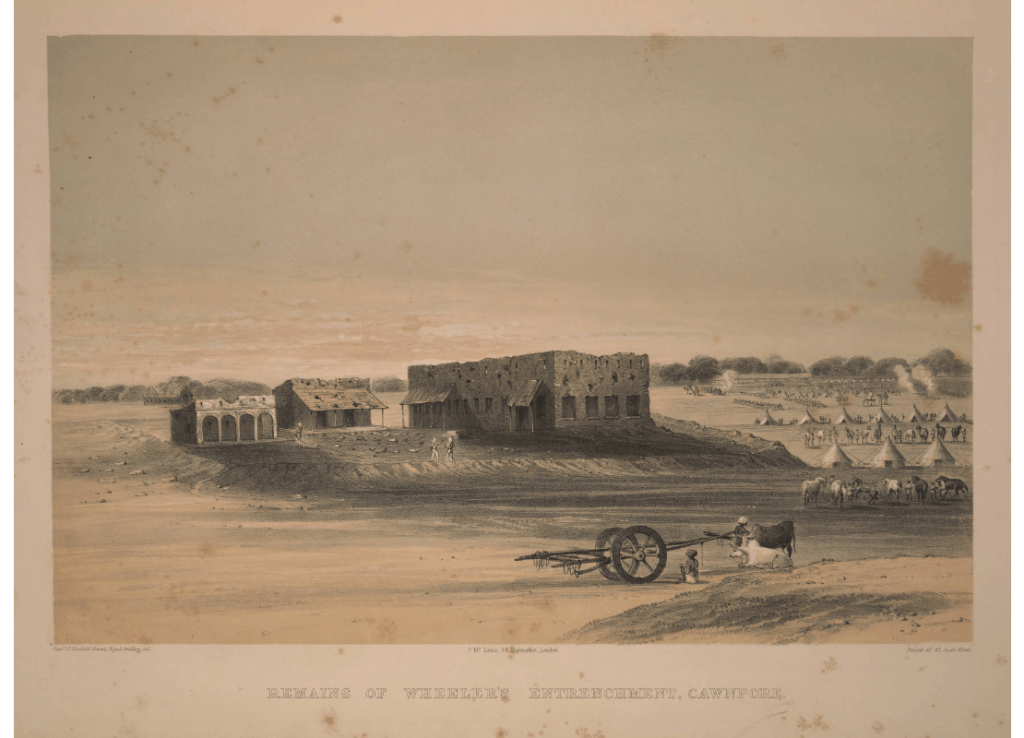
The next day the ladies were kept in suspense — no one could say quite for sure when they would leave, so to pass the time, several of them made an excursion to see Wheeler’s Entrenchment. Mrs Harris noted, “The entrenchments by way of a defence are quite laughable: a very narrow ditch, not knee-deep and a low bank of earth, over which we stepped with the greatest ease…” or as Mrs Inglis observed, “… a small child could have jumped over.” Yet the ladies could all agree that their troubles at Lucknow had indeed been small in comparison. In the entrenchment, scraps of music, pieces of books, rags of clothes and the bric-a-brac of daily life still lay scattered – Emily Polehampton gathered up a few sheets of music; Mrs Harris picked up a leaf from a Bible.
Others remained at camp and wrote letters home, the first news anyone would have had of them since June — it would be a delightful surprise for so many friends and family, many of whom by now believed their loved ones to be dead and buried on the great Indian plain. Newspapers had been reporting on the mutiny, but the stories were often inaccurate, exaggerated and emblazoned with sensationalism. There were countless stories from “the pen of an eyewitness” or some unnamed correspondent; many letters written to those at home had found their way into the hands of an editor who treated them “unquestionably as a source of information.” Unbeknownst to them, many private letter-writers were turned into unwitting reporters by editors starving for news. How horrifying must this have been for families at home when stories like these appeared:
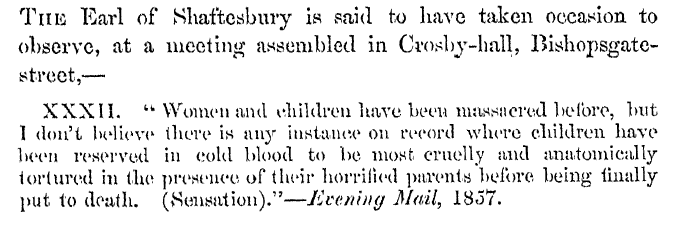
Or the Times, on the 6th of August 1857, writing,
“There are some acts of atrocity so abominable that they will not even bear narration…We cannot print these narratives…they are too foul for publication. We should have to speak of families murdered in cold blood – and murder was mercy! – of the violation of English ladies in the presence of their husbands, of their parents, of their children – and then, but not till then, of their assassination.”
One lady, Frances Wells, could finally vent her anger and frustration in long letters to her father — as the wife of the doctor who had so imprudently taken a drink from a medicine bottle way back in May, she felt she had much to complain about. Her son was misbehaving – spoiled by his over-attentive father, they had lost all their property, and she did not spare any compliments for Brigadier Inglis:
“…a man universally detested throughout the garrison by all ranks, and his mention of the names of officers has excited great indignation; many of whom he has praised never did a single thing the whole time and some of those that worked hardest were omitted entirely because they were not favourites; he disliked the 48th and left them out entirely.” Above all, poor Frances, who had buried one child at the Lucknow Residency, was ready to go home. Her husband, Walter, would travel with her.
Despatching the Impedimeta
“As soon as carriage could be procured, the Chief wisely determined to despatch everything in the shape of impedimenta to Allahabad.”
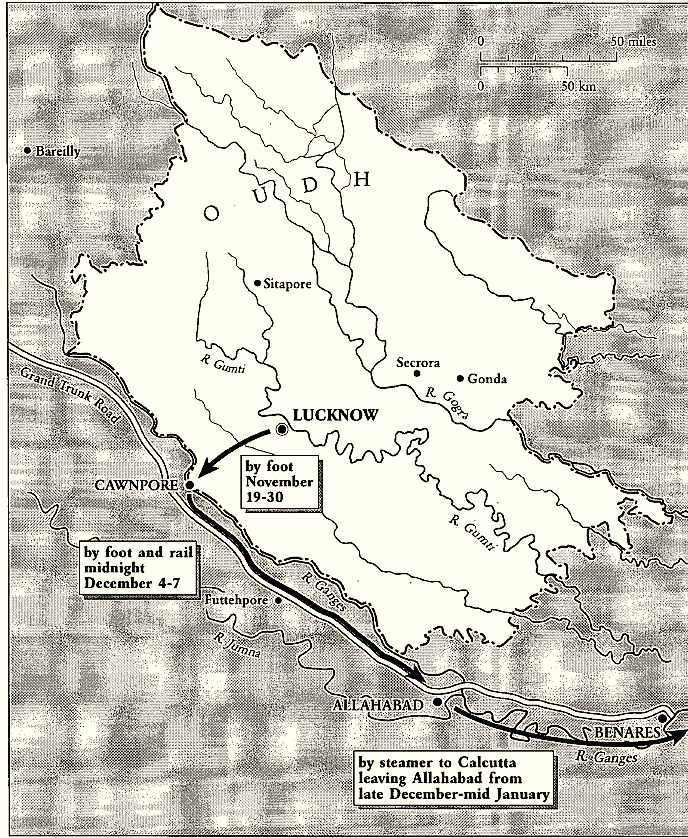
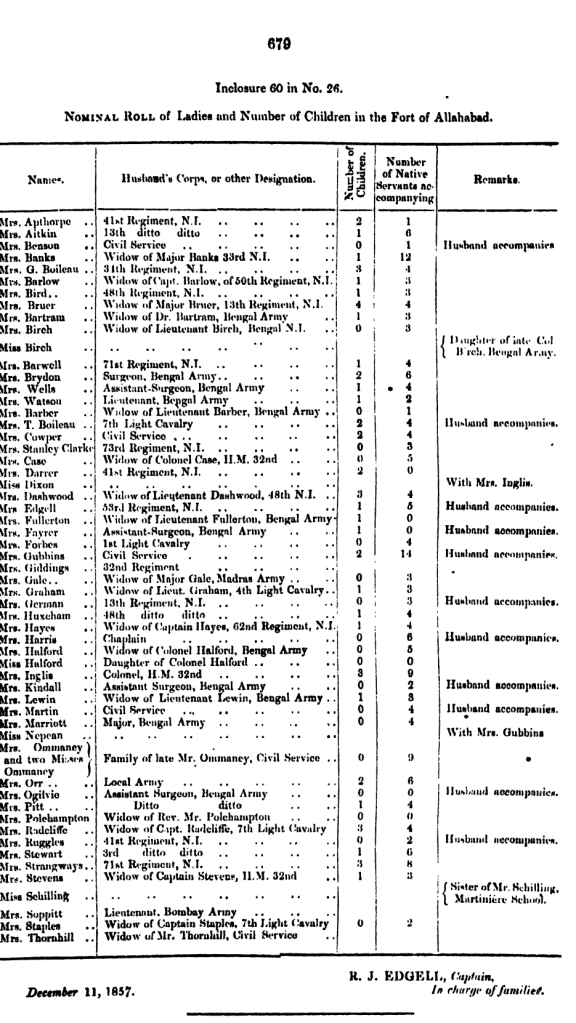
On the 3rd of December, the necessary preparations were complete, and the ladies would leave at 10 pm that very night. Their escort would consist of a wing of the 34th, two guns and a few native cavalry — all that could be spared to bring the civilians, the ladies, children and nearly 500 wounded men, with four doctors, away from Cawnpore. Dr Fayrer would accompany his pregnant wife and small son; Reverend Harris and his wife travelled together, Charlie Garmon received his sick certificate at the last moment so he could accompany his wife, Captain Edgell was put in charge of the ladies, Kate Bartum, alone again, was taken under the wing of Captain Boileau who looked after her and her cart, “keeping it near his own.”
As for Julia Inglis, whose husband was staying behind at Cawnpore, the news of their impending departure left her feeling wretched. Tied up with his duties, Brigadier Inglis would not be able to spend the final evening with his family and had to comfort himself by walking a short way with his wife and sons before settling them into the carriage and saying his last “sad farewell.” Mrs Inglis knew he would be far happier when they were gone. With the children in bed in the bullock cart, Mrs Inglis settled the baby on her lap, and with Mrs Case and her sister for company in the mule cart, the ladies began their slow march away from Cawnpore. The first night would take them 24 miles.
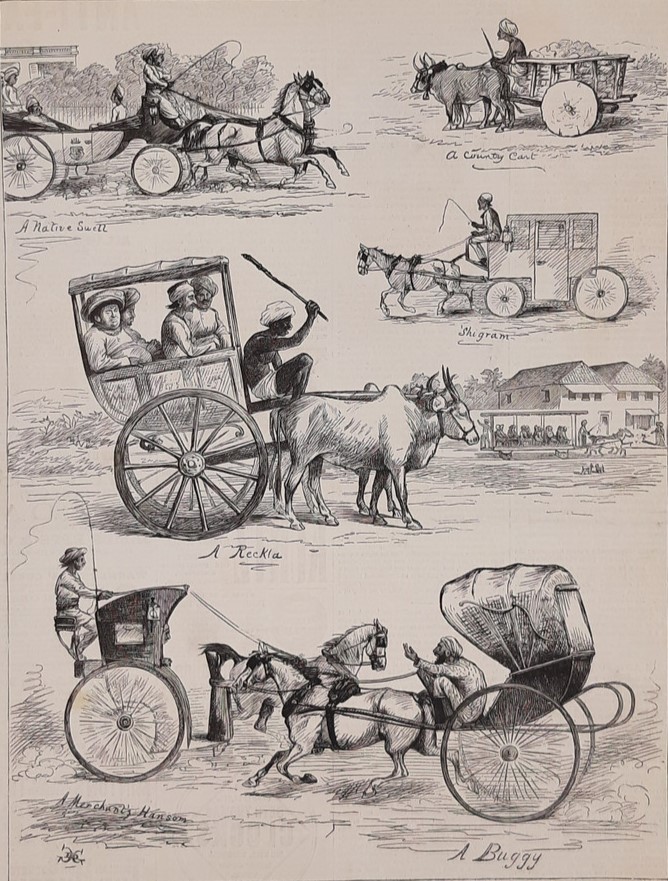
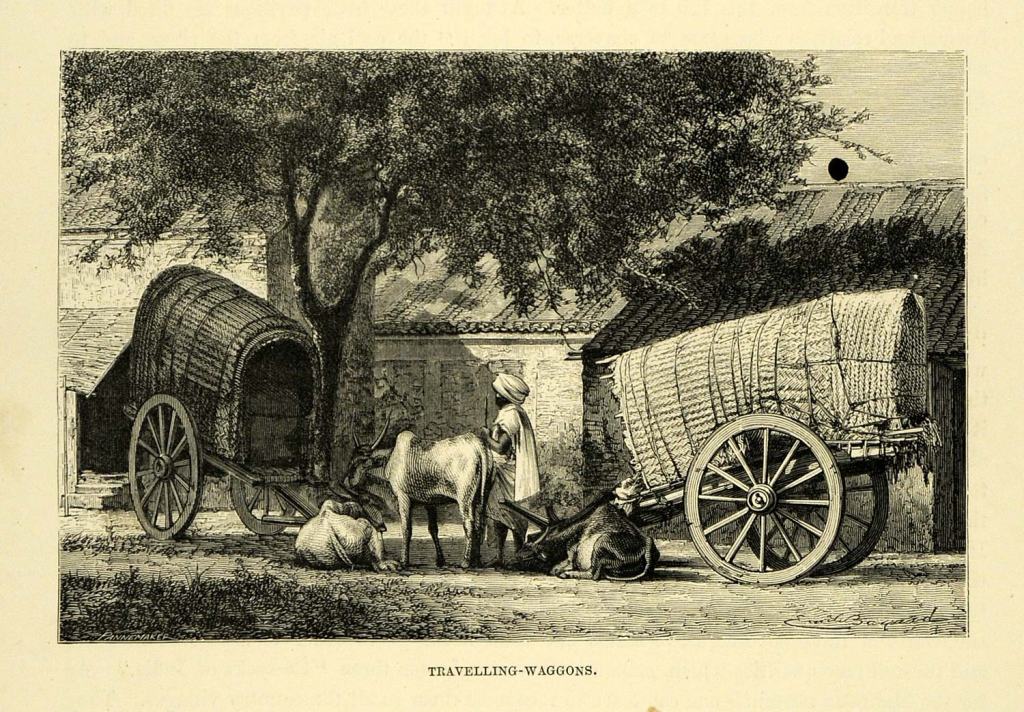
Maria Garmon left in a shigram with Mrs R. while her husband seated himself on the step and Mr R. rode in the front. She slept all night. Dr Fayrer bought a buggy for his charges, while Reverend Harris purchased an old horse and his wife shared a carriage. “Every description of conveyance was impressed into service for our transport, and we have presented a curious spectacle, travelling as we did, a few palki garries and the now obsolete buggy, and a few in common hackeries with a reed awning to keep off the sun and rain.” The Martiniere boys were expected to march – only the youngest was allowed to ride in ekkas. With no one paying attention, Edward Hilton and another boy “annexed” a cart for themselves. The long procession, interspersed with soldiers, cavalry and doolie bearers, the baggage train meandering in a long line behind, moved through the dark countryside, each step bringing them further away from Cawnpore.
At 11 in the next morning, the convoy arrived at their first camp, Mrs Harris noting the gentlemen were the worse for wear having ridden on their horses through the night. She delighted in the fresh air, the “out-of-door, picnicking life” would indeed be pleasant if it hadn’t been for the inconvenience of roughing it and the constant fear of enemies – it was, in her estimation, still a far sight better than sitting cooped up in a compound, as she had been, with nothing to look at but a bare stone wall, feeling from day to day, she would soon be “melancholy mad.”
The day was not without its incidents. A young woman, who Mrs Inglis calls a clerk’s wife, accidentally shot herself in the hand with her brother’s rifle – he had left it in the carriage when he disembarked; the movement caused the horse to start, the rifle fell forward and the lady grabbed it by its muzzle it to stop it from toppling. Unfortunately, the rifle went off and the ball ripped through her hand. Dr Fayrer was called for and he ordered the immediate amputation of her thumb. Dr Fayrer does not recall the incident at all and only notes he was kept very busy and he “amputated part of the hand of a wounded soldier.” Sadly for her, at 21, she was already a widow – her husband, to whom she had been married but three months had been killed during the siege. She was also heavily pregnant, expecting her confinement the next month. No doolie was found for her and she would continue the wearisome march at the back of an unsprung hackery.
The ladies spent the day pleasantly enough, sitting under the trees and watching as various detachments marched towards Cawnpore. Mrs Polehampton chose a comfortable neem tree to rest under and put a coverlet in the branches to shade her and her companions from the sun.
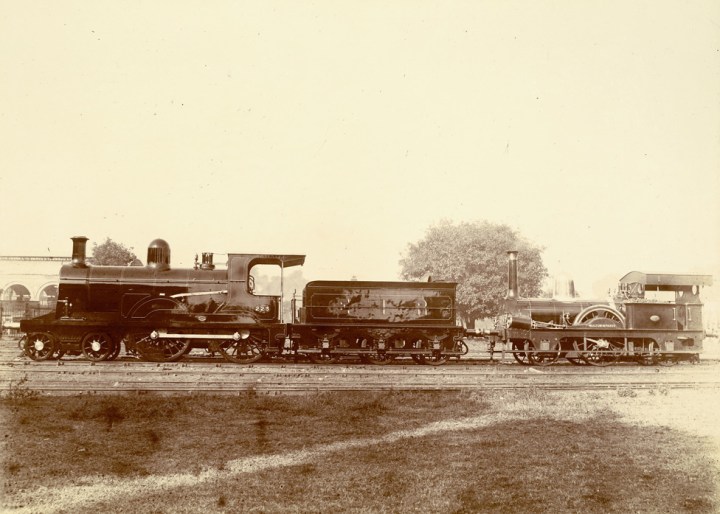
Two more night marches brought them to within 40 miles of Allahabad. A temporary rail terminus had been set up at Chhimi, (Khaga some eight miles further would open shortly after), which like Raniganj close to Calcutta, assisted in taking troops at least part of the way by train. Although this particular stretch was very short, it saved the troops at least 2 days march. From Chhimi they could then be conveyed by bullock train to Cawnpore. Trains were still something of a novelty in India and none of the Martiniere boys had ever seen one. The first passenger train had travelled four years previously from Bori Bundar (Bombay) to Thane, a distance of 21 miles; a year later the first Calcutta line was opened (from Howrah to Hooghly, 24 miles) – an experimental line to Raniganj opened in 1855, and a year later the Madras Railway Company opened their 63-mile line between Veyasarpandy and Walajah Road (Arcot).
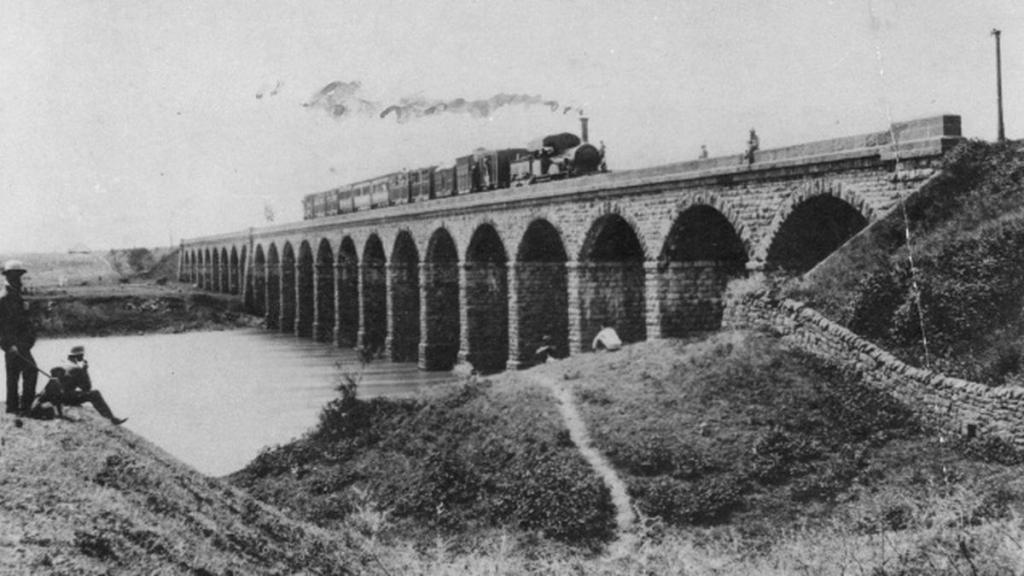
The line from Calcutta to Allahabad and onwards to Cawnpore was in its infancy and the events of 1857 would hamper construction considerably. The whole 119 miles from Allahabad to Cawnpore would open in March 1859.
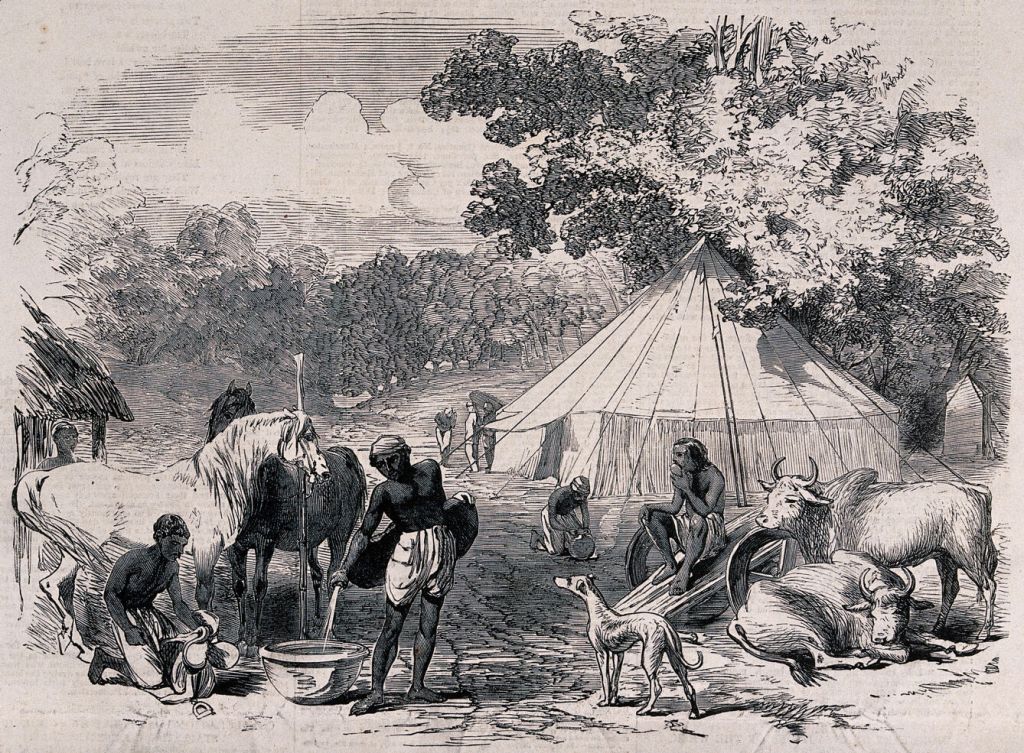
Meanwhile, at Chhimi one eager volunteer, Captain Oliver Jones, R.N., had been waiting two days for the detachment he was supposed to join ( they were coming up by road). On the 7th of December, the Lucknow convoy arrived. The station has been identified as such, from the rather corrupted spelling, Chemie as presented by Captain Oliver Jones and Chimmey by Ruutz-Rees. It was further misidentified by Dr Fayrer as Lohanda, Edward Hilton presented it as Kagra and curiously enough, by Mrs Harris as Raniganj,
“The wounded, of whom there were about five hundred in the convoy, were to march down the road. They were in a very miserable state, poor people, and there were only four medical men to look after them (no doubt it was impossible to spare more), so the “the Britons ” were piteous to hear. The Lucknow folks, as far as one saw them, seemed in very good spirits, and did not look at all starved or in bad condition, but very pleasant and happy, delighted, no doubt, to escape from the confinement and horrors they had been enduring for so many months…Two of the lieutenants of the Naval Brigade, Hay and Salmon, were going down wounded, and managed to smuggle themselves into the train, and were received with cordiality, and made as comfortable as possible by the conductor…” (Jones)
The ladies did not heed Jones, to sneaking wounded or the excited Martiniere boys. Mrs Inglis complained no one was in charge; they were tired and hungry but for fear of missing the train, could not go and find anything to eat. She managed to procure some cold chapatis and milk for her children to sustain them on the three-hour journey they were made to wait for 2 hours in their compartment. After bundling her sister, Mrs Inglis, three children and a variety of small parcels and boxes into the compartment, Mrs Case turned her attention to what appeared to be a rather alarming amount of baggage.
“It was soon made known that the luggage could go with us, so we had the camels unloaded, and their loads transferred to the luggage van, also some things out of the hackery; but we found it much better to let the latter and the goats follow us.”
Mrs Harris found herself suffocating in a very uncomfortable 2nd class carriage with 10 other people instead of the usual 8, meanwhile, Maria Germon, found herself packed into a carriage without a bite to eat, and kept waiting for three hours (though Inglis, Case and Harris agree it was 2) and worried her husband would not make it to the train on time – he had been sent to deal with the baggage. Among this was Emily Polehampton’s harmonium that had survived the siege (stored in the church). It would now travel back to England with her. With the Martinere boys stowed away in the ballast trucks, the train finally pulled out of the station at 10 am for its two-hour journey to Allahabad. Just as they moved off, the soldiers called out, as Emily Polehampton recalled, “Vengeance for th daughters and babes of England! And we shall have it too!” For Edward Hilton, less interested in shouting soldiers, the Iron Horse was an exhilarating experience and it carried them away at a “fearful speed.”
the End of the Journey
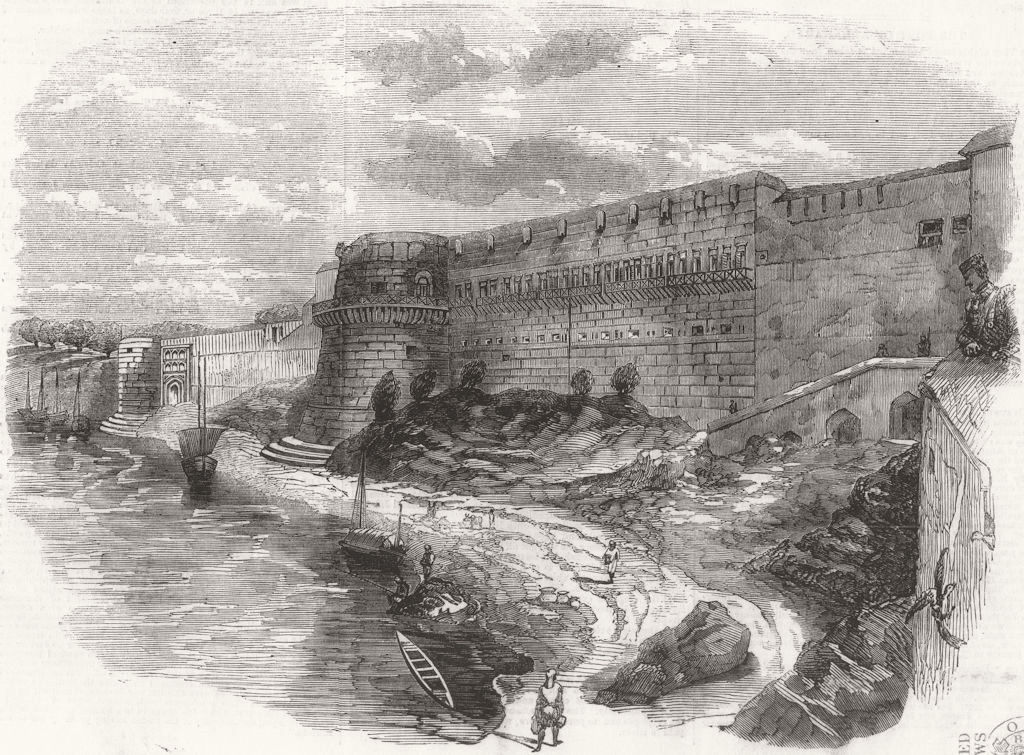
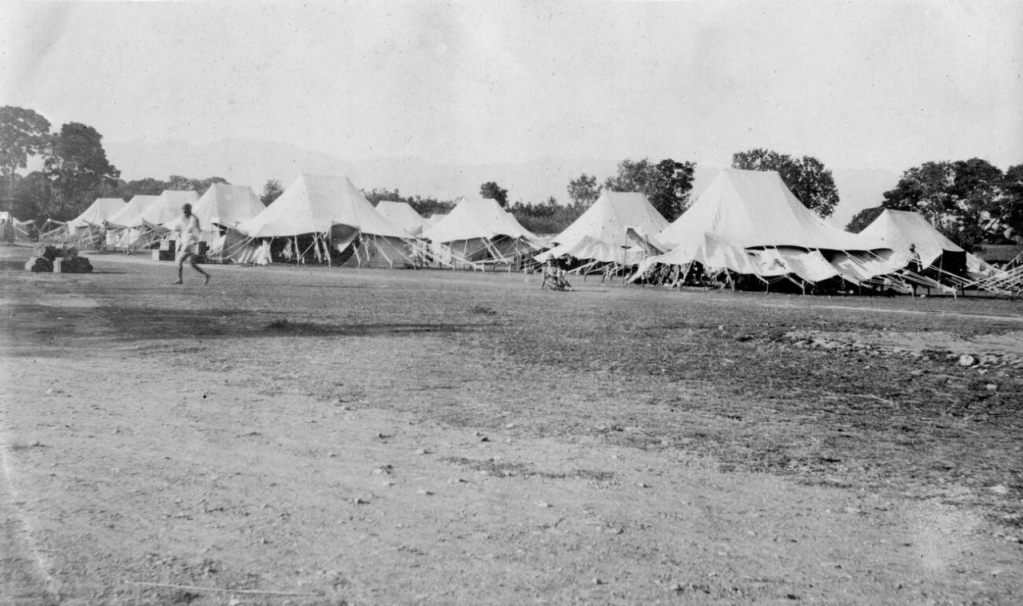
At Allahabad, everything was ready to welcome the Lucknow guests. Large, double-poled tents – provided by Lord Canning himself – had been pitched in the grounds of the fort and every possible thought was given to their comfort. As the train pulled in, an enthusiastic cheer greeted it and Edward Hilton was sure every single resident had turned out to meet them. While the gentlemen, the ladies, their children and the baggage were conveyed with as much ceremony and style as circumstances permitted to the luxury of the palatial tents, the soldiers’ wives with the children – many of them orphaned – were brought to the barracks, to resume their lives. While Mrs Germon revelled in the joy of having breakfast in bed, Mrs Harris was pleased to have furniture and a tablecloth and Mrs Inglis was practically overwhelmed by the largess of her tent – the other women had to make do with the clothes on their backs.
Rations were brought in every morning and duly distributed to the different tents according to the number of inhabitants. Slowly, but surely, the Lucknow ladies were returning to their own. “One morning Germon and I were cutting up some meat when he said: “I think this,” holding up a large bone,” will do for No. 6 tent; Apthorp who is there is on the sick list, and this will make him good soup”. Suddenly a voice from behind: “Please remember, Captain Germon, that there is Mrs Apthorp in that tent too”. This was Mrs Apthorp herself, very indignant that she was to be put off with a bone.” (Ruggles)
Finally, the joy of returning to a civilised life began to settle the ladies’ nerves. Mrs Harris appeared to be the first to awaken from her social delirium and on the 8th of December, joined Mrs Spry – the wife of the Reverend – Mrs Forbes and Emily Polehampton in distributing “shoes, boots, stockings, pocket handkerchiefs, soap and hair brushes etc..” to the ladies of the Lucknow garrison. The items had been carefully collected at Calcutta and sent up by Lady Canning.
Only on the 11th of December did Mrs Polehampton and Mrs Harris finally venture to the barracks to take down the names of “all the widows belonging to the Artillery and 32nd, for Mrs. Spry, who is going to give them each a black dress from the relief fund. Some of the poor things are in great distress, having come out of Lucknow with only the clothes they wore.” It was the condition of the children, some 30 or 40 in number, which distressed Mrs Harris. Determined their shocking behaviour – running about like wild things – was not fitting, even for children who had just endured 6 months of siege, needed to end. Together with Mrs Polehampton, she organised a school and divided it into 2 classes, those who could read and those who could not. She found them “more tameable than one could possibly have expected.” Mrs Inglis, for her part, on Christmas Day, gave a dinner for the women and children who were left of the 32nd. She found, to her dismay, there were now only 17 women left, almost all of them widows and every child had either lost one or both parents. Mrs Inglis had not seen any of the children since the siege began and with a heavy heart for their losses, started teaching the children herself on Sundays, as she had done before 1857 had so bitterly invaded their lives.
Mrs Spry, the reverend’s wife, although sympathetic to the sufferings of the Lucknow ladies, found their behaviour, on the other hand, practically scandalous. The ladies and widows were, as far as she could see, enjoying themselves. Mrs Spry found them, for the most part, to be, “a jolly party, the widows, wonderful, young and pretty, and most of them light-hearted.” As she herself had not the heart to attend the evening concert at the bandstand, she could not comprehend why the Lucknow ladies were relishing in the music and entertainment. They were far from the “torpor of death” and contrary to popular opinion at the time, the siege had not aged them at all, so as to be unrecognisable. A little thin, perhaps, but not a single one was the prematurely old, grey-haired widow Mrs Spry had been expecting to see.
Some of the ladies even went on an “outing,” unattended and in the evening, to the European shops, a mile away from the Fort. Mr Edmonstone, the judge, horrified to see the ladies walking back without an escort, insisted they ride in his buggy – the sharp rebuke he gave them was nothing compared to the sensation their wantonly brazen behaviour –“there are no European troops near the shops and a great many natives who would think nothing of insulting or shooting us,” (Polehampton) – would cause in the Fort when they were returned, safe and sound. At Allahabad, where nothing of note had happened for months, the officers still did not venture outside the fort without loaded revolvers – and now, here come the Lucknow ladies, walking to the shops. It left Mrs Spry and others, wondering if perhaps the Lucknow ladies were not, in fact, a little unhinged.
The ladies, unbeknownst to Mrs Spry and perhaps outside her understanding, had, within the confines of their world, become independent. For their sorrows, they had each other; Mrs Case, who fell into a near desperate state of melancholy when she arrived in Allahabad, was supported by her sister and Mrs Inglis; Katherine Bartrum and Emily Polehampton had each other. Having passed through the “same furnace” no one could understand their loss better than their fellow sufferers. For her part, Emily Polehampton resumed some of her nursing duties in Allahabad. In Calcutta, she would be given a special dispensation to continue her work and subsequently, accompanied 137 sick and wounded men back to England. The ladies of Lucknow were far from the “poor creatures” everyone expected them to be.
For the Martiniere boys, Allahabad had meant a return to decent food and above all, a chance to change their clothes. With all their belongings left behind at the college, most of them had by now been reduced to rags – unwilling to allow his boys to face another month in tatters, Mr Schilling set about preparing outfits for the boys and providing them with new bedding. They left Allahabad for Benares on country boats in the middle of January, a journey the boys found, after their turbulent lives, boring to the point of distraction – it is little wonder then, when they arrived in Benares, Mr. Schilling saw to it they returned to their studies. Here they would remain, in two well-appointed bungalows, for the rest of 1858, returning to Lucknow at the beginning of 1859.
Like the boys, the journey for everyone else would resume in January by river – only Ruutz-Rees and a few of the single gentlemen decided to proceed by dak gharrie instead, although previously warned by the jittery Allahabad officials not to do so – the ladies would proceed in steamers, while the women and children of the barracks would be towed behind on flats. There are very few descriptions of the journey itself – some ladies, like Julia Inglis, found the quarters cramped and the life dull, Kate Bartrum spent the time dwelling over everything she had lost. When they finally arrived in Calcutta, the first steamer was greeted with much fanfare.
“At Calcutta, we had a great reception: the crimson cloth was laid down at the landing place, the vessels
were dressed out in flags, and all were in full dress and very swell for the reception of as ragged looking
a lot of beings as one could well conceive. If I had had the red cloth I was walking on, I thought, some time back I would have made something out of it and not walked on it.” (Ruggles). It was the only steamer to be greeted with a 21-gun salute.
The citizens of Calcutta meant well, but when the passengers began to disembark, the “black dresses of most of the ladies told the tale of their bereavement, whilst the pallid faces, the downcast looks, and the slow pace bore evidence of the great suffering they must have undergone both in mind and body.” Julia Inglis who arrived a few days later was given a less stately welcome and after consulting with the captain, they were “suffered to land quietly.”
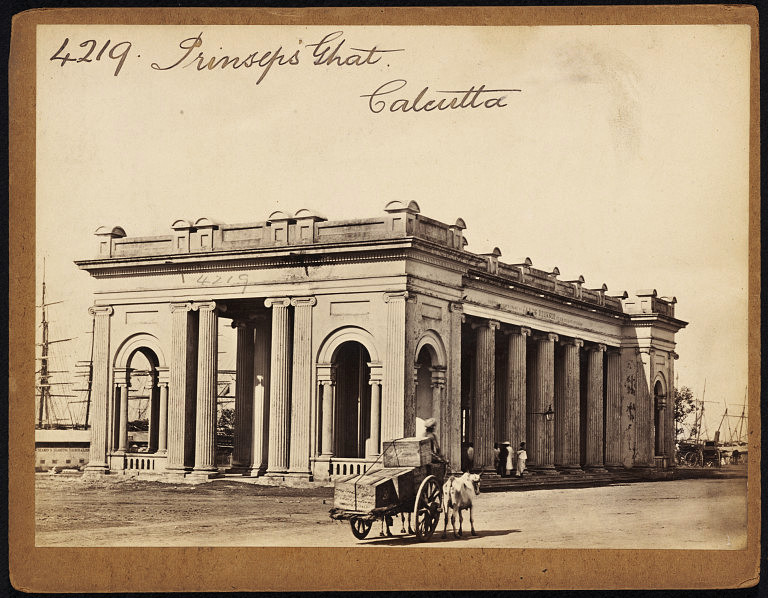
At Prinsep’s ghat, carriages – many of them sent by Lord Canning himself – were waiting for the passengers to whisk them away. Those who did not have any friends who could provide them with accommodation were taken to the Houses of Refuge. Eleven such houses existed in Calcutta where they could live in relative seclusion as they prepared for their onward trips. Curiously, the behaviour the ladies had exhibited at Allahabad continued in Calcutta. Ardent sympathisers found the younger ones to be boastful of their experiences, so much so, it was implied they might be lying; their feelings were found to be “blunted” and their bravado beyond what a lady was supposed to present. As one ADC noted in a letter to his sister, the ladies were cheerful, many of them quite petty in their worries and their clothes were vulgar and showy. Back in “normal society” the ladies of Lucknow did not conform to the expected picture of “poor creatures, ” and for many in Calcutta, it was a shock.
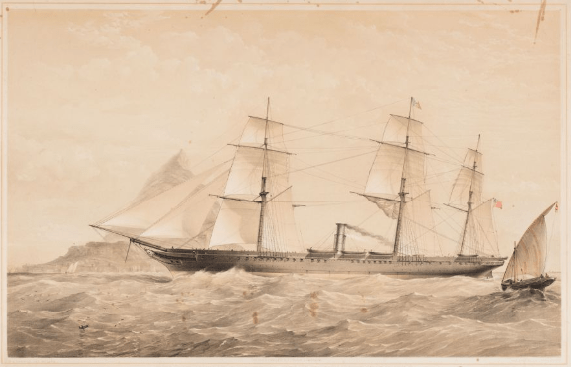
It was time to go home. Before leaving, Julia Inglis went to Dum-Dum to see the women and children of the 32nd at the barracks- they had been dropped off there without setting foot in Calcutta – to bid them goodbye. They had all been respectably rescued and now would carry on with their lives.
Sources:
Bartrum, Katherine Mary [Mrs. K.]. A Widow’s Reminiscences of the Siege of Lucknow. London: James Nisbet & Co., 1858.
Blunt, Alison. Travel, Home and Empire: British Women in India, 1857–1939. London: Guilford Press, 1997.
Bourchier, George. Eight Months Campaign against the Bengal Sepoy Army during the Mutiny of 1857. London: Smith, Elder, and Co., 1858.
Case, Adelaide [Mrs. A.]. Day by Day at Lucknow: A Journal of the Siege by the Widow of a Regimental Officer. London: Richard Bentley, 1858.
Fayrer, Joseph. Recollections of My Life. Edinburgh: William Blackwood and Sons, 1900.
Germon, Maria Vincent [Mrs. R.C.]. A Diary Kept by Mrs. R. C. Germon, During the Siege of Lucknow. London: Waterlow & Sons, 1870.
Gubbins, Martin Richard. An Account of the Mutinies in Oudh, and of the Siege of the Lucknow Residency. London: Richard Bentley, 1858.
[Harris, G.] A Lady’s Diary of the Siege of Lucknow: Written for the Perusal of Friends at Home. London: John Murray, 1858.
Hinshaw, Judith Edna. “Imperialism and Widowhood: British Widows of the 1857 Mutiny.” PhD diss., University of Arizona, 2011.
Inglis, Julia Selina. The Siege of Lucknow: A Diary. London: James R. Osgood, McIlvaine & Co., 1892.
Jones, Oliver J. Recollections of a Winter’s Campaign in India: In 1857–58. London: Saunders, Otley, and Co., 1859.
Mackay, James [Rev. John]. From London to Lucknow: With Memoranda of Mutinies, Marches, Flights, Fights, and Forays. 2 vols. London: James Nisbet & Co., 1860.
Polehampton, Henry S. A Memoir, Letters, and Diary of the Rev. Henry S. Polehampton, M.A., Chaplain of Lucknow. Edited by Edward Polehampton and Thomas Stedman Polehampton. London: Richard Bentley, 1858.
Qureshi, Hamid Afaq, ed. The Mutiny Records: Awadh & Lucknow of Edward H. Hilton. Lucknow: New Royal Book Co., 2009.
Roberts, Frederick Sleigh. Forty-One Years in India: From Subaltern to Commander-in-Chief. Vol. 1. London: Richard Bentley & Son, 1897.
Ruggles, J. Recollections of a Lucknow Veteran, 1845–1876. London: Longmans, Green, and Co., 1906.
 Mutiny Reflections