29th November — 5th December 1857
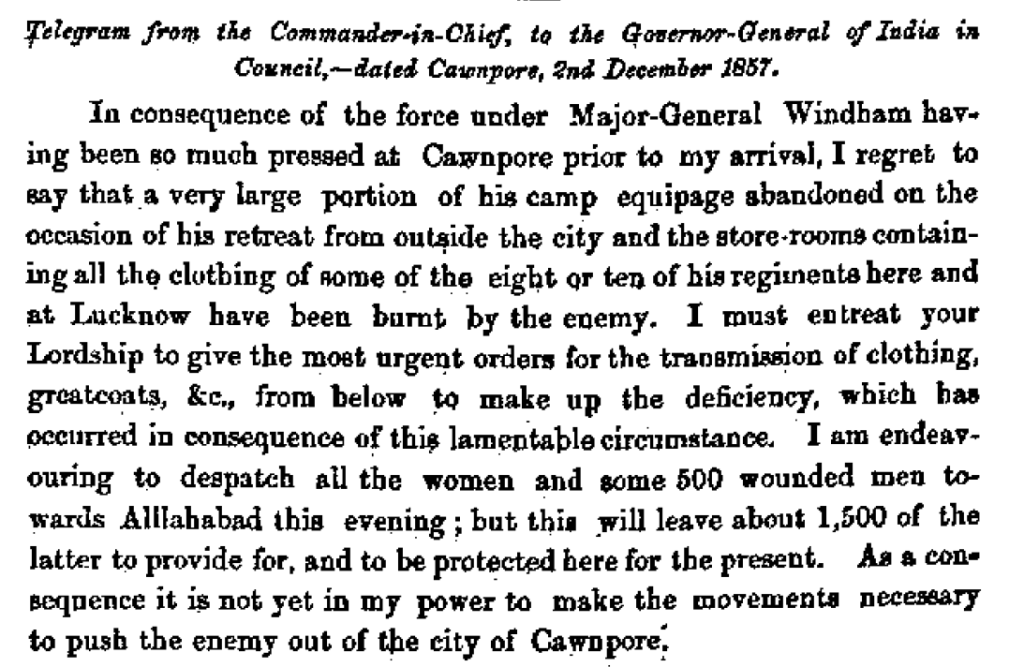
When the 93rd crossed the Bridge of Boats on the 29th of November, they first noticed dense black smoke billowing in the clear sky with tongues of flame shooting through it — it was, as they would soon find out, everything the possessed, being turned to ash. The rebels had set fire to the Assembly Rooms. With this act of destruction, the “Nana’s ragamuffins,” — so aptly named by very one irritated subaltern — had set fire to the spare kits of the European regiments. All the NCOs and men of the 93rd were reduced to the very clothes they were standing up in. Captain North, still guarding the Lucknow treasure, would eventually receive one of his trunks only to find the bottom had been cut out and everything removed, but at least he recovered the locks. There would be time later to mourn over material losses. For now, it was clear to the men who had relieved Lucknow that more fighting would be needed before they could rest.
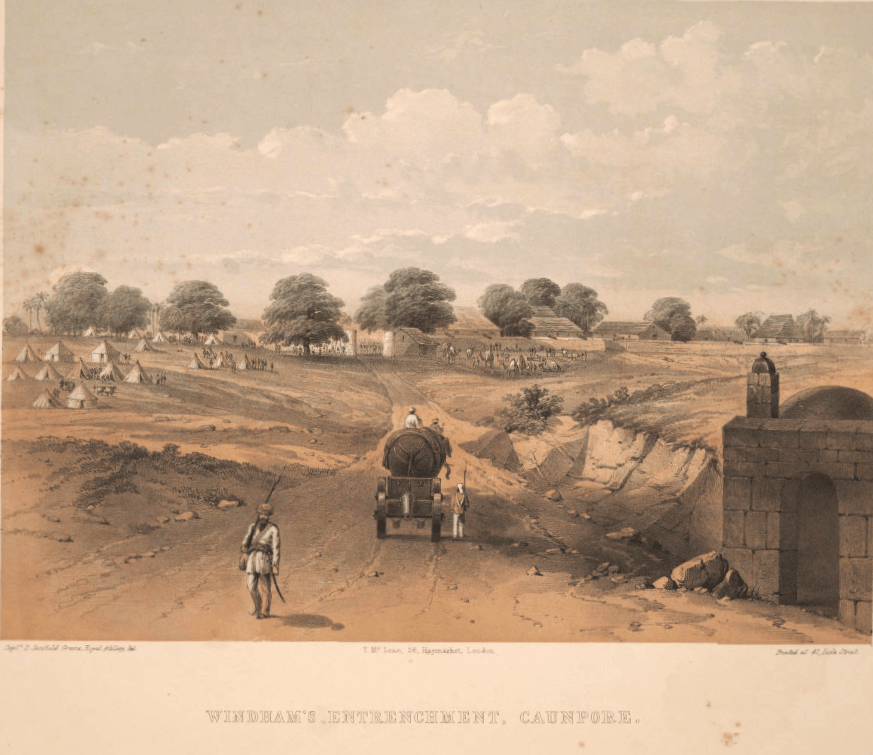
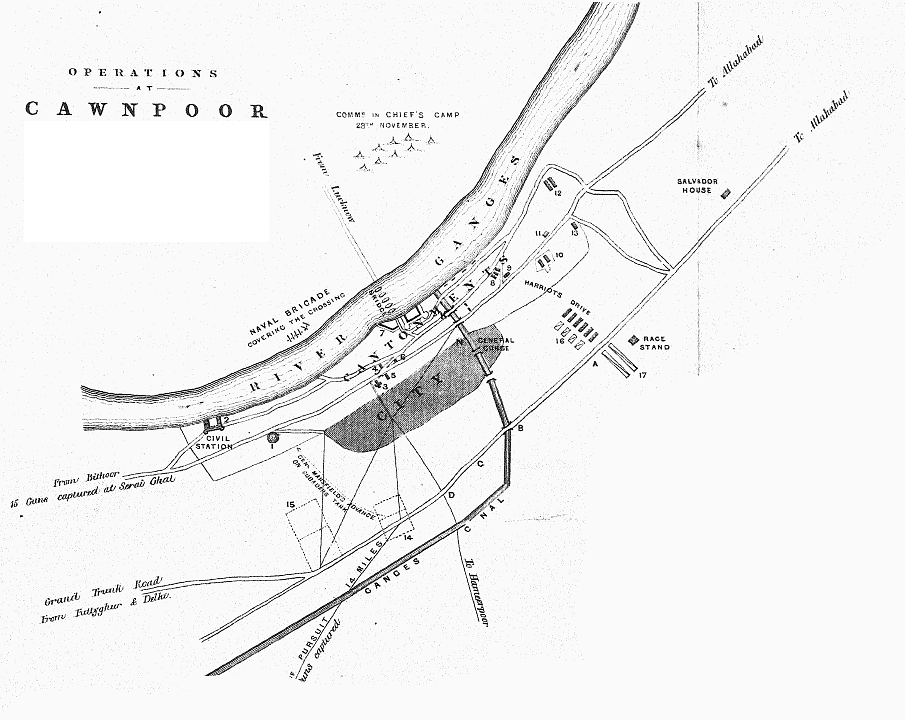
Safely across, the 93rd wheeled to the left passed close under Windham’s entrenchment, and under a storm of musketry, which swept over their heads, then wheeled to the right and came upon a wide open plain facing the rebels’ position in and around Cawnpore. Only a deep canal divided them from the rebels. It was hardly a pleasant position.
For their part, the rebels had set themselves admirably. Their left was among a wooded, high ground intersected by dry ditches and liberally protected by the ruined bungalows that lay between the town and the river. Their centre was placed in the sprawling town itself and could only be reached by traversing narrow, winding streets. The rebel right stretched out behind the Ganges Canal that now separated them from the 93rd, out into the plain beyond. Not only were they in possession of the main canal bridge but also the brick kilns – the Gwalior Contingent had chosen their camp 2 miles to the rear, on the Kalpi Road. The force now amounted to some 25’000 men and up to 40 guns; however, cohesion did not appear to be the order of the day. The men under the direct control of Tantia Tope had chosen their line of retreat to the rear of their left towards Bithur while the Gwalior Contingent could make for Kalpi. While the left and centre were the strongest and could only be assaulted with the certainty of heavy losses for Campbell, the right was not only the weakest but, tactically, the most important to gain. The vast plain, intersected only by the canal and almost in prolongation of the right-wing, ran the Kalpi Road. If this could be secured, the retreat of the Gwalior Contingent would be rendered impossible. For now, however, Sir Colin Campbell, although very interested in retaking Cawnpore, insisted, that until the wounded, the Lucknow ladies and their children were out from under his feet, he would hold a strictly defensive position. There would be time enough to deal with the rebels when the “impedimenta” was gone.
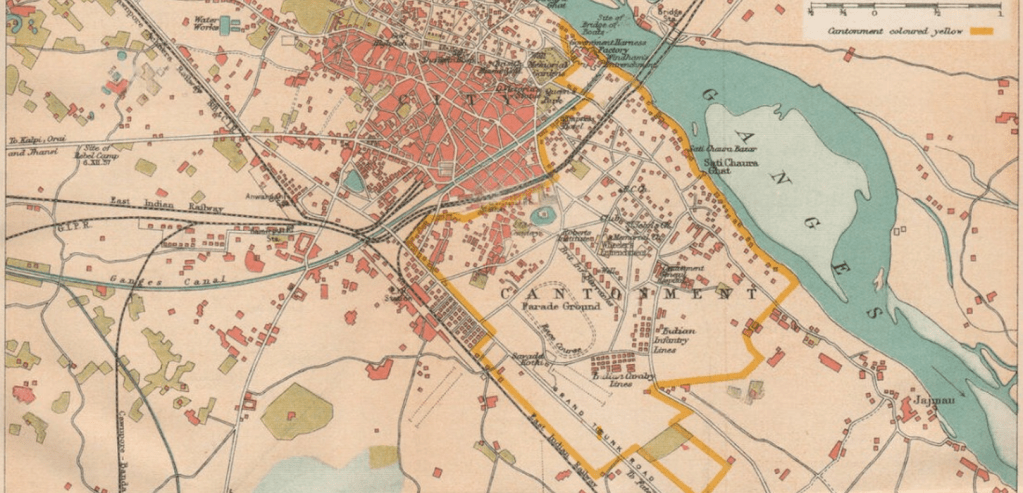
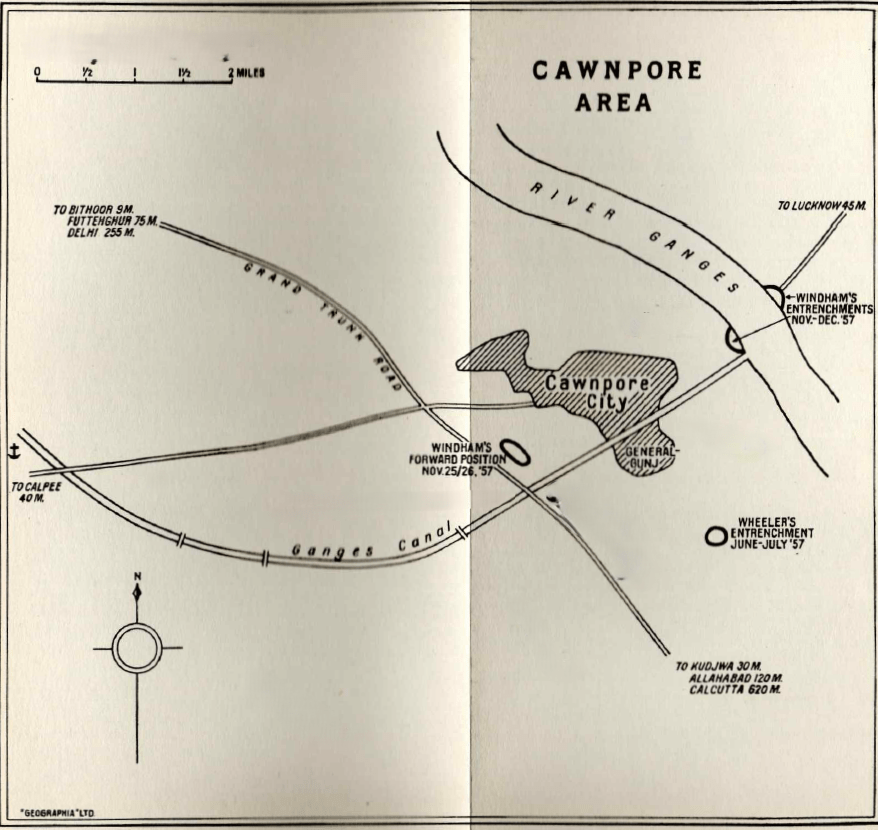
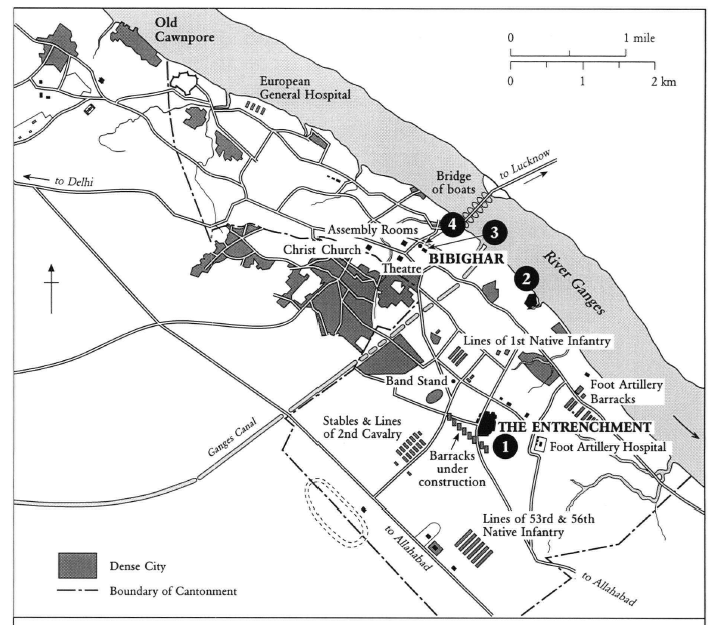
Brigadier Hope’s Brigade, Captain Remmington’s troop of Horse Artillery and Bourchier’s Battery and some squadrons of dragoons had been the first to cross over, at 8 in the morning on the 29th. Like the 93rd that followed, they were saluted by grape as they passed the entrenchment, but again, with no damage done. Sir Colin Campbell ordered them to take their position on the plain near the dragoon barracks, extending towards the Allahabad road, thus preventing the rebels, should they have had half a mind to do so, from advancing from the eastern portion of Cawnpore, while covering communications with Calcutta, preventing any mischief against the incoming reinforcements. As the troops crossed, pickets were pushed forward to within musket range of the canal, and the ruined houses in the front were quickly occupied. From the other side of the river, the rebels still had Peel to contend with – gradually, as the day wore on, their fire against the bridge subsided.
The 30th of November passed comparatively quiet for the force as Sir Colin perfected his arrangements to bring away the Lucknow convoy. The rebels continued to harass the camp with round shot and musketry, but “…evidently discharged from guns and muskets at a great angle, so as to drop all about the camp.” For Alexander, of the 93rd, they could have left off firing at him, had they been so inclined. Having placed himself on the sick list as he had “broken down under the fatigues of the march from the Banni Bridge…” he tried to find relief in the field hospital that Munro had admirably set up in the European cavalry mess-house, a large, airy building with a good, thatched roof, but there was no room. Alexander was sent to rest in his own tent.
“Round-shot also kept bowling through our camp, going right through the tents all day. My native servants were so scared that they came into the tent and told me they couldn’t stop there, but they were quite pacified and evidently considered their safety perfectly secured when I told them to put my two leather bullock – trunks one on the top of the other within the tent on the side furthest from the enemy and sit down outside with their backs to that rampart. It was very unpleasant to be thus tied to one’s couch for the day under such an artillery fire; and although I slept a good deal, and could not, had I wished it, have enticed my native servants from the false security behind my two bullock -trunks, yet I was very glad to be sent back to duty next morning.”
Lieutenant Gough, with a detachment of Hodson’s Horse, 1 troop of the 9th Lancers, 1 company of the 23rd, 1 company of the 82nd and 1 company of the 32nd with 2 horse artillery guns were placed at an outpost not far from the Savada Kothi. In the intervening days, until the ladies left, Gough and his men “…had a certain amount of skirmishing and occasional cannonading which served to keep up our spirits, knowing that a better time was coming.” As the rebel cavalry day picket was posted close by, Gough and his men constantly went out to try and tempt them to come out into the open, but “they were too shy for a closer acquaintance.” They were close enough to trade insults, but as for meeting Gough on the field, the rebel cavalry was too wise to attempt it.
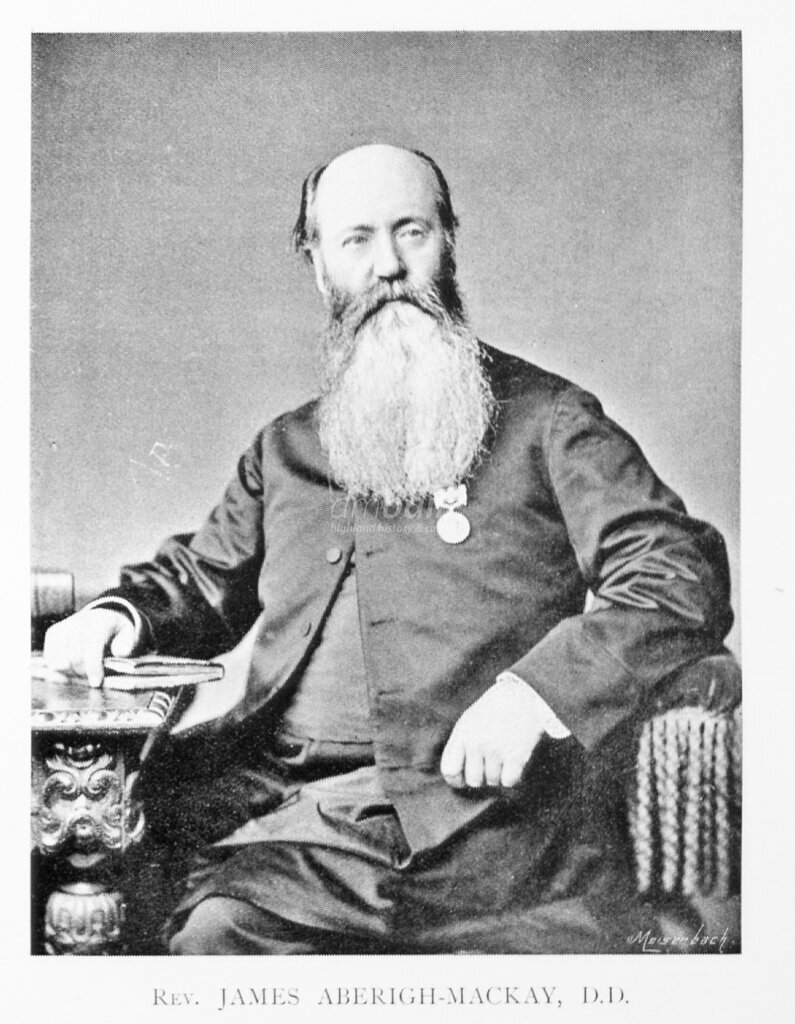
With the camp of the 9th Lancers on the plain close to Savada Kothi, Reverend Mackay, in his ever-persistent search for a decent meal, stumbled upon their mess tent while searching for Hope Grant’s tent. Grant was not there, and Mackay was hungry. The table in the tent was set for lunch but knowing no one, he accosted a man walking past. Unfortunately, he could not tell Mackay which regiment the tent belonged to but was quite sure if he asked politely enough, the officers would certainly invite him in. Emboldened, the reverend strode in, and finding himself quite alone with a table laden with a variety of cold meats and delectable refreshments, called out, “Qui Hai!” with as much authority as he could muster. A turbaned kitmutghar appeared from behind the tent and, on Mackay’s instructions, furnished him with a plate, a knife and a fork. Mackay sat down to tiffin, only slightly concerned with what would happen when the officers arrived.
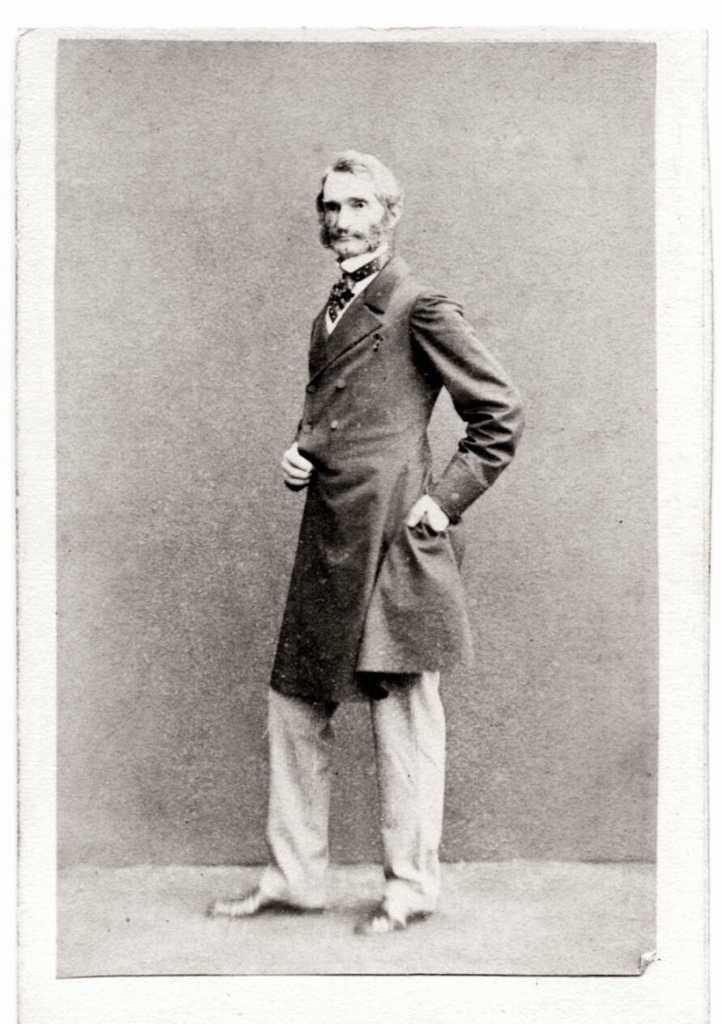
“By and by, several entered, some taking seats on each side, and others in front of me. Among the latter was a tall, wiry, energetic man, very plainly dressed; and I noticed that the younger officers, in replying to him, said, ‘Yes, sir’, no sir.’ ” It was General Hope Grant, the very man Mackay had been looking for. Mackay, somewhat flustered, introduced himself, mentioning that the C-in-C had attached him to his division. Grant, neither startled nor surprised, requested Major Ouvry to see to the reverend’s needs and invited him to join the mess of the 9th Lancers. For Mackay, the mess tent could not have been better organised if it had been laid out in Hyde Park – the Lancers, in the same impeccable form that had seen them through the Siege of Delhi. Unlike the other regiments, they had kept their plate and their silver candelabra, their tablecloth was still snowy white and above all, every man still possessed a uniform. There was no end of vegetables available, and Anson would comment even the fish was very nice.
Unfortunately, they did not have a band any more – their instruments had been left behind at Ambala and their best performers were killed at Delhi. The 3rd Rifle Brigade had theirs and provided excellent music, “One’s pulse is affected by the sound of a single trumpet, especially with the accompaniment of a few guns….”
With everyone finally over the bridge of boats, the position, as established by Sir Colin Campbell ran now in a semicircle, with Wheeler’s old entrenchment nearly at the centre, the right rested on Windham’s and the bridge of boats. The 93rd was pitched on the plain, not too far from Wheeler’s old walls. For Major Ewart, it was a sad reminder of what his cousin had endured. However, he had more pressing duties than dreadful reminiscences – his men were becoming careless. On the 30th the ammunition boxes, covered, as was the custom in India, with sacking, had been piled up close to Ewart’s tent with a sergeant’s guard placed over them. As Ewart was passing by, he noticed a young private polishing up his rifle, hard by the ammunition. Forgetting it was loaded, the rifle went off, and the shot sailed directly into the ammunition, setting the sacking of one of the boxes on fire. Ewart rushed up, tore off the sacking, and tried to remove the box. The private, startled by his own near misfortune, still had the presence of mind to bring water and douse the fire. Ewart reported the incident to Adrian Hope, who ordered the ammunition moved well away from the 93rd and placed under an officer’s guard.
 Mutiny Reflections
impressive chest of tools
LikeLiked by 1 person
We certainly have it easier going to the doctor now! Munro prided himself for always using chloroform. Seeing that chest, I can’t imagine anyone would refuse it, but they did.
LikeLiked by 1 person