The 1st of December
The 1st of December did not start well for the 93rd. At their morning muster parade, the rebels opened fire on the men. The round shot passed through the camp while shot and shrapnel burst over their heads, wounding Captain Cornwall and six men. One man, sitting in his tent trying to mend his tattered kilt, was knocked over like ninepins by a round shot that came “bowling along the ground, burst through the tent” and hit him on the back. If it was a day for escapes, it certainly was his. When the doctor examined him, to everyone’s astonishment, it was found he was only badly bruised. For Captain Cornwall, he was less fortunate. When the shrapnel burst overhead, one of the bullets struck him on the collar bone and ran backwards beneath his shoulder blade, lodging under the skin in the lower part of his back. It was such a sharp shock, Cornwall had neither felt the shot nor was he aware he was wounded.
Several wounded officers gathered around to watch the proceedings. Just as Munro removed the bullet, “…one of them (Goldsmith) stepped in front of Cornwall, and holding out to him a six-pounder cannonball said, quite seriously, ‘Look what Munro has taken out of you.’ ‘Good Lord!’ said Cornwall, quite as seriously, ‘is that it? No wonder it hurt.’ But on my handing him the real bullet, about the size of a marble, there was a burst of laughter, in which poor Cornwall tried to join.”
Cornwall was the oldest man in the regiment – so old the men had taken to calling him “Daddy Cornwall.” He was also too poor to purchase a promotion and after 35 years, was still a captain. Being rather stout and short-sighted, no one was particularly surprised the old gentleman had missed his own wounding! Curiously enough, it was the start of his fortunes – invalided home, he met a rich widow on the passage whom he wasted no time in marrying; on his arrival in Dublin he was presented with a fine sword and the freedom of the city. The sad death of Brigadier General Adrian Hope in April 1858 secured for Cornwall his majority without purchase and he returned to India at the end of 1859 to command the 93rd for nine months, leaving him clear to retire with a finer pension, in 1860.
For Munro’s next patient, however, there would be no such jocularity.
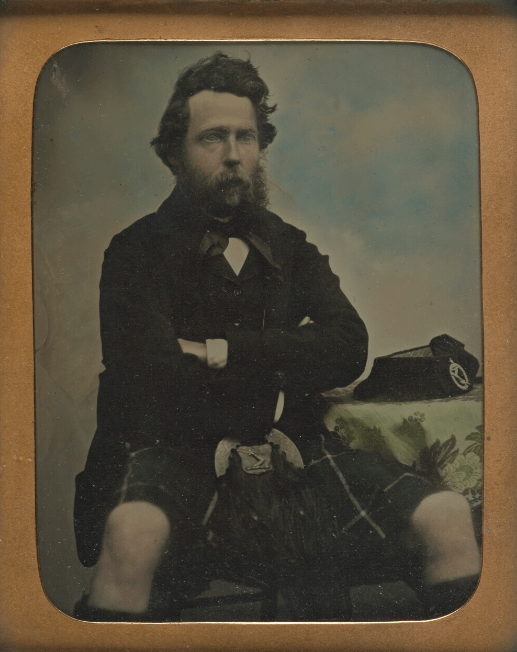
For Brevet Lieutenant-Colonel Ewart, the 1st of December began as a regular day, as regular as these strange circumstances allowed. He was field officer of the day for the brigade. Following the surprise attack on the 93rd, Sir Colin Campbell ordered the regiment to advance towards the canal and take up a position behind some houses where they were to remain for the rest of the day. Ewart spoke to Campbell shortly after who was irritated at being forced to act on the defensive. He remarked to Campbell how he wished that Outram and the others had not been left behind at the Alambagh – with them, they could have “driven the rascals away.” Campbell replied he wished the same, “but I could not foresee all this.” Ewart then offered him the Colour he had captured at the Sikandarbagh – the very Colour Campbell had damned him for – and Campbell, perhaps touched by the offer, replied,” Yes, above all things, ” and added it would be always be kept as an heirloom in his family. Happier than he had been, Ewart mounted his horse and went off to visit the guards and pickets. The day, however, would not get better. As he approached one of the pickets, some of the rebels had crossed one of the canal bridges, and mounting a small gun on a wall, fired a few rounds. The balls fell harmlessly around Ewart. He carried on.
After visiting the outposts, he returned to the 93rd. As the men were still “potted as Sir Campbell had ordered”, now relatively safe from the artillery fire which the rebels were still keeping up, albeit with little effect, Ewart dismounted his horse. A company had been placed behind each house and Ewart, as he stood between two of the buildings, to see “what the mutineers were about,” a cannon shot struck him on the left elbow. It carried off his left arm, which, when he looked down, was merely hanging on by a thin piece of skin. He was aware the hit had been a violent one but only when he saw his bleeding stump did he realise what had happened. The ball had also smashed the handle of his revolver and smashed his beloved field glass to pieces. The latter had been a gift from his eldest brother and had seen him not just through the mutiny, thus far, but Crimea. Ewart did not feel any “inclination to fall” nor was he knocked over; as he stood there, dazed, a quick-thinking private of the 93rd, named McKay rushed up and tied his handkerchief tightly around the stump. Captain Burroughs quickly organised a doolie to carry Ewart to the 93rd hospital, while Dr Menzies walked beside him, pushing his thumb on the large artery, to prevent Ewart from bleeding to death.
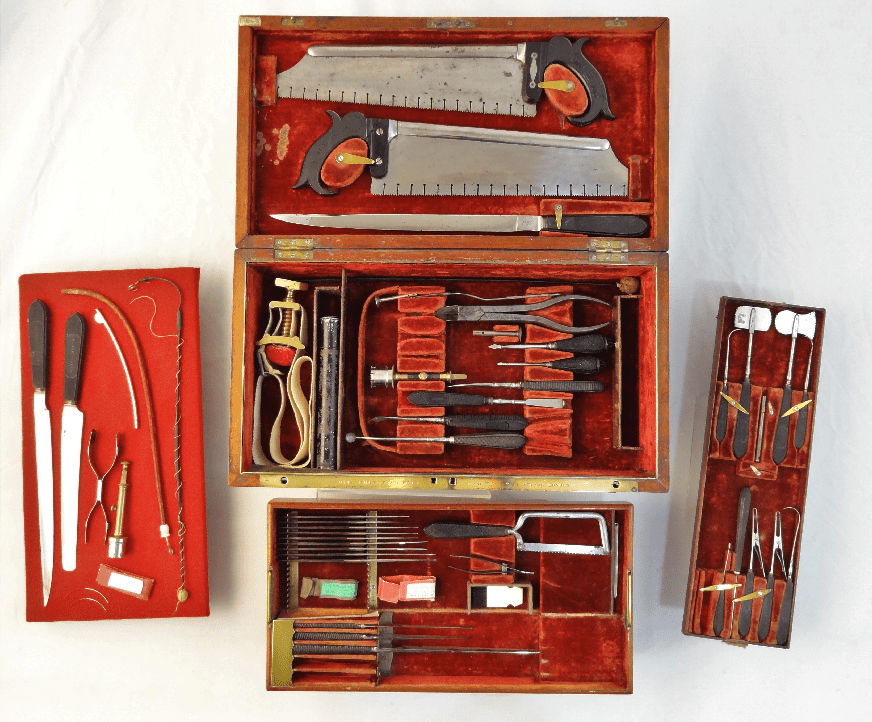
Photo credits: The Argyll and Sutherland Highlanders Museum
https://argylls.co.uk/the-story-of-surgeon-william-munro/
https://argylls.co.uk/the-story-of-surgeon-william-munro/
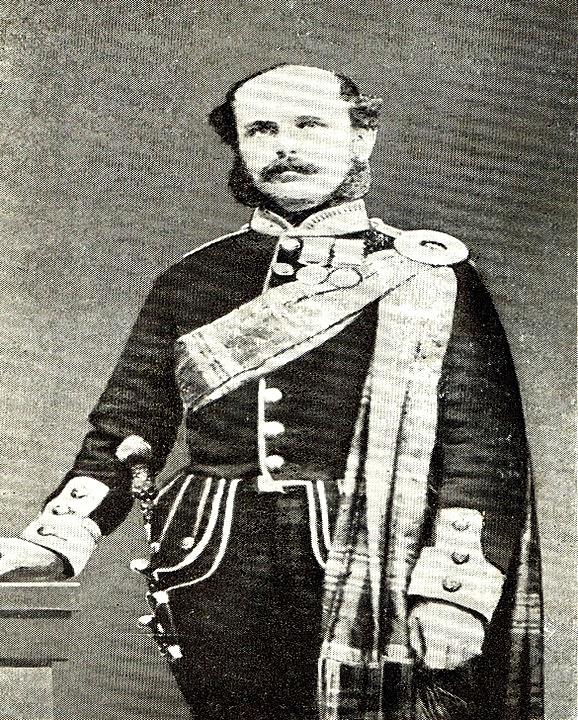
Inside, Munro was waiting. After looking at the wound, which was terrible to behold as the arm had been shattered above the elbow, he snipped away the thin piece of skin with a pair of scissors and what was left of Ewart’s arm, thumped to the floor. He said a further amputation would be needed, but for now, Ewart was to lay quietly to recover from the shock. His senses, however, impelled him to demand Munro proceed at once. Munro refused. When he returned a few minutes later, Ewart once again implored him to carry out the surgery. Again, Munro, after checking his pulse, said it was too dangerous and insisted Ewart wait until he “rallied from the great shock, and from the sudden loss of arterial blood.” Finally, Ewart’s entreaties prevailed, (or as Munro writes, he was sufficiently recovered) and he was carried to the amputation table. With a further three surgeons now in attendance, Ewart was given a liberal dose of chloroform – when he came to, another piece of his arm was gone, amputated close to the shoulder. He was placed back in a doolie “and had the leisure to think over what had occurred – not that I could so in perfect peace, as shells continued to fall round the bungalow…one burst not far from the door.” As he lay there, his first feelings were of “bitter sorrow and annoyance” as he had always been “exceedingly fond of cricket, archery and billiards.” He was also worried by the “singular circumstance that I now felt the fingers and thumb of my left hand much plainer than before the arm was knocked off, with the irritating sensation that I could not move them.” The doctors consoled Ewart that the sensation would eventually wear off – however, 18 years later, as he sat down to write his memoirs, Ewart could still feel his missing appendage as clearly as on the 1st of December 1857. He eventually learned his friends had buried his left arm, with some reverence, in the garden of the hospital; his right arm still sore from the sword cuts he had received at Lucknow, Lieutenant-Colonel Gordon kindly volunteered to write to Ewart’s mother to inform her of her son’s sad loss.
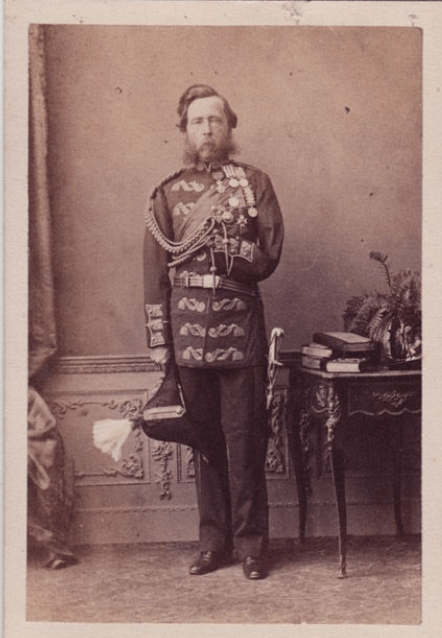
From the doolie, Ewart was moved to ” a room full of wounded.” He asked Munro if he could accompany the column to Allahabad – he was worse than useless in Cawnpore and it was only right he should join the exodus of the wounded. Munro said he was too weak and would die on the road. So Ewart stayed put in Cawnpore. On the 5th of December, he was taken to join his fellow sufferer of the 93rd – the wounded Captain Cornwall. Others would join them shortly. Sir Colin Campbell paid Ewart a brief visit – he told him he intended to send his Colour to England immediately and hoped Ewart would soon rejoin the 93rd.
For their part, the rebels had discovered were Campbell had pitched his tent, eventhough it was a “common bell one” and quite indistinguishable from the others. The shot and shell that rained down around Campbell’s tent did not suceed in hitting the C-in-C; in short order however, it wounded his orderly’s horse and two bullocks. A shot then passed through one of his ADC’s tents but Campbell still refused to move. Instead he ordered a 24-pounder brought up which quickly sent the rebel gunners packing. When the order finally came to move Campbell’s tent, the men doing so were in such a hurry they neglected to check if the tent was in fact empty – as the tent fell, out came a rather startled Sir Colin Campbell.
As for Peel’s brigade, they had no end of fighting. On the 1st they fought the rebels back up a narrow street to the town; on the 2nd, together with the 88th Regiment drove back another sneak attack – these would continue over the next days, becoming increasingly tiresome as Campbell held his men on the defensive. On the same day, Peel managed to get one of his guns to bottom of a narrow street bringing him face to face with that of the rebels; before they could open fire, the sailors peppered them with their rifles and “every now and them” Peel let them have it with his gun. “We made them leave their gun and apparently there it was alone in the middle of the street; but the cunning brutes had a rope made fast to it, and dragged it away without exposing themselves, but every now and then a bold fellow took a look at us, but he got such an unpleasant reception that he was obliged to retreat as quick as he could.”
 Mutiny Reflections
impressive chest of tools
LikeLiked by 1 person
We certainly have it easier going to the doctor now! Munro prided himself for always using chloroform. Seeing that chest, I can’t imagine anyone would refuse it, but they did.
LikeLiked by 1 person